

¿Cuánta potencia puede soportar un motor FA20 construido?
Aumentar la potencia de su FA20 sin corregir sus puntos débiles es una receta para el desastre. El sistema de lubricación de la plataforma, en particular, sufre las exigencias del uso en pista, e ignorarlo es el error más común y costoso que cometen los propietarios. Un motor FA20 bien construido no se trata solo de alcanzar grandes cifras de potencia; se trata de crear una base sólida que pueda manejar esa potencia con fiabilidad. Le guiaremos a través de las mejoras esenciales, desde componentes internos forjados hasta un separador de aire/aceite adecuado, que son indispensables para proteger su inversión y construir un motor duradero.
Conclusiones clave
- Priorice los componentes internos forjados para obtener una potencia real : Antes de añadir un turbo o una modificación agresiva, debe reemplazar los pistones y bielas de fábrica. Los componentes forjados son la base ineludible para construir un FA20 que pueda manejar con seguridad una potencia considerable sin sufrir fallos catastróficos.
- Sistemas de soporte para una fiabilidad a largo plazo : Un bloque corto resistente es solo una parte de la ecuación. Una construcción exitosa requiere un sistema completo, que incluye un sistema de lubricación mejorado (como un separador de aire/aceite), una bomba de combustible robusta y un ajuste profesional para garantizar que todas las piezas funcionen en perfecta armonía.
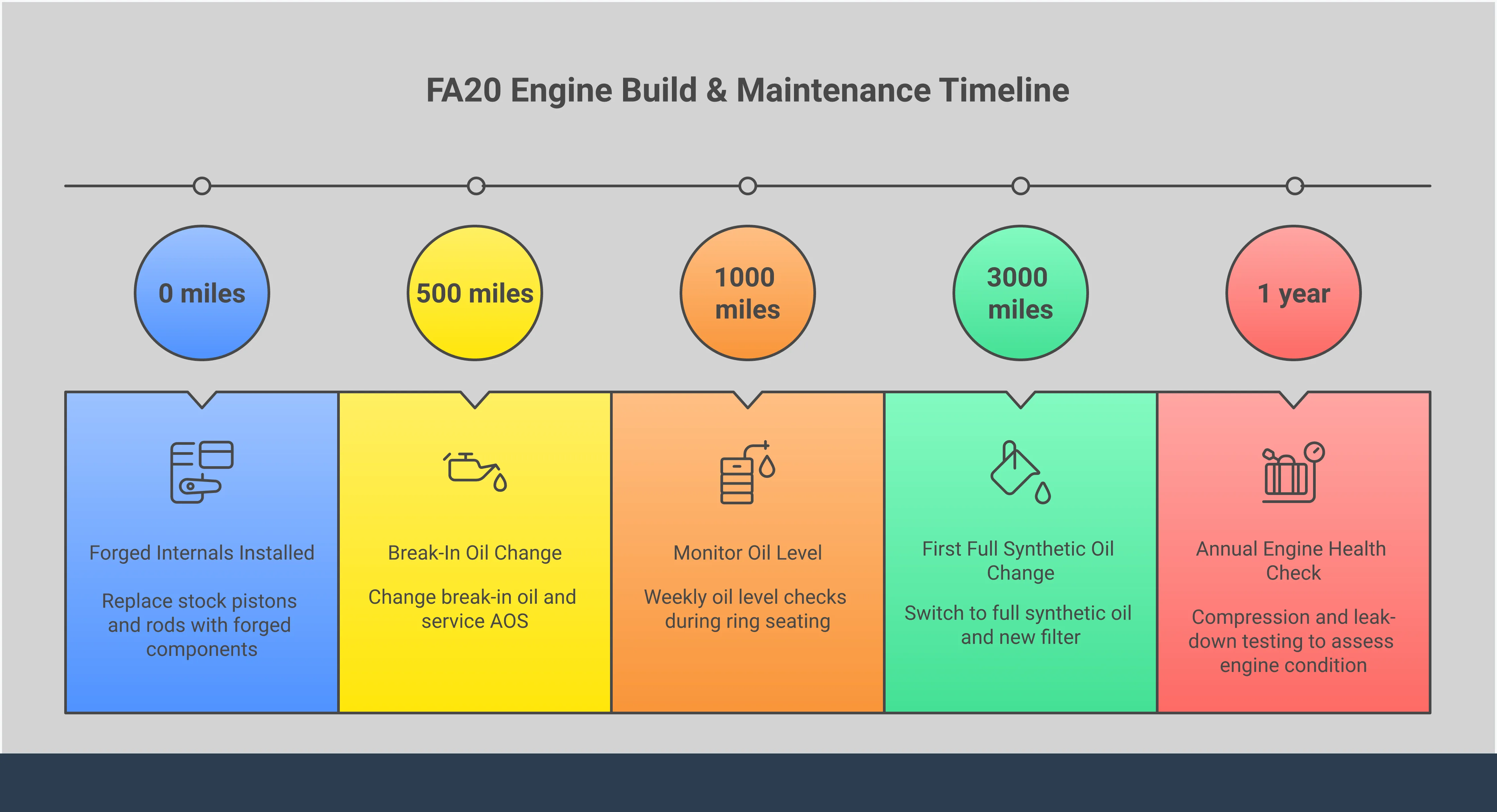
- Comprométase con un estricto plan de mantenimiento y rodaje : Un motor fabricado requiere más cuidado que uno de fábrica. Seguir un procedimiento de rodaje meticuloso y un programa de cambios de aceite frecuentes y de alta calidad es esencial para proteger su inversión y garantizar su longevidad.
¿Qué es un motor FA20 completamente construido?
Cuando escuchas el término " motor FA20 totalmente armado ", significa que el motor ha sido completamente reacondicionado con piezas de repuesto de alto rendimiento. No se trata de añadir algunos accesorios adicionales; es un proceso integral en el que el motor se desmonta y se reconstruye con componentes diseñados para soportar mucha más potencia y tensión que las piezas originales de fábrica. El objetivo es crear un motor potente que no solo sea más resistente, sino también más confiable en las condiciones extremas de la conducción en pista, el overlanding o el uso intensivo en carretera. Un motor armado te da la confianza para llevar tu vehículo al límite, sabiendo que cuenta con la base para respaldar ese rendimiento.
Construir un potente FA20 no se trata solo de buscar mayores caballos de fuerza. Se trata de crear un sistema equilibrado y duradero donde todos los componentes funcionen en armonía. Un motor de serie está diseñado por Subaru para satisfacer las necesidades del conductor promedio, equilibrando el rendimiento con el ahorro de combustible y las normas de emisiones. Un motor de fábrica, por otro lado, está diseñado específicamente para el rendimiento, reforzando los puntos débiles y preparando todo el conjunto para soportar las exigencias de los servicios profesionales de ajuste de motores y la inducción forzada. Esta transformación convierte a su Subaru WRX o BRZ en una máquina capaz de alcanzar su máximo potencial de rendimiento sin comprometer su salud a largo plazo.
De serie vs. fabricado: ¿cuál es la diferencia?
La principal diferencia entre un FA20 de serie y uno fabricado radica en la resistencia de sus componentes internos. Los motores de fábrica utilizan piezas, como pistones y bielas de fundición, perfectamente adecuadas para la conducción diaria, pero que pueden convertirse en puntos débiles al aumentar significativamente la potencia. Un motor fabricado las sustituye por componentes internos forjados mucho más resistentes que soportan presiones y temperaturas más altas en los cilindros sin ningún problema.
No se trata solo de aumentar la potencia, sino de garantizar que el motor pueda gestionar las mayores exigencias sin sacrificar la fiabilidad. Si bien un FA20 de serie es una plataforma capaz, forzarlo mucho más allá de sus límites previstos con ajustes agresivos o turbos más grandes es una receta para el desastre. Un motor de alta cilindrada proporciona la base sólida necesaria para soportar esos componentes de alto rendimiento y liberar una gran potencia de forma segura.
¿Qué actualizaciones definen un motor construido?
Una construcción adecuada de un FA20 se centra en varias áreas clave para crear un motor confiable de alto rendimiento. El primer paso, y el más crítico, es la actualización a componentes internos forjados. Los pistones y bielas forjados son el corazón de cualquier motor, proporcionando la resistencia necesaria para soportar una mayor sobrealimentación y mayores RPM. Sin esta base, cualquier otra modificación para aumentar la potencia es arriesgada.
Más allá del funcionamiento interno, mejorar los sistemas de soporte del motor es fundamental. Los sistemas de lubricación y refrigeración mejorados son esenciales para gestionar el calor adicional generado por un motor más potente. Un componente crucial para la longevidad del motor es el separador aire/aceite (AOS), que evita que el aceite contamine el sistema de admisión, un problema común que puede provocar detonaciones y daños en el motor. Estas mejoras específicas garantizan la fiabilidad del motor bajo presión.
Comprensión de los problemas comunes del motor FA20
Antes de construir un motor más potente, es necesario comprender sus debilidades inherentes. El FA20 es una plataforma fantástica, pero presenta algunas vulnerabilidades bien conocidas, especialmente cuando se somete al alto estrés de los días de pista o a una conducción agresiva. El error más común y costoso que cometen los propietarios es aumentar la potencia sin abordar primero estos puntos débiles. El sistema de lubricación de fábrica, por ejemplo, puede tener dificultades para mantener el ritmo bajo altas fuerzas G, lo que provoca una falta de aceite. Este único problema suele ser la causa principal de muchas fallas catastróficas, convirtiendo un divertido día de pista en un costoso remolque de regreso a casa. Comprender estas limitaciones es el primer paso para construir un motor potente y confiable.
Fallas mecánicas comunes
Los problemas más comentados del FA20 suelen estar relacionados con sus componentes internos. Con mayor potencia, las bielas de serie son un punto de fallo importante, ya que solo pueden soportar un par determinado antes de ceder. Esto suele provocar el temido "golpe de biela", que es prácticamente una sentencia de muerte para el bloque motor. De igual manera, el desgaste prematuro de los rodamientos es otro problema común, frecuentemente causado por problemas de lubricación o la tensión adicional de una puesta a punto más agresiva del motor. Estos no son simples sucesos aleatorios; son resultados predecibles cuando el motor se lleva al límite de su diseño original sin las modificaciones de soporte adecuadas.
El consumo significativo de aceite también puede afectar a estos motores, especialmente con el paso del tiempo o el uso intensivo. Esto no solo requiere rellenar el aceite con frecuencia, sino que también puede provocar niveles de aceite más bajos, lo que aumenta el riesgo de falta de aceite y daños en los rodamientos. Construir un FA20 confiable implica abordar estos problemas fundamentales de forma directa. Invertir en un conjunto de piezas robustas de alto rendimiento, como bielas y pistones forjados, no solo aumenta la potencia, sino que también garantiza la durabilidad del motor.
Retiradas de fábrica y boletines de servicio
Además de los puntos débiles mecánicos, también es crucial estar al tanto de cualquier llamada a revisión de fábrica o boletín de servicio técnico (TSB) que pueda aplicarse a su vehículo específico. El ejemplo más notable para la plataforma FA20 fue la llamada a revisión de resortes de válvula que afectó a algunos modelos anteriores de Subaru BRZ y Scion FR-S de 2012-2013. Un problema como este, si no se soluciona, podría provocar una falla del motor, independientemente de las modificaciones realizadas. Es un paso simple pero esencial consultar con su concesionario local o buscar en línea si hay llamadas a revisión abiertas para su VIN.
Considérelo como asegurar una base sólida antes de empezar a construir. Abordar cualquier problema identificado por el fabricante garantiza que no se está construyendo sobre una base defectuosa. También evita que una falla relacionada con un retiro del mercado se atribuya erróneamente a las piezas de repuesto, lo que podría complicar las reclamaciones de garantía o las reparaciones. Cuidar estos elementos de servicio oficiales es una parte responsable del proceso de modificación y asegura el éxito y la fiabilidad a largo plazo de su proyecto en carretera o en pista.
Anatomía de un motor FA20 construido
Un motor "completamente armado" no se trata de un solo componente mágico; es un sistema cuidadosamente seleccionado de piezas mejoradas, diseñadas para funcionar en armonía. Al llevar el FA20 más allá de sus límites de fábrica, ciertos componentes de serie se convierten en puntos débiles. Un armado adecuado aborda estas vulnerabilidades de frente, reemplazándolas con piezas robustas que pueden soportar el aumento de tensión, calor y potencia. Este proceso transforma el motor de un vehículo confiable para uso diario en una máquina potente de alto rendimiento capaz de soportar las exigencias de la pista o el sendero.
La base de cualquier construcción se centra en tres áreas críticas: el conjunto rotatorio (componentes internos), los sistemas de lubricación y refrigeración, y los sistemas de suministro de combustible y aire. Cada área es una pieza clave, y descuidar una puede comprometer todo el motor, por mucho que se invierta en las demás. Al reforzar la base del motor con componentes internos forjados, garantizar su longevidad con una mejor refrigeración y suministrarle el combustible necesario, se crea una configuración equilibrada y fiable. Estas mejoras son lo que distingue un proyecto de fin de semana de un motor construido profesionalmente y diseñado para un rendimiento sostenido.
Por qué los componentes internos forjados son su primera actualización
El corazón de cualquier motor de alta potencia es su conjunto rotatorio: pistones, bielas y cigüeñal. Los componentes internos del FA20 de fábrica están diseñados para los niveles de potencia de fábrica, pero pueden fallar bajo la enorme presión del aumento de presión de sobrealimentación y de los cilindros. Aquí es donde entran en juego los componentes forjados. A diferencia de las piezas de fundición, los componentes internos forjados se fabrican bajo una presión extrema, lo que crea una estructura de grano más densa y resistente. La actualización a componentes internos forjados es un paso indispensable para construir un motor que pueda manejar una potencia considerable de forma fiable. Estas piezas proporcionan la resistencia necesaria para evitar fallos catastróficos, lo que las convierte en la base fundamental de su FA20.
No omita estas mejoras de lubricación y refrigeración
Construir un FA20 potente no se trata solo de aumentar la potencia, sino de asegurar que el motor pueda soportar las mayores exigencias sin sacrificar la fiabilidad. Más potencia genera más calor, y los sistemas de lubricación y refrigeración de serie pueden saturarse rápidamente. El FA20, en particular, puede experimentar falta de aceite en curvas con alta gravedad. Abordar estas vulnerabilidades con componentes de alto rendimiento, como un separador de aire/aceite, no solo es una buena idea, sino un paso fundamental para garantizar la fiabilidad del motor bajo presión. Un separador de aire/aceite evita que el aceite contamine la admisión y ayuda a controlar la presión del cárter, protegiendo el motor cuando más importa.
Modificaciones esenciales del combustible y del tren de válvulas
Para generar más potencia, su motor necesita más aire y combustible. El sistema de combustible de fábrica solo puede suministrar una cantidad limitada, lo que limita sus objetivos de potencia. Es fundamental instalar inyectores de combustible de mayor flujo y una bomba de combustible más robusta para evitar la mezcla pobre del motor, que puede causar detonaciones y daños graves. Aunque algunos se preocupan por el sistema de inyección directa del FA20 y la acumulación de carbonilla, una puesta a punto profesional puede solucionarlo eficazmente. Una puesta a punto adecuada del motor garantiza que todo el sistema funcione en conjunto, optimizando el suministro de combustible y el tiempo de encendido para su configuración específica y sus objetivos de potencia.
¿Quién construye los mejores motores FA20?
Cuando esté listo para invertir en un motor, elegir al constructor adecuado es una de las decisiones más importantes. El "mejor" constructor suele depender de sus objetivos específicos, su presupuesto y el uso que le dará a su coche. ¿Busca un vehículo confiable para uso diario con más potencia o está construyendo un vehículo dedicado a la pista? Cada constructor se especializa en diferentes áreas, desde bloques cortos diseñados para proyectos personalizados hasta soluciones de motor completas e inmediatas.
Busque un constructor con una trayectoria comprobada, comunicación transparente y un profundo conocimiento de las características únicas de la plataforma FA20. Un constructor de confianza no solo le venderá un motor, sino que le ofrecerá asesoramiento sobre las modificaciones y ajustes necesarios para que funcione de forma segura y fiable. Debe ser capaz de explicar con claridad la elección de sus componentes y el proceso de montaje. Analizaremos algunas de las empresas más importantes del sector para ayudarle a comprender los diferentes enfoques para construir un FA20 de alto rendimiento.
Nuestro enfoque para construir un bloque corto FA20 a prueba de balas
Con más de dos décadas de experiencia, nos hemos dedicado a encontrar los componentes más duraderos para motores Subaru. Nuestro enfoque se centra en bloques cortos meticulosamente diseñados que constituyen la base de una construcción potente y fiable. Utilizamos piezas de nuestra propia marca, como los pistones forjados CrawfordSPEC JE y las bielas CrawfordSPEC Pauter Billet, fruto de años de pruebas internas. Nuestro diseño único de pistón permite que el motor funcione con mayor suavidad y genere más potencia con el mismo nivel de sobrealimentación. Para garantizar una instalación exitosa, también ofrecemos un kit de instalación de bloque corto que incluye todos los componentes necesarios e incluso aceite de rodaje especializado.
HKS: El paquete de motor todo en uno
HKS es una marca legendaria en el mundo del tuning, conocida por sus soluciones integrales de alta calidad. Su enfoque es ofrecer un motor FA20 completo, diseñado específicamente para aplicaciones de inducción forzada. Estos motores se ensamblan con componentes de primera calidad, como pernos principales ARP y bielas forjadas en I, diseñados para soportar aumentos de potencia significativos desde el primer momento. HKS ofrece diferentes niveles de construcción, o "pasos", que permiten a los clientes elegir un motor que se ajuste a sus objetivos de potencia. Esto los convierte en una excelente opción para quienes buscan un paquete probado y listo para instalar de un fabricante único y de renombre.
Especificaciones técnicas del HKS 2.2L
HKS adopta un enfoque integral con su motor de 2.2 L con sobrealimentación, aumentando la cilindrada de los 1998 cc de serie a 2116 cc. Esto se logra aumentando el diámetro del cilindro a 86,5 mm y la carrera del pistón a 90,0 mm. Una carrera más larga significa que el pistón recorre una mayor distancia dentro del cilindro, aspirando más aire y combustible en cada revolución, un factor clave para generar más potencia, especialmente con sobrealimentación. HKS también establece la relación de compresión en 10,4, creando un equilibrio ideal para aplicaciones sobrealimentadas. Estos motores completos se ofrecen en diferentes etapas, o "STEPs", para que puedas elegir la configuración que mejor se adapte a tus objetivos de rendimiento.
Funciones avanzadas de las compilaciones de HKS
Además de su mayor cilindrada, los motores HKS se construyen con un conjunto de componentes de alto rendimiento diseñados para una mayor durabilidad bajo presión. Incluyen pistones, bielas y cigüeñales forjados más resistentes, además de cojinetes y juntas mejorados para soportar la tensión de la alta potencia. Entre sus características clave se incluyen inyectores de aceite adicionales para refrigerar los pistones y árboles de levas de ángulo alto que mejoran la entrega de potencia a altas RPM. El motor STEP 2, más avanzado, va un paso más allá con un bloque de "cubierta cerrada" para una mayor resistencia de las paredes del cilindro, asientos de válvula especiales de cobre y bronce para una mejor disipación del calor, y puertos de admisión y escape con lumbreras manuales para maximizar el flujo de aire. Estas mejoras dan como resultado un motor robusto, listo para la pista.
Otros constructores de buena reputación a tener en cuenta
Construir un potente FA20 no se trata solo de ensamblar componentes internos resistentes, sino de crear un sistema equilibrado que pueda soportar el estrés. Una construcción confiable aborda las vulnerabilidades conocidas de la plataforma desde el principio. Al investigar a los fabricantes, pregúnteles cómo gestionan los posibles problemas de lubricación y refrigeración bajo cargas elevadas. La inclusión de componentes de alto rendimiento, como un separador de aire/aceite, es una gran señal de que un fabricante se centra en la fiabilidad a largo plazo, no solo en la potencia máxima. Un motor verdaderamente excelente es aquel en el que se puede confiar, tanto en la calle como en la pista.
¿Qué potencia puede soportar un FA20 construido?
El motor FA20 de serie ofrece un rendimiento excelente desde el primer momento, pero su verdadero potencial se libera con una construcción adecuada. Al actualizar los componentes, la pregunta inmediata es: ¿cuánta potencia puede realmente soportar? La respuesta no es una cifra única, sino un rango que depende completamente de la calidad de la construcción, las modificaciones complementarias y el ajuste final. Un FA20 bien construido puede transformar tu Subaru de un divertido vehículo para uso diario a una máquina todoterreno o de circuito.
Construir un potente FA20 no se trata solo de alcanzar la potencia máxima, sino de crear un motor fiable que pueda soportar las mayores exigencias sin comprometer su longevidad. El objetivo es lograr un equilibrio donde la potencia, el par motor y la durabilidad se integren. Con la combinación adecuada de piezas y servicios expertos de puesta a punto del motor, puedes llevar la plataforma del FA20 a niveles impresionantes, ya sea que busques un coche de calle con gran capacidad de respuesta o uno de competición de alto rendimiento. La clave está en un enfoque estratégico que aborde los puntos débiles del motor y lo fortalezca para alcanzar la potencia que deseas generar.
¿Cuánta potencia puedes esperar en cada etapa?
Tus objetivos de potencia determinarán la etapa de construcción necesaria. Para obtener mejoras moderadas, basta con añadir componentes básicos, pero para obtener mejoras significativas, es necesario reforzar el núcleo del motor. La actualización a componentes internos forjados y la mejora de los sistemas de lubricación y refrigeración son pasos indispensables para construir un motor que pueda soportar con fiabilidad un aumento de potencia considerable. Estas mejoras fundamentales garantizan que el motor pueda soportar las mayores presiones y temperaturas en los cilindros que conlleva la inducción forzada y una puesta a punto agresiva.
Con una construcción profesional, el FA20 puede alcanzar una potencia considerable. Por ejemplo, un bloque corto Crawford Performance Built está diseñado para alcanzar hasta 660 caballos de fuerza. Es importante recordar que estas cifras representan la potencia máxima que estas piezas pueden alcanzar con el mantenimiento y la puesta a punto adecuados. Alcanzar estos niveles requiere un ecosistema completo de componentes de alto rendimiento, incluyendo un sistema de combustible mejorado, una transmisión robusta y un kit de turbo o supercargador bien diseñado.
Limitaciones del motor de serie y factores de ajuste
Antes de construir un motor potente, es necesario comprender las limitaciones de la configuración de fábrica. El FA20 de fábrica está diseñado para lograr un equilibrio específico de rendimiento, eficiencia y fiabilidad en condiciones normales de conducción. Al exigirle más, se alcanzan rápidamente límites mecánicos y logísticos. Factores clave como la resistencia física de los componentes internos de fábrica, la capacidad del sistema de combustible e incluso el tipo de combustible utilizado determinarán la potencia que se puede generar con seguridad. Una puesta a punto profesional puede hacer maravillas, pero no puede desafiar las leyes de la física; en algún momento, las actualizaciones de hardware se vuelven esenciales.
Límites de potencia del FA20 de serie
El motor FA20 de serie ofrece un rendimiento sólido para la conducción diaria, pero sus componentes internos no fueron diseñados para aplicaciones de alta potencia. Las bielas se consideran ampliamente el principal punto débil y suelen ser los primeros componentes en fallar cuando se aumentan significativamente los niveles de sobrealimentación. Si bien no existe una cifra exacta de potencia a la que el motor de serie cederá, la mayoría de los preparadores experimentados coinciden en que superar con creces los 300-350 caballos de potencia en un bloque de serie es entrar en una zona de alto riesgo. Este límite depende en gran medida de la calidad de la puesta a punto, el combustible utilizado y la forma de conducir el coche. Para una potencia fiable, actualizar a un bloque corto con piezas forjadas de alto rendimiento es la única manera de crear una base duradera.
El papel del tipo de combustible en la potencia de salida
Para generar más potencia se requiere una mezcla precisa de más aire y más combustible. El sistema de combustible de fábrica está diseñado para satisfacer las demandas del motor, pero rápidamente se convierte en un cuello de botella con las mejoras de rendimiento. Si la bomba de combustible y los inyectores no pueden suministrar suficiente combustible, el motor funcionará con una mezcla pobre, lo que provoca un aumento repentino de la temperatura en los cilindros que puede provocar detonaciones y daños catastróficos en el motor. Además, el tipo de combustible que se utiliza juega un papel fundamental. Los combustibles de mayor octanaje, como el 93 o el E85, son más resistentes a la detonación, lo que permite al preparador adelantar el tiempo de encendido y aumentar la sobrealimentación de forma segura. Por eso, los servicios profesionales de preparación de motores son fundamentales para optimizar la configuración del motor según el combustible disponible.
Comprensión de las variaciones del dinamómetro
Muchos propietarios se obsesionan con alcanzar una cifra específica de caballos de fuerza en un dinamómetro, pero estas cifras pueden ser engañosas. Un dinamómetro es, ante todo, una herramienta de ajuste, no una medida definitiva de potencia. Diferentes tipos de dinamómetros, como un DynoJet o un Mustang, producirán lecturas diferentes para el mismo coche debido a su forma de calcular la carga y la resistencia. Factores ambientales como la temperatura y la humedad también influyen en los resultados. En lugar de centrarse en una cifra, es más productivo centrarse en las ganancias de potencia obtenidas y en el estado general del ajuste. Una curva de potencia uniforme y un motor fiable son mucho más valiosos que un resultado alto en una sola sesión de dinamómetro.
¿Debería agregar desplazamiento o inducción forzada?
Para generar gran potencia, un motor necesita mover más aire. Además de reforzar los componentes internos, las dos formas principales de lograrlo son aumentar la cilindrada o añadir inducción forzada. Muchos fabricantes optan por ambas. Aumentar la cilindrada, a menudo mediante la "carrera" del motor, proporciona una cámara de combustión más grande, lo que naturalmente produce más par y potencia. Por ejemplo, algunas soluciones de posventa aumentan el FA20 de sus 2.0 litros de fábrica a 2.1 o 2.2 litros.
Esta cilindrada adicional es especialmente efectiva cuando se combina con un turbocompresor o un supercargador. Un motor más grande y potente está mejor equipado para manejar la enorme presión y el flujo de aire de un sistema de inducción forzada. Motores como el HKS FA20 de 2.2 L están diseñados específicamente para este propósito, con piezas especializadas diseñadas para gestionar la tensión. Ya sea que esté construyendo un auto de carreras de altas revoluciones o un vehículo todoterreno enfocado en el par motor, combinar un tren de aterrizaje completo con la configuración correcta de inducción forzada es la forma más eficaz de liberar el máximo potencial del FA20.
¿Cuánto cuesta un FA20 completamente construido?
Planificar el presupuesto es uno de los pasos más importantes en la construcción de cualquier motor. El costo total de un FA20 completamente armado puede variar considerablemente según los objetivos de potencia, las piezas elegidas y si se encarga de la instalación usted mismo. Es importante considerar el panorama completo, desde el bloque del motor hasta todos los componentes de soporte y la mano de obra necesarios, para tener una idea realista de la inversión requerida.
La diferencia de precio: Motores completos vs. bloques cortos
Al calcular el precio de un FA20 armado, encontrará dos opciones principales: motores completos en caja y bloques cortos armados. Un motor completo, como el HKS FA20 2.2L, se entrega completamente ensamblado con componentes de alto rendimiento. Es una solución premium e inmediata para quienes buscan máxima potencia con mínimas conjeturas, pero tiene un precio considerable. La opción más común y flexible es comenzar con un bloque corto armado. Nuestro FA20 de bloque corto armado Crawford Performance ofrece una base robusta con componentes internos forjados, listo para manejar una potencia considerable. Este enfoque le permite personalizar el resto del armado según sus objetivos y presupuesto.
Los costos ocultos: instalación y soporte de mods
El costo del motor o bloque corto es solo el punto de partida. Para que su auto funcione de forma segura y potente, debe presupuestar la instalación y diversas modificaciones complementarias. El costo de la mano de obra para un cambio de motor puede variar según las tarifas del taller elegido y la complejidad de la construcción. Además, un motor armado requiere más combustible, mejor refrigeración y un escape más fluido para funcionar correctamente. Deberá invertir en un sistema de combustible mejorado, un escape de alto rendimiento y, posiblemente, un nuevo radiador o enfriador de aceite. Finalmente, los servicios profesionales de puesta a punto del motor son indispensables para garantizar que todos los nuevos componentes funcionen de forma armoniosa y fiable.
Cómo mejorar su transmisión para que coincida con su potencia
Añadir una tonelada de caballos de fuerza a tu motor es emocionante, pero esa potencia es inútil si no puedes transferirla a las ruedas de forma fiable. La transmisión y el embrague de fábrica de tu Subaru están diseñados para la potencia de fábrica y pueden convertirse rápidamente en un punto débil al lidiar con un aumento significativo de potencia. Lo último que quieres es invertir en un motor de fábrica solo para que el embrague patine o la transmisión falle. Por esta razón, un embrague de alto rendimiento es una mejora esencial para gestionar el par adicional. Para configuraciones más extremas, puede que necesites ir más allá reforzando la propia transmisión. Construir un coche potente se trata de crear un sistema equilibrado, y estas piezas de alto rendimiento proporcionan la durabilidad necesaria para transmitir la potencia con confianza.
Mods de soporte comunes: Eliminación de EGR y TGV
En el motor FA20, los sistemas de Recirculación de Gases de Escape (EGR) y Válvula Generadora de Caídas (TGV) están diseñados para reducir las emisiones, pero pueden causar problemas en un motor modificado. Con el tiempo, estos sistemas pueden contribuir a una acumulación significativa de carbón en el colector de admisión, lo que restringe el flujo de aire y perjudica el rendimiento. Retirar estos componentes ayuda a mantener el aire de admisión del motor más limpio y frío, lo que beneficia la generación de potencia constante. Sin embargo, no se trata de una simple modificación. Los sistemas EGR y TGV están integrados en la ECU, y retirarlos sin una calibración adecuada activará la luz de verificación del motor y reducirá el rendimiento. Por eso, se requieren servicios profesionales de ajuste de motores para recalibrar el software y garantizar que el motor funcione sin problemas, aprovechando al máximo el flujo de aire más limpio.
¿Qué modelos de Subaru utilizan el motor FA20?
El FA20 es un motor bóxer de cuatro cilindros y 2.0 litros que se convirtió en un elemento básico en la línea moderna de Subaru, especialmente impulsando al Subaru WRX de 2015 a 2021. Sin embargo, su aplicación más famosa es la plataforma de autos deportivos livianos con tracción trasera desarrollada conjuntamente por Subaru y Toyota.
Esta colaboración dio como resultado el Subaru BRZ, el Scion FR-S y el Toyota 86, un trío de autos reconocidos por su excepcional equilibrio y manejo. El FA20 era el corazón de estos vehículos, diseñado específicamente para ubicarse bajo en el chasis y mantener un centro de gravedad óptimo. Si bien el motor es el más asociado con estos modelos, comprender su compatibilidad y los requisitos para una instalación o intercambio es clave antes de comenzar cualquier proyecto. Ya sea que busque construir un auto de carreras de alta potencia o simplemente sacarle más provecho a su vehículo de uso diario, conocer la base de la plataforma es el primer paso.
Confirmación de compatibilidad con BRZ, FR-S y GT86
El motor FA20 es el motor original del Subaru BRZ, Scion FR-S y Toyota 86. Estos coches se diseñaron en torno a este motor específico, lo que lo convierte en una opción perfecta desde fábrica. El diseño compacto y plano del FA20 permite su montaje en una posición baja del chasis, una de las principales razones por las que estos coches son elogiados por su manejo preciso y su sensación de equilibrio. Dado que el motor y el chasis se desarrollaron conjuntamente, la compatibilidad con el motor de serie es perfecta. Esta sinergia inherente en el diseño significa que, al construir sobre el bloque de serie, se trabaja con una plataforma que fue concebida como una unidad cohesiva desde el primer día.
Necesidades de instalación y sistemas requeridos
Si está considerando cambiar el motor o instalar un FA20 completamente armado, hay varios sistemas críticos que debe revisar. Por ejemplo, cambiar un FA20DIT turboalimentado de un WRX requiere modificaciones significativas. Deberá considerar todo el sistema de turbo, un intercooler y un sistema de combustible mejorado para soportar el aumento de potencia. El sistema de gestión del motor también necesitará un servicio profesional de ajuste del motor para funcionar correctamente.
Incluso al cambiar un FA20 similar, los detalles importan. Instalar un FA20 de un modelo más reciente en un BRZ o GT86 más antiguo puede presentar dificultades con el cableado, los soportes del motor y la compatibilidad de la transmisión. Es fundamental verificar que todas las piezas de alto rendimiento y los componentes de fábrica funcionen correctamente antes de comenzar la instalación.
Cómo evitar errores comunes en la creación de FA20
Construir un motor FA20 de alto rendimiento es un proyecto emocionante, pero conlleva sus propios obstáculos. No se trata solo de añadir un turbo y listo; una construcción exitosa requiere un enfoque meticuloso para crear un sistema de propulsión equilibrado y duradero. El FA20 es una plataforma capaz, pero llevarla mucho más allá de sus límites de fábrica expone debilidades inherentes que deben abordarse para evitar un fallo catastrófico.
Los principales desafíos giran en torno a tres áreas clave. Primero, garantizar la fiabilidad del motor a medida que se aumenta la potencia y el par motor. Segundo, gestionar el presupuesto, que puede aumentar rápidamente y llevar a algunos a considerar el cambio de motor como una alternativa más práctica. Finalmente, es necesario superar los conocidos problemas de calentamiento y lubricación de la plataforma desde el principio. Abordar estos posibles problemas con las piezas de alto rendimiento adecuadas y un plan sólido es la clave para construir un FA20 que ofrezca una potencia excepcional sin sacrificar la tranquilidad.
¿Puede seguir siendo confiable un FA20 de alta potencia?
Aumentar significativamente la potencia somete a una enorme presión los componentes internos del motor. Los pistones, bielas y cojinetes de fábrica del FA20 se diseñaron para la potencia de fábrica, y simplemente no soportan el aumento de presión y calor en los cilindros provocado por la inducción forzada o una puesta a punto agresiva. Por eso, actualizar a componentes internos forjados es un paso indispensable para cualquier proyecto serio.
Sin embargo, la verdadera confiabilidad va más allá del bloque corto. Se trata de crear un sistema cohesivo donde cada componente contribuya a tus objetivos de potencia. Esto incluye un sistema de refrigeración robusto para gestionar el calor, un sistema de lubricación eficiente para garantizar una lubricación adecuada y servicios de ajuste precisos del motor para que todo funcione de forma segura. Un motor bien construido no solo es potente, sino que está diseñado para gestionar esa potencia de forma constante, vuelta tras vuelta o kilómetro tras kilómetro.
Cumplir con su presupuesto: construir vs. intercambiar
Seamos directos: construir un FA20 confiable y de alta potencia puede ser costoso. A medida que se acerca a los 400 o 500 caballos de fuerza, el costo de los componentes, el trabajo de la máquina y la mano de obra necesarios se acumula. Para algunos entusiastas, la inversión necesaria para que el FA20 sea a prueba de balas llega a un punto en que otras opciones se vuelven más atractivas.
Por eso, los cambios de motor como el LS, la serie K o incluso la propia serie EJ de Subaru son alternativas populares. Estas plataformas suelen ofrecer un mercado de repuestos más amplio, una forma más sencilla de generar gran potencia y, en algunos casos, un menor costo total para alcanzar un objetivo de potencia específico. Decidir entre construir el FA20 o cambiar de motor depende de tus objetivos finales, tu presupuesto y tu preferencia personal por conservar el corazón original del coche.
Motores DIY vs. Motores Prefabricados: Una Comparación de Costo y Tiempo
Una de las primeras decisiones importantes que tendrás que tomar es si construir el motor tú mismo o comprar un bloque corto prearmado. Hacerlo tú mismo puede parecer la opción más económica, pero los costos ocultos se acumulan rápidamente. Necesitarás herramientas especializadas y, casi con toda seguridad, tendrás que pagar por el trabajo de una máquina profesional. Si algo sale mal, el costo de reemplazar las piezas dañadas recae sobre ti. Un motor prearmado de un taller de confianza ofrece un costo fijo y suele incluir garantía, lo que te da tranquilidad. Además, reduce drásticamente el tiempo de inactividad de tu auto, de semanas o meses a solo el tiempo que tarda el cambio, lo que te permite volver a la carretera o al circuito mucho más rápido.
Alternativas de alta potencia: Cambios de motor comunes
Cuando el objetivo es una potencia extrema, algunos constructores consideran que cambiar a una plataforma de motor diferente es una opción más directa. Si bien un FA20 fabricado es increíblemente capaz, los cambios de motor como la serie LS de GM, la serie K de Honda o incluso la serie EJ de Subaru son populares por una razón. Estos motores suelen tener un mercado de repuestos más amplio para aplicaciones de alta potencia y, en ocasiones, pueden ser una forma más rentable de alcanzar de forma fiable más de 500 caballos de fuerza. La decisión de cambiar depende de su presupuesto, sus objetivos de potencia y si desea conservar el motor bóxer original de Subaru. Es un equilibrio entre el carácter único del FA20 y el potencial de otras plataformas probadas, respaldadas por una amplia gama de componentes de alto rendimiento.
Cómo solucionar problemas comunes de calor y lubricación
Antes de siquiera pensar en aumentar la potencia, es necesario abordar la vulnerabilidad más conocida del FA20: su sistema de lubricación. En curvas de alta gravedad en circuito o incluso durante una conducción intensa, el sistema de serie puede tener dificultades para evitar la falta de aceite, lo que provoca un desgaste prematuro y un posible fallo del motor. Por eso, instalar un separador de aire/aceite (AOS) de alta calidad es una de las primeras y más importantes modificaciones para cualquier FA20.
Un sistema de lubricación automática (AOS) evita que el aceite contamine el sistema de admisión y ayuda a controlar la presión del cárter, garantizando así una lubricación adecuada del motor bajo carga. Junto con un enfriador de aceite mejorado, puede controlar eficazmente las dos mayores amenazas para su motor: el calor y la pérdida de presión de aceite. Abordar primero estos problemas fundamentales proporciona la plataforma estable que necesita para todas las futuras actualizaciones del Subaru WRX .
Cómo elegir la configuración FA20 adecuada para usted
Elegir la configuración FA20 adecuada se reduce a ser honesto con tus objetivos, presupuesto y cómo planeas usar tu auto. No existe una configuración ideal: la configuración ideal para un auto de uso diario que participa ocasionalmente en circuitos es muy diferente a la de un auto de carreras. Antes de empezar a comprar piezas, es crucial planificar todo el plan, desde el interior del motor hasta la puesta a punto final. Este enfoque garantiza que todos los componentes funcionen en armonía y te ayuda a evitar costosos errores en el futuro. Analicemos los factores clave que debes considerar.
Potencia vs. Confiabilidad: Cómo Elegir
Es fácil obsesionarse con la búsqueda de grandes cifras de potencia, pero una construcción verdaderamente exitosa equilibra potencia y durabilidad. Construir un potente FA20 no se trata solo de aumentar la potencia; se trata de asegurarse de que el motor pueda soportar las mayores exigencias sin sacrificar la fiabilidad. Llevar al límite el bloque original puede ser divertido por un tiempo, pero es una forma rápida de terminar con un motor reventado. Para cualquier construcción que busque un aumento significativo de potencia, actualizar a componentes internos forjados y mejorar los sistemas de lubricación y refrigeración son pasos indispensables. Estas piezas esenciales de alto rendimiento crean una base que puede soportar con fiabilidad la presión del impulso adicional y las RPM más altas, brindándote tranquilidad tanto en la calle como en la pista.
Adaptación del sistema de combustible y la puesta a punto a su vehículo
Tu motor es solo una pieza del rompecabezas. Para aprovechar al máximo tu inversión, necesitas un plan sólido para tu sistema de combustible y una puesta a punto profesional. Para obtener el mejor asesoramiento, deberías compartir más información sobre las piezas actuales de tu motor, como válvulas, resortes, levas, pistones y bielas. Un turbo más grande y pistones forjados no funcionarán correctamente sin suficiente combustible, por lo que mejoras como inyectores de alto flujo y una bomba de combustible robusta son esenciales. Usar combustible de alta calidad como el E85 también puede marcar una gran diferencia, pero requiere un sistema compatible. Un servicio profesional de puesta a punto del motor lo integrará todo, garantizando que tu motor funcione de forma segura y eficiente, a la vez que ofrece la potencia que pagaste.
¿Un motor construido viene con garantía?
Invertir en un motor completamente armado es una decisión importante, y es natural preguntarse cómo afecta la garantía de su vehículo. Si bien el fabricante no cubre su nuevo motor de alto rendimiento, un constructor de confianza respaldará su trabajo. Comprender la diferencia entre la garantía de fábrica y la del constructor le dará la confianza para seguir adelante con su proyecto.
Un mito común es que instalar cualquier pieza de repuesto anula instantáneamente la garantía completa del vehículo. Si bien la ley federal ofrece cierta protección, reemplazar un componente esencial como el motor transfiere la responsabilidad del fabricante al constructor. Por eso es fundamental elegir un constructor que ofrezca una garantía sólida; es un reflejo directo de su confianza en su trabajo.
¿Qué cubre una garantía de motor estándar?
Al modificar su Subaru, es útil conocer sus derechos. La Ley de Garantía Magnuson-Moss garantiza que un fabricante no pueda anular la garantía completa de su vehículo solo por haber instalado piezas de repuesto de alto rendimiento. Para que se deniegue una reclamación de garantía, el concesionario debe demostrar que la pieza de repuesto fue la causa directa de la reparación necesaria.
Por ejemplo, si instala un bloque corto prefabricado y el sistema de navegación de su coche falla, el concesionario no puede atribuir la culpa a la modificación del motor. La garantía de la electrónica debería seguir vigente. Sin embargo, la garantía de fábrica ya no cubre el motor en sí ni ningún componente afectado directamente por su instalación y el aumento de potencia. Aquí es donde la garantía del fabricante se vuelve esencial.
La garantía de 12 meses/12,000 millas de Crawford Performance
Respaldamos cada motor que fabricamos. Por eso, nuestros bloques cortos FA20 cuentan con una garantía integral de 12 meses/19,300 km. Esta cobertura le brinda tranquilidad, sabiendo que su inversión está protegida contra defectos de materiales y mano de obra. Fabricamos nuestros motores para manejar una potencia excepcional con fiabilidad, y nuestra garantía refleja nuestra confianza en el producto final.
Al comprar un componente de motor ensamblado con nosotros, recibirá una pieza completamente nueva. No tendrá que devolver su bloque de motor antiguo, lo que significa que no tendrá que preocuparse por los costos de mantenimiento. Este sencillo proceso, combinado con nuestros servicios expertos de puesta a punto de motores, le garantiza un rendimiento confiable desde el primer día. Nuestra garantía es nuestra promesa de calidad.
Cómo mantener su motor FA20 fabricado
Invertir en un motor FA20 fabricado implica un compromiso serio con el rendimiento, y proteger esa inversión requiere un plan de mantenimiento específico. A diferencia de un motor de serie, un motor fabricado funciona bajo mucha mayor tensión y con tolerancias más estrictas. Un cuidado adecuado desde el primer día es el factor más importante para garantizar su longevidad y fiabilidad. El proceso comienza con un meticuloso período de rodaje, seguido de un programa de mantenimiento constante a largo plazo. Con un buen mantenimiento, podrá disfrutar de toda esa potencia extra con confianza, tanto en la pista como en una carretera secundaria con curvas.
Piénsalo así: no correrías un maratón sin calentar primero. El rodaje es el calentamiento del motor, que prepara el terreno para una vida larga y saludable. Después, se trata de mantenerse alerta con el monitoreo y los cambios de fluidos para mantenerlo funcionando a su máximo rendimiento.
Los primeros kilómetros críticos: Guía para el rodaje del motor
Los primeros 800 a 1600 kilómetros son los más críticos para su nuevo motor. Es entonces cuando los segmentos del pistón se asientan contra las paredes del cilindro, los cojinetes se asientan y todos los componentes nuevos aprenden a funcionar en conjunto. Acelerar este proceso es la forma más rápida de arruinar todo el trabajo duro y la inversión. El fabricante del motor le proporcionará instrucciones específicas y debe seguirlas al pie de la letra. Generalmente, esto implica variar la velocidad del motor, evitar las RPM constantes (como en la carretera) y evitar situaciones de alta carga. Antes de siquiera pensar en buscar potencia, es fundamental abordar los problemas de lubricación conocidos del FA20 con las piezas de alto rendimiento adecuadas para garantizar que todo esté correctamente lubricado desde el principio.
Cómo monitorear y mantener su motor construido
Una vez que el motor se haya asentado, es fundamental un cuidado preventivo y constante. Un motor armado es menos tolerante a la negligencia que uno de fábrica. Use aceite de alta calidad y cámbielo con más frecuencia de la recomendada por el fabricante; muchos propietarios optan por intervalos de entre 4800 y 8000 kilómetros. Preste mucha atención al estado de su motor monitoreando la presión y la temperatura del aceite. Uno de los mayores riesgos para estos motores es el preencendido a baja velocidad (LSPI), que puede ocurrir al acelerar a fondo a bajas RPM. Una puesta a punto profesional es su mejor defensa, ya que optimiza el combustible y el tiempo de encendido para evitar este peligroso golpeteo. Un servicio de puesta a punto de motor adecuado le ayudará a alcanzar con seguridad todo el potencial de su motor, manteniendo su fiabilidad durante años.
Artículos relacionados
- El mejor motor FA20 para BRZ: una guía completa
- Precio del motor FA20: Desglose del coste total
- 4 modificaciones para aumentar la fiabilidad del motor FA20
Preguntas frecuentes
¿Realmente necesito un motor completo para mi vehículo de uso diario? Para la mayoría de los usos diarios con piezas básicas, el motor FA20 de fábrica es perfectamente capaz. Sin embargo, si su objetivo es añadir un turbocompresor, un supercargador o un impulsor para obtener un aumento significativo de potencia, un motor completo deja de ser un lujo para convertirse en una necesidad de fiabilidad. Piense en ello como construir una base sólida antes de construir la casa: garantiza que su motor pueda manejar con seguridad la potencia adicional que planea añadir sin riesgo de fallo catastrófico.
¿Por qué se menciona con tanta frecuencia el separador aire/aceite (AOS) para el FA20? El FA20 es conocido por sus vulnerabilidades en el sistema de lubricación, especialmente durante la conducción agresiva o el uso en circuito. Un AOS es una pieza de soporte fundamental que evita que el aceite entre en el sistema de admisión, lo que puede reducir el octanaje del combustible y provocar una peligrosa detonación. Instalar un AOS de calidad es una de las medidas preventivas más importantes para proteger el motor, ya sea de fábrica o completamente armado.
¿Puedo simplemente añadir un turbo o un supercargador a mi FA20 de fábrica sin construir los componentes internos? Si bien es técnicamente posible añadir inducción forzada a un FA20 de fábrica, es una opción extremadamente arriesgada. Los pistones y bielas de fábrica no fueron diseñados para soportar el aumento de presión y calor en el cilindro que conlleva una sobrealimentación significativa. Forzar un bloque de fábrica de esta manera suele provocar fallos en el motor. Una construcción adecuada sustituye estos puntos débiles con componentes internos forjados, lo que proporciona una base duradera que puede gestionar la potencia con seguridad.
¿Cuánto tiempo puedo esperar que dure un motor FA20 armado? Un FA20 armado profesionalmente y con el mantenimiento adecuado puede ser increíblemente duradero, a menudo tan duradero como un motor de serie, incluso en condiciones de alto rendimiento. Los factores clave que determinan su vida útil son la calidad de los componentes, la precisión del ensamblaje, una puesta a punto conservadora y profesional, y su compromiso con el rodaje y el mantenimiento regular. Su longevidad está totalmente en sus manos una vez armado.
¿Es absolutamente necesaria una puesta a punto profesional después de la construcción? Sí, una puesta a punto profesional es un paso final indispensable. Un motor armado es un sistema complejo de componentes nuevos de alto rendimiento que deben calibrarse para que funcionen a la perfección. La puesta a punto optimiza la relación aire-combustible, el tiempo de encendido y los niveles de sobrealimentación para tu configuración específica. Saltarse este paso no solo implica perder potencia, sino que también pone en riesgo toda tu inversión.
Herramientas esenciales de monitoreo
Un motor armado comunica su estado de forma diferente a uno de fábrica, y el panel de control de fábrica no te lo contará todo. Para proteger tu inversión, necesitas ver qué sucede en tiempo real. Presta mucha atención al estado de tu motor monitoreando la presión y la temperatura del aceite con medidores de repuesto específicos. Estas herramientas proporcionan lecturas precisas que pueden alertarte de un posible problema, como una caída de la presión del aceite en una curva cerrada, mucho antes de que se convierta en una falla catastrófica. Un medidor de relación aire/combustible (AFR) es otra adición inteligente, ya que te ayuda a asegurar que tu motor no funcione con una mezcla peligrosamente pobre. Piensa en estos medidores como el monitor de signos vitales de tu motor: son piezas esenciales para el rendimiento y el cuidado preventivo.
Programa de mantenimiento avanzado
Olvídate de los intervalos de servicio recomendados por el fabricante; tu motor se rige por nuevas reglas. Un FA20 fabricado profesionalmente y con el mantenimiento adecuado puede ser increíblemente duradero, pero su vida útil depende de tu compromiso con el mantenimiento regular. Esto comienza con cambios de aceite más frecuentes con aceite sintético de alta calidad, generalmente cada 4800 a 8000 kilómetros, o incluso antes si frecuentas la pista. Además del aceite, debes inspeccionar regularmente las bujías para detectar signos de desgaste o combustión inadecuada, revisar todos los niveles de líquidos y estar atento a posibles fugas. Este programa proactivo, combinado con una puesta a punto profesional por parte de servicios expertos en puesta a punto de motores, es lo que garantiza que tu motor de alto rendimiento se mantenga en buen estado a largo plazo.
La importancia de los procedimientos de calentamiento adecuados
La paciencia después de un arranque en frío es una de las maneras más efectivas de conservar el motor. Cuando el motor está frío, el aceite es espeso y no ha circulado completamente, lo que significa que los componentes de alto rendimiento no están bien lubricados. Los pistones forjados, por ejemplo, se expanden a un ritmo diferente al de las paredes del cilindro, y conducir con fuerza antes de que todo alcance la temperatura de funcionamiento puede causar un desgaste prematuro. Lo mejor es conducir con suavidad, manteniendo las RPM bajas hasta que el indicador de temperatura del aceite indique que el motor está completamente caliente. Este simple hábito garantiza la protección de todas las piezas de precisión del motor, lo cual es crucial para cualquier persona que desee realizar mejoras importantes en su Subaru Crosstrek.