


The Ultimate 600 WHP Engine Build Guide
The Subaru EJ257 is known for two things: making incredible power and its notorious weak points. Pushing for a 600 WHP engine means you're playing in a league where those weaknesses become critical failures. You've likely heard the horror stories of cracked pistons and oil starvation. The difference between a one-hit wonder on the dyno and a reliable track weapon isn't a secret—it's a commitment to building the engine correctly from the start. This is about creating a durable powertrain that can handle repeated abuse. We’ll cover the essential reinforcements, from a closed-deck block to a bulletproof oiling system, to ensure your build is known for longevity, not just a single glorious pull.
Key Takeaways
- Fortify Your Engine's Foundation: A 600 WHP goal requires a closed-deck block, forged internals, and an upgraded oiling system. Addressing these core weaknesses from the start is the only way to build a foundation strong enough to handle the power.
- Select a Complete and Balanced System: Power comes from a cohesive package, so choose a turbocharger, fuel system, and cooling mods that work together. A professional custom tune is the final, non-negotiable step to safely integrate all your components.
- Invest in Quality and Proactive Maintenance: Budget parts create unnecessary risk at this power level, so prioritize quality components from trusted brands. Once built, protect your investment with a strict maintenance routine that includes frequent oil changes and regular inspections.
Why 600 WHP? A Modern Benchmark for Performance
The 600 wheel horsepower figure has become a new standard for serious enthusiasts. It's a number that signifies a truly transformed vehicle, moving it from a quick street car to a genuine performance machine. This target represents a sweet spot—it’s a massive leap over factory output that demands a complete and thoughtful build, yet it remains within a realm that can be reliable and drivable for dedicated track days or spirited weekend drives. Achieving this goal isn't just about bolting on a bigger turbo; it's about creating a balanced system where every component works in harmony to produce and manage incredible power safely and consistently.
How Perceptions of Power Have Changed
Not long ago, 400 or 500 horsepower was the exclusive territory of exotic supercars. Today, many performance sedans and even SUVs roll off the factory floor with those numbers. As automotive technology has advanced, the definition of high performance has evolved, and the enthusiast community's goals have shifted accordingly. It's now common to see cars with 600 horsepower, making it an exciting and attainable benchmark for builders. This figure clearly separates a modified car from a stock one, offering an exhilarating experience that factory components simply can't deliver. Reaching this milestone requires a serious commitment to quality performance parts and a solid build plan from the ground up.
More Than Just Straight-Line Speed: The Importance of Handling
Raw power is useless without control. A 600 WHP engine can easily overwhelm a stock chassis, suspension, and braking system, turning a capable car into an unpredictable one. Modern performance builds focus on creating a complete package, ensuring the car can handle the power you're putting down, whether you're carving through corners on a track or navigating a challenging backroad. Upgrading your suspension, brakes, and tires is just as critical as what’s under the hood. For models like the STI, which has a rich motorsport heritage, maintaining that nimble, responsive feel is essential to the driving experience, making comprehensive STI upgrades a necessity for a balanced build.
The EJ257: Your Blueprint for a 600 WHP Engine
The Subaru EJ257 engine is a legend in the tuning community for a reason. As the heart of the WRX STI for nearly two decades, it has powered countless builds, from spirited daily drivers to full-blown track monsters. If you’re aiming for the 600 wheel horsepower (WHP) mark, you’ve chosen a capable but demanding platform. This engine has a well-earned reputation for its "boxer rumble" and impressive power potential, but it also has known weaknesses that you need to address head-on.
Reaching 600 WHP isn't about just bolting on a bigger turbo. It requires a thoughtful, systematic approach to strengthening the engine from the inside out. You'll be pushing the stock components far beyond their intended limits, so a successful build is one that anticipates failure points and reinforces them before they become a problem. Think of the stock EJ257 as your starting block. It provides the core architecture, but achieving and sustaining this level of power depends entirely on the quality of the components you choose and the precision of your assembly and tune. Let's get into the specifics of what makes this engine tick and what it takes to prepare it for serious power.
Understanding the EJ257's Core Design
The foundation of your build is the EJ257 short block, which houses the core rotating assembly: the engine block, crankshaft, connecting rods, and pistons. From the factory, the EJ257 features a semi-closed deck design, offering a good balance of cylinder wall strength and cooling for stock power levels. This design is what makes it a great platform to start with. However, the factory cast pistons and connecting rods are the first components to fail when you start adding significant power. To build a durable 600 WHP engine, you’ll need to replace these with much stronger forged performance parts designed to handle intense heat and pressure.
Stock Power vs. Its True Potential
Out of the box, a healthy EJ257 can reliably handle up to 350-400 WHP with a professional tune. This is a respectable figure and makes for a very quick street car. Pushing beyond 400 WHP is where you enter the territory of diminishing returns on stock components. The stock pistons are particularly vulnerable to failure as you increase cylinder pressures past 22-24 PSI. Reaching 600 WHP is a completely different game. It requires a fully built engine and a carefully selected set of supporting modifications. This power level is often considered the practical limit for the EJ257 architecture, where you can still achieve a degree of reliability without needing exotic, race-only solutions.
What Makes the EJ257 a Tuner's Favorite?
One of the biggest advantages of building an EJ257 is its long production run. Since the engine's design remained largely consistent for years, a massive amount of community knowledge and aftermarket support has developed around it. You can find a wide array of Subaru STI upgrades for nearly every component, from intake manifolds to oil pans. This extensive support system makes it easier to find proven parts and expert advice. This history has also clearly identified the engine’s main vulnerabilities, like oil starvation during high-G cornering and the danger of detonation from a lean fuel mixture. Knowing these weak points from the start allows you to build an engine that is not only powerful but also durable.
Your 600 WHP EJ257 Mod Checklist
Reaching the 600 wheel horsepower mark transforms your Subaru into a serious performance machine, but it requires more than just a bigger turbo and an aggressive tune. A reliable build at this level is a balanced system where every component is chosen to support the others. Pushing the EJ257 this far means addressing its inherent weaknesses and building a foundation strong enough to handle the immense stress that comes with doubling its factory output. This isn't about bolting on parts and hoping for the best; it's a methodical process of creating a robust, cohesive powertrain.
The journey to 600 WHP focuses on four critical areas: reinforcing the engine block, selecting the right turbocharger, overhauling the fuel system, and adding essential supporting modifications to keep everything running safely. Each area is a pillar supporting the final build. A fortified block is useless without enough fuel, and a massive turbo is a liability without proper oiling and cooling. Neglecting any one of these can lead to catastrophic failure, turning your dream build into a nightmare. Let’s walk through the essential upgrades you’ll need to make your power goals a reality without sacrificing reliability.
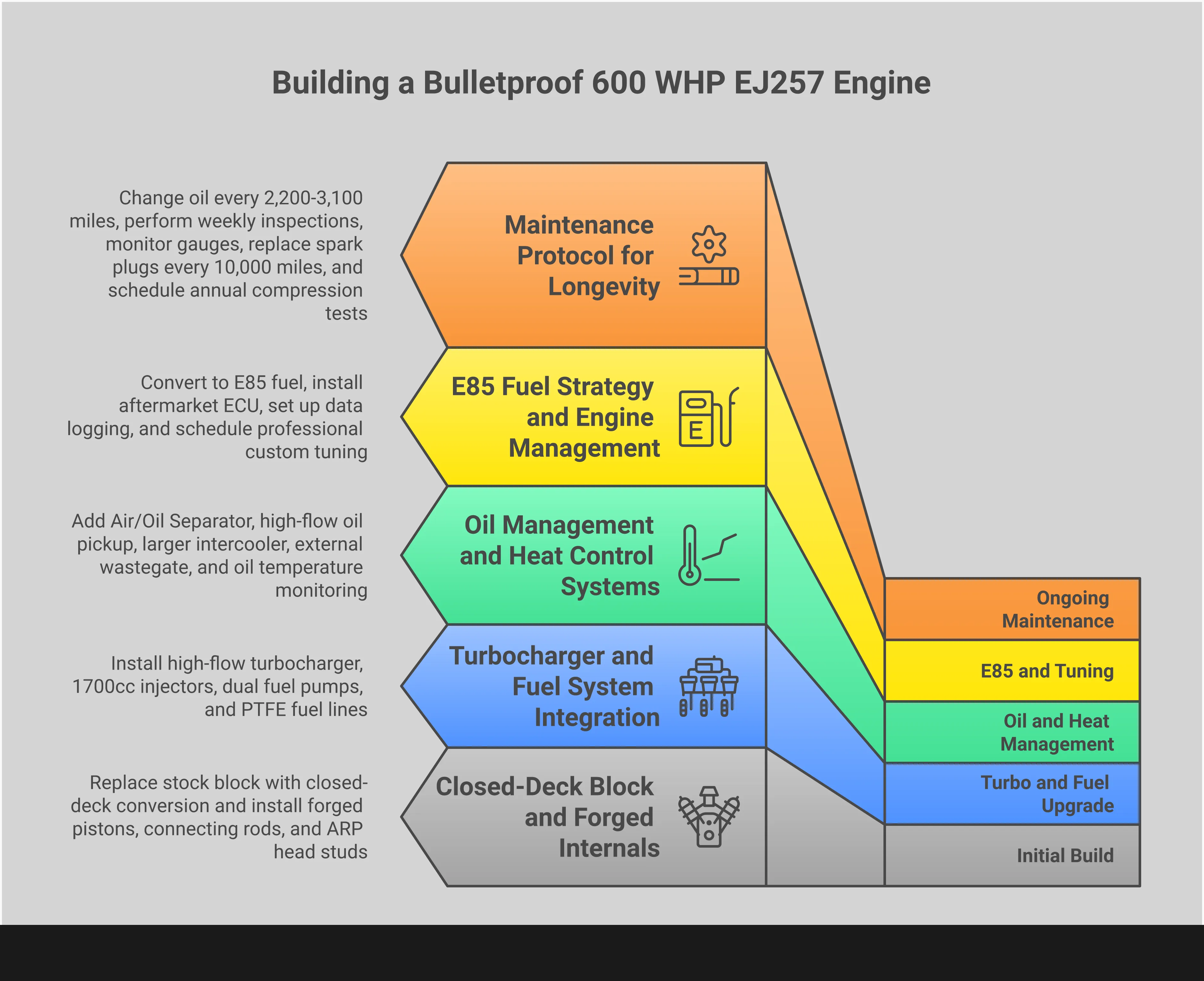
Laying the Foundation: "Full Bolt-On" (FBO) Upgrades
When you hear "full bolt-on," you might think of an intake, exhaust, and a tune. For a 600 WHP build, that definition expands significantly. Here, FBO refers to the complete set of supporting modifications required to create a foundation strong enough to handle extreme power reliably. This isn't about simply adding parts; it's about creating a balanced and resilient system. The stock EJ257 components were never designed for this level of stress, so you must systematically replace every potential weak link. This foundational stage is the most critical part of your build—get it right, and you'll have a monster; get it wrong, and you'll have a very expensive paperweight.
Your first priority is reinforcing the engine's core. The stock semi-closed deck block and cast pistons are the primary failure points when you start pushing serious power. A closed-deck block conversion is essential to provide the cylinder wall rigidity needed to prevent cracking under high pressure. At the same time, you must replace the factory pistons and connecting rods with high-quality forged internals. These performance parts are engineered to withstand the intense heat and forces generated at 600 WHP, ensuring your engine's rotating assembly doesn't become its weakest link. Skimping here is not an option; it's the difference between a reliable build and catastrophic engine failure.
With the block fortified, the next step is selecting a cohesive set of components that work in harmony. This starts with a turbocharger properly sized for your power goals and a fuel system that can keep up. The stock fuel system is completely inadequate; you'll need high-flow injectors and at least one high-capacity fuel pump to deliver enough fuel and prevent a lean condition, which can melt pistons. Equally important are cooling and oiling. A larger front-mount intercooler is non-negotiable for managing intake air temperatures, and a high-quality Air/Oil Separator is crucial for preventing oil starvation during aggressive driving—a known vulnerability of the EJ platform. Finally, a professional custom tune from an experienced expert is the only way to safely integrate these modifications. Off-the-shelf maps won't work at this level; you need a custom engine tuning service to ensure all your new components work together efficiently and reliably.
Start with a Stronger Block: Closed Decks and Forged Internals
The stock EJ257 block was never designed for 600 WHP. Its open-deck design leaves the cylinder walls unsupported, making them prone to flexing or cracking under high boost. For any build aiming for 500 WHP or more, reinforcing the block is non-negotiable. A closed-deck conversion adds the necessary support to keep the cylinders round and stable.
Beyond the block itself, the stock internals are a major weak point. The factory pistons and connecting rods can handle about 400 WHP before you’re on borrowed time. To build a durable engine, you must upgrade to forged internals. Forged pistons and H-beam or I-beam rods provide the strength needed to withstand the intense heat and pressure of a high-horsepower setup. These are foundational performance parts for any serious build.
Choosing the Right Turbo for 600 WHP
Your turbocharger is the heart of your power production, so choosing the right one is key. For a stock-location setup, options like the Forced Performance Black or the BCP X500R are capable of pushing you into the 600-700 WHP range, especially when paired with E85 fuel. These turbos offer a significant increase in airflow over the stock unit while fitting within the factory layout.
For even better performance, many builders opt for a rotated turbo kit. This setup repositions the turbo, allowing for a larger unit, a more direct exhaust path, and a shorter, more efficient intercooler piping route. The result is often better spool, lower backpressure, and more consistent power delivery. While more complex to install, a rotated setup is one of the most effective Subaru WRX upgrades for maximizing the EJ257’s potential.
Fueling Your 600 WHP Engine: Pumps, Injectors, and Lines
Making big power requires a massive amount of fuel, and the stock system simply can’t keep up. A 600 WHP build demands a complete fuel system overhaul. Start with high-flow fuel injectors, like Injector Dynamics 1700cc units, which can supply enough fuel (especially if you’re using E85) to prevent leaning out under boost.
Next, you’ll need to upgrade your fuel pump. A single high-flow pump may not be enough, so a dual-pump setup is the standard for this power level. Systems from Radium or Aeromotive are popular choices, often configured so one pump runs constantly while the second activates under boost. Don’t forget to upgrade your fuel lines and rails to ensure the entire system can handle the increased volume and pressure required for your engine tuning services.
Rounding Out Your Build: Cooling, Oil, and Intake
With the core components in place, it’s time to focus on the supporting mods that ensure your engine survives. Oil management is absolutely critical in any modified Subaru. An Air/Oil Separator (AOS), particularly a competition-style unit, is a must-have to prevent oil from contaminating your intake tract and lowering your fuel's octane rating.
Equally important is ensuring the engine receives consistent oil pressure. The factory oil pickup tube is a known failure point, so upgrading to a high-flow, heavy-duty pickup and baffle from a brand like Killer B or IAG is essential for preventing oil starvation during aggressive driving. Finally, a larger top-mount or front-mount intercooler is necessary to keep charge air temperatures down, which is vital for making consistent power and preventing detonation on your high-performance Subaru STI.
Managing Crankcase Pressure: The PCV System and Air/Oil Separators
As you increase power, you also increase "blow-by"—the combustion gases that slip past the piston rings and into the crankcase. The stock Positive Crankcase Ventilation (PCV) system is designed for factory power levels and quickly gets overwhelmed by the excess pressure from a 600 WHP setup. When this happens, the system can push oil vapor into your intake manifold. This is a serious problem because oil contamination effectively lowers your fuel's octane rating, which dramatically increases the risk of detonation. An Air/Oil Separator (AOS) is the solution and one of the most critical performance parts you can install. It intercepts the blow-by gases, separates the oil, and returns it to the engine, ensuring only clean air re-enters your intake. For a high-horsepower build, a quality AOS isn't just an upgrade; it's essential insurance for your engine's longevity.
Spark Plugs: A Critical Component for High-Boost Engines
Spark plugs are small but mighty, and in a high-boost engine, they play a vital role in preventing catastrophic failure. The immense heat and pressure inside the cylinders of a 600 WHP engine can cause the tip of a standard spark plug to overheat, turning it into a glow plug. This can lead to pre-ignition, where the air-fuel mixture ignites before the spark, causing detonation that can destroy a piston in seconds. To prevent this, you need to run a "colder" heat range spark plug. A colder plug is designed to transfer heat away from its firing tip more quickly, keeping it cool enough to prevent pre-ignition. Choosing the correct heat range is specific to your power level and tune, so it's a detail you'll want to discuss with your engine builder. Regular inspection and replacement are also key, as these plugs work hard to keep your high-performance Subaru STI running safely.
Can an EJ257 Reliability at 600 WHP
Reaching 600 wheel horsepower is an impressive goal, but making that power reliable is the real challenge. At this level, you’re operating far beyond the engine’s original design parameters. Every component is under extreme stress, and any weak link will quickly become a catastrophic failure. This isn’t the time to cut corners or hope for the best. Building a durable 600 WHP EJ257 requires a systematic approach that addresses the engine’s known vulnerabilities head-on. From the block itself to the oiling system, each part of the equation must be fortified. By focusing on a strong foundation and smart supporting modifications, you can build an engine that not only hits your power target but also survives track days, spirited drives, and daily use. Let’s get into the critical areas you need to reinforce to ensure your high-powered build lasts.
How Far Can You Push Stock Internals?
The stock internals of an EJ257 are respectable, but they have a clear ceiling. With a solid tune, a factory engine can handle around 350 WHP reliably. Pushing it to 400 WHP is entering the danger zone where you’re gambling with the life of your engine. The cast pistons and connecting rods were simply not designed for the heat and cylinder pressure generated at 600 WHP. To build a motor that lasts, upgrading to forged internals is non-negotiable. Forged pistons and H-beam or I-beam connecting rods provide the strength and durability needed to handle the immense forces inside a high-boost engine. Think of it as building a foundation for your power goals; without it, everything else is at risk of coming down.
How to Prevent Oil Starvation and Lubrication Issues
One of the most common causes of failure in modified Subaru engines is oil starvation. Under hard acceleration and aggressive cornering, oil can slosh to one side of the pan, momentarily uncovering the oil pickup. Even a split second without oil pressure at high RPM can destroy your bearings and lead to complete engine failure. To prevent this, you must upgrade the factory oiling system. Installing a high-flow oil pickup and a crankcase baffle ensures the pickup tube remains submerged in oil. An Air/Oil Separator (AOS) is another essential mod. It prevents oil from entering your intake tract, which reduces the risk of detonation and keeps your engine running cleanly. These performance parts are critical insurance for your investment.
Keeping it Cool: Managing Heat and Cylinder Stress
As you increase power, you also generate a massive amount of heat and cylinder pressure. The EJ257 features an open-deck block design, which is great for cooling in stock form but creates a structural weakness at high power levels. The unsupported cylinder walls can flex, distort, or even crack under the stress of 600 WHP. The solution is a closed-deck block conversion. This process involves inserting a support structure into the open coolant passages around the cylinders, effectively reinforcing the top of the block. This modification provides the rigidity needed to keep the cylinder walls stable, ensuring proper piston ring seal and preventing catastrophic block failure. It’s a foundational step for any serious Subaru STI upgrade plan.
Expected Longevity of a Properly Built Engine
When you invest in a full build, you want to know it will last. A properly constructed 600 WHP EJ257, built with top-tier forged internals and a closed-deck block, isn't a ticking time bomb. Its lifespan depends heavily on three things: the quality of the build, the precision of the tune, and your maintenance habits. With a professional tune that prioritizes safety over squeezing out every last horsepower, and a strict maintenance schedule using high-quality fluids, a well-built engine can offer tens of thousands of miles of reliable performance. It's crucial to remember that this is a high-stress engine; regular inspections and proactive care are part of the ownership experience. The longevity is a direct result of the expertise and care invested, from the initial assembly to the ongoing engine tuning services.
Don't Overlook These Critical Modifications
While the block and internals are the core of a 600 WHP build, several other modifications are just as important for reliability. Precise boost control is crucial, which is why an external wastegate (EWG) is highly recommended. An EWG offers superior boost management compared to an internal wastegate, preventing dangerous boost spikes that can destroy an engine. You should also invest in a set of high-performance head studs to prevent the cylinder heads from lifting under high boost. Finally, remember that a 600 WHP build is a complete package. This means pairing your built short block with properly ported and built cylinder heads to maximize airflow and efficiency. Every component must work together to create a powerful and durable system.
Beyond the Engine: Drivetrain and Supporting Mods
Building a 600 WHP EJ257 is a massive achievement, but all that power is useless if you can't transfer it to the pavement reliably. Once the engine is built, your focus must shift to the rest of the powertrain. The stock drivetrain components were designed to handle factory power levels, and doubling that output puts an incredible amount of strain on every part, from the clutch to the axles. A truly successful build is a balanced one, where the drivetrain is just as prepared for the power as the engine is. Ignoring this crucial step is a recipe for broken parts and a car that spends more time on a lift than on the road. It’s time to ensure the rest of your car can keep up with its new heart.
The first and most immediate weak link you'll encounter is the clutch, which simply can't hold the torque of a 600 WHP engine. Beyond that, the transmission, driveshaft, axles, and differentials are all subjected to forces they were never meant to endure. While the STI's 6-speed transmission is famously robust, it isn't invincible. Upgraded transmission mounts can help reduce drivetrain slop, while stronger axles may be necessary to prevent snapping under hard launches. Every component in the driveline needs to be assessed and fortified to create a cohesive system that can handle the abuse you plan to throw at it. Investing in quality performance parts for your drivetrain is just as important as what you put inside the engine.
Upgrading Your Manual Transmission for More Power
If your car is equipped with the factory 6-speed manual, you’re in a good position. The Subaru STI 6-speed is a legendarily tough gearbox, capable of handling significant power in its stock form. However, 600 WHP is pushing the upper limits of what the stock gearset can reliably sustain long-term. While the gears themselves are strong, the immediate failure point will be your clutch. The factory clutch is designed to slip and fail before you shatter expensive transmission internals, acting as a mechanical fuse. At this power level, an upgraded clutch isn't just a recommendation; it's a requirement. Without it, you'll be unable to put any of your newfound power to the ground effectively.
Clutch and Flywheel Recommendations
Choosing the right clutch is about matching it to your engine's torque output and your intended use. A common mistake is to install an overly aggressive racing clutch, like a 6-puck design, which results in harsh engagement and a terrible street driving experience. For a 600 WHP build, you'll want to look at a multi-plate clutch system. These clutches use multiple smaller discs to provide a higher clamping force and torque capacity without requiring a rock-hard pedal. This setup offers a much more progressive engagement, making the car more manageable in daily driving situations. When selecting your clutch, pair it with a quality flywheel—either a lightweight unit for faster revs or a street-friendly steel flywheel for smoother engagement.
Strengthening the Automatic Transmission
While less common in the high-performance Subaru scene, building a powerful car with an automatic transmission is entirely possible. The key to making an automatic transmission survive behind a 600 WHP engine is managing heat. The increased torque from your built motor generates significantly more friction and heat inside the transmission, which can quickly cook the fluid and lead to premature failure. The single most important upgrade is a high-capacity transmission cooler. This helps dissipate the extra heat and keep fluid temperatures in a safe operating range. For improved performance, consider a performance valve body or a separate transmission controller to achieve firmer, quicker shifts that can better handle the power delivery.
Choosing the Right Fuel for Maximum Power
Once your engine is built to handle the power, your choice of fuel becomes one of the most critical factors in reaching and sustaining 600 WHP. The right fuel does more than just burn; it dictates how much boost you can run, how aggressive your timing can be, and ultimately, how safe your engine is under extreme load. For a high-horsepower EJ257, the debate almost always comes down to two options: high-octane pump gas or E85.
While premium pump gas is convenient, E85 offers a significant performance advantage that is hard to ignore when chasing big numbers. It has a much higher octane rating and unique chemical properties that allow tuners to extract more power safely. However, making the switch isn't as simple as just filling up the tank. It requires a dedicated fuel system and a clear understanding of its properties to protect your investment.
E85 vs. High-Octane Gas: Which is Best?
For a 600 WHP goal, E85 is the clear winner. This ethanol-based fuel contains more oxygen than gasoline, which promotes a more complete and powerful combustion process. This efficiency translates directly into horsepower. It’s not uncommon to see a car tuned for 400 WHP on pump gas gain over 50% more power just by switching to E85 and retuning. The fuel’s high octane rating also allows for much more aggressive ignition timing, which is key to making power without risking engine-destroying knock events. While 91 or 93 octane pump gas is reliable, it simply can’t match the detonation resistance of E85, creating a much lower ceiling for a high-boost build.
Match Your Fuel System to Your Power Goals
You can’t run E85 on a stock fuel system, especially at the 600 WHP level. Ethanol requires about 30% more fuel volume than gasoline to produce the same energy, so your entire system needs an upgrade. This includes high-flow fuel injectors, one or more high-pressure fuel pumps, and larger-diameter fuel lines. More importantly, E85 is corrosive to standard rubber fuel lines and components. You must use a system with PTFE-lined hoses and ethanol-compatible parts to prevent long-term degradation. Investing in the right performance parts from the start will save you from catastrophic failures and expensive repairs down the road.
How to Prevent Engine Knock and Detonation
Engine knock, or detonation, is the single biggest threat to a high-horsepower Subaru engine. It happens when the air-fuel mixture ignites prematurely, sending a destructive shockwave through the cylinder that can crack pistons and destroy bearings. This is where E85 truly shines. Its superior cooling properties and high octane rating create a massive safety margin against knock. This resistance is precisely why you can run higher boost levels and more advanced ignition timing with E85. On pump gas, you are always operating much closer to the knock threshold, forcing your tuner to be more conservative and leaving potential power on the table.
Is Your Build Ready for Ethanol?
Running E85 requires a bit more attention than pump gas. Because it can absorb water from the atmosphere, it’s not ideal to let it sit in the tank for extended periods. If your build is for a daily driver, it’s a good practice to run a tank of gasoline through the system every few fill-ups with E85. This helps clean out any deposits and keeps the system healthy. You also need to ensure every component in your fuel path is ethanol-rated, from the tank to the injectors. Using the correct Subaru STI upgrades ensures your system can handle the fuel’s properties without breaking down, giving you reliable power every time you hit the throttle.
The Final Step: Tuning for Safe Power
After you’ve assembled all the high-performance hardware, the engine tune is what brings it all to life. Think of it as the brain of your operation, telling every component how to work together to create massive, reliable power. Skipping or cutting corners on your tune is the fastest way to turn your high-dollar build into a very expensive paperweight. This final step is about dialing in your engine for both maximum performance and long-term safety, ensuring your investment is protected every time you turn the key.
Why a Professional Custom Tune is Non-Negotiable
An off-the-shelf map won't cut it for a 600 WHP build. A professional custom tune is absolutely essential to ensure your new engine and all its supporting modifications operate in perfect harmony. Your tuner will meticulously adjust fuel delivery, ignition timing, and boost levels to match your specific setup, creating a bespoke map that maximizes power while staying within safe limits. This process is critical for preventing catastrophic issues like engine knock or lean air-fuel conditions that can destroy an engine in seconds. Investing in professional engine tuning services is the single best way to protect your engine and unlock its true potential.
Choosing Your Engine Management and Monitoring Tools
The stock Subaru ECU can only handle so much. To properly manage a 600 WHP EJ257, you need a more powerful engine management system. Aftermarket ECUs, like those managed with a Cobb Accessport or a full standalone system, provide the granular control and advanced safety features necessary for a high-power build. These systems give your tuner access to more detailed tables and fail-safes, allowing for a much more precise and reliable tune. In the cockpit, a set of quality monitoring gauges for boost, oil pressure, and air-fuel ratio is just as important. They provide real-time feedback on your engine’s health so you can spot a problem before it becomes a disaster.
The Need for an Upgraded MAP Sensor
As you push for higher boost levels, many stock sensors hit their limits, and the Manifold Absolute Pressure (MAP) sensor is one of the first to become a liability. The factory sensor is only designed to read up to about 22-24 PSI of boost. Once you exceed that, it can no longer provide accurate data to the ECU, which is a huge problem for your tune. The ECU is left guessing, which can easily lead to a lean air-fuel mixture and catastrophic detonation. For a 600 WHP build, especially one running a speed density tune, upgrading to a higher-range MAP sensor is essential. This small component provides the precise data your tuner needs to keep your engine safe, making it a critical piece of the puzzle for reliable high-horsepower engine tuning.
Dialing in Your Air-Fuel Ratios and Timing
The heart of any tune lies in optimizing the air-fuel ratio (AFR) and ignition timing. Your tuner’s goal is to find the perfect balance. An ideal AFR ensures complete combustion for maximum power without running dangerously lean, which can cause extreme heat and detonation. At the same time, advancing the ignition timing can create more power, but going too far also risks engine knock. This is where your fuel choice plays a huge role. E85’s higher octane rating and cooling properties allow for a much more aggressive ignition timing curve, which is essential for reaching the 600 WHP mark safely compared to the limitations of standard pump gas.
Why You Should Never Desensitize Knock Sensors
Your knock sensors are your engine's last line of defense. They act like a microphone, listening for the specific frequency of engine knock—that destructive, premature ignition that can shatter a piston in an instant. On a high-strung 600 WHP build, where detonation is the single biggest threat, these sensors are non-negotiable safety equipment. Some tuners might be tempted to "desensitize" them to ignore phantom noise from a louder, built motor, but this is an incredibly risky gamble. Experts across the industry have seen engines blow up from this exact modification, even at lower power levels. Disabling or altering your knock sensors is like removing the smoke detectors from your house because you keep burning toast. Instead of silencing the warning, you should rely on professional engine tuning services to correctly interpret the data and build a safe map that respects these critical alerts.
Why You Should Be Data Logging
A tune isn't a "set it and forget it" affair. Data logging is your tool for conducting regular health check-ups on your engine. By recording key parameters like knock feedback, injector duty cycle, and boost pressure during a pull, you can see exactly how your engine is behaving under load. This information is invaluable for catching small issues before they escalate into major failures. Regular logging helps you and your tuner track the engine's performance over time and make small adjustments as needed. It’s a proactive approach that provides peace of mind and is fundamental to keeping your high-performance build running strong for years to come.
How Much Does a 600 WHP EJ257 Build Cost?
Building a 600 WHP EJ257 is a serious commitment, both in time and money. Before you buy a single part, it’s crucial to understand the financial reality. There’s a well-known saying in the performance world: you can have it fast, reliable, or cheap, but you can only pick two. For a 600 WHP build that you want to last, "cheap" is off the table. The total cost can vary dramatically based on your starting point, labor rates, and the specific components you choose.
A smart approach is to plan your budget meticulously and then add a significant cushion for unexpected expenses. Many experienced builders will tell you to calculate your estimated cost and then double it to be safe. This isn't meant to discourage you, but to prepare you for the journey ahead. Investing properly from the start ensures you end up with a powerful, dependable machine instead of a constant source of frustration. You'll be sourcing a wide range of performance parts, and each one plays a critical role in reaching your goal safely.
How to Budget for Your Build, Part by Part
When planning your build, it helps to categorize your expenses. The largest portion of your budget will almost certainly go toward the engine's short block. This includes forged pistons, connecting rods, a balanced crankshaft, and potentially a closed-deck modification for strength. After the block, your next major expenses will be the turbocharger kit, a comprehensive fuel system upgrade, and professional cylinder head work.
Don’t forget to budget for supporting systems. This includes a high-capacity cooling system, an upgraded oiling system to prevent starvation, and a robust drivetrain to handle the new power. Finally, one of the most critical investments is a professional tune. Expert engine tuning services are non-negotiable for ensuring your engine runs safely and efficiently at its new power level.
Balancing Your Budget Between Power and Reliability
At the 600 WHP level, performance and reliability are directly linked. Pushing an engine to this limit, especially for track use or aggressive street driving, means every component is under extreme stress. Opting for higher-quality parts isn't just about making more power; it's about preventing catastrophic failures. A cheap component that fails under load can easily destroy your entire engine, turning a small savings into a massive expense.
Think of premium parts as an insurance policy for your investment. For example, choosing a proven turbocharger or fuel injectors from a reputable brand might cost more upfront, but it provides peace of mind that your engine is receiving the fuel and air it needs without compromise. When you browse for Subaru STI upgrades, prioritize components with a track record of durability under high-horsepower applications.
The Real Cost of Using Budget Parts
The "buy once, cry once" philosophy is essential for a high-horsepower build. It’s always better to save up for a proven, high-quality part than to settle for a cheaper alternative that might fail prematurely. The market is flooded with parts, but not all are created equal. Experienced tuners often refuse to work on cars with certain low-quality components because they know the risk of failure is too high.
Do your research and listen to the experts. A reputable performance shop or tuner can guide you toward brands and parts that have been proven to work reliably in builds like yours. Investing in quality Subaru WRX upgrades from trusted manufacturers will save you money, time, and headaches in the long run. Your goal is to spend more time driving your car and less time fixing it.
Keeping Your High-Performance EJ257 Healthy
Building a 600 WHP EJ257 is an incredible achievement, but the work doesn’t stop once the engine is assembled. The key to making that power last is diligent and consistent maintenance. A high-output engine operates under immense stress, and what works for a stock Subaru simply won’t cut it here. Think of your maintenance routine as the insurance policy for your investment. It’s the difference between enjoying your build for years and facing a premature, costly failure.
Protecting your engine involves more than just the occasional oil change. It requires a three-pronged approach: following a strict service schedule, actively monitoring your engine’s behavior, and establishing a proactive inspection routine. By committing to these practices, you can ensure your engine remains healthy, reliable, and ready to perform whenever you hit the throttle. This isn’t about being overly cautious; it’s about being smart and respecting the power you’ve created. A well-maintained engine is a happy engine, and a happy engine will give you the thrilling performance you built it for, mile after mile.
Creating a High-Performance Maintenance Schedule
For a high-performance EJ257, the factory maintenance schedule is no longer your guide. Your engine’s lifeblood is its oil, and it needs to be changed far more frequently. For an engine making this level of power, plan on changing the oil every 2,200 to 3,100 miles. If you’re spending time on the track or pushing the car hard regularly, you should change it even more often. Clean, high-quality oil is one of the most effective ways to prevent premature wear on your high-strung internals. Don’t forget to check other critical fluids like coolant and transmission fluid regularly, as they are also working harder to keep up with the increased power and heat.
How to Spot Trouble Before It Starts
You know your car better than anyone, so you are the first line of defense in catching problems early. Pay close attention to how your engine sounds, feels, and responds. Any new or unusual noises, like knocking or whining, should be investigated immediately. If you notice a sudden change in power delivery, hesitation, or smoke from the exhaust, don't ignore it. These are often the first signs of a mechanical issue, a failing sensor, or a problem with the tune. Addressing these warning signs right away can prevent a minor issue from turning into a catastrophic failure. Consistent monitoring is a critical part of owning any modified vehicle, especially one with expert engine tuning services.
Building a Routine for Preventive Care
A successful build relies on a comprehensive approach to care that goes beyond fluid changes. Make it a habit to regularly inspect your engine bay. Look for any signs of fluid leaks, check that all hoses are in good condition without cracks or bulges, and ensure electrical connections are secure. This routine is also a good time to appreciate the quality of your build. A clean, professional installation with top-tier performance parts makes spotting issues much easier. This proactive approach helps you stay ahead of potential problems and ensures all the supporting systems for your powerful engine are in perfect working order.
Related Articles
- The Subaru STI Engine: A Complete Owner's Guide
- Subaru STI Engine: Everything You Need to Know
- Subaru STI Engine: Everything You Need to Know (Spanish)
Frequently Asked Questions
Can I realistically daily drive a 600 WHP Subaru? You can, but it requires a different level of commitment than a stock car. A build at this level demands frequent oil changes, constant monitoring of your gauges, and a proactive approach to maintenance. While a well-built and properly tuned engine can be surprisingly streetable, you trade the "set it and forget it" nature of a factory car for the responsibility of managing a high-performance machine. It's less of a daily commuter and more of a high-maintenance weekend warrior that you can happen to drive daily if you're dedicated.
Is a closed-deck block conversion absolutely necessary? For a reliable 600 WHP build, yes, it is non-negotiable. The stock EJ257 has an open-deck design, which means the cylinder walls are not fully supported at the top. Under the immense cylinder pressure required to make this kind of power, those unsupported walls can flex or even crack. A closed-deck conversion adds the structural reinforcement needed to keep the cylinders stable, ensuring a proper seal and preventing catastrophic engine failure. It's a foundational step for building a motor that lasts.
Why is E85 so much better than pump gas for making this much power? E85's main advantage is its high octane rating and its cooling effect on the intake charge. This combination makes it extremely resistant to engine knock, which is the number one killer of high-horsepower Subaru engines. This resistance allows a tuner to safely run more boost and advance the ignition timing far beyond what is possible with 91 or 93 octane pump gas. In short, E85 provides a massive safety margin that is essential for making big power reliably.
If I cut corners, what's the first part of the engine that will likely fail? The stock pistons are almost always the first component to fail when you push the EJ257 past 400 WHP. They are cast, not forged, and simply cannot handle the heat and pressure generated by a 600 WHP setup. A close second is the oiling system. The factory oil pickup tube is a known weak point that can crack and starve the engine of oil, leading to catastrophic bearing failure. Upgrading to forged internals and a fortified oiling system are two of the most critical investments you can make.
Does the stock transmission need to be upgraded to handle 600 WHP? Absolutely. The stock six-speed transmission in the STI is strong, but it was never designed to handle the torque that a 600 WHP engine produces. While it might hold up for a short time with careful driving, aggressive launches or track use will quickly expose its limits, often resulting in stripped gears. To reliably put the power down, you will need to budget for a built transmission with upgraded gear sets and other reinforced drivetrain components like the clutch and axles.