

How to Build a Drag Setup Engine for Your WRX STI
A drag car is the ultimate test of a vehicle as a complete system. When the light turns green, it’s not just the engine under stress; it’s the clutch, transmission, axles, and tires working together in one violent, explosive moment. A powerful motor is useless if the drivetrain can’t handle the shock. Your WRX STI drag setup engine is just one critical piece of this complex puzzle. This guide breaks down how to build a truly cohesive machine, ensuring every component works in harmony to produce consistent, blistering times on the track.
Key Takeaways
- Fortify Your Engine for Reliable Power: A successful drag build starts with a strong foundation. Upgrading to forged internals is non-negotiable for handling high boost, while a robust fuel system and an efficient cooling setup are essential for protecting your investment.
- Connect Power to Pavement with a Strong Drivetrain and Tune: A powerful engine is useless without a drivetrain that can handle the torque. A performance clutch and reinforced axles are critical for launch reliability, and a professional dyno tune is the only way to safely optimize all your new components.
- Complete Your Build with Essential Supporting Mods: To get the most from your engine, you need to improve airflow and traction. A free-flowing exhaust, a front-mount intercooler, and a dedicated suspension and tire setup are key to achieving consistent, fast quarter-mile times.
Understanding the Drag Racing Landscape
Before you turn the first wrench, it’s smart to get a feel for the world you’re stepping into. Drag racing isn’t just about building the fastest car; it’s about building a car that fits the rules and can compete effectively in its class. Understanding the major organizations that govern the sport and knowing what kind of competition you’ll be up against will help you create a clear plan for your build. This way, you can invest in the right parts from the start and avoid costly changes down the line. It’s about setting a target and building your Subaru to hit the bullseye, whether you're aiming for a local test-and-tune night or a specific competitive class.
Governing Bodies and Classes (NHRA, PDRA, IHRA)
Three main organizations set the standards for drag racing in North America. The National Hot Rod Association (NHRA) is the largest, offering a wide range of classes from Top Fuel to street-legal categories. The International Hot Rod Association (IHRA) is another major player with its own set of rules and events. For those who prefer shorter sprints, the Professional Drag Racers Association (PDRA) specializes in eighth-mile racing. Each body has specific requirements for safety, vehicle modifications, and class eligibility. Researching their rulebooks is a crucial first step to ensure your build is compliant and competitive for the events you want to enter.
Choosing Your Platform: Subaru vs. Other Popular Engines
When you walk the pits at a drag strip, you’ll see a lot of familiar engine setups, but the Subaru boxer engine often stands out from the crowd. While V8s and inline-fours dominate many classes, the unique architecture of the EJ and FA platforms brings its own set of characteristics to the strip. Choosing to build a Subaru for drag racing means you’re taking a different path—one that comes with specific hurdles but also offers a distinct and rewarding experience. Understanding how your platform compares to the more common choices will help you appreciate its strengths and prepare for its challenges.
Common Alternatives: LS, Coyote, K-Series, and More
The drag racing scene is filled with proven powerhouses. The GM LS engine is a favorite for its lightweight, compact design and massive aftermarket support, making it easy to generate huge power. Ford’s Coyote V8 is another popular choice, known for its high-revving nature and robust construction. In the four-cylinder world, Honda's K-Series is legendary for its incredible power-to-liter ratio and tuning potential. These engines have become staples because they offer a more straightforward path to big horsepower, with decades of development and a vast community focused on making them go fast in a straight line.
Why the EJ/FA Platform is a Unique Challenge
Building a Subaru for the drag strip is a special kind of project. The boxer engine's flat design gives your car a low center of gravity, which is great for handling, but it can present unique challenges for weight distribution and packaging large turbos. The all-wheel-drive system provides incredible launch grip but also adds complexity and drivetrain stress. This is why a thoughtful approach is key. With specialized performance parts designed to handle extreme power and expert engine tuning to manage it, the EJ/FA platform can be transformed into a seriously competitive machine that surprises the V8 crowd.
Essential Engine Parts for Your WRX STI Drag-Ready WRX STI?
Building a WRX STI for the drag strip starts with the engine. To handle the immense power needed for competitive quarter-mile times, you have to go beyond the stock setup and build a robust, reliable powerhouse. This isn't just about adding a massive turbo; it's about creating a balanced system where every component works together to deliver consistent, explosive performance. From the internals that form the engine's foundation to the supporting systems that keep it running cool and fueled, each part plays a critical role. A proper build focuses on creating a durable engine that can withstand the demands of repeated high-stress launches and full-throttle passes. Let's walk through the essential Subaru STI upgrades that will transform your car from a street machine into a true drag contender.
How to Pick the Right Turbo for Maximum Power
The stock turbo on your WRX STI is great for daily driving, but it simply can't move enough air to produce the horsepower needed for drag racing. A larger, high-performance turbo is the key to making big power. When selecting a turbocharger for your WRX STI, consider reputable aftermarket manufacturers like Garrett, Blouch Turbo, and Forced Performance. These brands offer a range of options tailored to high-performance setups, ensuring you find the ideal turbo for your specific needs. The right choice depends on your power goals, balancing spool time with top-end performance. A properly matched turbo will give you the massive airflow required to push your STI down the track with incredible force.
Forced Induction Alternatives: The Case for Superchargers
While turbochargers are the go-to for most Subaru builds, it's worth considering the unique advantages of a supercharger, especially for drag racing. Unlike a turbo that relies on exhaust gases to spool up, a supercharger is mechanically driven by the engine's crankshaft. This means it can deliver power immediately, eliminating the turbo lag that can cost you precious tenths of a second at the starting line. This instant response is paired with impressive low-end torque, giving you a powerful and immediate launch. The power delivery is also much more predictable, offering a linear power band that can make it easier to manage traction as you rocket down the strip. For drivers who prioritize instant throttle response and a strong, consistent launch over peak horsepower numbers, a supercharger presents a compelling case.
Why Forged Engine Internals
Once you install a larger turbo, the stock engine internals become the next weak link. The factory pistons and connecting rods aren't designed to handle the extreme cylinder pressures created by high levels of forced induction. This is where forged components come in. Upgrading to forged engine internals is crucial for handling the increased power and stress that comes with drag racing. These parts are significantly stronger than their cast counterparts and are designed to withstand higher levels of pressure, providing the durability needed for consistent performance. Investing in a quality set of forged pistons and rods is non-negotiable for a reliable drag build and is the best insurance against catastrophic engine failure.
Getting Your Fuel System Ready for More Power
More air from your new turbo requires more fuel to maintain a safe and powerful air-to-fuel ratio. The stock fuel pump and injectors will quickly be overwhelmed, leading to a lean condition that can melt pistons and destroy your engine. To support the increased power output of a drag-ready WRX STI, upgrading to larger fuel injectors and a higher-flow fuel pump is essential. This ensures that your engine receives the necessary fuel to operate safely and efficiently under high-performance conditions. A complete fuel system upgrade, which may also include new fuel rails and a pressure regulator, will provide the consistent fuel delivery your high-powered engine demands.
Keeping Your Engine Cool Under Pressure
Making more power generates a lot more heat, and the factory cooling system can struggle to keep up during back-to-back runs at the drag strip. Overheating can cause detonation, reduce power, and lead to serious engine damage. An efficient cooling system is vital for maintaining optimal engine temperatures during drag racing. Upgrading to a larger aluminum radiator and a high-performance oil cooler will significantly improve your engine's ability to dissipate heat. Brands like GrimmSpeed and Extreme Turbo Systems (ETS) are known for their high-quality performance parts that can enhance your WRX STI's cooling capacity, ensuring you get consistent performance pass after pass.
How Do You Tune a WRX STI for the Drag Strip?
After installing performance hardware, the next step is tuning your engine. The tune is the brain of your operation, telling all those new components how to work together to produce maximum power safely. A proper tune ensures your air-fuel ratios, ignition timing, and boost levels are all optimized. Without it, you’re leaving power on the table and risking engine damage. Choosing the right engine tuning service is essential for a successful drag build.
ECU Remap vs. Standalone: Which Is Better for You?
Your first tuning decision is whether to remap the factory Engine Control Unit (ECU) or install a standalone system. An ECU remap, or flash tune, modifies the stock software to adjust fuel maps, ignition timing, and boost. It’s a great choice for mild to moderate builds, offering solid gains in power and throttle response. For serious drag setups with larger turbos or custom fuel systems, a standalone ECU is necessary. It replaces the factory unit, giving your tuner precise control over every engine parameter and removing the stock system's limitations.
Why a Custom Dyno Tune Is Worth It
While off-the-shelf maps are convenient, a custom dyno tune is essential for maximizing performance and reliability. A dynamometer lets a tuner simulate track conditions in a controlled setting, fine-tuning the map for your specific parts. This process optimizes the power curve for drag racing, improving torque and throttle response. Most importantly, it ensures your engine operates safely under the extreme stress of a launch. Your tuner can identify and correct potential issues like engine knock, protecting your investment and giving you peace of mind at the starting line.
Should You Make the Switch to an E85 Tune?
For a significant jump in horsepower, consider switching to E85 fuel. Its high octane rating resists detonation, allowing your tuner to run more aggressive timing and higher boost for substantial power gains. Making the switch requires more than just filling the tank. E85 demands more fuel volume, so you’ll need to upgrade your fuel system with compatible performance parts, including a high-flow pump and larger injectors. A professional tune is mandatory to recalibrate the ECU for the new fuel and safely unlock its potential.
How to Bulletproof Your WRX STI Drivetrain
Building a powerful engine is only half the battle. All that horsepower is useless if you can’t transfer it to the pavement reliably. For drag racing, your drivetrain takes an incredible amount of abuse, especially during the launch. The sudden, massive load can easily overwhelm stock components, leading to snapped axles, slipping clutches, and damaged differentials. This is where strategic upgrades become non-negotiable.
To build a truly competitive and reliable drag car, you need to reinforce the entire path power takes from the engine to the tires. This means looking beyond the engine bay and focusing on the transmission, clutch, axles, and differentials. A fortified drivetrain ensures that every bit of power you’ve worked so hard to create translates into forward momentum, launch after launch. Neglecting these parts is a recipe for a short, frustrating day at the track. Let’s get into the key components you need to address.
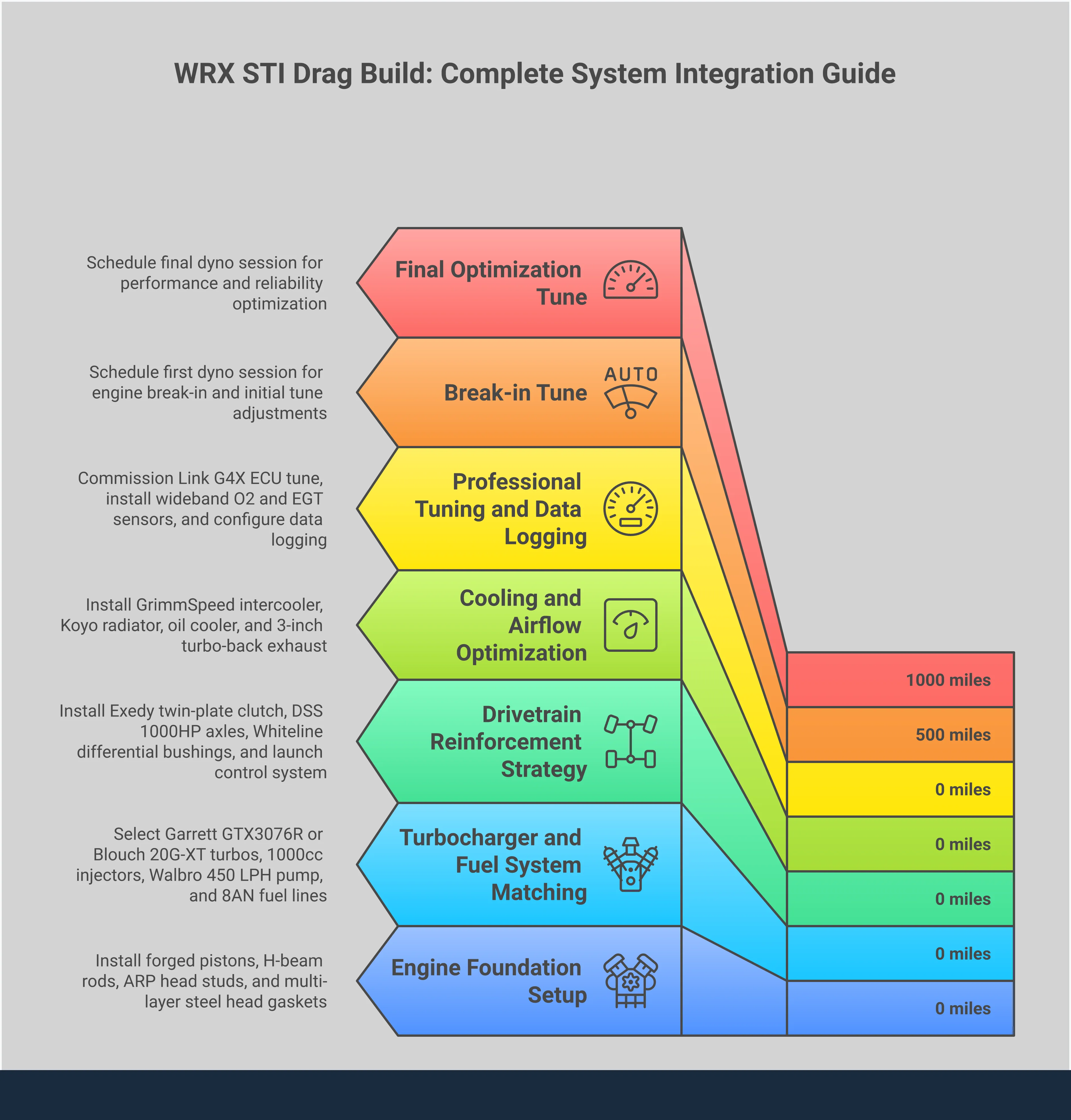
Choosing a Clutch and Flywheel That Can Handle the Power
Think of your clutch as the gatekeeper of your engine’s power. When you launch, it’s responsible for smoothly but firmly engaging and transferring immense torque. A stock clutch simply isn’t designed for that kind of shock and will quickly start to slip or fail completely, leaving you at the starting line. Upgrading to a performance clutch is essential. Look for options with higher clamping force and durable friction materials, like a multi-plate or ceramic clutch, which are built to handle aggressive launches. A lighter flywheel is another smart upgrade, as it allows the engine to rev more quickly, helping you get into your powerband faster. To build a reliable, high-performance machine, you need to upgrade the components that support your new power, and the clutch is your first line of defense.
Strengthening Diffs and Axles for Hard Launches
Once power moves past your transmission, the axles and differentials have the final job of putting it to the ground. During a hard launch with sticky drag tires, the shock load on these parts is enormous. Stock axles are a known weak point and can snap under the strain, ending your race day instantly. Upgrading to heavy-duty aftermarket axles made from stronger materials is a must for any serious drag build. You should also consider reinforcing your differentials. Braces can help prevent the housing from flexing under load, and for very high-horsepower builds, a fully built differential might be necessary to prevent gear failure. These performance parts are your insurance against catastrophic drivetrain failure.
Setting Up Launch Control for Perfect Starts
Consistency is key in drag racing, and a launch control system is your secret weapon for achieving it. This electronic aid allows you to hold the engine at a predetermined RPM, building boost and ensuring you leave the line with the perfect amount of power every time. By managing engine output, launch control minimizes wheel spin and maximizes traction, leading to drastically improved 60-foot times and overall consistency. Most standalone ECUs include this feature, and it can be fine-tuned for your specific setup, tires, and track conditions. Proper engine tuning services will help you dial in the system for the most effective and repeatable launches possible, giving you a significant competitive edge.
Top Brands for Your WRX STI Drag Build
When you’re building a car for the drag strip, every component has to work together perfectly. Choosing parts from reputable brands is the best way to ensure your engine is not only powerful but also reliable under extreme stress. The right combination of high-quality components will give you the competitive edge you need for consistent, fast quarter-mile times. Here are some of the most trusted brands that deliver the performance required for a serious WRX STI drag build.
Crawford Performance Engine Solutions
Building a drag engine starts with a solid foundation, and that’s where our expertise comes in. At Crawford Performance, we are known for meticulous engineering and build quality, making our engine solutions a top choice for maximizing power and reliability. We design our performance parts to handle the intense demands of drag racing, ensuring your setup can withstand run after run without failure. From short blocks to complete engine packages, our solutions are tailored to give you a durable core that’s ready to produce massive horsepower. When you build with Crawford, you’re building with a legacy of proven Subaru performance.
Top Turbochargers: Garrett and Blouch
A powerful turbocharger is the heart of any drag build. For your WRX STI, Garrett and Blouch Turbo are two of the most respected names in the industry. Both brands offer a wide range of turbos that can dramatically increase horsepower and torque, which is exactly what you need to lower your ETs. Selecting the right turbo depends on your specific power goals and how the car will be used. A properly sized turbo from either of these brands will provide the airflow necessary for a high-horsepower setup, and pairing it with our professional engine tuning services will ensure you get the most out of your investment.
Fuel Systems from AEM and DeatschWerks
As you force more air into your engine with a larger turbo, you need a fuel system that can keep up. AEM and DeatschWerks are leaders in high-performance fuel delivery, offering the fuel pumps, injectors, and regulators necessary to support serious power. Upgrading these components is not optional; it’s essential for preventing lean conditions that can lead to catastrophic engine failure. Their products ensure your engine receives a consistent and adequate fuel supply, especially during the high-demand moments of a launch and full-throttle acceleration down the strip.
Key Components from ETS and GrimmSpeed
Efficient airflow is critical for making reliable power and achieving a quick throttle response. Brands like ETS and GrimmSpeed are recognized for their exceptional engineering in performance components that support your turbo system. From front-mount intercoolers that lower charge air temperatures to exhaust manifolds that improve exhaust flow, their parts are designed to maximize efficiency. These upgrades help reduce turbo lag and allow your engine to breathe better, which are crucial factors for getting a strong start off the line and maintaining power throughout the entire run. Integrating these parts into your Subaru STI upgrades will complete your build.
What Does a Complete WRX STI Drag Build Cost?
Building a WRX STI for the drag strip is a serious commitment, and the final cost can vary dramatically based on your horsepower goals and how competitive you want to be. A weekend build for fun runs will have a very different price tag than a fully built machine aiming for single-digit quarter-mile times. The total investment is a combination of three key areas: the engine components themselves, the cost of professional installation and tuning, and the budget for all the necessary supporting modifications. Planning for all three from the outset is the best way to ensure your project stays on track and you end up with a reliable, high-performance vehicle. Let’s break down what you can expect to spend in each category.
How Much Do Drag Engine Parts Cost?
The core of your budget will go toward high-performance engine parts. A built short block with forged internals (pistons, connecting rods) can range from $4,000 to over $8,000, depending on the power level it’s designed to handle. Next, a high-performance turbocharger from a reputable brand like Garrett or Blouch can cost anywhere from $1,500 to $4,000+. You'll also need to upgrade your fuel system with larger injectors and a high-flow fuel pump, which can add another $800 to $1,500. Don't forget a robust cooling system, including an upgraded radiator and a front-mount intercooler, which can easily add another $1,000 to $2,500 to the bill. These performance parts are the foundation of a powerful and reliable drag car.
Don't Forget Installation and Tuning Costs
Buying the parts is only half the battle; getting them installed and tuned correctly is critical. Unless you’re an experienced engine builder, professional installation is highly recommended. Labor costs for a full engine build and installation can range from $3,000 to $7,000 or more, depending on the shop's hourly rate and the complexity of the job. After installation, a custom dyno tune is absolutely essential. This process ensures your engine runs safely while maximizing its power output. Expect to pay between $700 and $1,500 for comprehensive engine tuning services, which often includes the cost of dyno time. Skimping here is not an option, as a poor tune can destroy your expensive new engine in seconds.
Putting Costs in Perspective: The Professional Drag Racing Market
The World of Six-Figure Engines and Specialized Blocks
While the costs for a serious WRX STI build can feel substantial, it's helpful to see them within the larger context of competitive motorsports. In the world of professional drag racing, the financial investment reaches an entirely different level. It’s not uncommon for top-tier teams to run engines that cost over $100,000, with complete race cars selling for hundreds of thousands. In this arena, even single components carry staggering price tags; a specialized ProCharger head unit alone can cost nearly $17,000. This puts the investment for a powerful and reliable Subaru build into perspective. The goal isn’t to outspend a Pro Mod team, but to create a highly capable car that maximizes the potential of the EJ or FA platform with smart investments and expert tuning.
How to Budget for Essential Supporting Mods
A powerful engine is useless if the rest of the car can't handle the torque. You must budget for crucial supporting modifications to put the power to the ground effectively. A high-performance clutch and flywheel capable of handling the increased output can cost between $1,000 and $2,500. You may also need to strengthen your drivetrain with upgraded axles and differentials, adding another $1,500 to $4,000. For drag racing, specialized suspension and a set of sticky drag radial tires are non-negotiable, which can easily run you another $2,000+. These essential Subaru STI upgrades ensure your build is balanced and that all that new power translates into faster times at the strip.
Common Hurdles in a WRX STI Drag Build
Building a WRX STI for the drag strip is an exciting project, but it’s not without its hurdles. As you push for more power and faster times, you’ll encounter challenges that require careful planning and the right solutions. From shedding unnecessary pounds to ensuring all your high-performance components work together seamlessly, every step presents an opportunity to refine your build. Anticipating these common issues will help you create a more reliable, competitive, and ultimately more rewarding drag car. Let's walk through some of the key obstacles you should prepare for on your journey to the quarter-mile.
The Strategic Game of Weight Reduction
One of the first things any serious racer does is focus on the power-to-weight ratio. To get faster, you can either add more power or reduce weight; for drag racing, doing both is ideal. As one build team noted, "They started removing parts from the car to make it lighter, which is important for drag racing." Every pound you remove helps your STI accelerate faster and puts less strain on your engine and drivetrain. This can involve removing non-essential interior components like rear seats and sound deadening, or swapping heavy factory parts for lighter aftermarket performance parts, such as wheels and exhaust components.
Why Proper Engine Block Prep Is Critical
The stock EJ257 engine is impressive, but it has its limits, especially under the extreme stress of drag launches. To build a reliable, high-performance machine, you need to upgrade the components that support your new power. This means going beyond bolt-on parts and strengthening the engine's core. The factory pistons and connecting rods are often the first points of failure in high-horsepower builds. Investing in forged internals is essential for handling the increased cylinder pressures from a larger turbo and aggressive tune. Fortifying your engine block ensures it can withstand repeated abuse on the strip without compromising reliability, forming the foundation for all your Subaru STI upgrades.
How to Avoid Tuning Compatibility Headaches
As you add more performance parts, your factory ECU tune becomes less effective. A proper tune is what ties everything together, ensuring your engine runs efficiently and safely. A professional tune "improves power output, torque delivery, and throttle" response, making sure all your new hardware works in harmony. Without it, you risk poor performance, drivability problems, and even catastrophic engine damage. It’s crucial to work with an experienced tuner who understands the Subaru platform. Their expertise in engine tuning services will help you safely extract the maximum potential from your specific combination of modifications.
Making All Your New Parts Work Together
At a certain point, your build may become too complex for the factory computer. "When your Subaru build outgrows the limitations of factory engine management, a Link G4X standalone ECU opens the door to true tuning freedom." A standalone ECU replaces the factory unit entirely, giving your tuner complete control over every engine parameter. This is essential for highly modified setups running large turbos, aftermarket fuel systems, or alternative fuels like E85. A standalone system allows for more precise adjustments, better data logging, and the integration of advanced features like launch control and boost-by-gear, which are critical for competitive drag racing.
Don't Forget These Supporting Mods for Your Drag Build
A powerful engine is the heart of a drag-ready WRX STI, but it’s only one piece of the puzzle. To translate all that horsepower into blistering quarter-mile times, you need a strong supporting cast of modifications. These components ensure your engine can breathe efficiently, stay cool under pressure, and transfer its power to the pavement without issue. Neglecting these areas is like asking a world-class sprinter to run in dress shoes; you’re just not going to see their full potential.
Think of your car as a complete system. A high-performance turbocharger needs a free-flowing exhaust to expel gases, and a built motor requires a robust drivetrain to handle the immense torque. From the air your engine inhales to the tires that grip the asphalt, every part plays a critical role. Investing in the right supporting mods not only maximizes your performance but also improves the reliability and consistency of your build, giving you the confidence you need when you line up at the tree.
Getting the Most from Your Exhaust System
Your drag-built engine moves a tremendous amount of air, and it needs an efficient way to get rid of exhaust gases. A restrictive stock exhaust creates backpressure, which chokes the turbo, slows spool time, and limits power. Upgrading your exhaust system is crucial for maximizing performance. A full turbo-back exhaust with a high-flow downpipe and cat-back section will allow your engine to breathe freely. Brands like GrimmSpeed and Extreme Turbo Systems (ETS) are known for their high-quality engineering, making them excellent choices for enhancing your WRX STI's exhaust flow. The right setup not only adds power but also gives your car that aggressive sound you’re looking for.
Why You Need an Intake and Intercooler Upgrade
Just as your engine needs to exhale efficiently, it also needs to inhale a steady supply of cool, dense air. The factory intake and top-mount intercooler simply can't keep up with the demands of a high-horsepower drag build. A quality cold air intake will pull in cooler air from outside the hot engine bay. More importantly, upgrading to a large front-mount intercooler (FMIC) is essential. An FMIC provides superior cooling, which reduces intake temperatures and helps prevent detonation. This ensures you get consistent power run after run, which is critical for a successful day at the strip. These Subaru STI upgrades are fundamental for any serious build.
Picking Suspension and Tires for Maximum Grip
All the power in the world is useless if you can't put it to the ground. When building a WRX STI for drag racing, it's essential to focus on traction. Upgrading to performance tires and a suitable suspension setup will dramatically improve your launches and overall stability. A set of drag radials or full slicks will provide the grip you need to hook up off the line. To complement the tires, a good set of coilovers allows you to adjust the suspension for optimal weight transfer. You want the car to squat and shift its weight to the rear wheels on launch, maximizing grip and minimizing wheel spin for the best possible 60-foot times.
Advanced Suspension Geometry: Instant Center and Anti-Squat
Beyond just coilovers and tires, advanced suspension tuning for drag racing involves manipulating your car's geometry. When you launch, the rear of your STI naturally wants to squat down. While some squat is necessary for weight transfer, too much can unload the tires and cause them to spin. This is where understanding anti-squat and the instant center becomes critical. The instant center is a theoretical point where your suspension arms would intersect if you drew lines through them. By adjusting the angles of these arms, you can change the location of the instant center, which directly affects your car's anti-squat geometry. The goal is to use the force of acceleration to physically push the rear tires into the pavement, maximizing grip and ensuring all your engine's power translates into a powerful, controlled launch.
DIY vs. Pro Build: Which Is Right for You?
Deciding whether to tackle your WRX STI drag build yourself or hand the keys to a professional is a major crossroads. The satisfaction of building your own engine is immense, but the stakes are incredibly high when you're pushing for maximum power and reliability on the strip. This isn't just about swapping a few parts; it's about creating a cohesive system where every component works in perfect harmony under extreme stress.
Your decision should come down to three key factors: your mechanical skill and experience, the tools you have access to, and the overall complexity of your build. A simple bolt-on upgrade is one thing, but a full engine overhaul for drag racing is another beast entirely. Being honest with yourself about your capabilities from the start will save you from costly mistakes, blown engines, and a lot of frustration down the road. Let's break down what you need to consider before you start turning wrenches.
Be Honest: Do You Have the Skills?
Before you even think about ordering parts, take a moment for an honest self-assessment. Have you successfully completed major engine work before? A drag build requires more than just following a YouTube tutorial. You need a deep understanding of how each component affects the others. For example, installing a larger turbo without upgrading your fuel system or getting a proper tune is a recipe for disaster. If you're not completely confident in your ability to assemble an engine to precise specifications and understand the principles of engine tuning, it’s wise to consult a professional. The peace of mind is often worth the investment.
Do You Have the Right Tools for the Job?
A successful engine build requires more than a standard socket set. You’ll need access to specialized equipment like a calibrated torque wrench, an engine stand, an engine hoist, and potentially Subaru-specific tools for tasks like setting timing. While some modern performance parts are designed for easier, plug-and-play installation, a ground-up drag build is far more involved. Attempting to make do without the right tools can lead to stripped bolts, damaged components, or incorrect assembly, all of which can cause catastrophic failure once the engine is under load. Investing in the right equipment or a professional’s labor is non-negotiable.
Knowing When to Call in the Pros
Certain upgrades are clear signals that it’s time to bring in an expert. If your build plan includes a standalone ECU, a flex-fuel conversion, or a significantly larger turbocharger, professional tuning isn't just recommended, it's essential. A skilled tuner can create a custom map on a dynamometer to optimize your air-fuel ratios, ignition timing, and boost levels. This process ensures your engine produces maximum power safely and reliably. Forgoing a professional tune on a high-powered build is like guessing the combination to a safe; you’re far more likely to break something than to get it right.
Related Articles
Frequently Asked Questions
If I'm just starting, what's the first upgrade I should make? Before you even think about a bigger turbo, get a professional tune. A custom tune optimizes your car's current setup for safety and performance, establishing a solid baseline. After that, focus on supporting modifications like an upgraded fuel pump and a better cooling system. This approach ensures that when you do add more power, the rest of your car is prepared to handle it reliably.
Can a drag-built WRX STI still be driven on the street? It really depends on how far you take the build. A car with moderate upgrades, a performance clutch with good street manners, and a full interior can still be enjoyable for weekend drives. However, once you install a very aggressive multi-plate clutch, a standalone ECU, and remove creature comforts for weight reduction, daily driving becomes much less practical. You have to decide where your priority lies: on the street or at the strip.
Why is a front-mount intercooler recommended over the stock top-mount for drag racing? The stock top-mount intercooler sits directly above the hot engine, making it prone to heat soak while you're waiting in the staging lanes. A front-mount intercooler is positioned to receive direct, cool airflow, which keeps your intake air temperatures significantly lower and more consistent. This stability helps your engine produce reliable power pass after pass and provides a crucial safety buffer against engine knock.
How do I choose the right size turbo for my engine? Selecting a turbo is about matching it to your specific horsepower goals and the capabilities of your engine internals and fuel system. A turbo that is too large will create a lot of lag, making the car feel unresponsive off the line. One that is too small will run out of steam at higher RPMs and limit your peak power. The best course of action is to discuss your goals with your engine builder or tuner; they can recommend a turbo that provides the ideal balance of response and top-end power for your setup.
Is switching to E85 fuel really necessary for making big power? While not strictly necessary, E85 is a game-changer for any serious drag build. Its high octane rating is extremely resistant to detonation, which allows a tuner to safely run more ignition timing and boost pressure. This translates directly into substantial horsepower and torque gains that are difficult to achieve on pump gas. Although it requires upgrading your fuel system to handle the higher volume, the performance benefits and added safety margin make it a worthwhile investment.