


How to Build a Reliable 500whp EJ257 Engine
You wouldn't build a skyscraper on the foundation of a suburban home. The same principle applies to your engine. The stock EJ257 block is engineered perfectly for the power levels of a factory STI, but it was never meant to contain the forces generated by 500 wheel horsepower. Pushing it that far without reinforcement is a recipe for catastrophic failure. The secret to a powerful and long-lasting build lies in fortifying the foundation first. Before you even choose a turbo, you must address the block's weaknesses. This guide details the critical steps for building a bulletproof EJ257 500whp engine, starting with the bottom end.
Everyone in the Subaru world has heard the horror stories: an owner chases big power with a huge turbo and an aggressive tune, only to crack a piston ringland a few thousand miles later. These failures aren't bad luck; they're the predictable result of asking stock components to do a job they were never designed for. A reliable build isn't about pushing parts to their breaking point. It's about identifying those weak points and upgrading them first. This guide is the blueprint for avoiding common mistakes, showing you how to systematically build an ej257 500whp engine that is both powerful and durable.
Key Takeaways
- Build the Bottom End First: A stock EJ257 block can safely handle about 350 WHP. To reliably reach 500 WHP, you must reinforce the engine's foundation with a closed-deck conversion, forged pistons, and stronger connecting rods.
- Power Requires a Complete Supporting System: A strong engine block is only the starting point. You'll need a larger turbocharger, an upgraded fuel system to match, a high-flow exhaust, and a front-mount intercooler to effectively generate and manage the airflow needed for 500 WHP.
- Protect Your Investment with a Professional Tune and Diligent Maintenance: A custom tune from an experienced Subaru specialist is essential to make safe, reliable power. Afterward, you must adopt a strict maintenance schedule with frequent oil changes to ensure the long-term health of your high-performance engine.
Your Guide to a 500 WHP EJ257 Build
If you're aiming for serious power in a Subaru, the EJ257 engine is your starting block. This legendary turbocharged flat-four has been the heart of Subaru's most iconic performance models for years, earning a reputation for its incredible tuning potential. It’s the engine that has powered countless rally cars, track builds, and street machines, making it the perfect foundation for a reliable 500 wheel horsepower (WHP) project.
Think of the stock EJ257 as a talented athlete with raw potential. It’s strong out of the box, but to turn it into a world-class champion, you need the right training and equipment. Before we get into the specific parts and tuning strategies, let's cover the basics of this engine, which models you can find it in, and what its factory limits really are. Understanding this foundation is the first step to building an engine that not only makes big power but also lasts.
What Makes the EJ257 Tick?
At its core, the EJ257 is a 2.5-liter turbocharged boxer engine. The "boxer" or "flat-four" design means its cylinders lie flat and move horizontally, which gives Subaru vehicles their signature low center of gravity and distinctive rumble. First introduced to North America in the 2004 Subaru Impreza WRX STI, the EJ257 quickly became a favorite in the tuning community. Its semi-closed deck design provided a solid base for making power, and its widespread availability made it an accessible platform for enthusiasts ready to start modifying their cars.
Where Can You Find an EJ257?
The EJ257 was the go-to performance engine for Subaru for nearly two decades, so you can find it in a variety of models. This versatility gives you plenty of options, whether you're building a dedicated track car or a powerful daily driver. The most well-known home for this engine is the Subaru WRX STI, which used it from 2004 to 2021. You can also find the EJ257 short block in the WRX (2006-2014), Forester XT (2004-2013), Legacy GT (2005-2012), and Outback XT (2005-2009). This wide compatibility makes it a popular choice for swaps and builds across the Subaru lineup.
Understanding Wheel Horsepower vs. Crank Horsepower
When you start talking about engine power, you'll hear two terms thrown around: crank horsepower and wheel horsepower. It’s essential to know the difference. Crank horsepower (CHP) is the raw power the engine produces right at the crankshaft, before any other parts get in the way. This is often the number automakers use in their marketing. Wheel horsepower (WHP), on the other hand, is the power that actually makes it to the wheels and pushes your car down the road. WHP is always lower because power is lost as it travels through the drivetrain—the transmission, driveshaft, and differential. For an all-wheel-drive Subaru, this loss can be around 20%, which is why a car advertised with 227 CHP might only put down about 167 WHP on a dyno.
In the world of performance tuning, WHP is the only number that really matters. When you set a goal for a 500 horsepower build, you're talking about 500 WHP. This is a critical distinction because achieving 500 WHP means your engine needs to produce over 600 CHP to compensate for drivetrain loss. The stock EJ257 block is only reliable up to about 350 WHP, which is why hitting your 500 WHP target requires a serious investment in the engine's foundation. This is where a built bottom end with forged internals becomes absolutely necessary to handle the immense stress of that power level. Understanding this helps you set realistic expectations and budget correctly for your build.
Achieving your power goal isn't just about the engine block; it's about creating a balanced setup where every component works together. That final WHP figure is the result of a complete system, including a larger turbocharger, an upgraded fuel system, a high-flow exhaust, and an efficient intercooler. Each of these parts plays a crucial role in making and sustaining power safely. As we've discussed before, power requires a complete supporting system. So, when you plan your build and talk to your tuner, always be clear that your goals are in wheel horsepower. It ensures everyone is on the same page and you're building a car that is not only powerful but also reliable.
How Much Power Can a Stock EJ257 Handle?
Here’s the deal: a stock EJ257 is impressive, but it has its limits. With a professional tune and basic bolt-on parts, a factory engine can reliably handle around 350 WHP. Pushing it further without reinforcing the internals is asking for trouble. The most common failure point on a stock engine under high power is the pistons, specifically the ringlands, which can crack under the increased cylinder pressure. Once you start aiming for 400 WHP and beyond, you're entering the territory where forged internals are no longer a suggestion; they're a requirement. To build a 500 WHP engine that you can trust, you'll need to invest in quality performance parts from the ground up.
Why Can't a Stock EJ257 Handle 500 WHP?
The Subaru EJ257 is a fantastic engine with a massive enthusiast following for a reason. It’s responsive, loves to rev, and has a unique character. However, it was engineered to perform reliably within the power levels of a stock STI. When you aim for ambitious goals like 500 wheel horsepower (WHP), you’re asking it to handle nearly double its intended output. Pushing the engine that far without significant reinforcement is a recipe for disaster. The stock components simply weren't designed for that level of stress, heat, and cylinder pressure. To build a reliable high-horsepower EJ, you first have to understand its natural breaking points.
What Happens When You Push Past Stock Limits?
If you’re just looking for a modest increase in power, the stock EJ257 block is quite capable. With quality professional engine tuning services, a stock engine can handle around 350 WHP reliably. This is widely considered the safe limit for the factory internals. Pushing beyond this number on a stock block is a serious gamble. The engine’s lifespan decreases dramatically as you approach 400 WHP, and the risk of catastrophic failure goes way up. Every component, from the pistons to the oiling system, is pushed beyond its operational limits, turning your build into a ticking time bomb.
Watch Out for Piston and Bearing Failures
The first components to fail under high power are almost always the factory pistons. The cast aluminum pistons in a stock EJ257 are strong enough for daily driving, but they can’t handle the heat and pressure of a 500 WHP setup. Specifically, the "ringlands," the small metal sections that hold the piston rings in place, are notoriously brittle and prone to cracking. Once a ringland fails, you lose compression and your engine is done. For power levels above 400 WHP, you also need to replace the factory connecting rods with stronger, forged units that can withstand the increased forces.
Addressing Cylinder Wall and Head Gasket Issues
Another critical weak point is the engine block’s design. The EJ257 features an "open-deck" block, where the cylinder walls are not fully supported at the top. This design is great for cooling at stock power levels, but it lacks the rigidity needed to handle high boost. When you push past 24 psi of boost or 500 WHP, the immense cylinder pressure can cause the unsupported cylinder walls to flex or even crack. This flex can also lead to head gasket failure, as the head can no longer maintain a perfect seal against the block. To prevent this, the block must be strengthened by converting it to a closed-deck design, which adds the necessary support to keep the cylinders round and stable.
When the Stock Oiling System Isn't Enough
Two of the fastest ways to kill any Subaru engine are oil starvation and leaning out the air-fuel mixture. The stock oiling system struggles to keep up with the demands of a high-output engine. During aggressive driving, high G-forces can cause oil to slosh away from the oil pickup tube in the pan, momentarily starving the engine of its lifeblood. This lack of lubrication can destroy bearings in seconds. Furthermore, the increased heat from a 500 WHP build requires a more robust solution to manage oil temperatures and crankcase pressure. An Air/Oil Separator (AOS) becomes essential to prevent oil consumption and detonation, ensuring your engine is only burning a clean mixture of air and fuel.
How to Build a Bulletproof EJ257 Bottom End
The foundation of any reliable high-horsepower engine is a rock-solid bottom end. The stock EJ257 is a capable motor, but it was never designed to handle the immense stress that comes with generating 500 wheel horsepower. Pushing it that far without significant reinforcement is a recipe for disaster. To build an engine that can take the abuse and keep coming back for more, you need to address the core components: the engine block, rotating assembly, bearings, and the oiling system.
Focusing on these areas first ensures your investment is built on a stable platform. Each component works together to contain the violent forces happening inside your engine. Upgrading them isn't just about adding strength; it's about creating a balanced and durable system that can reliably deliver the power you're aiming for. These are the essential steps to fortifying your EJ257 for the long haul.
Why You Need a Closed Deck Block
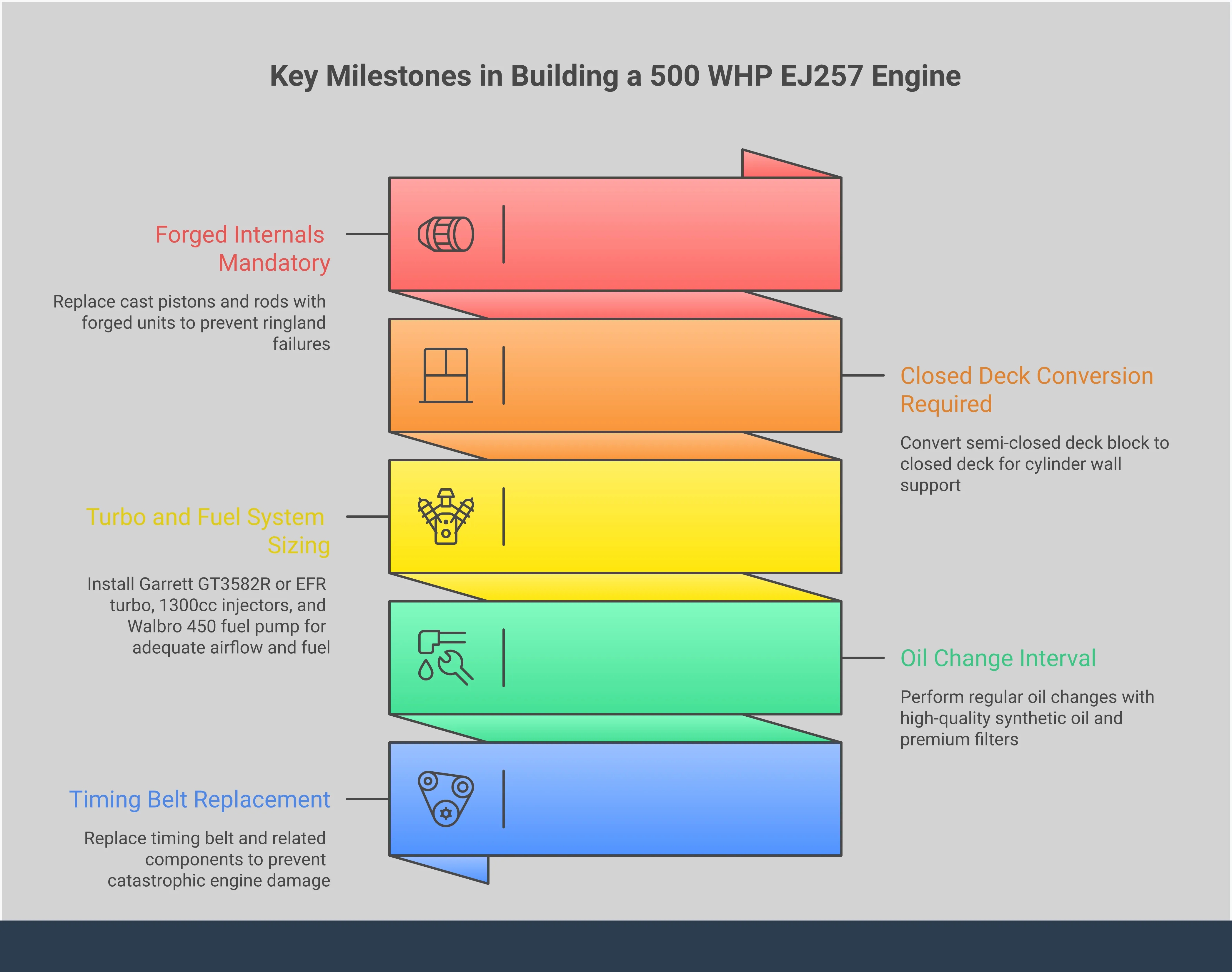
The stock EJ257 features a semi-closed deck block, which is fine for factory power levels. However, when you start pushing past 400 WHP, the cylinder walls can flex under the increased pressure, leading to catastrophic failure. The solution is a closed deck conversion. This process adds material to the top of the block, creating a solid "deck" that fully supports the cylinder walls.
This modification drastically increases the block's rigidity, preventing the cylinders from distorting or cracking under high boost. It’s the single most important step in building a reliable high-power EJ engine. Think of it as reinforcing the foundation of a house before adding a second story. Without a strong base, everything else you build on top is at risk.
Alternative: High-Quality Cylinder Sleeves
For those planning to push well beyond the 500 WHP mark, there's another path to a bulletproof block: installing high-quality cylinder sleeves. This process is more intensive than a closed-deck conversion, but it provides the ultimate in cylinder wall strength. Sleeving involves machining out the original cylinder walls and pressing in new, much stronger liners made from ductile iron. This modification makes the cylinders incredibly robust, preventing any chance of cracking or warping under extreme heat and pressure. It’s a common practice in professional motorsports and is considered the gold standard for builds aiming for maximum power and reliability.
The Importance of Professional Machine Work
Whether you opt for a closed-deck conversion or cylinder sleeves, neither is a DIY project. The success of your engine build hinges on the quality of the machine work. Precision machining is absolutely key for high-performance builds, ensuring the engine block is perfectly aligned for durability and consistent power. This isn't just about making parts fit; it's about creating perfect clearances and surfaces that will withstand thousands of miles of abuse. For high-power engines, precision CNC machining is required to perfectly align the main bearings and cylinder bores, a step that guarantees the rotating assembly spins freely and efficiently.
This level of detail is why you must partner with a shop that specializes in performance Subaru engines. An experienced machinist will ensure the block is perfectly decked, the cylinders are honed to the exact specification for your chosen pistons, and all clearances are double-checked. Cutting corners here is a recipe for premature bearing wear, oil consumption, and catastrophic failure. Investing in expert engine building and machining services ensures that your high-quality parts can perform as they were designed to, giving you a reliable foundation for making serious power.
Choosing the Right Forged Pistons and Rods
Once your block is reinforced, the next step is to upgrade the rotating assembly. The factory cast pistons and connecting rods are known weak points and simply cannot handle the heat and cylinder pressure of a 500 WHP build. Forged pistons and H-beam or I-beam connecting rods are essential replacements.
Forged components are created under immense pressure, resulting in a much denser and stronger grain structure than their cast counterparts. This allows them to withstand higher temperatures and greater force without failing. This upgrade is non-negotiable for reliability, as a failed piston or rod will destroy your entire engine. Investing in quality forged internals gives you the peace of mind that your engine can handle the power you throw at it.
Choosing Piston Alloy: 4032 vs. 2618
When you're selecting forged pistons, you'll notice they're typically made from one of two alloys: 4032 or 2618. The choice between them depends entirely on your car's primary use. For a high-performance street car aiming for 500 WHP, 4032 alloy is often the perfect fit. It has a higher silicon content, which means it expands less as it heats up. This allows for a tighter piston-to-wall clearance, resulting in a quieter engine, especially during cold starts. On the other hand, if your build is destined for the track or you plan on running very high boost levels, 2618 alloy is the tougher option. It's a more malleable material that can withstand detonation better than 4032, making it the safer choice for extreme applications. The trade-off is that it expands more, requiring looser clearances that can cause some piston slap noise when the engine is cold.
Setting Your Compression Ratio for Your Fuel Type
Your choice of fuel directly influences the ideal compression ratio for your build. The factory EJ257 compression ratio is quite low, typically around 8.2:1. For a 500 WHP build running on standard premium pump gas (91 or 93 octane), a slight increase to a ratio between 8.4:1 and 9.0:1 is a safe and effective target. This modest bump improves engine response without significantly increasing the risk of detonation. However, if you plan to run E85 or dedicated race fuels, you can be more aggressive. These high-octane fuels are much more resistant to knock, allowing you to safely run a higher compression ratio, often in the 9.0:1 to 10.0:1 range. This higher compression will yield more power and efficiency, but it locks you into using that specific fuel type. This decision must be made before ordering pistons, as it will dictate the final tune required to keep your engine safe and performing at its peak.
Upgrading Your Head Studs and Bearings
With the block and rotating assembly fortified, you need to ensure everything is held together securely. Upgraded head studs are critical for preventing head lift, where high cylinder pressure forces a small gap between the head and the block, leading to head gasket failure. High-quality studs provide superior clamping force compared to the factory bolts.
Additionally, the main bearings, particularly in the #2 and #4 positions, endure significant stress in the EJ257. Upgrading to performance bearings provides greater durability and oil clearance to handle the increased load. When assembling the engine case halves, using stronger case bolts can also improve rigidity, but this requires precise machining and assembly from experienced builders who offer professional engine tuning services.
Head Stud Recommendations
The factory head bolts are designed to stretch when torqued, which works fine for a stock engine. However, they are a major liability in a high-boost application. To reliably seal the combustion chamber under the extreme pressure of a 500 WHP build, you need to replace them with a set of high-strength head studs. Unlike bolts, studs provide a much more accurate and consistent clamping force, ensuring the cylinder heads stay firmly planted on the block. This prevents "head lift," a common failure where pressure escapes past the head gasket, leading to coolant loss and engine failure. For this level of power, ARP CA625+ head studs are the go-to choice. They are significantly stronger than standard ARP studs and provide the ultimate security for keeping your engine sealed under any circumstance.
Head Gasket Recommendations
Your upgraded head studs are only as good as the head gasket they are clamping down. The head gasket's job is to create a perfect seal between the engine block and the cylinder heads, containing combustion pressure while keeping oil and coolant separate. The immense pressure in a 500 WHP engine will quickly find any weakness in a standard gasket. For this reason, a quality multi-layer steel (MLS) head gasket is essential. These gaskets are designed to withstand the higher temperatures and pressures of a modified engine. When paired with a properly surfaced block and heads, along with the superior clamping force from ARP studs, a quality MLS gasket ensures your engine's combustion chambers remain sealed, protecting your investment in Subaru STI upgrades and keeping your build reliable.
Strengthening Your Oiling System and Valvetrain
Proper lubrication is the lifeblood of your engine, and the stock EJ257 oiling system can be overwhelmed in high-performance applications. Aggressive driving can cause oil to slosh away from the oil pickup, leading to oil starvation and catastrophic engine failure. Installing a high-flow oil pickup and baffle is a critical safety measure to ensure a constant supply of oil.
An Air/Oil Separator (AOS) is another essential upgrade. It captures oil vapor from the crankcase ventilation system before it can enter your intake, which helps prevent detonation and keeps your intake valves clean. Combining these oiling system upgrades with quality performance parts ensures your engine stays properly lubricated and breathes clean air, which is vital for both power and longevity.
What Turbo and Supporting Mods Do You Need for 500 WHP?
With a fortified bottom end ready to handle the stress, it’s time to focus on the components that will actually generate 500 wheel horsepower. Reaching this goal isn’t about a single magic part; it’s about creating a balanced system where each component supports the next. You need to move a massive amount of air into the engine, supply it with enough fuel, and efficiently manage the resulting heat and exhaust gases.
This means upgrading your turbocharger, fuel system, exhaust, and cooling systems in unison. The stock parts in these areas were designed for stock power levels and will quickly become bottlenecks, or worse, points of failure. Getting these supporting modifications right is the key to making big power reliably. A proper setup ensures your engine can breathe freely, stay fueled correctly, and keep its cool when you’re putting it to the test.
Choose the Right Turbo and Wastegate
The stock turbo on an EJ257 is great for daily driving, but it simply can’t move enough air to support 500 WHP. To hit your goal, you’ll need a much larger turbocharger. Popular options like the Garrett GT3582R or a Borg Warner EFR series turbo are designed to provide the airflow and boost pressure required for this power level. A larger turbo allows the engine to ingest significantly more air, which is the foundation of making more power.
Just as important is how you control that boost. A high-quality external wastegate is essential for a high-horsepower build. It offers far more precise boost control than an internal wastegate, preventing dangerous boost spikes that could damage your newly built engine. This combination of a capable turbo and a reliable wastegate gives your tuner the control they need to build power safely.
Turbocharger Brands: Precision vs. Garrett
When you step into the world of high-performance turbos, two names consistently dominate the conversation: Precision and Garrett. Both are excellent choices, but they cater to slightly different philosophies. Garrett is often seen as the benchmark for reliability and cutting-edge engineering, with a long history of providing OEM and motorsport solutions. Their ball-bearing turbos, like the popular GT3582R, are famous for their quick spool and excellent transient response, making them a fantastic all-around choice for a street or track car where you want power on demand.
On the other hand, Precision Turbo has built a reputation for raw, peak power, especially in the drag racing community. They offer a wide range of turbos that can support massive horsepower goals. While both brands deliver exceptional results, the best choice often comes down to your tuner’s preference and the specific characteristics you want from your powerband. Ultimately, the turbo is just one piece of a complete system of performance parts, and the right one will be the one that works in harmony with your engine build and tuning strategy.
Matching Your Fuel Pumps and Injectors to Your Goal
More air requires more fuel. The stock fuel pump and injectors will be maxed out long before you reach 500 WHP, leading to a lean air-fuel mixture that can cause catastrophic engine damage. To prevent this, you need to upgrade the entire fuel delivery system. Start with a high-flow in-tank fuel pump, like a Walbro 450, to ensure a steady supply of fuel from the tank.
Next, you’ll need larger fuel injectors to deliver that fuel to the cylinders. Injectors like the Injector Dynamics 1300x are a common choice, providing enough flow for 500 WHP on either pump gas or E85. If you plan on running ethanol, remember that it requires about 30% more fuel volume than gasoline, so size your injectors accordingly. Proper fueling is non-negotiable for engine safety and is a core part of our engine tuning services.
Fuel System Parts to Avoid
When you're building an engine for this level of power, what you don't use is just as important as what you do. The entire stock fuel system is a major liability in a 500 WHP build and must be replaced. The factory fuel pump is the first bottleneck; it simply can't supply the necessary volume, which will starve your engine and create a lean condition that can melt pistons. Similarly, the stock fuel injectors are inadequate for the job, especially if you plan to run ethanol, which requires significantly more flow. Even the factory fuel lines and fuel pressure regulator (FPR) become weak points, unable to handle the increased flow and pressure. Relying on any of these stock components is a surefire way to jeopardize your entire investment. You must upgrade to a complete system of high-quality aftermarket parts to ensure your engine receives the consistent, high-volume fuel supply it needs to make power safely.
Improving Airflow with an Exhaust and Intercooler
Making power isn’t just about forcing air in; it’s also about letting it out efficiently. A restrictive exhaust will choke your engine and limit the turbo’s effectiveness. A full 3-inch turbo-back exhaust system is the standard for this power level. This setup replaces everything from the turbo to the muffler, minimizing backpressure and allowing the engine to exhale freely. This helps the turbo spool faster and hold boost more effectively through the RPM range.
You also need to cool the compressed air from the turbo. The stock top-mount intercooler will quickly become overwhelmed, leading to high intake temperatures and a loss of power. A front-mount intercooler (FMIC) is the solution. Its larger core and placement in the front of the car provide far superior cooling, delivering a denser, more oxygen-rich air charge to the engine for more consistent power.
Header and Exhaust System Recommendations
Think of your engine as an athlete: it can’t perform at its peak if it can’t exhale properly. The stock exhaust system is designed for quiet daily driving, not for handling the massive volume of exhaust gas a 500 WHP engine produces. This creates significant backpressure, forcing the turbo to work harder to push exhaust out, which slows down its spool time and chokes your power potential. For a high-performance build, a free-flowing exhaust isn't just for sound; it's a fundamental requirement for efficiency and power. Upgrading to high-quality performance parts that reduce this restriction is essential to letting your engine breathe.
The industry standard for this power level is a full 3-inch turbo-back exhaust system. This includes a high-flow downpipe, which is the most critical component for reducing backpressure right after the turbo. You should also consider upgrading to equal-length headers. While unequal-length headers create the iconic "Subaru rumble," equal-length headers provide more efficient exhaust flow, resulting in faster turbo spool and more top-end power—a worthy trade-off for a serious performance build. Combining these components ensures your engine can expel gases as quickly as possible, which is a key part of our recommended Subaru STI upgrades for reaching your power goals reliably.
Why an AOS and Upgraded Radiator Are Essential
A 500 WHP engine generates a lot of heat and crankcase pressure, both of which need to be managed. An Air-Oil Separator (AOS) is one of the most important performance parts you can install. It captures oil vapor from the crankcase and returns it to the oil pan, preventing it from entering your intake. This keeps your air-fuel mixture clean and reduces the risk of detonation.
To handle the extra heat, an upgraded aluminum radiator is a wise investment. It offers improved cooling capacity over the stock unit, keeping engine temperatures stable during hard driving. Finally, to protect your engine from oil starvation during high-G cornering or acceleration, an upgraded oil pickup and baffle are critical. These components ensure the oil pump always has a steady supply of oil, safeguarding your bearings and other vital internals.
How Does Fuel Choice Affect Your 500 WHP Goal?
Choosing the right fuel is one of the most critical decisions you'll make when building a 500 WHP EJ257. It directly impacts your engine's power potential, safety, and long-term reliability. While it’s easy to focus on hard parts like turbos and pistons, the fuel running through your engine is what allows those components to work in harmony to produce serious power. Think of it as the foundation of your tune. The right choice makes power safely, while the wrong one can put your entire investment at risk. Making an informed decision here will set the stage for a successful and durable build.
Pump Gas vs. E85: Which Makes More Power?
If 500 WHP is your target, you’ll find it difficult and risky to achieve on standard pump gas. With 91 or 93 octane, your tuner will be forced to keep ignition timing low to prevent engine knock, which severely limits power. Even with a perfectly optimized setup, you’ll likely top out around 435 WHP. To safely cross the 500 WHP threshold, you need a fuel that offers a bigger safety margin. This is where E85 comes in. Its high ethanol content allows for much more aggressive tuning, enabling power outputs that can approach 600 WHP with the right supporting performance parts and a professional tune.
How Ethanol Helps Prevent Engine Knock
The main reason E85 makes more power is its ability to resist detonation, also known as engine knock. As one enthusiast guide puts it, "E85 will help prevent knock/detonation which is why you want it." Knock is the enemy of any high-performance engine, especially a turbocharged one like the EJ257. It occurs when the air-fuel mixture ignites prematurely, creating a destructive shockwave inside the cylinder that can damage pistons and bearings. E85’s high octane rating and cooling properties create a much more stable combustion environment, giving your tuner the freedom to increase boost and advance ignition timing without putting the engine in danger. This is key to making big power reliably.
What You Need to Run E85 Safely
Switching to E85 isn't as simple as just filling up the tank. Ethanol is more corrosive than gasoline and requires about 30% more fuel volume to produce the same energy. This means your entire fuel system needs an upgrade. You'll need larger fuel injectors, a higher-flowing fuel pump, and ethanol-compatible fuel lines, often called a "PTFE suitable system," to prevent them from breaking down over time. Forgetting this step can lead to fuel starvation and catastrophic engine failure. If you plan to daily drive your car on E85, it’s also a good idea to run a tank of pump gas every so often to help clean out any potential buildup in the system.
Practical Tips for Running E85 Daily
Daily driving on E85 is completely manageable, but it does require more planning than using standard gasoline. You’ll need to know where to find E85 stations, and it’s crucial to understand that the ethanol content can vary significantly from pump to pump. This is why investing in a full flex-fuel setup is the smartest move for any daily-driven car. A flex-fuel system uses a sensor to read the exact ethanol percentage in your tank and allows the ECU to adjust the tune automatically, providing a massive safety net for your engine. To keep your fuel system healthy, it's also a good practice to run a tank of premium pump gas every few fill-ups to help clean out potential deposits. Finally, be prepared for slightly longer crank times on cold mornings—it's a normal quirk of ethanol, but something our professional engine tuning services can help mitigate.
How Do You Tune a 500 WHP EJ257 for Reliability?
You’ve assembled a robust bottom end and installed all the right supporting mods. Now comes the most critical step in ensuring your 500 WHP EJ257 survives on the street or track: the tune. A great tune is more than just a dyno number; it’s the precise calibration that harmonizes every upgraded component, ensuring they work together efficiently and safely. This is where you translate mechanical potential into reliable power. An improper tune can undo all your hard work in an instant, while a professional tune will protect your investment and deliver the consistent performance you’re looking for. Think of it as the brain of your entire operation, making intelligent decisions every time you press the throttle.
Find a Professional Tuner
The single most important step in this process is to find a reputable and experienced Subaru tuner. This isn't the time for a DIY approach or trusting a general performance shop. You need an expert who lives and breathes the EJ platform. When you connect with a professional, be clear about your power goals and how you plan to use the car. A skilled tuner will create a custom map tailored to your specific build, maximizing power while maintaining safe operating parameters. Investing in professional engine tuning services is the best insurance policy you can buy for your high-performance engine, minimizing the risk of catastrophic failure from a bad calibration.
Community-Recommended Tuners
When it comes to finding a tuner you can trust, the Subaru community is your best resource. Certain names come up again and again for their deep expertise with the EJ platform. Shops like P&L Motorsports, Prime Motoring, and IAG Performance have built strong reputations for delivering safe, reliable power. These specialists understand the unique quirks of the boxer engine and know how to get the most out of your specific combination of performance parts. Of course, we also offer our own expert engine tuning services, drawing on decades of experience building and racing Subarus. The key is to do your research, check reviews, and talk to other owners before making a final decision on who will calibrate your build.
Getting Your Air-Fuel Ratio and Boost Levels Right
The core of any good tune is the precise management of fuel, air, and spark. Your tuner will carefully dial in the air-fuel ratio (AFR) and boost levels to match your engine's capabilities. This is especially important when using different fuels. For example, E85 allows for more aggressive ignition timing, which is key to extracting maximum power from a four-cylinder engine like the EJ257. Pump gas, on the other hand, has a lower knock resistance, requiring a more conservative tune. Getting these values perfect ensures your engine produces power efficiently without creating dangerous conditions like detonation that can destroy pistons.
Understanding Dyno Results: Dynojet vs. Mustang
After your tune, you'll get a dyno sheet showing your final horsepower and torque numbers. But not all dynos are created equal, and the numbers can vary significantly depending on the machine used. The two most common types are Dynojet and Mustang dynos. A Dynojet is an inertia dyno; it measures power by calculating how quickly your car can accelerate a heavy, free-spinning roller. In contrast, a Mustang dyno is a load-bearing dyno. It applies a programmable amount of resistance to the rollers to simulate real-world conditions like wind resistance and road incline, making your engine work harder to get a reading.
Because of this fundamental difference, a Mustang dyno will almost always show lower power figures than a Dynojet, sometimes by as much as 10-15%. This is why they're often called "heartbreakers." It's crucial to know which type of dyno was used when you compare your results with others online. A good rule of thumb is that a Mustang dyno reading multiplied by about 1.12 can give you a rough estimate of what it might read on a Dynojet. Ultimately, the specific number is less important than the gains you see on the same dyno before and after tuning. It's a tool for measuring change, not just a number for bragging rights.
Using Data Logging to Protect Your Engine
A tune isn't a "set it and forget it" affair. Data logging is an essential practice for monitoring your engine's health and ensuring the tune remains optimal under real-world driving conditions. Forget chasing a specific number on one particular dyno; what matters is how your car performs on the road. By logging data like AFRs, knock events, and boost pressure, you and your tuner can make informed adjustments and catch potential issues before they become major problems. This continuous feedback loop is vital for maintaining the long-term reliability of a high-output build and ensuring your Subaru STI upgrades are performing as they should.
Considering an Aftermarket ECU for High-Power Builds
While the stock Subaru ECU is surprisingly capable, a 500 WHP build pushes it to its absolute limits. For this level of performance, a standalone aftermarket ECU is a smart investment. It gives your tuner far greater control over every engine parameter, allowing for the precise calibration needed to harmonize all your upgraded components. An aftermarket ECU provides more detailed data logging and safety features that can protect your engine if something goes wrong, like a fuel pressure drop. This level of control is the foundation of professional engine tuning services, allowing a tuner to create a map that is not only powerful but also safe and reliable. Think of it as giving your expert tuner the best possible tools to perform the delicate surgery required for a high-output engine, ensuring every drop of fuel and spark of ignition is perfectly timed to prevent dangerous conditions like detonation.
Don't Forget Your Drivetrain
All the horsepower in the world is useless if your drivetrain can't handle it. Fortunately, the stock STI 6-speed transmission is famously robust and can reliably manage power levels up to 1000 WHP, making it more than capable for your 500 WHP goal. However, you still need to support it. Upgrading to a performance clutch is a must to prevent slippage under heavy loads. Using high-quality gear oil and differential fluids is also crucial for reducing wear and managing the increased stress on your transmission and differentials. A reliable build considers the entire system, from the engine to the wheels.
The Strength of the Stock STI 6-Speed Transmission
One of the best pieces of news for anyone building a high-horsepower Subaru is the incredible strength of the factory 6-speed transmission found in the STI. This gearbox is legendary for a reason. It’s famously overbuilt from the factory and can reliably handle power levels up to 1000 WHP, making it more than capable of managing your 500 WHP goal without breaking a sweat. This saves you a significant expense, as you won't need to invest in costly gear sets or a full transmission swap. However, the stock clutch is a different story. It was never designed to hold the torque of a 500 WHP engine and will start slipping immediately. A performance clutch and flywheel are mandatory Subaru STI upgrades to ensure all that newfound power actually makes it to the wheels.
Essential Suspension and Bushing Upgrades
Making 500 WHP is one thing; being able to use it is another. A reliable build considers the entire system, and that includes how the car puts power to the ground. The stock suspension and soft rubber bushings are designed for comfort at factory power levels, and they will be completely overwhelmed by the forces your new engine produces. Under hard acceleration, you’ll experience excessive body roll, wheel hop, and a general feeling of instability. To fix this, you need to replace the factory bushings with stiffer polyurethane units and upgrade your suspension. A quality set of coilovers will give you the control needed to keep the car planted, ensuring the power is used for acceleration, not just spinning tires. These performance parts transform the car from a powerful but unruly machine into a sharp, responsive, and predictable driver's car.
Keeping Your 500 WHP EJ257 Healthy
Building a 500 WHP EJ257 is a serious accomplishment, but the work doesn't stop once the engine is assembled. To protect your investment and ensure your Subaru runs reliably for years to come, you need a maintenance plan that matches its new power level. A high-output engine puts greater stress on every component, from the oiling system to the timing belt, operating with much tighter tolerances and generating significantly more heat than a stock motor. Sticking to a factory maintenance schedule designed for a 250-horsepower daily driver simply won't cut it anymore.
Adopting a proactive approach to care is the key to enjoying all that power without the constant worry of a catastrophic failure. This means shifting your mindset from reactive repairs to preventative maintenance. You'll need to be more in tune with your vehicle, listening for new sounds and checking fluids more often. This section outlines the new rules for keeping your high-power EJ257 healthy, covering more frequent fluid changes, regular inspections, and planning for major service intervals long before they become problems. Think of it as the owner's manual for your newly built engine.
The Critical Engine Break-In Period
The first few hundred miles on your new engine are the most important of its life. The break-in period is when all the new components—the piston rings, bearings, and cylinder walls—settle in and create perfect mating surfaces. Rushing this process is the fastest way to ruin your investment. During this time, it's essential to vary your engine speed, avoid high-RPM pulls, and stay out of boost. You should also monitor your oil pressure and temperature gauges like a hawk and listen for any unusual sounds. After the first 500 miles, perform an oil change to remove any metal particles from the initial wear. This careful process ensures all components wear in evenly, which is fundamental for long-term reliability and sets the stage for a final, aggressive tune. Once the break-in is complete, you can work with a professional on the final engine tuning services to safely unlock the engine's full potential.
What's Your New Oil Change Schedule?
Your factory-recommended oil change interval is a thing of the past. For an EJ257 making 400-500 WHP, you should plan on changing your oil every 3,000 to 3,500 miles. If you frequently take your car to the track or drive it aggressively, you’ll want to shorten that interval even further. High-performance engines generate more heat and contaminants, which break down oil faster. Using high-quality synthetic oil and a premium filter is non-negotiable. Fresh oil is the lifeblood of your engine, providing critical lubrication that protects your forged internals and bearings from premature wear. Don't skip this simple but vital step.
Your Regular Inspection Checklist
Regular inspections are your first line of defense against major issues. If you're installing a new short block because your old engine failed, this step is especially critical. Tiny metal fragments from the previous failure can hide in your oil system, like the cylinder heads or oil cooler. You must have these components professionally cleaned before installation, or those metal bits will quickly destroy your new engine. Create a weekly or bi-weekly checklist: look for any fluid leaks, listen for strange noises, and check your oil and coolant levels. Catching a small problem early can save you from needing to replace major performance parts down the road.
Planning Ahead for Long-Term Maintenance
A reliable build requires thinking ahead. Two major items to keep on your radar are the timing belt and carbon buildup. The timing belt on an EJ257 should be replaced around every 100,000 miles, along with its related components. If this belt fails, it can cause severe, and often terminal, engine damage. It’s a service you can’t afford to postpone. Additionally, direct injection systems are prone to carbon buildup on the intake valves, which can hurt performance. Scheduling professional engine tuning services periodically will keep your engine breathing efficiently and address these issues. Planning for these big jobs helps you budget for them and ensures your engine remains in peak condition.
Budgeting and Sourcing Parts for Your Build
Embarking on a 500 WHP build is a serious commitment, not just of your time, but also of your financial resources. It’s essential to go into it with a clear budget and a smart strategy for sourcing your components. The total cost can vary widely based on the parts you choose, how much labor you do yourself, and where you source everything. The key to a successful project is to prioritize quality over cutting corners. Investing in reputable, high-quality performance parts from the start will save you from the costly and frustrating experience of a premature engine failure. Think of your budget as a roadmap for your build, guiding your decisions and helping you allocate funds where they matter most.
Creating a detailed list of every component you'll need is the best first step. From the short block and turbo to the fuel injectors and head studs, account for everything. Research prices from trusted vendors and factor in costs for machine work, professional assembly, and a custom tune. This comprehensive approach helps you see the full financial picture and avoid unexpected expenses. Remember, the goal is to build an engine that is not only powerful but also reliable. A well-planned budget is the foundation that makes that possible, ensuring you can afford the right parts to do the job correctly the first time.
Estimating Your Short Block Cost
The heart of your build is the short block, and it will represent a significant portion of your budget. If you're starting with a brand-new factory block, you can expect the cost to be somewhere between $2,500 and $3,100 for just the OEM unit. However, this is only the beginning. To handle 500 WHP, that block will still need a closed-deck conversion, forged pistons, and stronger connecting rods. When you factor in the cost of these individual parts and the specialized machine work required, the total can climb quickly. This is why many builders opt for a professionally built short block from a reputable Subaru specialist, which bundles all the necessary upgrades into a single, reliable package.
Checking Casting Codes on New Blocks
When sourcing a new OEM block, it's crucial to verify you're getting the correct part. The most current and widely used block for these builds is the Subaru OEM EJ257 Short Block, part number #10103AC870. Checking this part number and the casting codes on the block itself ensures you have the latest revision from Subaru, which often includes subtle improvements over older versions. This small step can save you from compatibility headaches and ensures your build is starting with the best possible foundation. Always confirm with your supplier that you are purchasing the exact part number specified for your project.
When to Buy Parts for the Best Deals
Timing your purchases can make a big difference in your overall budget. Many performance part manufacturers and shops, including ours, run sales during major holidays like Black Friday or throughout the year. Subscribing to newsletters from your favorite brands is a great way to stay informed about upcoming promotions. Another smart strategy is to look for package deals or kits. For instance, an EJ257 short block kit might bundle the block with all the necessary gaskets and seals at a discounted price compared to buying each piece separately. Planning your build timeline around these sales events can help you secure premium parts while saving a significant amount of money.
Practical Weight Reduction Tips
While most of your budget will go toward making power, don't overlook the benefits of reducing weight. A lighter car is a faster car, as the engine has less mass to move. This improves acceleration, braking, and handling, making your 500 WHP feel even more potent. Some weight reduction methods are free, like removing unnecessary items from your trunk or back seat. For more dedicated builds, you can invest in lightweight components. Swapping the stock battery for a smaller, lighter one or upgrading to lightweight wheels can shed significant pounds. Every bit of weight you remove enhances your car's power-to-weight ratio, making your entire performance package more efficient and responsive.
Related Articles
Frequently Asked Questions
What is a realistic budget for a reliable 500 WHP build? Building a truly reliable 500 WHP engine is a significant investment, and the final cost can vary quite a bit based on the parts you choose and labor rates. However, you should plan for a budget that covers a closed-deck block, forged internals, a quality turbo kit, a full fuel system upgrade, and professional assembly and tuning. Trying to cut corners on the engine's foundation or the tune itself is the fastest way to a second, more expensive rebuild. It's better to invest in quality components and expert services from the start to ensure your engine is built to last.
Can I build my engine in stages, or does it all need to be done at once? While you can add supporting modifications like an Air/Oil Separator or a cat-back exhaust over time, the core jump to 500 WHP really needs to be treated as a single, comprehensive project. The engine internals, turbo, and fuel system are all designed to work together as a balanced package. You can't safely run a large turbo on a stock block, nor can you run high boost without the fuel to support it. For this power level, it's best to plan the build as one cohesive phase to ensure all the components are matched and tuned correctly from the beginning.
How will a 500 WHP build affect my car's daily drivability? A 500 WHP Subaru will feel very different from a stock one, but it can still be perfectly streetable with the right tune. You can expect a heavier clutch pedal, more mechanical noise, and a different power delivery. A larger turbo may have more lag, meaning power will come on more aggressively at higher RPMs instead of the instant response you feel from the smaller stock turbo. A professional tune is key to smoothing out these characteristics for city driving, but it's important to remember you are building a high-performance machine, and some compromises in comfort come with the territory.
With newer Subaru engines out, is the EJ257 still a good choice for a high-power build? Absolutely. While newer platforms are impressive, the EJ257 remains one of the best and most understood engines for high-horsepower builds. It has decades of development behind it from both Subaru and the aftermarket community. This means there is a massive selection of proven performance parts available and a deep knowledge base among tuners who know exactly how to extract reliable power from it. Building on a platform this well-documented gives you a clear and tested path to achieving your goals.
What's the most common mistake people make when aiming for 500 WHP? The single biggest mistake is focusing on the power-adding parts while neglecting the engine's foundation. Many builders get excited about a big turbo and forget that the stock pistons, rods, and engine block were never designed to handle that level of stress. A reliable build starts from the bottom up with a reinforced block and forged internals. Skipping these steps to save money almost always leads to catastrophic engine failure. Your engine's strength is the foundation for all the power you build on top of it.