

Separador de aceite y aire para WRX: qué es y por qué lo necesitas
Tu WRX tiene una característica inherente que le resta potencia: el paso de gases del motor . Durante cada ciclo de combustión, la presión impulsa una mezcla de vapor de aceite y combustible a través de los anillos del pistón. El sistema de fábrica dirige esta neblina aceitosa directamente a la admisión. Esto recubre todo, desde el intercooler hasta las válvulas, lo que reduce el octanaje del combustible y perjudica el rendimiento. Un separador de aire y aceite para el WRX es la solución definitiva. Es una mejora crucial que intercepta esta contaminación, protegiendo tu motor y conservando la potencia que pagaste.
Conclusiones clave
- Un AOS es un seguro de motor, no una modificación de potencia : Su función es proteger el rendimiento actual del motor al evitar la contaminación del aceite en el sistema de admisión. Esto previene la acumulación de carbonilla y reduce el riesgo de detonación del motor, preservando su salud a largo plazo.
- Esencial para los modificados, proactivo para los de fábrica : Un WRX modificado requiere un sistema de escape automático (AOS) para gestionar de forma segura el aumento de presión del motor y evitar detonaciones. En un motor de fábrica, es una medida proactiva que mantiene limpia la admisión y preserva el rendimiento de fábrica durante años.
- Elija un sistema de funcionamiento autónomo : Un sistema de funcionamiento autónomo (AOS) de calidad es un sistema de circuito cerrado que drena automáticamente el aceite acumulado de vuelta al motor, a diferencia de un depósito colector que requiere vaciado manual. Busque características clave como calefacción integrada y deflectores internos eficaces para garantizar una protección fiable del motor.
¿Qué hace un separador de aceite y aire en su WRX?
Un Separador de Aire y Aceite (AOS) es un componente crucial diseñado para proteger el motor de su Subaru al controlar el paso de aceite. Durante el funcionamiento normal, especialmente en motores turboalimentados como el WRX, la alta presión en las cámaras de combustión impulsa los gases a través de los anillos del pistón hacia el cárter. Este gas, conocido como "paso de aceite", se mezcla con vapor de aceite. El sistema de Ventilación Positiva del Cárter (PCV) de su vehículo está diseñado para liberar esta presión, pero en el proceso, transporta esa niebla aceitosa directamente al sistema de admisión del motor.
Aquí es donde entra en juego un AOS. Actúa como un sistema de filtración, interceptando el aire aceitoso del cárter antes de que contamine la admisión. El dispositivo separa el aceite líquido del aire, drena el aceite limpio al cárter del motor y dirige el aire, ahora más limpio, de vuelta a la admisión para su combustión. Al instalarlo, se añade una capa de protección que mantiene el motor funcionando de forma limpia y eficiente, lo que lo convierte en uno de los componentes de rendimiento más eficaces para la salud del motor a largo plazo.
Cómo un AOS limpia el escape del motor
Un AOS separa el vapor de aceite de los gases del cárter mediante una combinación de deflectores y condensación. A medida que el aire caliente y aceitoso entra en el depósito del AOS, se expande, se enfría y fluye a través de una serie de cámaras o un sistema centrífugo. Este proceso hace que las gotas de aceite suspendidas se condensen y se desprendan del aire, acumulándose en la parte inferior de la unidad.
Desde allí, el aceite recolectado se drena de nuevo al cárter, listo para usarse. Esta es una diferencia clave con un depósito colector, que simplemente recoge el aceite y requiere vaciado manual. Al filtrar y devolver el aceite continuamente, un AOS garantiza que el motor no pierda aceite a través del sistema de ventilación, a la vez que evita que los vapores nocivos reduzcan el octanaje del combustible y obstruyan las válvulas de admisión.
Cómo funcionan juntos un AOS y su sistema PCV
Un separador de aire y aceite no reemplaza el sistema PCV de fábrica de su WRX, sino que lo mejora. El sistema PCV es esencial para aliviar la presión del cárter, lo cual es vital para prevenir fugas de aceite y otros problemas. El separador de aire y aceite se instala en línea con las mangueras PCV, convirtiéndose en un filtro sofisticado para el sistema.
Permite que el sistema PCV realice su función principal de ventilación de presión sin el inconveniente de la circulación de aceite por la admisión del motor. Al limpiar el aire que recircula el sistema PCV, un AOS garantiza que solo aire, y no una neblina que diluye el aceite y el combustible, llegue a la cámara de combustión. Esto lo convierte en una de las mejoras más valiosas del Subaru WRX para mantener el rendimiento, especialmente en modelos de inyección directa propensos a la acumulación de carbonilla en las válvulas de admisión.
Por qué su WRX necesita un separador de aire y aceite
Instalar un Separador de Aire y Aceite (AOS) es una de las mejoras más inteligentes que puedes hacer en tu Subaru WRX. No se trata solo de añadir una pieza más bajo el capó; se trata de proteger activamente tu motor y asegurar su óptimo funcionamiento. Un AOS aborda los desafíos inherentes del sistema PCV (Ventilación Positiva del Cárter) del motor bóxer, que puede permitir que el vapor de aceite entre en la admisión. Al separar ese aceite y devolverlo al cárter, un AOS ofrece beneficios tangibles que apreciarás tanto en tus desplazamientos diarios como en un día de pista. Desde prevenir la acumulación de carbonilla que reduce la potencia hasta proteger los componentes internos del motor, las ventajas son evidentes. Analicemos exactamente cómo este componente esencial contribuye a un motor más saludable y potente.
Mantenga limpias las válvulas de admisión
Uno de los mayores enemigos de un motor de inyección directa es la acumulación de carbonilla. Cuando el vapor de aceite del cárter llega al colector de admisión, se adhiere a las válvulas de admisión, creando depósitos de carbonilla duros. Con el tiempo, esta acumulación restringe el flujo de aire, perjudica el rendimiento y puede causar un ralentí irregular. Un AOS intercepta este vapor cargado de aceite antes de que llegue a la admisión, garantizando que solo pase aire limpio. Esto mantiene limpias las válvulas y el sistema de admisión, ayudando a que el motor respire libremente y mantenga su rendimiento a largo plazo. Considérelo una línea de defensa crucial para el sistema respiratorio de su motor, especialmente importante para mantener el funcionamiento eficiente de sus componentes de alto rendimiento.
Restaurar la potencia y el MPG perdidos
Un motor limpio es un motor eficiente. Cuando el vapor de aceite recubre el interior del intercooler, actúa como aislante, reduciendo su capacidad para enfriar el aire cargado. El aire más caliente es menos denso, lo que implica menos oxígeno para la combustión y, en consecuencia, menos potencia. Al mantener el aceite fuera del intercooler y del conducto de admisión, un AOS ayuda a mantener temperaturas de admisión más bajas y una entrega de potencia constante. Un proceso de combustión más eficiente también puede resultar en un mejor ahorro de combustible, ya que el motor no trabaja tanto para generar potencia. Es una actualización sencilla que complementa todas las demás mejoras del Subaru WRX , garantizando un funcionamiento óptimo del motor.
Evite la pérdida de potencia, no solo gane potencia
Mucha gente piensa que un AOS es una modificación de potencia, pero su verdadero valor reside en prevenir la pérdida de potencia. Considérelo un seguro para el motor, no un potenciador. Sin un AOS, el vapor de aceite entra en la admisión y se mezcla con el combustible entrante, reduciendo su octanaje. Esto es crucial, ya que el combustible de menor octanaje es más propenso a la detonación prematura, o golpeteo del motor, lo que puede causar daños catastróficos, especialmente en un motor turboalimentado. Al instalar un AOS, garantiza que su motor reciba una mezcla de combustible y aire limpia y de alto octanaje, lo que le permite funcionar de forma segura y eficiente. Es uno de los componentes de rendimiento más cruciales que puede instalar para la salud a largo plazo del motor, creando una base sólida para cualquier otra modificación que planee realizar.
Proteja su motor a largo plazo
Un AOS es una inversión proactiva en el futuro de su motor. Al evitar que el aceite contamine la mezcla aire-combustible, reduce el riesgo de problemas que pueden acortar la vida útil del motor. El aceite en la cámara de combustión puede provocar detonación y un mayor desgaste en componentes críticos como pistones y anillos. Al garantizar una combustión más limpia, un AOS ayuda a mantener la integridad interna del motor. Para cualquier propietario de un WRX, especialmente para aquellos con un motor bóxer modificado o modificado, esta es una de las medidas preventivas más efectivas. Es fundamental para un enfoque integral de la salud del motor, al igual que nuestros servicios expertos de ajuste de motores.
Cómo prevenir los lodos ocultos en el motor
Piense en el lodo del motor como si fuera colesterol para su WRX. Es una sustancia espesa, similar al alquitrán, que se acumula cuando el aceite se descompone y se mezcla con contaminantes del escape de gases. Esta suciedad obstruye conductos de aceite vitales, privando de lubricación a componentes críticos y provocando un desgaste prematuro. Un separador de aire y aceite es la contramedida directa, ya que intercepta ese vapor aceitoso antes de que se degrade y se convierta en lodo. Al filtrar continuamente los gases del cárter y devolver aceite limpio al cárter, un separador de aire y aceite garantiza que su motor se lubrique con aceite puro, no con una mezcla contaminada. Esta es una forma fundamental de proteger su inversión en piezas de alto rendimiento y mantener la integridad del motor.
Prevenir el golpeteo y la detonación del motor
El golpeteo, o detonación, es la peor pesadilla de un motor de alto rendimiento. Ocurre cuando la mezcla aire-combustible se enciende prematuramente, creando una onda expansiva destructiva dentro de la cámara de combustión. El vapor de aceite contribuye significativamente a este problema, ya que reduce el octanaje del combustible, haciéndolo más propenso a explosiones incontroladas. Un sistema de encendido automático (AOS) desempeña un papel vital en la prevención del golpeteo, al mantener el aceite completamente fuera de la cámara de combustión. Esto mantiene el octanaje previsto del combustible y garantiza una combustión estable y controlada. Proteger el motor de la detonación es fundamental para prevenir fallas catastróficas, especialmente con alta presión de sobrealimentación y carga pesada.
¿Vale la pena un AOS para un WRX de serie o uno modificado?
Esta es una de las preguntas más frecuentes de los propietarios de Subaru, y la respuesta no siempre es un sí o un no. El valor de un Separador de Aire y Aceite (AOS) depende realmente de su vehículo específico y de cómo planea usarlo. Ya sea que mantenga su WRX con las especificaciones de fábrica o que construya uno listo para la pista, un AOS juega un papel fundamental en la protección de su motor.
Considérelo menos como una pieza que aumenta el rendimiento y más como una pieza crucial del seguro de vida del motor. Para algunos, es una medida preventiva inteligente que mantiene el motor funcionando sin problemas a largo plazo. Para otros, es una necesidad absoluta para proteger inversiones significativas en modificaciones que aumenten la potencia. El debate a menudo se reduce a la necesidad frente a la prevención. Todos los motores WRX, debido a su diseño bóxer, son susceptibles a la fuga de aceite, que envía una nube de vapor de aceite a través del sistema de admisión. El sistema PCV de serie intenta controlar esto, pero no es una solución perfecta. Un sistema AOS proporciona una protección mucho más robusta. Analicemos los beneficios tanto de la configuración de serie como de la modificada para que pueda decidir si es la opción adecuada para su auto.
El caso de un AOS en un WRX de serie
Incluso recién salido de fábrica, el motor bóxer de tu WRX produce gases de combustión (gases que se escapan de los anillos del pistón). El sistema PCV de fábrica los devuelve a la admisión, lo que puede provocar la acumulación de carbonilla en las válvulas y reducir el octanaje efectivo del combustible con el tiempo. Para un conductor diario, ¿es imprescindible un AOS? No necesariamente, pero es una inversión muy inteligente para la salud del motor a largo plazo.
Instalar un AOS en un WRX de serie es una medida preventiva. Mantiene el conducto de admisión, el turbo y el intercooler limpios de contaminación de aceite, garantizando que el motor mantenga su rendimiento original durante años. Si bien no notará un aumento de potencia, preservará la eficiencia del motor y evitará problemas futuros. Considérelo una parte fundamental de cualquier lista confiable de mejoras para el Subaru WRX .
Por qué un WRX modificado necesita un AOS
Si has modificado tu WRX o planeas hacerlo, la conversación cambia. Un AOS pasa de ser un "lujo" a ser "imprescindible". Al aumentar la sobrealimentación, ajustar la ECU o añadir otras piezas de rendimiento, también se incrementa la presión de los cilindros y, en consecuencia, la cantidad de gases de escape. El sistema PCV de fábrica se satura rápidamente, permitiendo la entrada de cantidades significativas de vapor de aceite en la admisión.
Esta contaminación del aceite es un problema grave para un motor optimizado. Reduce el octanaje efectivo de la mezcla aire-combustible, lo que aumenta drásticamente el riesgo de detonación o golpeteo, un evento catastrófico para cualquier motor, especialmente uno de alto rendimiento. Un AOS es una protección crucial para su inversión, ya que garantiza que solo aire limpio entre en la cámara de combustión. Es una de las modificaciones de apoyo más efectivas que puede realizar para garantizar que su motor funcione de forma segura y fiable con su nueva potencia.
Separador de aceite de aire vs. Catch Can: ¿cuál es mejor?
Al buscar maneras de proteger el motor de su Subaru, rápidamente se encontrará con un debate común: ¿Separador de Aire y Aceite (AOS) o un colector de aceite? Ambos están diseñados para controlar el escape de gases del motor: la mezcla de aceite, combustible y vapor de agua que se filtra por los anillos del pistón hacia el cárter. Este vapor se recircula de vuelta a la admisión a través del sistema de Ventilación Positiva del Cárter (PCV) para ser reutilizado, pero arrastra aceite. Este aceite recubre el colector de admisión, las válvulas y el intercooler, lo que reduce el octanaje del combustible y puede provocar detonaciones, un problema importante para cualquier motor de alto rendimiento.
Tanto un AOS como un colector pueden solucionar este problema interceptando el escape antes de que llegue a la admisión. Separan el aceite del aire, asegurando que solo recircule aire limpio. Si bien comparten el mismo objetivo, funcionan de maneras fundamentalmente diferentes, y elegir el adecuado depende del mantenimiento que esté dispuesto a realizar. Para la mayoría de los propietarios de Subaru que buscan una protección fiable y duradera para las mejoras de su WRX , una opción destaca claramente como la solución más integrada y sencilla. Analicemos cómo funciona cada una para que pueda elegir la mejor opción para su coche.
Cómo funcionan: Separación vs. Recolección
Un separador de aire y aceite es un sistema que se instala y se olvida. Se conecta directamente a las líneas de ventilación del cárter y la PCV del motor, creando un circuito cerrado. A medida que el vapor de aceite pasa por el separador de aire, los deflectores internos separan el aceite del aire. El aire limpio se devuelve a la admisión, mientras que el aceite recolectado se drena automáticamente al cárter de aceite del motor. Nunca tendrá que vaciar nada.
En cambio, un depósito colector es un dispositivo más sencillo que requiere intervención manual. También separa el aceite del aire, pero lo recoge en un pequeño depósito. Este depósito tiene una capacidad limitada y debe vaciarse con regularidad. Si se olvida, se llenará demasiado y la suciedad acumulada se dirigirá directamente a la admisión, lo que anularía su función.
Rendimiento y mantenimiento: un análisis comparativo
Desde el punto de vista del rendimiento, ambos sistemas protegen la salud del motor. Al evitar que el aceite entre en la admisión, previenen la acumulación de carbonilla, reducen el riesgo de detonación y ayudan al intercooler a funcionar eficientemente. Esto es especialmente crucial si ha invertido en servicios profesionales de ajuste del motor. La verdadera diferencia no radica en las ventajas de rendimiento, sino en la fiabilidad de su prestación.
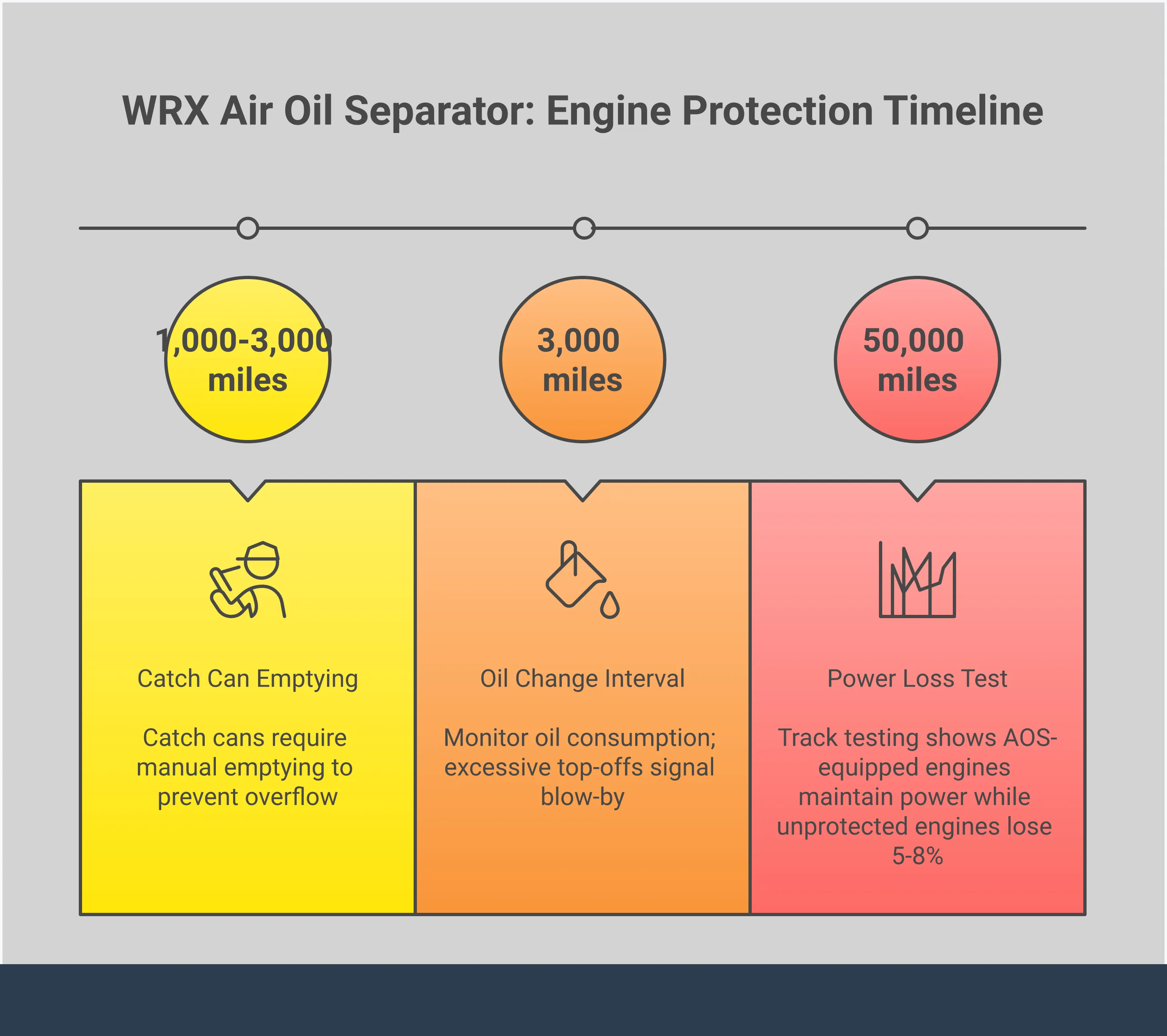
Aquí es donde el mantenimiento se convierte en un factor decisivo. El AOS proporciona protección constante y sin preocupaciones. Una vez instalado, no requiere más atención. Un depósito de retención añade una tarea recurrente a su lista de tareas pendientes. Para un vehículo de uso diario o un coche de carreras donde la fiabilidad es clave, el AOS es la mejor opción. Elimina el riesgo de error humano y garantiza que su motor esté siempre protegido.
Cómo elegir el mejor separador de aceite y aire para el WRX
Una vez que haya decidido que un separador de aire y aceite es la mejor opción para su WRX, el siguiente paso es elegir el adecuado. No todos los sistemas AOS son iguales, y las diferencias de diseño y materiales pueden afectar considerablemente el rendimiento y la fiabilidad. Una unidad barata y mal diseñada puede ser menos efectiva que no tener ninguna. Para asegurarse de obtener una pieza que realmente proteja su motor, debe analizar detenidamente su construcción, diseño interno y cómo se adapta a su vehículo. Analicemos las características clave que distinguen a un AOS de primera calidad del resto.
Por qué son importantes la calidad de construcción y la filtración
La calidad de un AOS comienza con los materiales con los que está fabricado. Busque unidades fabricadas con materiales duraderos y conductores de calor, como aluminio fundido o aluminio macizo. Esto no se limita a la estética; el aluminio ayuda a la unidad a alcanzar y mantener la temperatura de funcionamiento, lo cual es fundamental para evitar la condensación y la acumulación de lodos. Una construcción sólida también garantiza que pueda soportar las duras condiciones del compartimento del motor durante años. En el interior, el sistema de filtración se encarga del trabajo pesado. Los sistemas más eficaces utilizan filtración multietapa, que a menudo incorpora filtros coalescentes y deflectores para separar el aceite del aire. Estos filtros están diseñados para capturar incluso las gotas de aceite más finas, garantizando que solo se recircule aire limpio en la admisión. Las piezas de alto rendimiento y alta calidad priorizan estos detalles para ofrecer resultados reales.
La importancia de los deflectores y elementos calefactores
Un AOS eficaz necesita estar caliente para funcionar correctamente. Los mejores diseños incorporan elementos calefactores, generalmente haciendo circular el refrigerante del motor por canales integrados en el cuerpo del AOS. Esto mantiene la unidad a la misma temperatura que el motor, evitando que el vapor de agua y el combustible se condensen y se mezclen con el aceite acumulado para formar un lodo espeso y lechoso. Sin un calentamiento adecuado, este lodo puede obstruir el sistema e inutilizarlo, especialmente en climas fríos. Igualmente importante es el diseño del deflector interno. Un sistema de deflectores bien diseñado crea una vía que fuerza el aire a cambiar de dirección, provocando que las gotas de aceite más pesadas se desprendan de la suspensión, permitiendo al mismo tiempo el paso del aire. Este proceso separa el aceite eficientemente sin crear turbulencias innecesarias ni restringir el flujo de aire, lo que lo convierte en una característica clave en las mejoras de alta calidad del Subaru WRX .
Comparación de marcas populares de AOS
La comunidad Subaru tiene la suerte de contar con varias marcas reconocidas que ofrecen separadores de aire y aceite de alta calidad. Si bien todas buscan resolver el mismo problema de escape de gases del motor, lo abordan con diferentes diseños, materiales y filosofías. Elegir el adecuado suele depender de tus necesidades específicas, tu presupuesto y la confianza en la ingeniería de la marca. Algunas son conocidas por su trayectoria pionera, otras por su amplia disponibilidad y otras por sus soluciones de ingeniería únicas. Analicemos algunos de los principales competidores del mercado para que puedas compararlos y decidir cuál es el más adecuado para proteger tu WRX.
Separadores de aire y aceite Crawford Performance
Como creadores del separador de aire y aceite original para motores Subaru, nuestro diseño ha marcado la pauta en protección de motores durante años. El separador de aire y aceite Crawford Performance fue desarrollado y probado en las condiciones más exigentes imaginables, incluyendo la conducción de los legendarios coches Gymkhana de Ken Block. Nuestro sistema está diseñado para ser la solución más eficaz para evitar que el aceite contamine la admisión, garantizando un funcionamiento más limpio y una mayor vida útil del motor. Nos hemos forjado una reputación ofreciendo piezas de alto rendimiento fiables y probadas en competición, y nuestro separador de aire y aceite AOS es la piedra angular de ese legado. Es una solución fiable y sin mantenimiento, perfeccionada durante décadas para ofrecer una protección inigualable al motor de su Subaru.
Serie IAG Performance Street
IAG Performance es otra marca reconocida en el mercado de repuestos de Subaru, y su Street Series AOS es una opción popular entre los entusiastas. Ofrecen una amplia gama de aplicaciones, con kits específicos diseñados para casi todos los modelos WRX y STI desde 2002 hasta la actualidad. Sus unidades son conocidas por su fácil disponibilidad y son comunes en los compartimentos de motor modificados. El diseño de IAG se centra en brindar una solución integral para la fuga de gases de escape, y a menudo se recomiendan como una opción sólida para proteger tanto los motores de serie como los modificados. Su amplia adopción los ha convertido en un componente familiar y confiable dentro de la comunidad.
Rendimiento de Perrin
Perrin Performance se ha ganado la reputación de producir piezas de alta calidad que ofrecen un excelente equilibrio entre calidad y precio, y su Separador de Aire y Aceite no es la excepción. Conocido por su sólida construcción y rendimiento confiable, el Perrin AOS es una opción confiable para los propietarios de WRX que buscan una protección eficaz del motor sin complejidades innecesarias. Es una unidad sencilla y de excelente ingeniería que cumple su función eficazmente. Para muchos conductores, Perrin representa una opción confiable y de precio medio que cumple con sus promesas, lo que lo convierte en un componente popular en muchas mejoras y configuraciones de Subaru WRX .
Killer B Motorsport
Killer B Motorsport es muy apreciado por su meticulosa ingeniería y su enfoque en la solución de problemas específicos con diseños innovadores. Su sistema AOS es frecuentemente elogiado por sus funciones inteligentes y su eficiente funcionamiento. Un aspecto interesante de su diseño es su especial eficacia en climas cálidos, mostrando un nivel de ingeniería detallada que considera diferentes entornos operativos. Para los propietarios que aprecian un diseño inteligente y un enfoque en la excelencia técnica, Killer B presenta una opción atractiva. Es una marca que atrae a los entusiastas con mentalidad técnica que valoran la ingeniería meticulosa en sus componentes de alto rendimiento.
Cómo conseguir el tamaño y el ajuste adecuados para su WRX
La capacidad es un factor sencillo pero crucial. Un AOS con un depósito más grande, a menudo de alrededor de un litro, puede gestionar más fugas de aceite antes de que tenga que drenar de nuevo al cárter. Esto es especialmente importante para motores modificados con mayor sobrealimentación o para coches que se utilizan habitualmente en circuito, ya que tienden a producir más fugas de aceite. Una mayor capacidad proporciona un margen adicional, lo que garantiza que el sistema no se sature en condiciones de conducción exigentes. Por último, un ajuste correcto es fundamental. Un AOS no es una pieza universal. Debe estar diseñado específicamente para el modelo y año de su WRX para garantizar que todas las mangueras, soportes de montaje y conexiones se alineen perfectamente. Un kit específico para el vehículo evita problemas de instalación y garantiza que el sistema funcione correctamente, sin fugas ni problemas de holgura. Una instalación correcta es clave y, a menudo, va de la mano con servicios profesionales de puesta a punto del motor para garantizar que su coche funcione a la perfección con su nuevo hardware.
Adaptación del vehículo a los modelos Subaru (2002-presente)
Un AOS no es un componente universal. Un ajuste correcto es fundamental, ya que el compartimento del motor de un WRX antiguo es muy diferente al de un Subaru Crosstrek moderno. Cada modelo tiene puntos de montaje, enrutamiento de mangueras y requisitos de espacio libre únicos. Por eso es esencial un AOS específico para cada vehículo. Debe estar diseñado para su modelo y año exactos, ya sea un Subaru STI preparado para circuito o un Forester robusto diseñado para overlanding, para garantizar que cada soporte y conexión se alineen perfectamente. Un kit diseñado específicamente elimina las complicaciones de instalación y garantiza que el sistema funcione correctamente, sin fugas ni problemas de espacio libre que puedan comprometer su eficacia. Este ajuste preciso garantiza que su motor reciba la protección que necesita desde el primer día.
Mitos sobre el separador de aceite y aire del WRX: ¡Desmentidos!
Al investigar mejoras para tu WRX, te encontrarás con muchas opiniones contradictorias, especialmente en lo que respecta a los separadores de aire y aceite. Puede ser difícil distinguir entre realidad y ficción en foros y redes sociales. Aclaremos algunos de los mitos más comunes para que puedas tomar una decisión informada sobre tu auto. Comprender qué hace realmente un separador de aire y aceite (AOS) y qué no hace es el primer paso para proteger tu motor y sacarle el máximo provecho, ya sea en la pista o simplemente disfrutando de tu conducción diaria.
Estos mitos pueden impedirte instalar una de las mejoras preventivas más valiosas disponibles para tu Subaru. Muchos conductores se abstienen de comprar un AOS porque creen que es un gasto innecesario para su configuración específica o que un simple depósito de aceite funcionará igual por menos dinero. Otros creen que, mientras se mantengan al día con los cambios de aceite, su motor estará a salvo de los efectos de la combustión de gases. Desglosaremos por qué estos mitos no se sostienen y te contaremos la verdadera historia de cómo un AOS beneficia a tu WRX. Esto te ayudará a ver más allá del ruido y a concentrarte en lo que realmente mantiene tu motor funcionando a la perfección durante años, preservando tanto su potencia como su vida útil.
Mito 1: Son sólo para coches modificados
Uno de los mayores errores es creer que un AOS solo es para autos de carreras de alta potencia y muy modificados. Lo cierto es que todos los motores WRX, desde fábrica, producen gases de combustión. Esto ocurre cuando los gases de combustión se filtran a través de los anillos del pistón hacia el cárter, arrastrando vapor de aceite. El sistema PCV del auto devuelve esta mezcla a la admisión, cubriendo las válvulas y las aletas del intercooler con una acumulación de aceite. Esta acumulación puede reducir el octanaje efectivo del combustible y, con el tiempo, perjudicar su rendimiento. Un AOS es un componente crucial del mantenimiento preventivo para cualquier WRX, de fábrica o no, ya que garantiza que el motor respire aire limpio y mantenga su potencia con otras mejoras .
Mito 2: Es un mod "Configúralo y olvídate"
Otro mito sugiere que si eres diligente con los cambios de aceite y mantienes limpio el sistema PCV, no necesitas un AOS. Si bien un mantenimiento constante es fundamental para la salud del motor, no detiene el proceso fundamental de los gases de escape. El sistema PCV está diseñado para aliviar la presión del cárter, pero no para filtrar el vapor de aceite que este genera. Un AOS funciona en conjunto con el sistema PCV, actuando como un filtro para atrapar ese aceite antes de que contamine el tracto de admisión. Considéralo una mejora en tu rutina de mantenimiento, no un reemplazo. Proporciona una capa adicional de protección que el mantenimiento regular por sí solo no puede ofrecer.
Mito 3: Todos los separadores de aire y aceite son iguales
Es fácil asumir que todos los sistemas de separación de aceite cumplen la misma función, pero nada más lejos de la realidad. Existen diferencias significativas en diseño, materiales y eficacia entre los distintos kits de AOS y los colectores de aceite convencionales. Un AOS de calidad utiliza un sofisticado sistema de deflectores multicámara para enfriar y condensar eficazmente el vapor de aceite, separándolo del aire. Las unidades más económicas pueden carecer de deflectores o elementos calefactores adecuados, lo que las hace ineficientes o incluso peligrosas en climas fríos, donde la condensación puede congelarse y bloquear el sistema. Invertir en piezas de alto rendimiento diseñadas específicamente para su Subaru le garantiza una protección fiable y eficaz, no solo un depósito vacío bajo el capó.
Mito 4: Un AOS es una modificación obligatoria para todos los propietarios
Aclaremos esto: si bien un AOS es una de las mejoras preventivas más inteligentes disponibles, decir que es "obligatorio" para todos los propietarios es una exageración. La realidad es más matizada y depende completamente del uso que le des a tu coche. Para un WRX completamente de serie que se usa a diario, un AOS es una inversión importante en la salud del motor a largo plazo, ya que previene la acumulación lenta y constante de contaminación en la admisión que degrada el rendimiento con el tiempo. Sin embargo, la urgencia cambia si has modificado el motor. Una vez que empiezas a aumentar la potencia con piezas de alto rendimiento y una puesta a punto, el AOS se convierte en una protección fundamental contra la detonación. Así que, considéralo menos un mandato universal y más como una póliza de seguro esencial que se vuelve innegociable a medida que aumentas la potencia de tu motor.
Instalación del WRX AOS: qué esperar
Ya está listo para instalar un separador de aire y aceite en su WRX . La buena noticia es que la instalación es muy sencilla. Ya sea que decida hacerlo usted mismo o encargue la instalación a un profesional, conocer el proceso le ayudará a tomar la decisión correcta para su auto y su nivel de comodidad. Lo más importante es asegurarse de que el trabajo se haga correctamente, para que su separador de aire y aceite pueda proteger eficazmente su motor durante años. Analicemos la instalación.
Herramientas que necesitará y una descripción general paso a paso
Instalar un AOS es un proyecto de fin de semana popular para muchos propietarios de Subaru. El proceso generalmente implica pasar las mangueras desde el cárter y las tapas de válvulas hasta la unidad AOS y luego de vuelta a la entrada del turbo. Necesitará un juego básico de herramientas, que incluye una carraca con extensiones, varios vasos y alicates de punta fina y para abrazaderas de manguera. Cada kit de AOS incluye instrucciones específicas, y es fundamental seguirlas al pie de la letra, ya que las conexiones pueden variar. Los pasos fundamentales son bastante similares en los distintos modelos, desde el WRX y el STI hasta el Forester, por lo que puede encontrar muchas guías útiles en línea si necesita ayuda visual.
Herramientas útiles y productos relacionados
Además del juego básico de llaves de vaso y alicates, algunas herramientas específicas pueden simplificar mucho la instalación. Un juego de alicates para abrazaderas de manguera de largo alcance con cable flexible es fundamental para acceder a abrazaderas de fábrica difíciles de alcanzar sin rasparse los nudillos. Una bandeja magnética le evitará la frustración de perder tornillos en el compartimento del motor, y un buen faro es esencial para ver lo que está haciendo. Mientras trabaja en esta área, es el momento perfecto para inspeccionar el desgaste de las demás líneas de vacío y refrigerante. Si planea una construcción más grande, considere combinar este trabajo con otras mejoras para ahorrar tiempo. Esta es una excelente oportunidad para explorar otras piezas de rendimiento que pueden mejorar la confiabilidad y la eficiencia de su motor.
Instalación DIY vs. Instalación profesional: ¿cuál debería elegir?
La decisión de instalar el AOS usted mismo o contratar a un profesional depende de su experiencia y confianza en la mecánica. Una instalación casera puede ser increíblemente gratificante y le ahorra dinero en mano de obra. Si tiene paciencia y sigue las instrucciones cuidadosamente, es una excelente manera de familiarizarse con su motor. Sin embargo, una instalación incorrecta puede provocar fugas u otros problemas, lo que frustraría el objetivo de la actualización. Si no se siente cómodo trabajando en un compartimento del motor estrecho o simplemente desea la tranquilidad de que todo esté perfecto, la mejor opción es buscar un servicio profesional. Un AOS es una pieza de protección fundamental, por lo que es fundamental garantizar su correcto funcionamiento desde el primer día.
Mantenimiento del separador de aire y aceite de su WRX
Un separador de aire y aceite está diseñado para ser una solución de bajo mantenimiento, especialmente en comparación con un depósito colector que requiere vaciado constante. Sin embargo, "bajo mantenimiento" no significa "sin mantenimiento". Para garantizar que su separador de aire y aceite (AOS) siga protegiendo eficazmente su motor, es recomendable incorporar algunas revisiones rápidas al mantenimiento regular del vehículo, como durante un cambio de aceite. Un AOS de calidad es un equipo robusto, pero las mangueras y conexiones siguen estando expuestas al intenso calor y la vibración del compartimento del motor. Dedicar unos minutos a inspeccionar el sistema periódicamente garantiza su óptimo funcionamiento, protegiendo su inversión en otras piezas de alto rendimiento y manteniendo el motor en buen estado.
Durante la inspección, verifique que todas las abrazaderas de las mangueras estén bien apretadas y que las mangueras no presenten grietas, abultamientos ni desgaste. Una conexión floja o una manguera rota puede provocar una fuga de vacío, lo que puede causar un ralentí inestable y otros problemas de rendimiento. También debe buscar residuos de aceite alrededor de las conexiones, lo que podría indicar una fuga. En sistemas sin elementos calefactores, es recomendable revisar las líneas para detectar cualquier acumulación espesa y lechosa, especialmente con el frío. Detectar estos pequeños problemas a tiempo evita que se agraven en el futuro.
Riesgos del clima frío y consejos de mantenimiento
Si vive en un clima gélido, es fundamental prestar atención a su sistema de escape automático (AOS). Con el frío, el vapor de agua de los gases de escape puede condensarse dentro del AOS y sus líneas, mezclándose con el aceite y formando un lodo espeso y lechoso. Este lodo puede solidificarse y bloquear completamente el sistema. Cuando las líneas se obstruyen, la presión del cárter no tiene salida, lo que puede forzar el aceite a atravesar los sellos o incluso empujar la varilla medidora. Para evitar esto, inspeccione regularmente las líneas para detectar acumulaciones durante el invierno. Si bien algunos propietarios aíslan las líneas, la solución más efectiva es un AOS con un elemento calefactor integrado. Los sistemas que hacen circular el refrigerante del motor mantienen la unidad a temperatura de funcionamiento, evitando así la formación de condensación. Esto lo convierte en una de las mejoras más confiables para el Subaru WRX que protege el motor durante todo el año.
¿Necesita un AOS para su estilo de conducción?
La forma en que conduces tu WRX influye mucho en la urgencia con la que podrías necesitar un Separador de Aire y Aceite. Ya sea que estés conduciendo por las calles de la ciudad en tu trayecto diario al trabajo o llevando tu auto al límite en una pista, tu motor produce gases de escape. La verdadera pregunta no es si un Separador de Aire y Aceite es beneficioso, sino cuán crucial es para tu caso específico. Analicemos cómo tu estilo de conducción influye en la decisión.
Conductor diario vs. guerrero de fin de semana: ¿Importa?
Uno de los mayores mitos es que un AOS es solo para autos de alta potencia para circuito. Si bien es cierto que forzar al máximo tu WRX en circuito genera más gases de escape, incluso un motor de serie en el trayecto diario produce vapor de aceite que puede contaminar el sistema de admisión. Con el tiempo, esto puede provocar la misma acumulación de carbonilla y pérdida de rendimiento. Piénsalo así: para un auto de circuito, un AOS es una protección esencial contra problemas inmediatos. Para un conductor diario, es una medida preventiva inteligente que mantiene el motor limpio y eficiente a largo plazo, preservando la salud de sus componentes de alto rendimiento.
Casos de uso más allá de la pista: todoterreno y remolque
Las ventajas de un AOS van mucho más allá del asfalto liso de una pista de carreras. Si usa su Subaru para todoterreno o remolcar, somete el motor a una carga pesada y sostenida, condiciones que generan tanta o más tensión interna como una sesión en pista. Subir terrenos empinados e irregulares o arrastrar un remolque aumenta la presión en los cilindros, lo que provoca un mayor volumen de gases de escape. Esto es especialmente cierto en vehículos modificados equipados con soluciones para todoterreno que aumentan el peso y exigen más al motor. Un AOS se convierte en un componente crucial en estas situaciones, ya que gestiona el aumento de vapor de aceite y protege el motor cuando trabaja al máximo, lejos de casa.
Bajo la constante presión del remolque o la conducción todoterreno, prevenir la contaminación del aceite es fundamental. Cuando el vapor de aceite reduce el octanaje efectivo del combustible, el riesgo de detonación se dispara, una situación peligrosa cuando se depende de la potencia del motor para subir una cuesta o atravesar una zona difícil. Un AOS actúa como el guardaespaldas del motor, garantizando que solo entre aire limpio en la cámara de combustión. Esto mantiene la integridad del combustible y protege contra la detonación, preservando así la salud a largo plazo del motor. Es una mejora fundamental que respalda el rendimiento de todos los demás componentes, garantizando que el motor pueda soportar con seguridad las exigencias que se le imponen, sin importar el terreno.
Señales de que tu WRX necesita un AOS
Es posible que tu WRX ya te esté indicando que necesita un AOS. Una señal clásica es encontrar una película de aceite dentro del intercooler o del colector de admisión durante el mantenimiento de rutina. Esto es evidencia directa de que el vapor de aceite está pasando por el sistema PCV. Otro indicador es un consumo de aceite considerable entre cambios, lo que te obliga a rellenarlo con más frecuencia de la debida. Si experimentas estos problemas, instalar un AOS es una solución directa para detener el problema de raíz. Al capturar ese aceite antes de que circule, puedes evitar más acumulaciones y proteger tu motor. Es una de las mejoras más efectivas del WRX para garantizar la fiabilidad a largo plazo.
Su lista de verificación previa a la compra de un WRX AOS
Decidir instalar un separador de aire y aceite en su WRX es una decisión inteligente para proteger el motor, pero no es una decisión que se tome a la ligera. Antes de finalizar la compra, es importante considerar los aspectos prácticos de la instalación, el mantenimiento continuo y la propuesta de valor general. Tener claros estos puntos le garantiza elegir la pieza adecuada para su auto y su presupuesto, lo que le permitirá obtener un rendimiento a largo plazo sin sorpresas en el futuro.
Cómo se integra con su configuración actual
Instalar un AOS es un proyecto de fin de semana manejable para muchos entusiastas, pero requiere cierta experiencia mecánica y las herramientas adecuadas. Normalmente necesitarás un juego de llaves de vaso básicas, extensiones y varios alicates para manipular mangueras y abrazaderas. El proceso implica el tendido de nuevas líneas y el montaje de la unidad AOS en el compartimento del motor, por lo que un espacio de trabajo despejado es fundamental. Aunque la instalación es similar para la mayoría de los modelos WRX y STI desde 2002 hasta la actualidad, sigue siempre las instrucciones específicas de tu kit. Si no te sientes cómodo trabajando cerca del motor, una instalación profesional es una excelente alternativa para garantizar que todo esté conectado correctamente y funcione correctamente desde el primer día.
¿Necesitará volver a realizar un ajuste después de la instalación?
Si bien un AOS reduce significativamente la suciedad que de otro modo cubriría las válvulas de admisión, no es una modificación que requiera intervención manual. La mayoría de los sistemas de alta calidad están diseñados para ser prácticamente libres de mantenimiento, drenando el aceite separado de vuelta al cárter. Sin embargo, es recomendable inspeccionar periódicamente las mangueras para detectar cualquier signo de desgaste o grietas. Una pregunta frecuente es si un AOS requiere una nueva puesta a punto del motor. La respuesta suele ser no. Un AOS es una pieza preventiva que ayuda a que el motor funcione de forma más eficiente y segura con su puesta a punto actual, garantizando una mezcla aire-combustible más limpia. Complementa los servicios de puesta a punto del motor manteniendo el rendimiento, no alterando los parámetros de la ECU.
Comprobación del cumplimiento de las emisiones (CARB EO)
Antes de añadir un separador de aire y aceite a su carrito, es fundamental considerar el cumplimiento de las normas de emisiones, especialmente si vive en un estado con regulaciones estrictas como California. La Junta de Recursos del Aire de California (CARB) emite un número de Orden Ejecutiva (OE) para las piezas de repuesto que han demostrado no aumentar las emisiones de su vehículo. Al comprar, busque un separador de aire y aceite (AOS) que se anuncie como "legal en los 50 estados" o que tenga un número de OE específico de CARB en la información del producto. Esta certificación le garantiza que la pieza es legal para uso en la vía pública y que no le hará fallar en una prueba de emisiones. Verificar el cumplimiento es fundamental para garantizar que todas sus piezas de alto rendimiento funcionen juntas de forma legal y fiable.
Equilibrar el costo con la protección del motor a largo plazo
Un Separador de Aire y Aceite de calidad es una inversión, y es justo comparar su precio con los beneficios tangibles. Considérelo como un seguro para su motor. El costo inicial es una fracción de lo que gastaría en limpiar válvulas de admisión carbonizadas o, en el peor de los casos, reparar daños en el motor causados por detonaciones. Para cualquier motor bóxer turboalimentado, un Separador de Aire y Aceite (AOS) es una de las piezas preventivas de rendimiento más efectivas que puede instalar. Protege su motor, ayuda a mantener un rendimiento constante y le brinda tranquilidad, ya sea en su viaje diario al trabajo o en un día de pista. Con el tiempo, el valor de un motor en buen estado y confiable supera con creces el precio inicial de compra.
Entendiendo los rangos de precios y las garantías
Al considerar un separador de aire y aceite, es importante considerarlo una inversión en la salud de su motor. Un separador de aire y aceite de calidad de una marca reconocida suele tener un precio inicial de alrededor de $500, y este precio refleja la ingeniería y los materiales necesarios para un rendimiento confiable. No se trata de una simple lata; es un sistema diseñado para proteger su motor de la contaminación por aceite y los costosos daños que puede causar. La mayoría de las unidades de alta calidad, incluyendo nuestroskits de separador de aire y aceite Crawford Performance , vienen con una garantía estándar de 12 meses/12,000 millas, lo que le brinda confianza en su compra. Si bien el costo inicial puede parecer significativo, es una fracción de lo que podría gastar en limpiar válvulas de admisión carbonizadas o reparar daños en el motor por detonación. Invertir en el mejor separador de aire y aceite para su WRX es una medida proactiva que le ahorra dinero y dolores de cabeza a largo plazo.
Entonces, ¿vale la pena invertir en un separador de aceite y aire del WRX?
Vayamos directo al grano: ¿Vale la pena invertir en un Separador de Aire y Aceite para tu WRX? La respuesta es un sí rotundo. Considéralo menos un accesorio opcional y más un seguro esencial para tu motor. El diseño único del motor bóxer de Subaru lo hace propenso a fugas de aceite, incluso recién salido de fábrica. Un Separador de Aire y Aceite (AOS) soluciona este problema directamente, impidiendo que el vapor de aceite contamine el sistema de admisión, lo cual es crucial para mantener el rendimiento y proteger el motor de daños a largo plazo.
Ya sea que uses tu WRX a diario o lo modifiques para circuito, instalar un AOS es una de las mejoras preventivas más efectivas. Es una modificación fundamental que garantiza que tu motor funcione de forma más limpia, más resistente y durante más tiempo. En lugar de esperar a que aparezcan síntomas como pérdida de potencia o ralentí irregular, un AOS trabaja de forma proactiva para mantener tu motor en óptimas condiciones desde el principio.
Un rápido resumen de los pros y los contras
Un AOS es una inversión inicial, pero su valor se hace evidente al considerar los costos que ayuda a evitar. Si bien no aumenta la potencia como una mejora del turbo, protege la potencia que ya tiene. Al evitar que el aceite entre en la admisión, un AOS garantiza que el intercooler funcione eficientemente y que el motor reciba aire limpio. Esto evita la pérdida gradual de potencia causada por la acumulación de carbón y la reducción del octanaje del combustible. Si consideramos el costo de las posibles reparaciones del motor en el futuro, el costo de mejoras de calidad para el Subaru WRX, como un AOS, es un precio pequeño a pagar por la tranquilidad y un rendimiento constante y confiable.
Invertir en la salud futura de su WRX
El beneficio más importante de un AOS es su función para preservar la salud del motor. Funciona con el sistema PCV de su auto para eliminar los vapores de aceite dañinos antes de que se depositen en las válvulas de admisión y los pistones. Esta sencilla función tiene un gran impacto, ya que previene directamente la acumulación de carbón que puede obstruir el motor y reduce el riesgo de detonación, que puede ser catastrófica. Al garantizar que solo aire limpio y combustible puro entren en la cámara de combustión, un AOS ayuda a que su motor funcione como fue diseñado. Es una de las mejores mejoras preventivas que puede instalar, protegiendo su inversión y garantizando que su WRX se mantenga confiable durante años.
Artículos relacionados
- Separador de aceite y aire para Subaru WRX 2015: Guía del comprador
- Los 4 mejores separadores de aire y aceite para el WRX (clasificados)
- Separador de aire y aceite para Subaru: La guía definitiva
Preguntas frecuentes
¿Necesito ajustar mi auto después de instalar un Separador de Aire y Aceite (AOS)? No, no es necesario ajustarlo después de instalar un Separador de Aire y Aceite (AOS). Un AOS es una pieza protectora que ayuda a que el motor funcione de forma más eficiente con su ajuste actual, garantizando una mezcla aire-combustible más limpia. No altera los parámetros del motor de forma que requiera cambios en la asignación de la ECU, lo que lo convierte en una modificación de soporte sencilla y segura.
¿Instalar un separador de aire y aceite anulará la garantía de mi auto? Legalmente, un fabricante no puede anular la garantía completa de su vehículo simplemente por haber instalado una pieza de repuesto. Debe demostrar que la pieza específica que instaló causó directamente la falla por la cual solicita la cobertura de la garantía. Un separador de aire y aceite de alta calidad e instalado correctamente está diseñado para proteger su motor, lo que lo convierte en un activo para la confiabilidad del auto.
Tengo un WRX de fábrica que uso solo para conducir a diario. ¿Es realmente necesario un AOS? Aunque no es tan urgente como lo sería para un coche modificado, instalar un AOS en un coche de fábrica para uso diario es una de las mejores inversiones preventivas que puedes hacer. Todo motor bóxer produce fugas de aceite desde el primer día. Un AOS detiene la acumulación lenta y constante de aceite en el sistema de admisión, preservando el rendimiento original del motor y previniendo problemas en el futuro.
¿Cuál es la principal diferencia entre un AOS y un colector de aceite? La principal diferencia radica en el mantenimiento. Un AOS es un sistema de circuito cerrado totalmente automatizado que separa el aceite y lo drena directamente al cárter del motor. Básicamente, se configura y se olvida. Un colector de aceite, en cambio, es un dispositivo más sencillo que recoge el aceite en un pequeño depósito que debe vaciarse manualmente con regularidad.
¿Cómo puedo saber si el AOS funciona correctamente? La mejor señal de que el AOS funciona correctamente es la ausencia de problemas. Funciona silenciosamente para evitar que el aceite contamine el sistema de admisión. Sabrá que es eficaz cuando, al realizar el mantenimiento, el intercooler y las tuberías de admisión estén limpios y sin la película aceitosa común en los motores turboalimentados sin turbo.