

Ventajas y desventajas de los cabezales de longitud desigual: sonido vs. potencia
El rugido de Subaru es legendario, pero ¿merece la pena sacrificar el rendimiento? Ese sonido proviene directamente de los colectores de escape de longitud desigual, y su diseño único crea un conjunto específico de características. Para muchos conductores, el par motor mejorado a bajas revoluciones y el sonido icónico del escape son la combinación perfecta para un coche de calle divertido y con buena respuesta. Para otros, especialmente para quienes se preparan para la pista, las ineficiencias y limitaciones inherentes en la potencia máxima son un factor decisivo. Este artículo analiza los debates del foro para ofrecer una visión clara de las ventajas y desventajas de los colectores de escape de longitud desigual, para que puedas decidir si realmente se ajustan a tus objetivos para tu coche.
Conclusiones clave
- Elige UEL para disfrutar del clásico rugido y las ventajas de conducción diaria : Los colectores de longitud desigual son la fuente del sonido de escape característico de Subaru. También mejoran el par motor a bajas revoluciones y la respuesta del turbo, haciendo que tu coche se sienta más atractivo y responsivo tanto en ciudad como en carretera.
- Seleccione los colectores según sus objetivos de potencia : Los colectores UEL son perfectos para la mayoría de los vehículos urbanos, pero su diseño limita la potencia máxima. Para aplicaciones de alta potencia en pista o competición, el flujo eficiente de los colectores de igual longitud (EL) es la mejor opción.
- Considere una puesta a punto profesional como parte de la actualización : La instalación de colectores de escape modifica fundamentalmente el flujo de aire del motor. Una puesta a punto profesional es esencial para ajustar la ECU de su coche, garantizando una potencia segura y fiable, y protegiendo el motor de posibles daños.
¿Qué son los encabezados de longitud desigual?
Si alguna vez has escuchado ese sonido distintivo y vibrante del escape de un WRX o STI, seguramente has oído los colectores de longitud desigual (UEL) en acción. Los colectores de longitud desigual son un tipo de colector de escape donde los tubos individuales, o conductos, que conectan cada cilindro con el colector central tienen longitudes diferentes. Esto no es un defecto de diseño, sino una consecuencia directa de la arquitectura del motor bóxer de Subaru. En los modelos turboalimentados, los cilindros de un lado del motor están naturalmente más alejados del turbo que los del otro. Un colector UEL toma la ruta más directa para cada conducto, lo que resulta en longitudes desiguales.
Esta configuración provoca que los pulsos de escape de cada cilindro lleguen al colector a intervalos irregulares. El resultado es un sonido pulsante y peculiar que se ha convertido en sinónimo de la marca Subaru: el icónico "ruido Subaru". Si bien muchos propietarios eligen colectores UEL específicamente por este sonido, el diseño también tiene efectos distintivos en el rendimiento del motor y la respuesta del turbo. Comprender cómo funcionan estas piezas de alto rendimiento es el primer paso para decidir si son las adecuadas para su vehículo, ya sea que esté actualizando un vehículo de uso diario o uno de competición.
En qué se diferencian de los encabezados de igual longitud
La contraparte directa de los colectores UEL son, como era de esperar, los colectores de igual longitud (EL). Con una configuración EL, los ingenieros utilizan curvas y rutas complejas para garantizar que cada conducto, desde el cilindro hasta el colector, tenga exactamente la misma longitud. Esta sincronización permite que los pulsos de escape se fusionen de forma suave y uniforme, creando un flujo más equilibrado. La diferencia más notable es el sonido; un colector EL produce un sonido de escape más agudo y uniforme, similar al de un motor de cuatro cilindros en línea. Debido a que requieren una fabricación más compleja, los colectores EL suelen ser más caros que sus homólogos UEL, que son más sencillos de producir.
Comprensión del flujo de escape
El diseño de los colectores UEL afecta directamente la eficiencia con la que el motor expulsa los gases de escape. Debido a que los pulsos de escape llegan desincronizados, pueden colisionar y crear turbulencia dentro del colector. Esta ineficiencia puede dificultar la respiración del motor a altas RPM, lo que podría limitar la potencia máxima en comparación con un sistema EL más aerodinámico. Esta menor eficiencia de barrido también puede provocar ligeras variaciones de temperatura entre los cilindros. Sin embargo, esta misma ineficiencia a veces puede contribuir a un giro más rápido del turbo a bajas RPM, lo que proporciona al coche una mayor respuesta en la conducción urbana. La elección entre ambos suele depender de un equilibrio entre el rugido característico y la respuesta a bajas revoluciones de los UEL frente a la entrega de potencia suave y a altas RPM de los EL.
Los pros: ¿Por qué elegir encabezados UEL?
Elegir colectores UEL va más allá del rendimiento; se trata de realzar el carácter de tu Subaru. Este diseño ofrece una combinación única de sonido, respuesta y practicidad que muchos conductores encuentran irresistible. Si buscas realzar la personalidad clásica de Subaru y, al mismo tiempo, obtener beneficios tangibles de rendimiento para la conducción diaria, los colectores UEL son una excelente opción. Ofrecen una experiencia auditiva distintiva y una sensación más envolvente al volante, haciendo cada conducción más emocionante. Analicemos exactamente por qué son una actualización tan popular para modelos desde el WRX hasta el Forester.
Carrete turbo más rápido y respuesta más rápida
Uno de los beneficios más inmediatos que notará con los colectores UEL es que aceleran el turbocompresor. Dado que los pulsos de escape llegan al turbo a diferentes intervalos, la turbina puede comenzar a girar antes a bajas RPM. Para usted, el conductor, esto se traduce en una aceleración más sensible y un menor retraso del turbo. Su auto se sentirá más ágil al acelerar, especialmente en tráfico con frecuentes arranques o al salir de una curva. Esta respuesta más rápida hace que su Subaru se sienta más dinámico y conectado, lo que proporciona una mejora notable en la conducción diaria de su WRX o STI.
Ese característico rugido de Subaru
Seamos sinceros: para muchos entusiastas, este es el evento principal. El icónico "ruido de Subaru" es resultado directo del diseño de longitud desigual del colector de escape. Debido a que los conductos de escape tienen diferentes longitudes, los pulsos de escape de los cilindros del motor salen de forma desigual, creando ese sonido profundo y burbujeante inconfundiblemente Subaru. Este sonido es fundamental en la experiencia de conducción para muchos propietarios, ya que le da al coche un carácter agresivo y llamativo que un sistema de serie o de igual longitud simplemente no puede replicar. Si desea que su coche suene tan potente como se siente, instalar un juego de piezas de rendimiento UEL es la manera definitiva de lograr ese sonido de escape característico.
Ahorro de costes y peso
Las mejoras de rendimiento no siempre tienen por qué ser caras. Los colectores UEL suelen ser más sencillos de diseñar y fabricar que sus homólogos de igual longitud. Esta construcción menos compleja suele significar una mejora más rentable , lo que permite obtener una mejora significativa del sonido y el rendimiento con una inversión menor. Además, este diseño más sencillo a veces puede resultar en un componente más ligero. Si bien la diferencia de peso puede no ser enorme, cada libra ahorrada contribuye a un mejor manejo y rendimiento general. Esta combinación de asequibilidad y eficiencia convierte a los colectores UEL en un primer paso inteligente y accesible para muchos proyectos de modificación de Subaru.
Mejor par motor a bajas revoluciones
Más allá del sonido, los colectores UEL ofrecen una mejora tangible del rendimiento donde más se usan: en el rango de RPM bajas a medias. Las características de diseño que contribuyen a un turbocompresor más rápido también ayudan al motor a generar más par a bajas revoluciones. Esto significa que sentirás mayor potencia al acelerar desde parado o al circular por la ciudad. Esta mejora en el rugido a bajas revoluciones hace que el coche se sienta más potente y capaz en la conducción diaria, sin necesidad de revolucionar el motor al máximo. Para aprovechar al máximo esto, es esencial una puesta a punto profesional que optimice los parámetros de tu motor para el nuevo hardware, garantizando así el máximo rendimiento de tus servicios de puesta a punto.
Las desventajas: ¿Cuáles son las compensaciones?
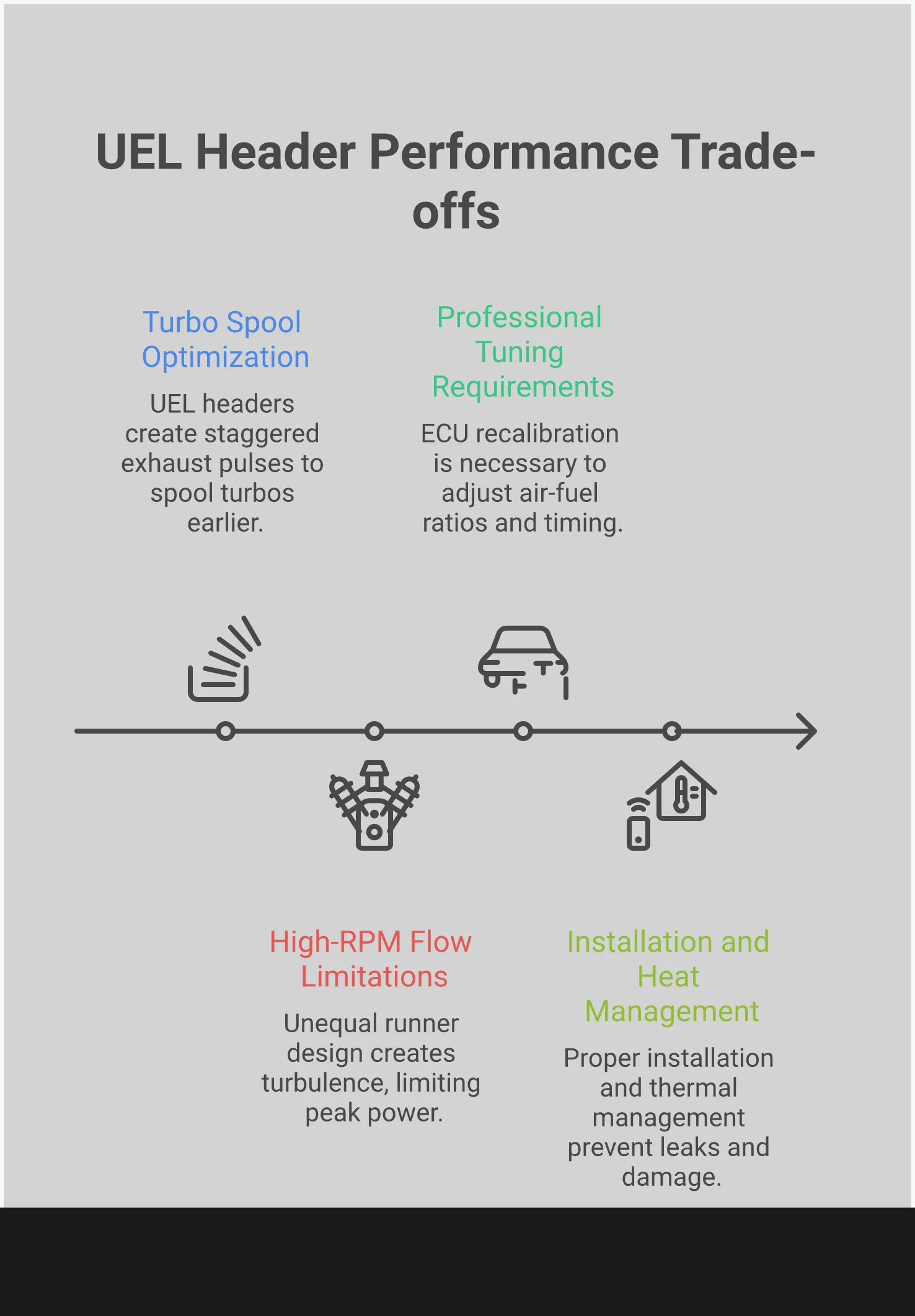
Ese icónico rugido de Subaru es innegablemente genial, pero tiene un precio. Los colectores de longitud desigual, los mismos responsables de ese sonido, implican algunas desventajas en el rendimiento que es importante comprender antes de tomar una decisión. Si bien ofrecen grandes ventajas en el rango de RPM bajas a medias, su diseño genera ineficiencias que pueden limitar el potencial máximo del motor. El problema radica en el nombre mismo: "longitud desigual". Debido a que los conductos de escape desde el motor hasta el colector tienen longitudes diferentes, los gases de escape no fluyen con la suavidad ni la uniformidad que podrían. Esto genera algunas desventajas específicas relacionadas con la potencia, la dinámica del motor y el rendimiento a altas RPM. Para muchos conductores y entusiastas del uso diario, estas desventajas son un pequeño precio a pagar por el sonido y la respuesta en bajas revoluciones. Pero si busca la máxima potencia y eficiencia, es crucial sopesar cuidadosamente estas desventajas con las ventajas. La elección de las piezas de rendimiento adecuadas siempre comienza con comprender su objetivo final y alinear el hardware con su visión del automóvil, ya sea un vehículo diario divertido con una excelente banda sonora o un arma de pista diseñada para la velocidad pura.
Flujo desigual y límites de potencia
La principal desventaja de los colectores UEL es su ineficiencia inherente en la gestión de los gases de escape. Debido a la diferente longitud de los conductos, los pulsos de escape de cada cilindro llegan al colector a intervalos irregulares. Esto interrumpe un proceso llamado barrido de gases de escape, donde el flujo de un pulso ayuda a extraer el siguiente. Sin esta secuencia uniforme y sincronizada, el motor tiene que esforzarse más para expulsar los gases de escape. Este flujo irregular crea un cuello de botella, especialmente al aumentar la velocidad del motor, lo que puede limitar la capacidad del motor para respirar eficientemente y, en última instancia, limitar su potencia máxima. Para un Subaru WRX orientado a la pista, esto puede ser un factor limitante importante.
Turbulencia a altas RPM
Ese flujo desigual no solo limita la potencia, sino que también genera turbulencias. Imagínatelo como si varios carriles de tráfico se fusionaran caóticamente en lugar de hacerlo de forma ordenada. Cuando esos pulsos de escape irregulares colisionan en el colector, crean un flujo de aire desordenado y turbulento. Esta turbulencia aumenta la contrapresión en el sistema de escape, lo cual perjudica el rendimiento a altas RPM. Aunque puede que no se note durante el trayecto diario al trabajo, este efecto se acentúa mucho al forzar el motor. El motor tiene dificultades para expulsar los gases de escape rápidamente, lo que puede reducir el rendimiento justo cuando más se necesita, lo que hace que los colectores UEL sean poco ideales para configuraciones que se encuentren cerca del límite de revoluciones.
Desequilibrios de temperatura del cilindro
Una consecuencia más técnica de la longitud desigual de los conductos es la posibilidad de desequilibrios en la temperatura de los cilindros. Dado que los gases de escape de algunos cilindros tienen un recorrido más largo hasta el colector, permanecen en los colectores una fracción de segundo más. Esto puede provocar que los cilindros correspondientes funcionen a temperaturas ligeramente superiores a las de los demás. En un coche de serie o ligeramente modificado, esta diferencia de temperatura suele ser manejable. Sin embargo, en un vehículo de alto rendimiento, mantener temperaturas constantes y uniformes en todos los cilindros es fundamental para la salud del motor y la precisión de la puesta a punto. Un servicio de puesta a punto adecuado puede ayudar a gestionar estos desequilibrios, pero es un factor a considerar para la fiabilidad del motor a largo plazo.
No es ideal para construcciones de alta potencia
Al sumar todo, la conclusión es clara: los colectores UEL no son la mejor opción para configuraciones de alto rendimiento y alta potencia. Si su objetivo es impulsar su motor a 500, 600 o más caballos de fuerza, las ineficiencias inherentes del diseño UEL se convertirán en un obstáculo importante. A ese nivel de rendimiento, cada gramo de flujo y eficiencia importa. Por eso verá colectores de igual longitud (EL) en casi todos los Subaru de pista o de carreras de aceleración. Simplemente son mejores para mover un volumen masivo de gases de escape de manera eficiente, lo que permite que el turbo funcione de manera óptima y que el motor produzca la máxima potencia. Para mejoras ambiciosas del Subaru STI, un colector EL es casi siempre la mejor opción.
Cómo los cabezales UEL cambian tu conducción
Cambiar el colector de escape original por un juego de colectores UEL no solo cambia el sonido del escape, sino que también modifica radicalmente la sensación y el rendimiento de tu Subaru en carretera. Desde el momento en que giras la llave, notarás una diferencia en el sonido, la respuesta del acelerador y la entrega de potencia. Estos cambios se deben a cómo los colectores UEL gestionan el flujo de gases de escape del motor al turbo. Veamos qué puedes esperar al hacer el cambio.
El impacto en la potencia y el torque
Una de las ventajas más inmediatas de instalar colectores UEL es la mejora de la potencia a bajas y medias revoluciones. Al optimizar el flujo de escape, estos colectores ayudan a que el turbo gire más rápido, a menudo entre 200 y 300 RPM antes que con la configuración de fábrica. Esto se traduce en una respuesta del acelerador más rápida y una conducción más atractiva, especialmente al acelerar al salir de las curvas o circular por el tráfico urbano. Si bien los colectores de igual longitud pueden producir una mayor potencia máxima, los colectores UEL ofrecen un satisfactorio aumento de par justo donde más se siente. Esto los convierte en una fantástica primera modificación para conductores diarios y para cualquiera que busque mejorar el rendimiento de su Subaru WRX sin sacrificar la comodidad en carretera.
La ciencia detrás del estruendo
Ese icónico y retumbante sonido del escape es la principal razón por la que muchos conductores eligen los colectores UEL. El sonido no es solo una apariencia; es resultado directo del diseño del colector. Debido a que los conductos de escape tienen diferentes longitudes, los pulsos de escape de cada cilindro llegan al colector a intervalos desiguales. Esta sincronización escalonada crea el sonido profundo y burbujeante que se ha convertido en sinónimo de los Subaru de alto rendimiento. En cambio, los colectores de igual longitud sincronizan estos pulsos, lo que resulta en un tono más suave y agudo. Para los entusiastas que desean que su Subaru STI suene tan potente como se siente, el característico retumbo de un colector UEL es la mejor opción.
Cambios en la velocidad y la presión de los gases de escape
El diseño desigual influye directamente en la dinámica de los gases de escape. Los gases que circulan por los conductos más largos tienen que recorrer una mayor distancia, lo que puede aumentar ligeramente la temperatura en esos cilindros. Este flujo desigual también crea una dinámica de presión única que ayuda a girar el turbocompresor más rápido a bajas revoluciones. Sin embargo, estas mismas características pueden convertirse en una limitación a altas RPM, donde la turbulencia puede restringir la potencia máxima. Para sacar el máximo provecho de sus nuevos colectores y garantizar un funcionamiento seguro y eficiente del motor, es esencial una puesta a punto profesional. Un servicio de puesta a punto adecuado ajustará los parámetros de su vehículo para adaptarlos a las nuevas características del flujo de aire, maximizando así el rendimiento.
UEL vs. ELH: ¿Cuál debería elegir?
Decidir entre colectores de longitud desigual o igual se reduce a una disyuntiva clásica: sonido versus máximo rendimiento. No hay una única respuesta correcta, pero comprender tus prioridades te ayudará a tomar la decisión con claridad. Se trata de adaptar el hardware a tus objetivos específicos para tu Subaru, ya sea un vehículo para uso diario, un todoterreno o un todoterreno. Analicemos los factores clave para ayudarte a encontrar el ajuste perfecto para tu vehículo.
Considere sus objetivos de rendimiento
Tu objetivo final de potencia es el factor más importante. Si planeas un motor de alta potencia (piensa en 600 HP o más), los colectores de igual longitud son la opción más eficiente. Su diseño garantiza que los gases de escape de cada cilindro lleguen al turbo al mismo tiempo, creando un flujo constante que permite la máxima potencia a altas RPM. Para la mayoría de los autos de calle y Subarus moderadamente modificados, los colectores UEL proporcionan un satisfactorio aumento de par a bajas revoluciones y un turbo más rápido, lo que se siente genial en la conducción diaria. Pero para quienes buscan hasta la última gota de potencia para la pista, los colectores EL son la mejor opción para un rendimiento superior.
Tenga en cuenta su estilo de conducción y sus preferencias de sonido
Aquí es donde tu corazón podría imponerse a tu cabeza. ¿Vives para ese icónico y peculiar "ruido" de Subi? Si es así, los colectores de longitud desigual son tu única opción. Ese sonido característico es resultado directo de los pulsos de escape escalonados creados por los conductos de diferente longitud. Es una parte esencial de la identidad de los entusiastas de Subaru. Si prefieres un sonido de escape más suave y refinado, similar al de un motor tradicional de cuatro cilindros en línea, o si estás construyendo un coche de lujo, entonces los colectores de longitud igual te lo darán. Tu elección aquí realmente define el carácter de tu auto, así que piensa en qué tipo de experiencia deseas cada vez que giras la llave.
Su presupuesto y necesidades de equipamiento
La practicidad también influye. Los colectores de longitud desigual suelen ser menos complejos de fabricar, lo que los convierte en la opción más asequible. Esto permite ahorrar dinero para otras piezas de alto rendimiento o una puesta a punto profesional. Los colectores UEL también sustituyen directamente al colector de serie en muchos motores de la serie EJ, presentes en modelos como el WRX y el STI, lo que facilita su instalación. Si bien los colectores EL pueden requerir un enrutamiento más complejo y, en ocasiones, modificaciones para su instalación, las mejoras en el rendimiento justifican el coste y el esfuerzo adicionales para los constructores más experimentados.
Mitos comunes sobre la UEL, desmentidos
Aclaremos un error común: el ruido sordo no significa mayor potencia. Muchos entusiastas creen que los colectores UEL ofrecen un rendimiento superior debido a su sonido agresivo, pero esa no es la única razón. El ruido sordo es consecuencia de la ineficiencia del escape. Si bien los UEL pueden mejorar la respuesta a bajas revoluciones, su flujo irregular limita el potencial de potencia máxima. La idea de que son universalmente mejores en rendimiento es un mito. Para sacar el máximo provecho de cualquiera de las configuraciones, una puesta a punto profesional es indispensable. Un servicio de puesta a punto de motor adecuado optimizará la relación aire-combustible y la sincronización para que se adapten a su nuevo hardware, garantizando una potencia fiable sin sacrificar la calidad.
Instalación y mantenimiento de sus cabezales UEL
Una vez que hayas elegido tus colectores UEL, el siguiente paso es instalarlos en tu Subaru y mantenerlos en óptimas condiciones. Una instalación y un mantenimiento adecuados son tan importantes como la calidad de la pieza. Una instalación descuidada puede provocar fugas en el escape, pérdida de potencia y mucha frustración, lo que perjudica por completo el rendimiento que esperabas. Piensa en esta fase como la última y crucial de tu actualización, donde tu atención al detalle se refleja directamente en el sonido y el rendimiento.
Tomarse el tiempo para hacerlo bien le garantiza obtener el rugido característico y la potencia de respuesta que desea, sin complicaciones. Se trata de crear un sellado perfecto, controlar el intenso calor generado por los gases de escape y asegurarse de que la computadora del motor comprenda el nuevo hardware con el que trabaja. Un poco de atención al detalle durante el proceso de instalación y unas sencillas revisiones periódicas protegerán su inversión y mantendrán su motor funcionando con la máxima potencia. Desde usar las juntas correctas hasta obtener una puesta a punto profesional, cada paso es vital para maximizar los beneficios de sus nuevos colectores y garantizar su rendimiento confiable durante años. No se trata solo de instalar una pieza, sino de integrarla a la perfección en el ecosistema de su vehículo.
Consejos para una instalación limpia
Una instalación exitosa del colector de escape comienza incluso antes de usar una llave inglesa. Seguir las instrucciones cuidadosamente es clave para asegurar un ajuste correcto y obtener el rendimiento esperado. Primero, asegúrese de trabajar con el motor completamente frío para evitar quemaduras y deformaciones en las piezas. Use juntas nuevas de alta calidad; reutilizar las viejas puede provocar fugas en el escape. Al apretar los pernos, siga con precisión la secuencia de torque recomendada por el fabricante y las especificaciones. Apretar demasiado puede dañar la brida y causar fugas con la misma facilidad que apretar demasiado. Un poco de antiadherente en las roscas también puede facilitar mucho la extracción en el futuro.
Manejo del calor y prevención de fugas
Los colectores de longitud desigual operan bajo un calor intenso, y controlarlo es crucial para proteger los componentes circundantes y garantizar su longevidad. Las piezas de alto rendimiento están diseñadas con características como soldaduras robustas y bridas gruesas para soportar la tensión térmica y minimizar las fugas. Para reducir aún más las temperaturas bajo el capó, considere usar una envoltura térmica o recubrir los colectores con cerámica. Después de los primeros ciclos de calentamiento, es recomendable volver a verificar el par de apriete de todos los pernos de montaje, ya que a veces pueden aflojarse ligeramente a medida que el metal se expande y se asienta. Inspeccione regularmente las juntas para detectar cualquier signo de hollín negro, lo que indica una fuga que debe repararse.
Por qué es crucial una afinación adecuada
Instalar colectores UEL no es una simple modificación. Una calibración profesional es esencial para sacar el máximo provecho de su nuevo hardware y mantener su motor seguro. Cambiar el flujo de escape altera fundamentalmente la relación aire-combustible y los parámetros de sincronización del motor. Sin una calibración, su motor podría funcionar con una mezcla demasiado pobre o demasiado rica, lo que provoca detonación, reducción de potencia y daños potencialmente catastróficos. Los servicios profesionales de calibración de motores recalibrarán su ECU para que se adapte a las nuevas características del escape, garantizando que su Subaru funcione eficientemente, genere potencia confiable y se mantenga en buen estado a largo plazo. Saltarse este paso simplemente no vale la pena.
Controles de mantenimiento a largo plazo
Para garantizar que sus colectores UEL ofrezcan un rendimiento óptimo a largo plazo, basta con realizar unas pocas revisiones periódicas. Cada pocos meses o durante su cambio de aceite habitual, dedique un momento a una rápida inspección. Revise detenidamente las soldaduras y la zona del colector para detectar cualquier signo de tensión o grietas. Preste atención a cualquier tictac o silbido nuevo o inusual con el motor en marcha, ya que suele ser el primer indicio de una fuga de escape. Si utilizó una envoltura térmica, compruebe su estado para asegurarse de que no se esté volviendo quebradiza ni deshilachando. Una rápida revisión visual y una escucha atenta pueden ayudarle a detectar pequeños problemas antes de que se agraven.
Artículos relacionados
- Escape de alto rendimiento para Subaru Rally: Guía del comprador
- La guía definitiva de escapes de repuesto de Subaru
- La guía definitiva del sistema de escape del Subaru WRX
Preguntas frecuentes
¿Es imprescindible una calibración profesional después de instalar colectores UEL? Sí, una calibración no solo es recomendable, sino esencial. Instalar colectores UEL cambia la respiración del motor al alterar el flujo de escape y la contrapresión. Sin una calibración profesional, la computadora del motor no sabrá cómo ajustarse, lo que puede provocar una mezcla demasiado pobre o rica. Esto no solo le resta el rendimiento esperado, sino que también puede poner en riesgo la salud del motor. Piense en la calibración como el paso final que sincroniza su nuevo hardware con el cerebro de su auto, garantizando una potencia segura y confiable.
¿Mejorarán o empeorarán los colectores UEL mi viaje diario? Para la mayoría de los conductores, los colectores UEL hacen que la conducción diaria sea más placentera. El turbocompresor más rápido y el mejor par motor a bajas revoluciones hacen que tu coche se sienta más ágil y dinámico, especialmente en el tráfico con frecuentes arranques o al acelerar desde un semáforo. Notarás más potencia en el rango de revoluciones que usas con más frecuencia. Las desventajas, como una potencia máxima ligeramente inferior, rara vez se notan en la vía pública, lo que convierte a los colectores UEL en una excelente opción para mejorar la sensación de conducción en carretera.
¿Son los colectores UEL compatibles con todos los modelos de Subaru, como el Crosstrek o el Forester? Si bien los colectores de longitud desigual se asocian más comúnmente con modelos turboalimentados como el WRX y el STI, no son exclusivos de ellos. La clave está en encontrar la pieza adecuada para su motor y año de modelo. Confirme siempre la compatibilidad del producto antes de comprarlo para asegurarse de que esté diseñado para su vehículo, ya sea un Impreza, un Forester u otro modelo de la línea Subaru.
Además del ruido sordo, ¿cuánto más ruido harán mi auto con los colectores UEL? Los colectores en sí mismos cambian principalmente el tono y el carácter del sonido del escape, creando ese ruido sordo característico. Si bien pueden contribuir a un ligero aumento de volumen, el volumen general de su auto está determinado más por el resto del sistema de escape, específicamente el convertidor catalítico y el silenciador. Si mantiene el catalizador de fábrica, el cambio de volumen será leve, pero el sonido será mucho más profundo y agresivo.
Si no busco una potencia enorme, ¿existen desventajas reales en los colectores UEL para un coche de calle? Sinceramente, para un coche de uso diario o uno de calle moderadamente modificado, las desventajas son mínimas. La principal desventaja de los colectores UEL es que limitan la potencia máxima a RPM muy altas, una desventaja que la mayoría de los conductores ni siquiera notan durante la conducción normal. Para un coche de calle, simplemente se prioriza el sonido icónico y la respuesta del par motor a bajas revoluciones por encima de la eficiencia a altas RPM de un sistema de igual longitud.