


What Is a Performance Cam Engine for Your Subaru?
The "best" modification is always the one that aligns with your goals. A camshaft profile that's perfect for a dedicated track car will feel frustrating and sluggish in a daily driver. Before you even think about parts, you need to define what you want your car to do. Are you building a high-revving track machine or a responsive street car with more mid-range punch? The right camshaft is the key to tailoring your performance cam engine to that specific purpose. This guide will help you match the right components to your driving style, ensuring your investment delivers the performance you actually want.
Key Takeaways
- Define your goals before you buy: The right camshaft profile depends entirely on how you use your car. A cam designed for maximum track performance will feel sluggish on the street, so choose one that aligns with your primary driving style.
- Plan for supporting modifications: Camshafts work as part of a system. To see real gains and maintain engine health, you must budget for essential supporting parts like stronger valve springs and a professional ECU tune.
- Invest in expert installation and ongoing care: A camshaft upgrade requires precision. Professional installation and a custom ECU tune are non-negotiable for unlocking power safely, while regular maintenance with quality oil is crucial for protecting your investment.
What Do Subaru Camshafts Actually Do?
If you're looking to get more power out of your Subaru, you’ve probably heard about camshafts. Think of them as the brain of your engine's breathing process. Tucked away inside the cylinder heads, these rotating shafts are fundamental to your engine's performance, dictating how and when it makes power. While they might seem like a complex component, understanding their function is the first step in planning your next engine modification.
Every Subaru engine has them, but not all camshafts are created equal. The ones that came from the factory are designed for a specific purpose, and swapping them out for a performance set is a proven way to change your car's character and power delivery. Let's get into what they do and how an upgrade can benefit your build.
How Cams Control Your Engine's Power
Your Subaru's turbocharged engine uses a Double Overhead Cam (DOHC) design, meaning it has four camshafts in total. Two manage the intake valves that let the air-fuel mixture into the cylinders, and two control the exhaust valves that let the burnt gases out. As the camshafts spin, specially shaped lobes push on the valves, opening and closing them at precisely the right moment. This sequence is the heart of your engine’s operation, and its timing determines how efficiently your engine runs. The shape of the cam lobes dictates how long and how far the valves open, directly influencing your engine's performance characteristics.
Understanding Camshaft Specs: Lift, Duration, and Overlap
When you start shopping for performance camshafts, you'll encounter three key specifications: lift, duration, and overlap. These aren't just abstract numbers; they define how your engine will behave. Lift refers to how far the valve opens. A higher lift is like opening a door wider—it allows more air and fuel into the cylinder, which is fundamental for creating more power. Duration measures how long the valve stays open. A longer duration improves an engine's ability to breathe at high RPMs, effectively shifting the powerband higher, making it a great choice for track-focused builds. Lastly, overlap is the brief window when both the intake and exhaust valves are open at the same time. This helps clear out exhaust gases and pull in the fresh air-fuel mixture more efficiently at high speeds, but it can also result in a rougher idle. Choosing the right combination of these specs is key to matching the cam to your driving style, and it's a change that absolutely requires a professional engine tune to function safely and effectively.
Stock vs. Performance Cams: What's the Real Difference?
Stock camshafts are engineered for a balance of smooth daily driving, fuel economy, and predictable power. They get the job done, but they leave a lot of potential on the table. Performance camshafts, on the other hand, are designed with one primary goal: making more power. They feature more aggressive lobe profiles that hold the valves open longer and lift them higher. This allows more air and fuel to enter the cylinders, resulting in a bigger combustion event and more horsepower, especially in the mid-to-high RPM range. Upgrading your cams is a serious step toward building a high-output engine for your Subaru WRX or STI.
How Does Subaru's AVCS Technology Work?
If you’ve spent any time looking into Subaru performance, you’ve likely come across the term AVCS. This stands for Active Valve Control System, and it’s Subaru’s version of variable valve timing (VVT). Think of it as your engine’s ability to breathe differently depending on what you’re asking it to do. Instead of having a fixed valve timing that’s a compromise between low-end torque and high-end power, AVCS adjusts the camshaft timing on the fly. This dynamic control is crucial for getting the best performance, fuel economy, and drivability from your engine, and understanding it is key before diving into any camshaft upgrades.
Variable Valve Timing, Explained
At its core, variable valve timing is a technology that allows an engine to change when its intake and exhaust valves open and close. In a Subaru with AVCS, the engine control unit (ECU) uses oil pressure to rotate the camshafts relative to their drive sprockets. This adjustment can be up to 35 degrees, giving the engine incredible flexibility. By changing the valve timing, the ECU can optimize airflow into and out of the cylinders for any given situation. This means your engine isn’t stuck with one setting; it can adapt for a smooth idle, efficient cruising, or maximum power when you put your foot down.
What Makes Dual AVCS So Effective?
Not all AVCS systems are created equal. Some earlier or base model Subarus have AVCS only on the intake camshafts. Performance-oriented models, like the STI, often feature Dual AVCS, which controls both the intake and exhaust cams. This gives you and your tuner much finer control over the engine’s breathing. With Dual AVCS, you can precisely manage valve overlap, which is the brief period when both intake and exhaust valves are open. This allows for better cylinder scavenging at high RPMs and improved efficiency at lower speeds, resulting in a broader torque curve and more power across the entire rev range.
How AVCS Affects Power and Fuel Efficiency
The impact of AVCS is felt in every driving scenario. At low engine speeds, the system delays cam timing to ensure a stable and smooth idle. During mid-range cruising, it adjusts timing to improve engine efficiency and fuel economy. When you demand maximum performance at high RPMs, AVCS advances the intake cam timing to open the valves sooner. This helps force out residual exhaust gases and pull in more of the fresh air-fuel mixture, leading to significant power gains. Proper engine tuning services are essential to fully capitalize on the potential of your vehicle’s AVCS.
Quantifying the AVCS Advantage
The real benefit of AVCS isn't just a higher peak horsepower number; it's the transformation of the entire powerband. With a properly calibrated AVCS map, a skilled tuner can add significant torque across the low and mid-range, often picking up 20-30 lb-ft in areas where the engine would otherwise feel sluggish. This translates directly to a car that feels more responsive and pulls harder without you needing to constantly chase redline. The advantage is a much broader, more usable power curve that makes the car faster and more engaging in real-world driving, from city streets to the track. A professional ECU tune is what unlocks this potential, precisely manipulating valve events to completely change how your Subaru delivers its power.
What Types of Performance Cams Can You Get?
When you start looking at camshafts, you'll find they are categorized based on their performance profile and how they affect your engine's behavior. The right choice for your Subaru depends entirely on your goals. Are you looking for a modest power increase for your daily commute, or are you building a dedicated track car that lives in the high RPM range? Each type of cam is designed to deliver power differently, so understanding the main categories is the first step in finding the perfect match for your build and driving style.
Drop-in Cams: An Upgrade for Your Daily Driver
If you want to add some excitement to your daily drive without committing to a full engine overhaul, drop-in camshafts are an excellent starting point. These are designed to provide a noticeable performance gain while still working with your stock valve springs and other engine components. The installation is more straightforward than more aggressive options, making them a popular first engine mod. A drop-in cam typically improves power in the mid-to-high RPM range, giving you more pull when you need it without sacrificing the smooth idle and low-speed drivability you rely on for everyday use. They offer a perfect balance of performance and practicality.
Aggressive Cams: Built for the Racetrack
For those building a Subaru for the track or serious competition, aggressive camshafts are the way to go. These cams are engineered with higher lift and longer duration, which means they hold the valves open longer to allow more air and fuel into the engine at high RPMs. This is how you achieve maximum horsepower for racing. However, this performance comes with trade-offs. An aggressive cam profile will create a rougher, "lumpy" idle and can reduce power at lower RPMs, making the car less pleasant for street driving. These cams almost always require supporting performance parts like upgraded valve springs and retainers, along with professional engine tuning services to recalibrate the ECU.
Understanding Camshaft Stages
You'll often see camshafts marketed in "stages," like Stage 1, Stage 2, or Stage 3. This is a simplified way for manufacturers to categorize a cam's aggressiveness. A Stage 1 cam is typically a mild upgrade, similar to a drop-in, designed to give you a noticeable power bump without requiring major supporting modifications. As you move up to Stage 2 and beyond, the profiles become much more aggressive. These cams are designed to make serious power in the mid-to-high RPM range but will require you to invest in other performance parts like stronger valve springs, retainers, and a custom tune to work correctly and safely. It's important to remember that these stages aren't standardized across the industry, so always look at the specific lift and duration numbers to understand what you're really buying.
Common Camshaft Designs: Hydraulic vs. Mechanical
Your Subaru engine comes from the factory with hydraulic lifters, which use oil pressure to automatically maintain the correct clearance between the camshaft and the valves. This design is quiet, reliable, and requires no regular maintenance, making it ideal for street cars. For extreme, high-revving race builds, some builders opt for mechanical (or solid) lifter camshafts. These require manual adjustment of the valve lash but offer superior valvetrain stability above 8,000 RPM, preventing an issue known as "lifter pump-up." For the vast majority of Subaru builds, even those making significant power for the track, a hydraulic cam is the right choice. A switch to mechanical lifters is a serious modification best discussed with your engine builder and tuner as part of a comprehensive plan for engine tuning services.
Custom-Made Camshafts for Specific Builds
For those pushing the limits with a truly unique build, an off-the-shelf camshaft might not be the perfect fit. This is where custom-ground camshafts come in. A custom cam is designed from the ground up to match your specific combination of parts—your turbo size, cylinder head porting, intake manifold, and intended use. Working with a specialized cam designer or engine builder, you can create a profile that optimizes your powerband exactly where you want it. This process ensures every component in your engine works in harmony to produce the best possible results. While it's a more significant investment, a custom cam is the ultimate solution for extracting maximum performance from high-end Subaru STI upgrades and all-out race projects.
AVCS vs. Non-AVCS Cams: Which Is Right for You?
Most modern turbocharged Subarus are equipped with the Active Valve Control System (AVCS), which is Subaru’s version of variable valve timing. This technology dynamically adjusts camshaft timing to optimize performance across the entire RPM range, giving you better low-end torque and stronger high-end power. When choosing a camshaft, the most important factor is ensuring it's compatible with your engine's system. You aren't choosing between AVCS and non-AVCS; you're choosing a cam designed specifically for your car's setup. Performance cams for AVCS-equipped models, like those for Subaru WRX upgrades, are engineered to take full advantage of the system for the broadest possible powerband.
How to Choose the Right Camshaft for Your Subaru
Selecting the right camshaft isn't about finding the most aggressive option available; it's about matching the component to your specific goals, engine, and driving style. A cam that shines on the racetrack might feel sluggish and frustrating during your daily commute. Before you make a purchase, you need a clear picture of what you want to achieve. Are you looking for a modest power increase for spirited street driving, or are you building a dedicated track car that lives in the high RPM range? Answering this question is the first step toward finding the perfect camshaft profile for your Subaru.
Your engine's current setup also plays a major role. A camshaft is part of a complex system, and its performance is directly tied to other components like your cylinder heads, valve springs, and turbocharger. A thoughtful, holistic approach to your build will always yield better and more reliable results than simply installing the most aggressive cam you can find. Let's walk through the key factors to consider.
Matching Cams to Your Driving Style: Street vs. Track
Your primary use for the car should be the main guide for your camshaft choice. For a daily driver or a weekend car that sees mostly street use, you’ll want a cam that improves power without sacrificing low-end torque and drivability. An overly aggressive cam can make the car difficult to drive in stop-and-go traffic. A well-balanced performance camshaft, like those designed for SOHC EJ25 engines, can deliver a great bump in mid-to-high RPM power while keeping the car responsive and enjoyable for everyday driving. These cams provide a noticeable improvement without the drawbacks of a full race setup.
If your Subaru is destined for the track, your priorities shift. Here, the goal is maximum power, typically at higher RPMs. Aggressive track cams use higher lift and longer duration to move as much air and fuel as possible, which is exactly what you need when you're pushing the engine to its limits. This often comes at the cost of a rough idle and reduced low-end power, but those trade-offs are acceptable for a dedicated performance build. These specialized performance parts are designed to help you shave seconds off your lap times.
How Camshaft Strategy Differs in Other Vehicles
While the basic function of a camshaft is universal—to open and close engine valves—the strategy behind its design varies wildly between different types of vehicles. For example, in the world of American V8s, a common goal is to achieve a choppy, "lumpy" idle, which is a byproduct of an aggressive cam with significant valve overlap. This sound is often as desirable as the peak horsepower number it produces. In contrast, the goal for a turbocharged Subaru engine is typically much different. Thanks to technologies like Dual AVCS, the focus is on creating a broad, usable powerband that delivers strong performance across a wide range of RPMs, rather than sacrificing all low-end drivability for a high horsepower figure.
The physical engine architecture also plays a huge role. A traditional pushrod V8 uses a single camshaft located in the engine block, while your Subaru's DOHC boxer engine uses four camshafts located in the cylinder heads. This fundamental difference in design means that how camshafts work and are modified is specific to the platform. What works for a Mustang or a Camaro simply won't apply to a WRX or Forester. This is why it's so important to use parts and tuning strategies developed specifically for the unique characteristics of Subaru engines.
Turbo vs. NA: Does Your Engine Type Matter?
The type of engine in your Subaru, whether it's turbocharged or naturally aspirated, fundamentally changes what you should look for in a camshaft. Turbocharged engines, like the ones in the Subaru WRX and STI, rely on forced induction. The right camshaft will optimize valve timing to help the turbo spool faster and work more efficiently. It’s a delicate balance of managing valve overlap to build boost effectively without letting exhaust gases flow back into the combustion chamber. The goal is to complement the turbo's power delivery, not fight against it.
For naturally aspirated engines, found in models like the Crosstrek and Impreza, the camshaft is even more critical for making power. Without a turbo to force air in, the cam is solely responsible for how much air the engine can draw. Performance cams for these engines typically feature higher lift and longer duration to hold the valves open longer, maximizing the air-fuel mixture entering the cylinders. This is one of the most effective ways to increase horsepower and torque in a naturally aspirated build.
How to Confirm a Cam Fits Your Subaru Model
Finally, you must ensure the camshaft you choose is compatible with your specific Subaru model and engine. Subaru has used various engines over the years, from the EJ series to the newer FA and FB platforms, and parts are rarely interchangeable. A camshaft designed for a 2015+ Subaru STI with its EJ257 engine will not work in a newer WRX with an FA20. Always verify the part is made for your car’s exact year, model, and engine code.
Compatibility extends beyond just the engine block. The camshaft must work seamlessly with your cylinder heads and valvetrain. Upgrading to more aggressive cams often requires you to also install stronger valve springs and retainers to prevent valve float at high RPMs. Mismatching components can lead to poor performance or catastrophic engine failure. When in doubt, consult with a performance expert to confirm you have a complete, compatible package for your build.
Using Online Tools to Narrow Your Search
The sheer number of camshaft options online can be overwhelming, but the right digital tools can simplify your search significantly. Start with reputable manufacturer websites and dedicated Subaru forums. These resources often feature part-filtering systems that allow you to input your vehicle's specific year and model, whether you're driving a WRX, STI, or Crosstrek. This is the most reliable way to create a shortlist of compatible options and avoid the headache of ordering the wrong part. Many of these sites also provide detailed specifications, dyno charts, and customer reviews, giving you a clear picture of how a cam will perform in a real-world build. A little online research ensures your investment in performance parts is a smart one.
What Gains Can You Expect from a Camshaft Upgrade?
A camshaft upgrade is one of the most effective ways to change your Subaru’s personality. While many modifications add incremental power, a new set of cams alters the very heart of how your engine breathes and behaves. Think of it as retraining your engine for a specific type of performance. Instead of just chasing a peak horsepower number, a camshaft upgrade allows you to reshape your entire power curve, moving power and torque to the part of the RPM range where you use it most. Whether you want more pull coming out of corners on the track or a stronger top-end rush on the highway, the right camshafts make it happen.
This modification directly controls the engine's intake and exhaust valves, dictating how much air-fuel mixture gets in and how quickly exhaust gases get out. By changing the lift and duration of the valve openings, performance cams allow your engine to take deeper, more efficient "breaths" at higher speeds. This is why a cam swap is considered a foundational part of any serious engine build. It unlocks the potential of other performance parts, like a larger turbo or upgraded intake manifold. When properly selected and paired with a professional tune, a camshaft upgrade delivers a driving experience that is not just faster, but also more responsive and engaging.
Get More Power and Torque at Every RPM
The most noticeable result of a camshaft upgrade is a significant increase in horsepower and torque. Performance cams are engineered to keep the valves open longer, allowing more air and fuel to enter the combustion chamber, which generates a more powerful explosion. This is especially effective for building power in the mid-to-high RPM range. If you feel your stock Subaru WRX or STI runs out of steam as you approach redline, a performance camshaft can completely change that, providing that crucial power at higher revolutions. This gives you a strong, continuous pull all the way to the top, making your car more competitive on track days and more thrilling during spirited drives.
How Much Horsepower Can You Really Add?
So, what's the magic number? While there's no one-size-fits-all answer, a well-executed camshaft upgrade can add anywhere from 20 to 75 horsepower. The final figure depends heavily on your specific engine, the aggressiveness of the cam profile, and, most importantly, your supporting modifications. Simply dropping in new cams without addressing other parts of the system won't get you the results you're looking for. To unlock that potential power safely, you'll need to pair your new camshafts with essential upgrades like stronger valve springs and a comprehensive ECU retune. A professional tune is non-negotiable, as it recalibrates your engine's fuel and timing maps to work with the new airflow characteristics. This is where expert engine tuning services become critical, ensuring all your components work together harmoniously to deliver reliable power.
Experience a Sharper Throttle Response
Beyond raw power, a camshaft upgrade dramatically improves how your car feels to drive. By optimizing valve timing, performance cams make your engine far more responsive to your inputs. The moment you touch the throttle, the engine reacts with more immediacy and eagerness. This is because the improved airflow allows the engine to respond more quickly, creating a direct and connected feel between your right foot and the engine. This sharper throttle response makes the car feel lighter and more agile. To fully realize these gains, a professional engine tuning service is essential to perfectly synchronize the fuel delivery and ignition timing with the new camshaft profile, ensuring smooth, reliable, and potent performance.
Common Camshaft Myths to Avoid
When it comes to engine modifications, camshafts are often surrounded by a lot of hype and misinformation. It’s easy to get caught up in the promise of big power gains, but a successful upgrade requires a clear understanding of how these components actually work within your Subaru’s engine. Making the right choice is about more than just picking a part with impressive specs; it’s about creating a balanced system that works for your specific goals.
Let’s clear up some of the most common myths so you can approach your camshaft upgrade with confidence. Knowing what to look for and what to avoid will save you time, money, and potential headaches down the road. A well-planned modification will deliver the performance you’re looking for, whether you’re building a track-ready STI or a capable overlanding Crosstrek.
Myth: Any Aftermarket Cam Is an Upgrade
It’s a common belief that swapping your stock cams for any aftermarket option will automatically give you more power, but that’s not always the case. Performance camshafts are designed to hold the valves open longer and lift them higher, allowing more air into the cylinders. However, this only translates to a power increase if your engine can actually use that extra airflow. If you haven’t upgraded supporting components, like your turbocharger, you may not see any benefit. In some cases, you could even lose power if the new cams aren’t matched to the rest of your setup. A successful build is about synergy between all your performance parts, not just one component.
Fact: Precision and Timing Are Everything
The performance you get from your camshafts is heavily dependent on their installation and timing. Even the highest quality cams won’t perform correctly if they aren’t dialed in with absolute precision. Simply setting the camshafts correctly can make a massive difference in power output. The brand of timing belt you use also matters, as lower-quality belts can stretch over time and throw off your cam timing by several degrees. This seemingly small change can significantly reduce engine performance and efficiency. This is why professional installation and a proper ECU tune are critical steps to ensure your engine runs smoothly and makes the power you expect.
Myth: One Size Fits All Power Goals
There is no single "best" camshaft for every Subaru. Different cam profiles are engineered for different purposes. Some are designed to deliver maximum power at high RPMs, which is ideal for a track-focused Subaru WRX. Others might be designed to improve mid-range torque, which is more useful for a daily driver or an off-road build. Choosing a cam profile that doesn’t align with your driving style or other modifications can lead to a disappointing experience. Before you buy, think carefully about what you want to achieve. The right camshaft should complement your power goals and the rest of your vehicle’s setup, not work against them.
What Other Modifications Do You Need?
Installing performance camshafts is a significant step, but it’s rarely a standalone upgrade. To truly get the most from your new cams, you need to ensure the rest of your engine can support their potential. Think of it as a system where each component works together. When you improve one part, others often need to be brought up to the same level to maintain balance and unlock real gains. This means looking at related parts like valve springs and your turbo, and most importantly, ensuring everything is installed and tuned by a professional who understands the intricacies of Subaru engines.
Why You Should Also Upgrade Valve Springs and Your Turbo
When you install more aggressive camshafts, your stock valve springs may not be up to the task. Performance cams place higher demands on the valvetrain, and factory springs can struggle to keep up, potentially leading to "valve float" at high RPMs, which kills performance. Upgrading to stiffer valve springs is a necessary step to ensure your valves close properly and keep pace with the new cam profile. Likewise, since performance cams allow more air into the engine, you need to supply that air. Pairing your new cams with a larger turbocharger and other performance parts ensures your engine isn’t gasping for air, allowing it to take full advantage of the upgrade.
Why You Need Professional Installation and ECU Tuning
A camshaft installation is a precision task that should be handled by an experienced technician. There is very little room for error, and with aggressive cams, checking for proper piston-to-valve clearance is critical to prevent catastrophic engine failure. Once the hardware is correctly installed, the job is only half done. The final, and arguably most important, step is a professional ECU tune. Your engine’s computer needs to be recalibrated to work with the new cam profiles. An expert engine tuning service will adjust fuel maps and timing to optimize performance, ensuring your Subaru runs powerfully, smoothly, and reliably. This is where you’ll see the true horsepower and torque gains from your investment.
Avoiding Common Pitfalls: The Importance of a Proper Tune
Skipping a professional tune after installing new camshafts is one of the biggest and most costly mistakes you can make. Your Subaru's ECU is programmed to operate with the stock cam profiles, and performance cams fundamentally change how your engine breathes. Without a proper tune, the ECU is trying to run a new setup with old instructions, which can lead to poor performance, rough idling, and even catastrophic engine damage. The final, and most critical, step is to have an expert engine tuning service recalibrate the ECU. This process involves adjusting the fuel maps, ignition timing, and AVCS parameters to work in harmony with the new cams, ensuring your engine runs powerfully and reliably while realizing the full performance gains from your investment.
How to Maintain Your Performance Camshafts
Once you’ve installed performance camshafts, your job isn’t over. High-performance parts demand high-performance care. Think of it as protecting your investment. Because these components operate under more stress than their stock counterparts, a proactive maintenance schedule is essential for ensuring longevity and consistent power delivery. Sticking to a routine prevents minor issues from turning into catastrophic engine failures.
Proper maintenance ensures your entire valvetrain, not just the cams, operates in harmony. Clean oil, correct timing, and regular check-ups are the foundation of a healthy, modified engine. Neglecting these basics can quickly undo all the hard work and money you’ve put into your build. By staying on top of a few key service items, you can enjoy the added power and response from your camshaft upgrade for years to come. This isn't just about following a checklist; it's about creating a reliable vehicle that performs exactly as you want it to, every time you turn the key.
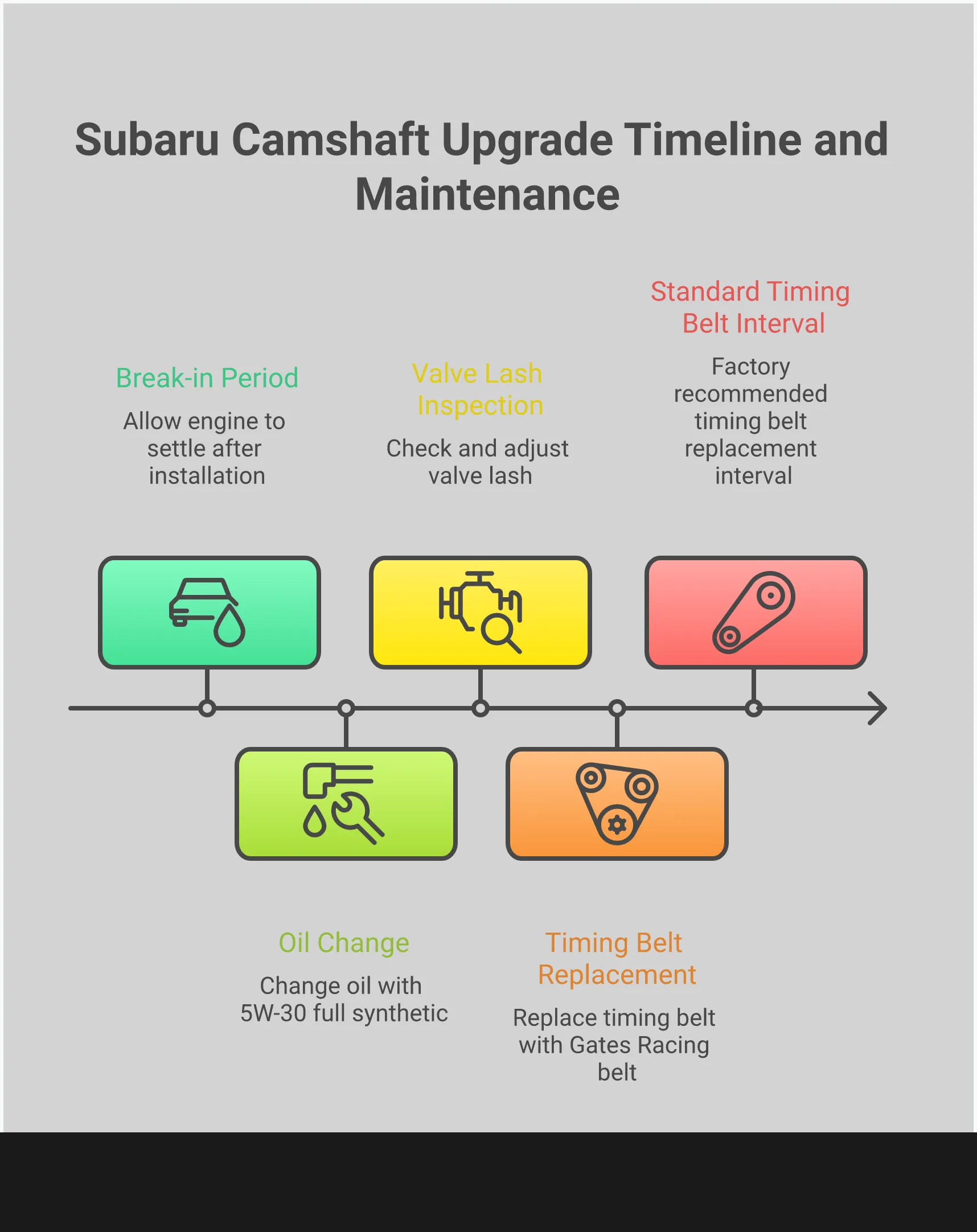
Don't Skip Oil Changes and Timing Belt Service
Clean engine oil is the lifeblood of your Subaru’s engine, and it’s even more critical after installing performance camshafts. Oil lubricates the cams and lifters, reducing friction and preventing premature wear. While Subaru suggests a standard interval, many enthusiasts with modified engines choose to change their oil more frequently. Using high-quality synthetic oil ensures your performance cams receive the best possible protection. Just as important is the timing belt, which synchronizes the camshafts with the crankshaft. A timing belt failure can cause catastrophic damage, as the pistons can collide with the valves. Following the recommended replacement interval, typically around 105,000 miles, is a must for any Subaru owner.
When to Schedule a Professional Inspection
While you can handle many maintenance tasks at home, nothing replaces a professional inspection from a technician who specializes in Subarus. During a routine service, a multi-point inspection can identify early signs of wear on your camshafts or other valvetrain components that you might otherwise miss. This is especially important after installing aggressive aftermarket parts. An expert can listen for unusual noises, check for proper valve lash, and ensure everything is operating correctly. Scheduling these check-ups gives you peace of mind and helps you catch potential problems before they require expensive repairs, keeping your Subaru WRX upgrades running smoothly.
How Much Do Quality Subaru Camshafts Cost?
Upgrading your camshafts is a serious step toward unlocking your Subaru's potential, and it's an investment in your engine's performance and longevity. The cost of camshafts reflects the precision engineering, high-grade materials, and extensive research required to produce a component that can withstand extreme stress while delivering consistent power gains. While it might be tempting to look for a bargain, this is one area where quality directly impacts your engine's health. A well-made camshaft works in harmony with your entire engine setup, while a poorly manufactured one can lead to catastrophic failure.
When you're ready to explore options, remember that the price tag often corresponds to the level of performance and durability you can expect. Think of it as the foundation for your power goals; a stronger foundation allows you to build higher. Investing in reputable performance parts from the start saves you from costly repairs and ensures your build is reliable, whether you're on the street, track, or trail. This isn't just about hitting a peak horsepower number; it's about achieving a usable powerband that suits your driving style. A quality cam will deliver smooth, predictable power, while a cheaper alternative might create a "peaky" engine that's difficult to manage. Before you even look at prices, define your goals. Are you building a weekend track car, a daily driver with more punch, or a rugged overlanding rig? Your answer will guide your budget and your choice of components.
What to Expect: Pricing by Performance Tier
When you start shopping for performance camshafts, you'll find that prices typically range from around $930 to $1,800 for a set. The exact cost depends on the brand, the specific grind of the cam, and your Subaru model. For instance, cams for newer engines like the FA24 in the 2022+ WRX may sit at the higher end of the spectrum, often over $1,100. Brands like GSC Power-Division and Kelford Cams are popular choices, with most of their offerings falling within this price bracket. The price difference usually comes down to the cam's intended use. A "drop-in" cam for a daily driver will generally be less expensive than an aggressive, high-lift cam designed for a dedicated race car.
A Look at the Broader Camshaft Market
When you explore the camshaft market, you'll find a wide array of options designed for different performance goals. This isn't a one-size-fits-all component; the right choice is entirely dependent on how you plan to use your Subaru. A cam profile that excels on the racetrack, delivering maximum power in the high RPM range, will feel sluggish and unresponsive during a daily commute. The market is segmented to serve specific needs, from mild "drop-in" cams that provide a modest power increase for a street-driven Subaru WRX to aggressive profiles for dedicated track builds. Understanding your own goals is the first and most critical step in selecting the right part for your engine.
Investing in quality from the start is essential for a reliable and enjoyable build. While budget-friendly options exist, reputable performance parts are engineered for durability and a usable powerband, not just a peak horsepower number. A well-designed camshaft delivers smooth, predictable power that suits your driving style. Remember that the camshafts are only part of the equation. To see real gains and maintain engine health, you must budget for essential supporting modifications like stronger valve springs and a professional ECU tune to bring the entire system together.
Investing in Quality: Budget vs. Premium Cams
The saying "you get what you pay for" is especially true for internal engine components. Premium camshafts are crafted from superior billet steel and undergo rigorous testing to ensure perfect lobe separation, lift, and duration. This precision is what gives you a reliable powerband and protects your valvetrain. A budget cam might promise similar specs, but it often lacks the material strength and engineering accuracy to perform reliably under pressure. Remember, a camshaft upgrade is only as good as its supporting modifications. To take full advantage of the increased airflow, you'll likely need upgraded valve springs and a larger turbo. Most importantly, a professional tune is non-negotiable. Proper engine tuning services will synchronize all your new components, maximizing power and ensuring your engine runs safely.
Related Articles
Frequently Asked Questions
Do I really need a professional tune after installing new camshafts? Yes, absolutely. A tune isn't just recommended; it's a critical part of the installation. Your new camshafts change how and when air enters and exits the engine. Your car's computer (ECU) is still operating on the old instructions from the factory cams, which can lead to poor performance, rough running, or even engine damage. A professional tune recalibrates the fuel and timing maps to match the new airflow, ensuring your engine runs safely and you get the power gains you paid for.
Will performance camshafts change how my car sounds and idles? They certainly can. The sound change is a direct result of the cam's profile, specifically the valve overlap. A mild "drop-in" cam designed for a daily driver might only create a slightly tougher idle that's barely noticeable. However, an aggressive track cam will produce a distinct, choppy or "lumpy" idle that many enthusiasts love. This sound is a sign that the cam is designed for maximum airflow at high RPMs, which often comes at the cost of a perfectly smooth idle.
Are aggressive camshafts always the best choice for making more power? Not at all. The "best" camshaft is the one that matches your driving style and the rest of your car's setup. An aggressive cam is designed to make peak power at very high engine speeds, which is perfect for a dedicated track car. On the street, however, that same cam can make the car feel sluggish at lower RPMs, making stop-and-go traffic frustrating. For a daily driver, a milder cam that improves mid-range power is often a much better and more enjoyable choice.
Can I just install camshafts without any other upgrades? While you can sometimes install mild "drop-in" cams with stock components, it's generally not the best approach for a balanced build. More aggressive camshafts almost always require you to install stronger valve springs and retainers. The factory springs aren't designed for the higher lift and can't close the valves fast enough at high RPMs, leading to a condition called valve float that can cause serious engine damage. To see the best results, your cams should be paired with other parts, like an upgraded turbo, that support the increased airflow.
How do I know if I need cams for an AVCS or non-AVCS engine? This isn't a choice you make, but rather a requirement of your specific engine. Most modern Subarus are equipped with AVCS (Active Valve Control System), which is a form of variable valve timing. If your engine has AVCS, you must use camshafts designed to work with that system. The key is to verify the exact year and model of your Subaru and purchase cams that are explicitly listed as compatible. Using the wrong type will result in poor performance and likely trigger a check engine light.