


The Ultimate EJ257 400whp Engine Guide
A powerful engine and a reliable one don't have to be mutually exclusive. Too many builds fail because they chase a dyno number without a solid plan. A truly dependable EJ257 400whp engine is a complete system where forged internals, the turbo, fuel delivery, and cooling all support each other. Simply bolting on parts without a cohesive strategy is the fastest way to an expensive failure. This guide breaks down the build into a logical, step-by-step process, ensuring you create a balanced and durable setup that delivers power you can actually trust.
Key Takeaways
- Strengthen the Engine's Core for Reliability: The stock EJ257 internals are a known weak point, so to safely reach 400whp, upgrading to forged pistons and connecting rods is the most important step to prevent common and catastrophic engine failures.
- Support Your Power Goals with the Right Parts: Achieving 400whp isn't just about a bigger turbo; it requires a complete system. You'll need an upgraded fuel pump, injectors, intercooler, and exhaust to ensure the engine has the fuel and cooling it needs to perform safely.
- Invest in a Professional Tune to Protect Your Build: A custom engine tune is the final, essential step that brings all your new parts together. It optimizes performance, ensures safe operation, and is the single best way to protect your investment and achieve a reliable high-horsepower engine.
What Is the Subaru EJ257 Engine?
If you’ve driven a Subaru WRX STI from 2004 to 2021, you’ve experienced the legendary EJ257 engine. This 2.5-liter turbocharged boxer engine is the heart of the STI and is famous for its raw power delivery and enthusiast-friendly design. It’s a platform that has powered rally champions and street builds for decades, making it one of the most recognizable and modified engines in the import scene.
The EJ257 is more than just its specs; it’s known for a personality that many modern engines lack. Its design creates a distinct, rumbling exhaust note that is instantly identifiable as a Subaru. For builders, the EJ257 represents a fantastic starting point for a high-horsepower project, with a massive aftermarket and a wealth of community knowledge. Whether you're aiming for a weekend track car or a powerful daily driver, understanding this engine is the first step toward building it right.
Which Subaru Models Have the EJ257?
While the EJ257 is synonymous with the WRX STI, Subaru recognized its potential and used it across a range of turbocharged models. This engine's versatility is a big reason why it has such a dedicated following. If you're looking for an EJ257, you can find it in more than just the top-tier performance sedan. Its widespread use means there are plenty of platforms to start a build with, whether you're modifying a wagon or an SUV. This powerful 2.5-liter engine was the factory-installed heart of several key models, including:
- Subaru WRX STI: 2004–2021
- Subaru WRX: 2006–2014
- Subaru Forester XT: 2004–2013
- Subaru Legacy GT: 2005–2012
- Subaru Outback XT: 2005–2009
- Subaru Baja Turbo: 2002–2006
The presence of the EJ257 in models like the Forester XT and Legacy GT gave these unassuming vehicles a serious performance edge. This shared engine platform also means that many performance parts are compatible across different models, giving owners a huge catalog of upgrades to choose from when they decide to build for more power.
EJ257 Specs and Design Features
The EJ257 is a 2.5-liter, four-cylinder boxer engine, meaning its pistons move horizontally. This layout gives the car a lower center of gravity, which contributes to the STI's excellent handling. One of its most celebrated characteristics is the iconic "Subaru rumble," a direct result of its unequal-length exhaust headers. This sound has become synonymous with Subaru performance.
This engine has been the go-to for the American-market WRX STI for years, creating a legacy built on accessible performance and a massive community of tuners. Its straightforward design makes it a favorite for those looking to learn and modify their own vehicles. With the right Subaru STI upgrades, the EJ257 can transform from a capable street engine into a true performance powerhouse.
Why Does the Semi-Closed Deck Matter?
One of the EJ257’s greatest strengths for performance builds is its semi-closed deck block design. In simple terms, this means the top of the engine block has extra support connecting the cylinder walls to the block's outer casing. This reinforcement makes the cylinders much more rigid and less prone to distortion under the high pressure that comes with increased horsepower and torque.
Compared to an open-deck design, the semi-closed deck provides a much more stable foundation for a high-output build. This structural integrity is a key reason why the EJ257 can reliably handle more power than many other factory turbocharged engines. Understanding the differences between engine designs, like the EJ257 vs the FA20, highlights why this feature is so critical for anyone planning to push past stock power levels.
What's the EJ257's Tuning Potential?
A stock EJ257 engine is certainly capable, but most enthusiasts agree that pushing it to 400 wheel horsepower (whp) on original internal components is a major risk. The stock cast pistons, in particular the piston ringlands, are well-known weak points that can fail under the increased stress. While some tuners might get close to this power level on a healthy stock motor, it’s often referred to as a "ticking time bomb."
To safely and reliably reach 400whp, you need to strengthen the engine's core. This means investing in forged pistons and connecting rods that can handle the pressure. Building the engine correctly from the start with quality performance parts is the only way to ensure your high-horsepower EJ257 is both powerful and durable for the long haul.
Understanding AWD Drivetrain Loss
When you see a horsepower number, it's important to know if it's measured at the engine's crank or at the wheels. Crank horsepower is the raw power the engine produces, but some of that power gets lost on its way to the pavement through the transmission, driveshafts, and differentials. This is called drivetrain loss. Subaru's Symmetrical All-Wheel Drive system is fantastic for grip, but with more moving parts, it naturally has a higher drivetrain loss, typically around 20-25%. This means to achieve your goal of 400 wheel horsepower (whp), your engine actually needs to produce between 500 and 533 horsepower at the crank. This is a critical calculation when planning your build, as every component must be selected to support this higher crank horsepower figure, not just the final number you want to see on the dyno.
What Is the Stock Block Power Limit?
While every engine has its own unique tolerances, the general consensus in the tuning community is that pushing a stock EJ257 past 380 whp is entering the danger zone. The primary weak point is the factory cast pistons, specifically the piston ringlands. Under the increased cylinder pressure and heat that comes with higher boost, these components are prone to cracking, which can lead to catastrophic engine failure. This is why upgrading to forged pistons and connecting rods is the foundational step for any reliable 400whp build. Investing in quality performance parts from the start provides the strength needed to handle the extra power safely, ensuring your engine is built for longevity, not just a single impressive dyno pull.
How to Build Your EJ257 for 400whp
Hitting the 400whp mark in an EJ257-powered Subaru is a classic goal for a reason. It’s the perfect blend of exhilarating power and street-friendly performance, transforming your STI or WRX into a seriously capable machine. Getting there reliably, however, is about more than just chasing a peak number on a dyno sheet. It requires a thoughtful, systematic approach to building a complete package. You can’t just add a massive turbo and hope for the best. A durable 400whp build is a balanced system where the engine’s core, fuel delivery, and cooling are all upgraded to work in harmony. This ensures you can actually enjoy that power day in and day out without worrying about your engine’s health. Let’s walk through the key areas you’ll need to address to build your EJ257 the right way.
Strengthening the Core: Forged Pistons & Rods
The factory internals are the first thing you need to address. The stock cast pistons, especially their ringlands, are a well-known failure point under the increased cylinder pressures of a 400whp setup. To create a strong foundation, you must upgrade to stronger internal parts, like forged pistons and connecting rods. Forging creates a much denser and more robust component than casting, allowing these parts to handle significantly more heat and stress without failing. This upgrade isn't just about performance; it's the single most important step you can take to ensure the long-term reliability of your high-powered engine. It provides the strength needed to handle the extra power safely.
Piston and Head Gasket Recommendations
When you start pushing for more power in an EJ257, the first components to show their limits are almost always the pistons—specifically the fragile "ringlands"—and the head gaskets. To safely and reliably reach 400whp, strengthening the engine's core with forged pistons and connecting rods isn't just a good idea; it's essential. This upgrade is the most critical step in preventing catastrophic engine failure. Think of it as laying a solid foundation. Quality forged internals provide the durability to handle the increased stress from higher boost, ensuring all the other performance parts you add to the build can do their job effectively.
Upgrading Head Studs for High Horsepower
As you increase cylinder pressure with a bigger turbo, the factory head bolts can stretch, allowing the cylinder heads to lift away from the block. This tiny movement is all it takes to cause a head gasket failure, which can lead to coolant leaks and serious engine damage. The solution is to use stronger head studs to keep the cylinder heads clamped down tightly. Upgraded studs provide significantly more clamping force, ensuring a secure seal even under high boost. Building the engine correctly from the start with quality Subaru STI upgrades like these is the only way to make sure your high-horsepower EJ257 is both powerful and durable for the long haul.
Choosing the Right Turbo for 400whp
Your stock turbocharger simply can't move enough air to support 400whp, so an upgrade is essential. The key is to select a turbo that matches your power goals without creating excessive lag. A turbo that’s too large will feel sluggish at low RPMs, making the car less enjoyable for daily driving. Many successful builds use a rotated turbo kit, which repositions the turbo for better airflow and opens up a wider range of options. Paired with the right supporting mods, a well-chosen turbo is central to reaching your goal. You can find a variety of turbo options and other components in our catalog of Subaru STI upgrades.
Recommended Stock-Location Turbos
For many builders, a stock-location turbo is the most straightforward path to 400whp. This means the new turbo bolts into the same position as the factory one, which simplifies installation and often allows you to reuse some existing components like your downpipe. While convenient, don't mistake this for a minor upgrade. A quality stock-location turbo designed for this power level will be significantly more efficient than the original, capable of moving much more air without excessive strain. When selecting one, look for a unit known for a responsive powerband that doesn't sacrifice too much low-end torque, ensuring your car remains fun and drivable around town. These turbos are a popular choice for a reason, offering a great balance of performance and practicality for daily drivers and weekend warriors alike.
Turbos for Maximum Power vs. Reliability
Choosing a turbo is all about finding the right balance for your driving style. It’s tempting to go for the biggest turbo you can find, but that often comes with a trade-off in drivability. A turbo that’s too large will create significant lag, feeling sluggish and unresponsive at lower RPMs until it finally spools up. For a 400whp goal, the sweet spot is a turbo that delivers power efficiently without turning your car into a one-trick pony. Reliability isn't just about the turbo itself; it's about how the entire system works together. A properly sized turbo, combined with the right fuel and cooling performance parts and a professional tune, will create a durable and enjoyable setup that you can trust.
Don't Starve Your Engine: Fuel System Upgrades
More air requires more fuel. It’s a fundamental rule of engine building. The stock fuel pump and injectors will be maxed out long before you reach 400whp, creating a dangerous lean condition that can lead to detonation and catastrophic engine damage. A complete fuel system upgrade is not optional. This means installing a high-flow fuel pump to supply the necessary volume and larger fuel injectors to deliver the precise amount of fuel each cylinder needs. Building a reliable 400whp engine requires proven performance parts, and a capable fuel system is one of the most critical investments you'll make for both power and safety.
Recommended Injectors and Fuel Pumps
To build that capable fuel system, you need components that can keep up. For a 400whp goal, Injector Dynamics 1050x injectors are a top choice in the Subaru community, known for their precise fuel delivery and consistent performance. These injectors need a steady supply of fuel, which is where a high-flow fuel pump like the AEM 340lph comes in. This pump ensures your new, larger injectors have the volume they need under pressure. Skimping here is not an option. Investing in the right combination of proven performance parts is the only way to guarantee your engine receives the fuel it demands under heavy load, protecting it from the lean conditions that can end a build before it truly begins.
Don't Forget These Essential Supporting Mods
With the core engine and turbo sorted, a few supporting modifications are needed to complete the package. A larger top-mount or front-mount intercooler is crucial for cooling the compressed air from the new turbo, which prevents heat soak and keeps power consistent. You'll also need a less restrictive intake and a full turbo-back exhaust to help the engine breathe efficiently. Finally, the most critical piece is the tune. A professional engine tune calibrates the engine control unit (ECU) to orchestrate all the new parts. A careful and precise tune is what unlocks the engine's potential while keeping it operating within safe limits for long-term reliability.
Headers and Exhaust System Upgrades
To make big power, your engine needs to breathe. Getting exhaust gases out efficiently is just as important as getting air in. The stock exhaust system is designed for quiet operation and factory power levels, meaning it’s full of restrictive bends and narrow piping that will choke a 400whp engine. Upgrading to a full turbo-back exhaust, including a high-flow downpipe, is essential. This allows the turbo to spool faster and reduces backpressure, letting the engine operate more effectively. This is also where you can customize your car’s sound. While unequal-length headers preserve the classic Subaru rumble, equal-length headers can offer performance gains at the cost of that signature tone. Either way, a less restrictive exhaust is a non-negotiable part of any serious performance parts package.
Upgrading the Turbo Inlet
The turbo inlet is one of those small parts that makes a huge difference. It’s the tube that connects your intake to the turbocharger, and the stock version is a major bottleneck. Factory inlets are often made of a soft, ribbed plastic that can collapse under the increased suction from a larger, more powerful turbo. When the inlet collapses, it starves the turbo of air, drastically reducing performance and putting unnecessary strain on the turbo itself. An aftermarket, hard-pipe turbo inlet provides a smooth, rigid pathway for air, ensuring your turbo gets the unrestricted airflow it needs to function efficiently. It’s a simple but critical upgrade that ensures your entire intake system can support your power goals.
Other Key Supporting Parts
A few other key components are necessary to tie the whole build together and ensure reliability. As mentioned before, a larger top-mount or front-mount intercooler is crucial for cooling the compressed air from the new turbo. This prevents heat soak—a condition where the intercooler becomes too hot to be effective—and keeps your power output consistent, especially during spirited driving or on the track. You’ll also need a high-flow fuel pump and larger injectors, as a complete fuel system upgrade is not optional for safely making this kind of power. These supporting modifications aren't just add-ons; they are foundational pieces of a balanced system, ensuring every part of your Subaru STI upgrade plan works in harmony.
Can a 400whp EJ257 Be Reliable?
So, can you really have a reliable 400whp EJ257? The short answer is yes, but it requires a thoughtful approach and a clear understanding of the engine's limits. Pushing any engine well beyond its factory specifications introduces new stresses, and the EJ257 is no exception. The idea of a "ticking time bomb" often comes up in forums, but that narrative usually applies to stock engines with a big turbo and an aggressive tune. A reliable build isn't about luck; it's about systematically addressing the engine's weak points. By upgrading key components, ensuring proper cooling, and securing a professional tune, you can build a powerful engine that you can trust on the street or the track. Let's get into the common issues and how to solve them.
What Breaks First? Common Failure Points
When you push a stock EJ257 toward the 400whp mark, you're entering a territory where factory components are stretched to their absolute limit. The most common points of failure are the piston ringlands and rod bearings. The stock cast pistons, particularly the thin sections between the piston rings (the ringlands), are notoriously brittle and can crack under the increased cylinder pressure and heat. Similarly, the stock rod bearings can fail from the added stress and potential oiling issues at high RPM. These aren't hypotheticals; they are well-documented weak points that can lead to catastrophic engine failure if not addressed before you add significant power.
How Strong Is the Stock STI Transmission?
Beyond the engine itself, the next big question is always about the transmission. The good news is that the factory 6-speed STI transmission is famously robust, and many enthusiasts find it can reliably handle power levels up to the 400-450 wheel horsepower range. However, its survival depends heavily on your driving style—aggressive launches and constant hard shifting will dramatically shorten its life. The clutch is often the first component to slip, acting as a fuse for the rest of the drivetrain. To properly support your power goals, a stronger clutch is a wise investment. When planning your Subaru STI upgrades, you should also install stiffer motor and transmission mounts to reduce drivetrain shock and protect your gearbox for the long haul.
How to Prevent Ringland and Bearing Failure
The key to preventing these common failures is to replace the stock components with stronger, purpose-built parts. Forged pistons and connecting rods are the foundation of a reliable high-horsepower EJ257. Unlike the brittle stock cast pistons, forged units are designed to handle immense pressure and heat without cracking. Upgrading these internals removes the engine's most significant weak points. However, quality parts are only half the equation. A professional engine tuning service is essential to ensure the engine runs safely, with proper fueling and timing to prevent detonation, which is a primary killer of pistons and bearings.
Essential Engine Protection: AOS and Oil Pickup
Beyond forged internals, two of the most critical components for engine longevity are an Air/Oil Separator (AOS) and an upgraded oil pickup. An AOS is vital because it prevents oil vapor from being recirculated into your engine's intake. When oil gets into the combustion chamber, it effectively lowers your fuel's octane rating, which can lead to detonation—a primary cause of piston failure in high-performance builds. At the same time, a high-flow oil pickup ensures your engine never starves for oil during hard cornering or acceleration when the oil sloshes away from the stock pickup. Think of these two items not as upgrades, but as essential insurance for your investment, providing the engine protection needed to handle 400whp reliably.
Keeping it Cool: How to Manage Engine Heat
More power means more heat, and effectively managing that heat is non-negotiable for engine longevity. The stock cooling system is adequate for a stock car, but it can quickly become overwhelmed when you're generating 400whp. An upgraded aluminum radiator increases cooling capacity, while an external oil cooler helps maintain stable oil temperatures, preventing thermal breakdown and ensuring proper lubrication for critical parts like bearings and the turbo. Installing high-quality performance parts like these is a crucial step in safeguarding your investment and keeping your engine operating within a safe temperature range, whether you're on a long road trip or pushing it hard at a track day.
The Cylinder 4 Cooling Mod
Even with an upgraded radiator and oil cooler, the EJ engine has a well-known quirk you should address: Cylinder 4 tends to run hotter than the others. This is due to its location at the back of the engine and the way coolant naturally flows through the block, leaving it with less cooling than its neighbors. In a stock engine, this isn't a major issue, but when you're pushing 400whp, that extra heat can create a hot spot, increasing the risk of detonation and piston failure. The Cylinder 4 Cooling Mod is a simple but highly effective solution that reroutes coolant to specifically target this area, ensuring temperatures are more balanced across all four cylinders. It’s a smart, preventative upgrade that adds a crucial layer of reliability to your build, protecting the performance parts you’ve invested in.
How Long Will Your Built Engine Last?
It's important to have realistic expectations for a 400whp EJ257. Even with a fully built engine, its lifespan depends heavily on the quality of the build, the precision of the tune, your maintenance habits, and how you drive it. A car that sees frequent track days will experience more wear than one that's a daily driver with occasional spirited runs. If you push a stock block to this level, you should be prepared for a potential failure down the road. For a truly reliable setup, investing in a built short block with forged internals is the recommended path. This approach gives you a much stronger foundation for making power and significantly extends the engine's life under stress.
Pushing Past 500whp: The Closed-Deck Conversion
While 400whp is a fantastic goal for a street car, the path to 500whp and beyond requires a much more serious commitment to engine reinforcement. At this level, the semi-closed deck of the stock EJ257 block becomes a liability. To safely handle the immense cylinder pressures needed for 500whp, the block must be converted to a full closed-deck design. This process involves inserting precisely machined metal supports into the coolant passages around the cylinders, effectively making the top of the block a solid, rigid surface. This modification prevents the cylinder walls from flexing or cracking under extreme boost, providing the structural integrity necessary for a reliable high-power build.
The 600whp Reliability Threshold
For the EJ257, the 600whp mark is widely considered the final frontier for reliability. Pushing beyond this point, which often requires more than 35 PSI of boost, is venturing into uncharted territory where component failure becomes a matter of when, not if. At this level, every part of the vehicle, from the engine and transmission to the axles and differential, is under extreme stress. While it's possible to make more power, maintaining any semblance of longevity becomes incredibly difficult and expensive. For enthusiasts seeking the ultimate expression of the EJ257, achieving a reliable 600whp requires the absolute best performance parts and expert engine tuning services.
Tuning Your EJ257 for Power and Reliability
After installing all your performance hardware, the final and most critical step is the engine tune. Think of the tune as the brain of the operation. It’s what tells all those new, high-performance parts how to work together to create power safely. A great tune is the difference between a reliable 400whp build that you can enjoy for years and one that ends in catastrophic failure. It harmonizes the fuel delivery, turbocharger output, and ignition timing to match your engine’s new capabilities, ensuring every component works in sync.
Without a precise, professional tune, your expensive forged internals and upgraded turbo are just parts waiting for instructions. The right calibration ensures every component operates within its safe limits while maximizing performance. This isn’t a step where you want to cut corners. Investing in a quality tune from an experienced professional protects your entire investment and gives you the confidence to actually use the power you’ve built. Crawford Performance offers expert engine tuning services to ensure your build is both powerful and dependable. A proper tune will also account for variables like altitude and fuel quality, making your car perform consistently wherever you drive it. It’s the essential final touch that brings your entire build to life.
Why You Need a Professional Tune
An off-the-shelf map or a careless tune can destroy your engine in a heartbeat. A professional tuner doesn’t just upload a file; they meticulously craft a custom calibration specifically for your vehicle’s unique combination of parts, your local climate, and the fuel you use. As one forum user wisely put it, "A very good, careful engine tune is super important. It can help the engine last longer... A bad tune can cause the engine to blow up very fast." This process involves live data logging and adjustments on a dynamometer to ensure your engine is running at its best without risking damage.
Understanding Different Dyno Readings
It’s easy to get fixated on the peak horsepower number, but it's important to know that dyno readings can vary significantly. As we've noted before, "Dyno numbers can be misleading; focus on real-world performance and tuner reputation." Different types of dynamometers, weather conditions, and even the way the car is strapped down can alter the final figure. A "heartbreaker" dyno like a Mustang will often read lower than a DynoJet, but neither is more "correct" than the other. Instead of chasing a specific number, pay attention to the shape of the power curve. A smooth, broad torque curve will result in a car that feels responsive and powerful across the entire RPM range, which is far more enjoyable to drive than a car with a high peak number that only lasts for a moment.
Finding a Reputable Tuner
Choosing the right tuner is arguably the most important decision you'll make for your build. A skilled tuner does more than just make power; they ensure the engine operates safely under all conditions. "Investing in a quality tune from an experienced professional protects your entire investment and gives you the confidence to actually use the power you’ve built." Look for a tuner who specializes in the EJ257 platform and has a proven track record with builds similar to yours. Ask questions, read reviews, and find someone who will take the time to create a custom map for your specific combination of performance parts. This is the final step in safeguarding your engine and unlocking its true potential.
Should You Switch to E85 Fuel?
If you're aiming for 400whp, switching to E85 fuel is one of the smartest moves you can make for both power and reliability. E85 has a much higher octane rating than pump gas and a cooling effect on the intake charge, which makes it highly resistant to engine knock. This allows a tuner to be more aggressive with ignition timing, safely creating more power. As many builders have found, pump gas requires more ignition timing to make less power, while with E85, "you will make more power & be able to run a significant amount more of ignition timing."
Expected Power Gains from E85
The power increase from E85 isn't just a small bump; it's a significant leap. Because of its high octane rating and cooling properties, E85 is extremely resistant to engine knock, which is a major limiting factor when tuning on pump gas. This resistance gives your tuner the freedom to safely advance ignition timing and increase boost pressure, unlocking substantial gains in both horsepower and torque across the entire powerband. This is why many consider it a game-changer for reaching 400whp reliably. The switch to E85, combined with professional engine tuning services, allows your engine to operate more efficiently and produce more power with a greater margin of safety compared to 91 or 93 octane gasoline.
E85 Maintenance for Daily Drivers
While E85 is fantastic for performance, it requires a bit more attention if your car is a daily driver. E85 is hygroscopic, meaning it absorbs water, and it can be more corrosive to certain fuel system components over time. To keep your system healthy, it's a smart practice to run a full tank of regular pump gas through the engine every two or three tanks of E85. This helps clean and lubricate the fuel pump and injectors. As one enthusiast guide notes, you should also make sure to drive the car spiritedly on occasion to "really flush out your system / motor." This simple maintenance routine is the best way to protect your investment and ensure your high-performance fuel system parts operate reliably for years to come.
Dialing In Your Air-Fuel Ratios and Timing
The core of any tune lies in perfecting the air-fuel ratio (AFR) and ignition timing. AFR is the precise mixture of air and fuel entering the cylinders, while ignition timing dictates the exact moment the spark plug fires. A professional tuner carefully adjusts these values across the entire rev range to ensure a clean, efficient burn. Running too lean (too much air) or advancing the timing too far can cause dangerously high cylinder temperatures, leading to detonation and severe engine damage. This delicate balance is what unlocks smooth, reliable power from your performance parts.
How to Manage Torque and Avoid Engine Knock
A reliable 400whp tune isn't just about hitting a peak number; it's about managing how that power is delivered. A sharp, sudden spike in torque puts immense stress on your connecting rods and bearings. A good tuner will shape the torque curve to be smooth and predictable, protecting your engine's internals. They also focus on preventing "knock," which is an uncontrolled explosion in the cylinder. Knock is a primary cause of ringland failure in EJ257s. By carefully managing torque and using sensors to eliminate knock, a tuner ensures your engine stays healthy under load.
How Does the EJ257 Compare to Other Subaru Engines?
When you're planning a high-horsepower build, it’s natural to weigh your options. The EJ257, found in the WRX STI from 2004 to 2021, has a long and storied history in the performance world. While newer engines like the FA20 and FA24 have introduced modern technologies like direct injection and twin-scroll turbos, the EJ257 remains a top choice for enthusiasts aiming for serious power. Its proven platform, extensive aftermarket support, and semi-closed deck design give it a unique edge for aggressive builds.
The decision between an EJ and an FA engine often comes down to your ultimate goals. Are you looking for a responsive daily driver with good low-end torque, or are you building a raw, high-revving machine for the track? The FA series engines are fantastic for modern performance, offering efficiency and quick response right out of the box. However, the EJ257 has a different kind of appeal. It’s a platform that has been tested, tuned, and pushed to its limits for decades, creating a massive knowledge base and a vast catalog of available parts. Understanding the fundamental differences in their design, fueling, and modification paths is key to choosing the right foundation for your project. Each engine has its strengths, but for those chasing big numbers, the EJ257’s legacy and capabilities are hard to ignore.
EJ257 vs. FA20: Performance Potential
When comparing the EJ257 to the FA20DIT found in the 2015+ WRX, the main difference lies in their power delivery and ultimate potential. The EJ257 is best if you want a raw, powerful car for serious track racing or if you need a lot of power at high engine speeds. Its larger displacement and traditional design are favored for extreme, high-horsepower builds where peak performance is the primary goal. The FA20, with its direct injection and twin-scroll turbo, offers better fuel efficiency and quicker throttle response, making it a fantastic engine for a spirited daily driver. However, for pure, top-end power, the EJ257’s long history of Subaru STI upgrades gives it a clear advantage.
Why Port Injection Gives the EJ257 an Edge
One of the most significant technical differences between the EJ257 and newer FA engines is the fuel delivery method. The EJ257 uses a conventional port injection system, which sprays fuel into the intake ports just before the cylinder. This system is generally simpler and more straightforward for tuners to work with, especially when upgrading for more power. In contrast, the FA20 uses direct injection, which sprays fuel directly into the combustion chamber. While direct injection is more efficient, it can become a limiting factor in high-horsepower builds without costly fuel system upgrades. The simplicity of the EJ257’s port injection makes it easier to provide the massive amount of fuel needed for a 400whp goal, a key reason why expert engine tuning services can extract so much power from it.
Comparing Modification Paths: EJ vs. FA
Regardless of which engine you choose, pushing to 400whp on stock internals is a major risk. To safely handle that much power, both the EJ257 and FA20 need stronger internal parts. For the EJ257, this means upgrading to forged pistons and connecting rods to prevent common failures like ringland and bearing issues under high boost. A popular and effective setup often includes JE pistons and Manley H-tuff rods. While a meticulous tune can help a stock engine survive for a while, it doesn't eliminate the physical limitations of the factory components. If you want to reliably make 400whp or more, the safest and most effective path is to invest in a built engine with quality performance parts.
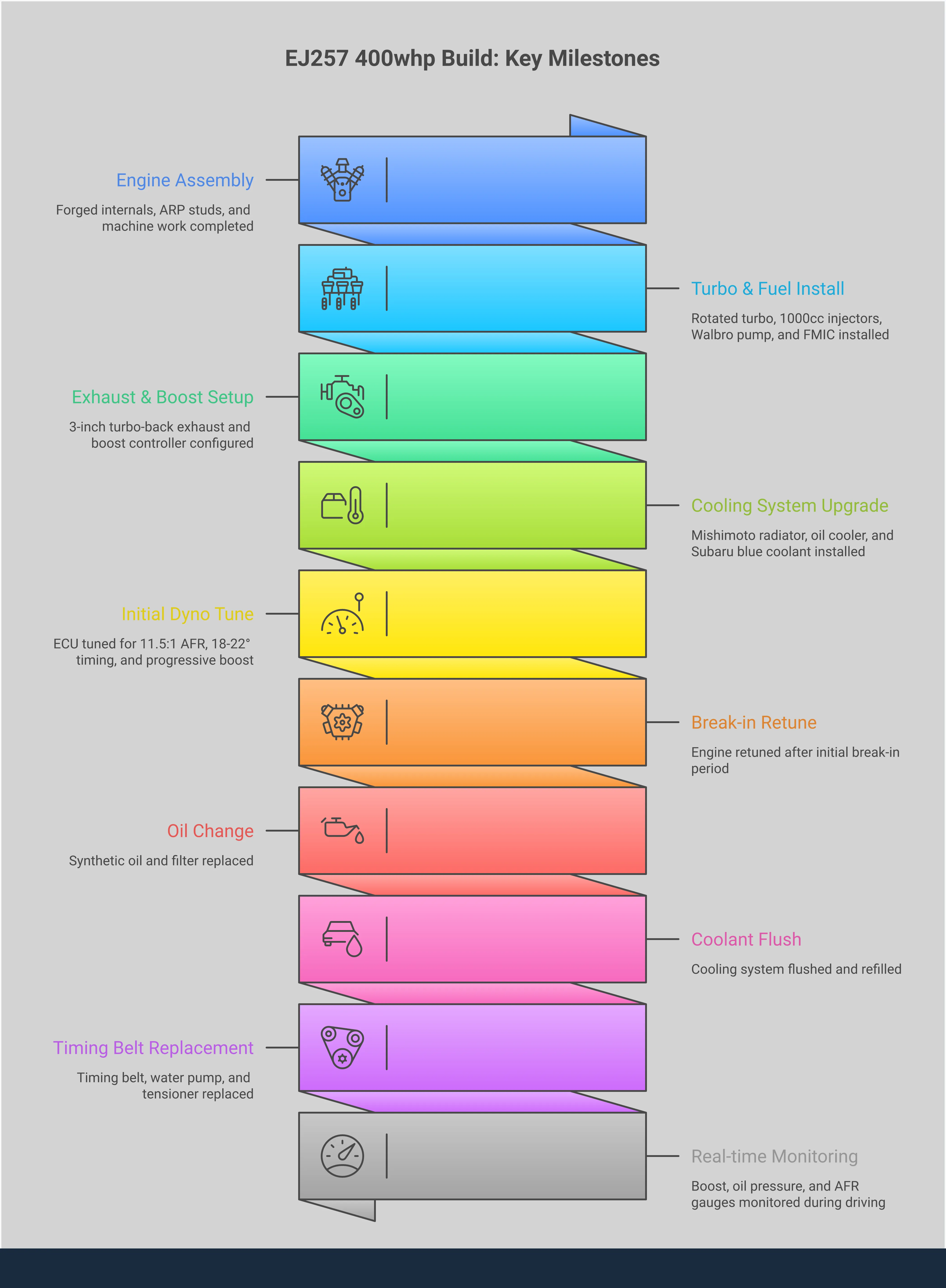
Your Step-by-Step 400whp EJ257 Build Guide
Building a 400whp EJ257 isn't just about buying powerful parts; it's about executing a smart, methodical plan. A successful build balances power with reliability, ensuring your Subaru delivers thrilling performance without compromising its longevity. The right approach involves careful planning, a specific installation order, and a disciplined break-in period. Following these steps will help you create a powerful engine that you can depend on, whether you're on the street or the track. Let's walk through the essential phases of your build.
Step 1: Planning Your Build Strategy
Before you buy a single component, map out your entire build. A successful project requires a clear strategy that considers your goals, budget, and how each part will work together. To build a reliable 400whp Subaru STI, it is essential to choose proven performance parts, fueling, and tuning. Start by creating a detailed list of every upgrade you'll need, from the turbo and fuel injectors to the intercooler and exhaust. Research each component to ensure compatibility and quality. This initial planning phase is the most critical step for preventing costly mistakes and ensuring all your new parts create a cohesive, high-performing system.
Checking Engine Block Casting Codes
Before you order a single part, you need to know exactly what you're working with. This is especially important if you're building from a used or JDM engine block. Every Subaru engine has casting codes stamped directly onto the block, often on the top surface below the alternator. These codes, like 'b25c' or 'EJ25', confirm the engine's displacement and series. Different production years also used different castings, such as the '701' or '702' blocks, which can have subtle but important variations. Verifying these numbers is a critical step because it ensures you purchase compatible performance parts, from pistons to head gaskets. Ordering the wrong components for your specific block is a surefire way to run into assembly issues or, even worse, engine failure down the line.
Step 2: What to Install and When
The order in which you install your parts is just as important as the parts themselves. Certain upgrades must be in place to support others. For example, you should address your fuel system before adding a larger turbo to prevent the engine from running lean. We have seen many high-horsepower builds on a stock engine that start with a rotated turbo kit and bigger fuel injectors and a fuel pump. This highlights how foundational these systems are. A logical sequence ensures your engine has the necessary support at every stage, protecting it from damage and maximizing the gains from each new component. Think of it as building a strong foundation before putting up the walls.
Step 3: The All-Important Engine Break-In
Once your engine is assembled, the work isn't over. A proper break-in period is essential for seating new components like pistons and rings, which ensures a strong seal and long engine life. A good tune is critical for the engine's longevity, and following proper break-in procedures can help ensure that the engine remains reliable at higher power levels. This typically involves driving the car gently for the first several hundred miles, varying the engine speed, and avoiding high boost or RPMs. After the initial period, an oil change is crucial to remove any metal particles from the new parts. Pairing this process with professional engine tuning services will solidify your build's power and reliability.
How Much Does a 400whp EJ257 Build Cost?
Planning your budget is one of the most critical steps in any engine build. The total cost for a reliable 400whp EJ257 can vary widely depending on the parts you choose, whether you do the work yourself, and the condition of your starting platform. It’s not just about the big-ticket items; the smaller components, labor, and tuning all contribute to the final number. A well-planned budget prevents you from cutting corners on essential components that ensure the engine’s longevity and performance.
Think of your build in three main categories: the core performance parts required to make the power, the decision to build the engine block or stick with the stock internals, and the often-overlooked costs that can surprise you at the end. Breaking it down this way helps you create a realistic financial plan and prioritize where to invest your money for the best results. A smart build focuses on creating a balanced and reliable system, not just chasing a peak horsepower number.
Breaking Down the Costs: Parts and Labor
To reach 400whp, your EJ257 needs to breathe better and get more fuel. The core of your parts list will include a larger turbocharger, a high-flow fuel pump, and bigger fuel injectors. You’ll also need supporting performance parts like an upgraded top-mount or front-mount intercooler, a free-flowing exhaust system, and an intake. Each of these components plays a vital role in safely achieving your power goals.
Labor is another significant part of the equation. While some enthusiasts handle installation themselves, professional assembly is highly recommended to avoid costly mistakes. Shop labor rates vary by location and expertise, but investing in a technician who specializes in Subarus is always a wise choice. They can ensure everything is installed and calibrated correctly, which is fundamental to the engine's reliability.
Example: A Complete 400whp Package Cost
To give you a concrete idea, a complete and reliable 400whp package typically costs between $8,000 and $12,000. This range accounts for all the essential hardware, including a responsive turbocharger, a full fuel system with an upgraded pump and injectors, a high-efficiency intercooler, and a turbo-back exhaust. Crucially, this budget should also cover professional installation and a custom tune, which are non-negotiable for engine safety. While it's a serious investment, this approach ensures you're building a balanced system with quality performance parts designed for both power and long-term durability. It’s the smart way to avoid cutting corners that could lead to a much more expensive engine failure down the road.
The Cost of Building vs. Buying a Stock Engine
One of the biggest questions is whether to build the engine block itself. The good news is that a healthy stock EJ257 block can often handle 400whp with the right bolt-on parts and a precise tune. This path saves you a significant amount of money, as you avoid the cost of forged pistons, connecting rods, and the associated machine work and labor. For many street-driven Subaru STI upgrades, the stock block is perfectly adequate.
However, if you plan to push the car on the track or want an extra layer of security, a built short block is the way to go. This involves strengthening the engine's rotating assembly, which can easily double or triple the cost of your build. A built engine provides a much stronger foundation for future power increases, but for a 400whp goal, it's often a choice of security over necessity.
How Much Is a Factory EJ257 Short Block?
A factory OEM (Original Equipment Manufacturer) EJ257 short block will typically run you between $2,500 and $3,100. This is a solid option if you're aiming for a fun street car and plan to keep power levels under the 400whp mark. However, it's important to remember that the stock internals are the engine's primary weak point. To safely reach 400whp and maintain reliability, upgrading to forged pistons and connecting rods is the recommended path. While a factory block can be a cost-effective starting point, those serious about long-term performance should consider investing in a built short block with stronger internals to prevent common engine failures.
Don't Forget These Hidden Costs
Beyond the main hardware, several other expenses are essential for a successful build. The most important is a professional tune. Your new parts won’t work together correctly or safely without custom engine tuning services to recalibrate the ECU. This is not an area to save money on, as a bad tune can destroy even the strongest engine.
You should also budget for a new clutch, as the stock one likely won't handle the increased torque. Other potential costs include upgraded fluid dampers, air/oil separators, and various gaskets and fluids needed during assembly. Finally, remember that a higher-performance engine requires more diligent maintenance, including more frequent oil changes with high-quality oil, to keep it running strong for years to come.
When to Buy Parts for the Best Deals
A 400whp build is a serious investment, but smart timing can make a big difference for your budget. If you have the patience, planning your major purchases around key holidays is an excellent strategy. Many retailers run significant sales during periods like Black Friday, Memorial Day, and Veterans Day. Timing your purchases this way isn't about cutting corners; it's about making your budget work harder for you. The money you save on a turbo or fuel system can be reinvested into other critical areas, like a professional tune or other high-quality performance parts. This approach helps ensure you can afford everything needed for a reliable engine that lasts.
Maintain Your High-Performance EJ257
Once you’ve built your 400whp EJ257, the work isn’t over. A high-performance engine demands more attention than a stock one, and consistent maintenance is what separates a reliable build from a ticking time bomb. Pushing your engine to its limits means you also need to be disciplined with its upkeep. Staying on top of a strict service schedule, actively monitoring performance, and knowing the early warning signs of trouble are the keys to enjoying your powerful Subaru for years to come. This proactive approach will save you from costly repairs and keep your car performing at its peak.
Cleaning the System After an Engine Failure
If your EJ257 suffered a catastrophic failure, like a spun bearing or cracked piston, your work is just beginning. Before you even think about installing a new short block, you have to address the contamination left behind. Tiny metal particles from the old engine have circulated through your entire oiling system, and if they aren't completely removed, they will act like liquid sandpaper and destroy your new engine in short order. This isn't a step you can skip. A thorough cleaning is the most critical insurance policy for your investment, ensuring your new build has a clean environment to operate in from the very first startup.
Your focus should be on the entire oiling circuit. Components with small, intricate passages are notorious for trapping debris. The factory oil cooler, for example, is impossible to flush completely and must be replaced—no exceptions. The same goes for the turbocharger's oil feed and return lines. Your turbocharger and AVCS cam gears should be professionally disassembled and inspected, or replaced entirely. Taking the time to replace these key performance parts is far cheaper than rebuilding your new engine a second time. A clean system is the foundation of a reliable high-horsepower build.
Creating Your Maintenance Schedule
With a modified engine, the factory service intervals no longer apply. You need to be much more proactive. Start with your oil. For any modified EJ257, you should change the oil and filter every 3,000 to 4,000 miles. The increased power and heat put more stress on the engine, breaking down oil faster. Another critical item is the timing belt. This should be replaced around every 100,000 miles, along with its related components. If that belt fails, it can cause catastrophic engine damage that is often beyond repair. Keeping up with these services is a non-negotiable part of owning a high-horsepower build.
How to Monitor Engine Performance
Your ears and eyes are some of the best tools for monitoring your engine’s health. A professional tune is essential for setting the right parameters, but it’s up to you to ensure everything is operating as it should. Pay close attention to how your car feels and sounds. One of the biggest threats to your engine is "knock," which is an uncontrolled explosion in the combustion chamber. Proper engine tuning services are designed to prevent this, but it’s still something to be aware of. Installing gauges for boost, oil pressure, and air-fuel ratio can give you real-time data, allowing you to spot a problem before it becomes a disaster.
Listen to Your Engine: Warning Signs You Can't Ignore
Knowing what to look for can save your engine from catastrophic failure. Pushing a stock block to 400whp is risky, and even a fully built motor requires your full attention. If you drive the car hard, especially in track conditions, the risk of failure increases significantly. Be alert for any sudden changes. This includes unusual noises like knocking or ticking, a sudden loss of power, or excessive smoke from the exhaust. If you notice any of these signs, back off immediately and get the engine inspected. Ignoring a small issue is the quickest way to turn it into a major, wallet-draining problem.
Related Articles
Frequently Asked Questions
Is it absolutely necessary to build the engine with forged internals for 400whp? While it's technically possible to reach 400whp on a stock block with a perfect tune and ideal conditions, it is not recommended for long-term reliability. The stock pistons are a known weak point and are prone to failure at that power level. Upgrading to forged pistons and connecting rods is the most important step you can take to build a durable engine. Think of it as insurance for your investment; it provides the strength needed to handle the increased stress safely.
How will a 400whp build change how my car feels for daily driving? A 400whp build will transform your car into a much more powerful and responsive machine, especially at higher RPMs. However, daily drivability depends heavily on your turbo choice and the quality of your tune. A larger turbo might introduce more lag, meaning power will come on a bit later than it did with the stock setup. A skilled tuner can smooth out the power delivery, making the car feel aggressive when you want it to be but still manageable for regular driving.
Do I have to use E85 fuel to reach 400whp? You don't have to use E85, but it is highly recommended for both performance and safety. E85's higher octane rating and cooling properties make it much more resistant to engine knock, which is a major cause of failure. This allows a tuner to create more power safely. While you can still make good power on premium pump gas (like 91 or 93 octane), the tune will need to be more conservative, and you'll be closer to the engine's safety limits.
Besides the engine parts, what other components will I likely need to upgrade? A 400whp build requires a holistic approach. The stock clutch will not be able to handle the significant increase in torque, so an upgraded clutch is essential. You should also plan for cooling system upgrades, such as a larger radiator or an external oil cooler, to manage the extra heat your engine will produce. These supporting modifications are not optional; they are critical for keeping your entire powertrain reliable.
What is the single most important step in the entire build process? Without a doubt, the most critical step is the professional engine tune. All the high-quality parts in the world won't work together correctly without a precise calibration. A professional tuner customizes the engine's software to match your specific combination of parts, ensuring the air-fuel ratios and timing are perfect. This is what protects your engine from damage, maximizes performance, and ultimately determines the success and longevity of your build.