

Guía sobre la fiabilidad y el rendimiento del motor EJ25
Compraste tu Subaru por su potencial. El agarre de la tracción total, el turbocompresor... todo pide a gritos más potencia. Pero antes de buscar cifras más altas, desde una simple modificación hasta una configuración completa para circuito, debes preguntarte: ¿podrá el motor de serie con ello? Añadir simplemente la sobrealimentación es una apuesta arriesgada. El secreto para liberar el verdadero potencial de tu coche no es solo añadir potencia; es construir una base que la soporte. Esta guía trata sobre cómo crear una fiabilidad de rendimiento del motor a prueba de balas. Te mostraremos cómo fortalecer tu motor para que puedas disfrutar de cada caballo de potencia con confianza.
Conclusiones clave
- Priorice el mantenimiento como su primera mejora : Un EJ25 confiable comienza con una rutina de mantenimiento rigurosa. Acorte los intervalos de cambio de aceite y vigile de cerca su sistema de refrigeración para crear una base sólida para futuras modificaciones de rendimiento.
- Refuerce los puntos débiles conocidos del motor : Proteja su inversión solucionando los puntos de falla comunes antes de que ocurran. Mejoras como un separador de aire/aceite, un tubo de toma de aceite más resistente y componentes internos forjados son cruciales para construir un motor resistente que pueda soportar con fiabilidad el aumento de potencia.
- Combine piezas de calidad con una puesta a punto profesional : Un hardware de alto rendimiento es solo la mitad de la ecuación. Una construcción exitosa depende de un ensamblaje preciso, un período de rodaje adecuado y una puesta a punto profesional para garantizar que todos sus nuevos componentes funcionen en conjunto para una alimentación segura y confiable.
Conceptos básicos sobre la confiabilidad del motor
Antes de profundizar en los detalles del EJ25, es útil comprender qué hace que un motor sea confiable. En esencia, la confiabilidad del motor se basa en un equilibrio entre diseño, materiales y gestión del estrés. Un motor bien construido no se trata solo de alcanzar grandes valores de potencia en un banco de pruebas; se trata de entregar esa potencia de forma constante y segura, ya sea en una ruta o en un día de pista. Factores como la calidad de los metales utilizados, la complejidad del diseño y la agresividad del ajuste del motor influyen enormemente en su vida útil. Reflexionar sobre estos fundamentos le dará una idea mucho más clara de por qué ciertas mejoras son esenciales para su Subaru y cómo contribuyen a una construcción en la que puede confiar durante años.
¿Qué hace que un motor sea confiable?
La fiabilidad no es casualidad; es el resultado de decisiones de ingeniería intencionales. Dos de los factores más importantes que determinan la durabilidad de un motor son su construcción física y las instrucciones electrónicas que le indican cómo funcionar. Un motor construido con materiales robustos y un diseño sencillo tiene una ventaja inherente en cuanto a longevidad. De igual manera, un motor ajustado para funcionar correctamente dentro de sus límites mecánicos experimentará mucho menos desgaste que uno llevado al máximo. Comprender esta interacción entre hardware y software es el primer paso para construir un motor potente y fiable para su Subaru.
El papel de los materiales y la simplicidad del diseño
Cuando se trata de la longevidad del motor, cuanto más simple, mejor. Como señala una fuente, «Los motores con un diseño sencillo, con menos piezas, tienden a durar más». Menos componentes implican menos puntos potenciales de fallo. La elección del material es igualmente crucial. El uso de metales de alta calidad, como acero forjado o hierro fundido, para componentes clave como pistones y bielas les ayuda a soportar el calor y la presión, previniendo el desgaste prematuro. Por eso, la actualización a piezas de alto rendimiento forjadas es fundamental para construir un EJ25 robusto; se reemplazan piezas fundidas de fábrica más débiles con materiales diseñados para soportar la tensión de un mayor rendimiento sin sacrificar nada.
Ajuste conservador vs. alto rendimiento
Llevar un motor al límite es una forma segura de acortar su vida útil. Una puesta a punto conservadora que mantiene el motor funcionando dentro de un margen seguro reduce la tensión en los componentes internos, lo que se traduce en una mayor vida útil. Esto no significa que no pueda generar una potencia significativa. Una puesta a punto profesional se centra en encontrar el equilibrio perfecto entre rendimiento y fiabilidad. Los técnicos expertos que ofrecen servicios de puesta a punto se centran en crear una banda de potencia uniforme y en garantizar que el consumo de combustible y el tiempo de encendido estén optimizados para su combinación específica de piezas, lo que protege su inversión y le ofrece una experiencia de conducción emocionante.
Cómo el diseño del motor afecta la durabilidad
La disposición física de un motor influye directamente en su rendimiento y durabilidad a largo plazo. Las diferentes configuraciones, como la en línea, la de tipo V o la bóxer de su Subaru, presentan ventajas y desventajas únicas. El número de cilindros, la disposición de los pistones e incluso el tipo de combustible contribuyen a su fiabilidad general. Estos fundamentos de diseño influyen en todo, desde la complejidad del mantenimiento hasta la capacidad del motor para manejar las modificaciones de rendimiento, lo que los convierte en un factor importante a considerar al planificar su construcción.
Motores en línea vs. motores en V
La configuración del motor juega un papel importante en la confiabilidad. Los motores en línea, como los de cuatro cilindros o seis cilindros, suelen ser elogiados por su durabilidad, ya que su diseño simple resulta en menos piezas móviles y un excelente balance primario. Los motores en V, como los de seis cilindros o ocho cilindros, pueden generar más potencia en un conjunto compacto, pero son inherentemente más complejos, lo que puede generar necesidades de mantenimiento más complejas. El Subaru EJ25 utiliza un diseño "bóxer" o de cuatro cilindros planos, donde los pistones se mueven horizontalmente. Esta disposición proporciona un centro de gravedad bajo para una maniobrabilidad superior, pero también implica consideraciones únicas de lubricación y refrigeración que deben tenerse en cuenta al aumentar la potencia.
Longevidad de la gasolina frente al diésel
Si bien la mayoría de los Subaru de alto rendimiento funcionan con gasolina, es interesante destacar la durabilidad inherente de los motores diésel. Generalmente, los motores diésel se construyen con componentes mucho más resistentes para soportar sus mayores relaciones de compresión. Esta sobreconstrucción significa que, con el cuidado adecuado, suelen durar más que sus homólogos de gasolina. Sin embargo, los principios siguen siendo los mismos: un motor bien mantenido, fabricado con piezas de calidad, siempre tendrá más probabilidades de durar mucho tiempo, independientemente del combustible que utilice. Esto refuerza la importancia de invertir en una base sólida para su EJ25 de gasolina.
Turboalimentado vs. aspirado naturalmente: una comparación de confiabilidad
El debate entre motores turboalimentados y atmosféricos suele reducirse a un equilibrio entre la potencia y la complejidad. Un motor atmosférico utiliza la presión atmosférica para llenar sus cilindros de aire, lo que resulta en un diseño más simple y, a menudo, más fiable, con menos piezas susceptibles de fallo. En cambio, un motor turboalimentado utiliza los gases de escape para hacer girar una turbina, lo que impulsa más aire hacia el motor y genera significativamente más potencia con la misma cilindrada. Esta mayor complejidad introduce más calor y presión, lo que somete a mayor tensión a los componentes del motor y exige un mantenimiento más minucioso y modificaciones de soporte para garantizar la fiabilidad a largo plazo.
¿Qué es el bloque corto EJ25?
Si eres un entusiasta de Subaru, seguro que has oído hablar del EJ25. Este motor es el corazón de muchos modelos icónicos, desde el WRX STI, inspirado en los rallyes, hasta el versátil Forester XT. Pero ¿qué es exactamente el "bloque corto"? En pocas palabras, el bloque corto es la mitad inferior del motor. Es la base que incluye el bloque motor, el cigüeñal, las bielas y los pistones. Considéralo el motor principal, donde se inician la combustión y la generación de energía.
Comprender el bloque corto EJ25 es crucial, ya que es la clave del rendimiento de tu Subaru y, a menudo, el foco de las preocupaciones sobre fiabilidad. Los componentes de serie están diseñados para la conducción diaria y pueden soportar aumentos moderados de potencia, pero al forzar aumentos más significativos, sus límites pueden quedar al descubierto. Aquí es donde pueden surgir problemas comunes, como fallos en la junta de culata o problemas con los anillos del pistón. Por eso, muchos propietarios optan por un bloque corto "prefabricado": una versión reforzada con componentes mejorados diseñados para soportar la presión de una mayor potencia. Antes de analizar los problemas comunes y sus soluciones, analicemos su diseño básico, qué modelos lo incorporan y qué hace que su diseño bóxer sea tan especial.
Dentro del EJ25: Componentes principales y diseño
En esencia, el bloque corto del EJ25 es un conjunto de piezas móviles esenciales. El bloque del motor alberga los cilindros donde los pistones se desplazan hacia arriba y hacia abajo. El cigüeñal convierte este movimiento lineal en la fuerza de rotación que, en última instancia, hace girar las ruedas. Las bielas conectan los pistones al cigüeñal. Cuando se habla de un bloque corto prefabricado, significa que estas piezas de fundición originales se han sustituido por componentes internos forjados de alta resistencia.
Actualizar a un bloque corto es como comprar un seguro contra fallas catastróficas del motor. Crea una base duradera que puede soportar con seguridad la presión de una potencia significativamente mayor y una puesta a punto agresiva. Estas piezas de mayor rendimiento están diseñadas para soportar mayor calor y presión, lo que le brinda la confianza para impulsar su vehículo sin preocuparse por que un componente crítico ceda.
¿Qué modelos de Subaru utilizan el motor EJ25?
El motor EJ25 ha sido un elemento básico en la gama de Subaru durante décadas, impulsando algunos de sus modelos más populares en Estados Unidos. Fue diseñado para ofrecer a los conductores estadounidenses el par motor a bajas revoluciones y la potencia inmediata que buscaban. Si has conducido un Subaru de alto rendimiento desde 2002 hasta la actualidad, es muy probable que tengas alguna versión del EJ25 bajo el capó.
Encontrarás este motor en modelos icónicos como el Subaru WRX de 2006 a 2014 y el Subaru WRX STI de 2004 a 2021. También impulsó el Forester XT de 2004 a 2013, el Legacy GT de 2005 a 2012 y el Outback XT de 2005 a 2009. Cada modelo tiene una variante ligeramente diferente del EJ25, pero todos comparten la misma arquitectura fundamental.
Por qué es importante el diseño del motor bóxer
Una de las características más distintivas del EJ25 es su diseño "boxer". A diferencia de los motores en línea o en V, donde los pistones se mueven verticalmente, un motor boxer tiene una disposición de cuatro cilindros bóxer. Los pistones están horizontalmente opuestos, acercándose y alejándose como un boxeador lanzando puñetazos. Este diseño es un sello distintivo de la ingeniería de Subaru y ofrece una importante ventaja en el rendimiento.
El diseño plano le otorga al motor un perfil más bajo, lo que resulta en un centro de gravedad más bajo para todo el vehículo. Esto mejora la estabilidad, reduce el balanceo de la carrocería en las curvas y otorga a los vehículos Subaru su famosa agilidad de manejo. El equilibrio inherente del motor también contribuye a una entrega de potencia más suave. Si bien produce buena potencia en su versión de fábrica, este diseño único lo convierte en una plataforma excelente para modificaciones de rendimiento y servicios de ajuste de motores especializados.
Problemas comunes del EJ25 a tener en cuenta
El motor Subaru EJ25 es un auténtico icono, propulsando algunos de los coches de alto rendimiento con tracción total más apreciados. Su característico rugido bóxer y su increíble potencial de ajuste le han granjeado una clientela fiel. Sin embargo, como cualquier motor llevado al límite, el EJ25 tiene algunos puntos débiles bien documentados. Familiarizarse con estos problemas no se trata de centrarse en los aspectos negativos, sino de ser un propietario y constructor inteligente. Al comprender los posibles desafíos del motor, se pueden abordar de forma proactiva, transformando esas debilidades en fortalezas.
Piensa en ello como construir una base sólida. Antes de empezar a añadir potencia, necesitas asegurarte de que el núcleo de tu motor esté preparado para ello. Abordar estos problemas comunes desde el principio es la clave para crear un motor potente y fiable que puedas disfrutar con confianza, ya sea conduciendo por una carretera de montaña sinuosa, en una sesión de fin de semana en la pista o explorando un sendero remoto. Cada posible problema presenta una oportunidad para actualizarlo con componentes superiores que no solo solucionan el problema, sino que también mejoran la durabilidad y el rendimiento general del motor. Con un enfoque estratégico, puedes construir un EJ25 mucho más robusto que cuando salió de fábrica, listo para cualquier desafío.
Ese famoso problema de la junta de culata
Si has estado en el mundo de Subaru, probablemente hayas escuchado hablar de las juntas de culata. En el EJ25, la falla de la junta de culata puede deberse a factores como el sobrecalentamiento, el alto kilometraje o el aumento de la presión en los cilindros debido a modificaciones de rendimiento. Las señales reveladoras suelen incluir una pérdida inexplicable de refrigerante, el aumento de la temperatura del motor y la salida de humo blanco y fragante del escape. Esto indica una fuga entre los conductos de refrigerante y la cámara de combustión. La solución correcta implica más que un simple reemplazo; es una oportunidad para instalar juntas de culata de acero multicapa (MLS) duraderas y espárragos de culata mejorados. Esta combinación proporciona un sellado mucho más resistente y fiable, lo que la convierte en un paso esencial para cualquier mejora del Subaru WRX orientada al rendimiento.
Cómo abordar el consumo excesivo de petróleo
Muchos propietarios de EJ25 notan que sus motores consumen aceite entre cambios, un problema que puede agravarse en vehículos modificados. Esto suele deberse al escape de aceite, donde el vapor de aceite del cárter se introduce en el sistema de admisión durante la sobrealimentación. Esto no solo reduce el nivel de aceite, sino que también puede cubrir el intercooler y las válvulas, reduciendo el octanaje efectivo del combustible y perjudicando el rendimiento. La solución más eficaz es instalar un separador de aire/aceite (AOS) de alta calidad. Un sistema AOS intercepta estos vapores aceitosos, separando el aceite y devolviéndolo al cárter, permitiendo el paso de aire limpio. Esto mantiene el aceite en su sitio y protege el motor de los riesgos de funcionar con un nivel bajo de aceite.
Cómo prevenir fallas en pistones y anillos
Los pistones de serie en los motores EJ25 turboalimentados son un punto débil conocido, especialmente al aumentar la sobrealimentación y la potencia. La falla de Ringland ocurre cuando la pequeña pieza del pistón que separa los segmentos se agrieta o se rompe. Esto provoca una pérdida repentina de compresión, un detonación notable y una disminución drástica del rendimiento, que a menudo requiere una reconstrucción completa del motor. Este tipo de falla suele deberse a la detonación (detonación), que somete a los pistones a una tensión extrema. Para construir un motor verdaderamente resistente, la actualización a pistones forjados es indispensable. Los componentes internos forjados son significativamente más resistentes que los componentes fundidos de fábrica y son fundamentales para cualquier motor que busque una potencia fiable y confiable con piezas de alto rendimiento de calidad.
Solución de problemas de cojinetes y flujo de aceite
La falla de los cojinetes de biela es uno de los problemas potenciales más graves para un EJ25, y a menudo resulta en daños catastróficos en el motor. Este problema generalmente se debe a la falta de aceite. Durante una conducción agresiva, las fuerzas G elevadas pueden provocar que el aceite se escape del tubo de aspiración, privando momentáneamente a los cojinetes de biela de la lubricación que tanto necesitan. Con el tiempo, el desgaste de los muñones de bancada del bloque del motor también puede provocar una caída de la presión del aceite. Mejorar el sistema de lubricación con componentes como un cárter de aceite de alta capacidad, un tubo de aspiración mejorado y una placa deflectora es fundamental para prevenir la falta de aceite y garantizar que la parte inferior del motor se mantenga en buen estado bajo presión.
Por qué es tan importante la calidad de la fundición
No todos los bloques de motor son iguales. Los procesos de fabricación en fábrica pueden generar pequeñas inconsistencias en la fundición del bloque, lo que puede convertirse en problemas importantes en una construcción de alta potencia. Algunos bloques pueden presentar ligeras variaciones en la densidad del material o el grosor de la pared, lo que puede crear puntos débiles al someterse a las tensiones de mayor potencia y par. Por eso, una construcción meticulosa de un motor comienza con un bloque cuidadosamente seleccionado e inspeccionado. Para una configuración verdaderamente a prueba de balas, es fundamental confiar en el conocimiento de expertos. Los servicios y constructores profesionales de puesta a punto de motores se toman el tiempo necesario para garantizar que cada componente, empezando por el propio bloque, cumpla con los más altos estándares requeridos para un motor duradero y de alto rendimiento.
Comprar un auto usado: Qué revisar en un EJ25
Ya sea que compre un auto completo o solo un motor usado para un proyecto, una inspección minuciosa es su mejor defensa contra heredar los problemas de otros. Un EJ25 en buen estado es el punto de partida perfecto para una construcción de alto rendimiento y confiable, pero uno descuidado puede convertir rápidamente el proyecto de sus sueños en una pesadilla financiera. Antes de comprometerse, es esencial investigar y buscar indicios de la vida útil del motor. Prestar atención a los registros de mantenimiento y realizar algunas pruebas de diagnóstico clave puede revelar el verdadero estado del motor y ayudarle a realizar una inversión inteligente. Esta diligencia inicial le ahorrará tiempo, dinero y mucha frustración en el futuro.
La importancia del historial de servicio
Un historial de servicio detallado es uno de los activos más valiosos que puede encontrar al evaluar un EJ25 usado. Una pila de recibos que muestren cambios de aceite, purgas de refrigerante y otros mantenimientos rutinarios constantes es un fuerte indicador de que el dueño anterior cuidó el vehículo. Como siempre decimos, debe priorizar el mantenimiento como su primera actualización . Un motor con una rutina de mantenimiento sólida tiene una base mucho más sólida para futuras modificaciones. Busque evidencia de intervalos de cambio de aceite reducidos, especialmente si el auto fue modificado, y verifique que el sistema de enfriamiento haya recibido el cuidado adecuado. Este historial documentado le da la confianza de que está comenzando con una base sólida, no con un motor que ya está al borde del colapso.
Por qué es una buena idea realizar una prueba de compresión
Si el historial de servicio es el currículum del motor, la prueba de compresión es la entrevista. Esta sencilla prueba de diagnóstico mide la presión dentro de cada cilindro, lo que permite observar directamente el estado de los pistones, anillos y válvulas. Lo que se busca son valores constantes en los cuatro cilindros. Un motor en buen estado mostrará lecturas uniformes, pero variaciones significativas pueden indicar problemas internos graves, como anillos de pistón desgastados, una junta de culata defectuosa o problemas en las válvulas. Una prueba de compresión es un procedimiento relativamente rápido y económico que puede evitarle comprar un motor que requiera una reconstrucción inmediata y costosa, lo que la convierte en un paso esencial en cualquier inspección previa a la compra.
Mantenimiento del EJ25 para una confiabilidad a largo plazo
Mantener tu EJ25 en óptimas condiciones no es cuestión de suerte, sino de un mantenimiento proactivo. Este motor puede ser increíblemente confiable si le prestas la atención que merece. Al estar al tanto de algunas áreas clave, puedes abordar los puntos de falla comunes antes de que se conviertan en problemas catastróficos. Piensa en esto como la base para todas las futuras modificaciones de rendimiento. Un motor de fábrica en buen estado es el mejor punto de partida para una construcción potente y confiable. Repasemos los hábitos esenciales que protegerán tu inversión y te mantendrán en la carretera o en la pista durante años.
Siga un programa de cambio de aceite inteligente
Aunque Subaru recomienda un cambio de aceite cada 9.600 km, debe considerarse como un máximo, no como un objetivo. Para un motor como el EJ25, especialmente si tiene turbocompresor o se conduce con mucha intensidad, los cambios más frecuentes son una garantía económica. Recomiendo cambiar el aceite y el filtro cada 6.400 km o cada cuatro meses, lo que ocurra primero. Este sencillo hábito ayuda a prevenir la degradación del aceite y garantiza que los componentes internos estén correctamente lubricados, lo que reduce el desgaste. Usar aceite sintético de alta calidad es fundamental. El aceite limpio es el alma de su motor, y seguir un programa riguroso es la mejor manera de protegerlo a largo plazo.
Mantenga su sistema de enfriamiento bajo control
El sobrecalentamiento es el mayor problema del EJ25, y a menudo provoca la temida falla de la junta de culata. El sistema de refrigeración es la primera línea de defensa. Acostúmbrese a revisar regularmente los niveles de refrigerante e inspeccionar las mangueras para detectar grietas o fugas. Preste mucha atención al indicador de temperatura mientras conduce. Si nota que sube más de lo habitual, repárelo de inmediato. Las principales señales de advertencia de un problema en el sistema de refrigeración o un posible problema en la junta de culata incluyen pérdida inexplicable de refrigerante, motor sobrecalentado o humo blanco saliendo del escape. El mantenimiento de este sistema es fundamental para prevenir los daños relacionados con el calor que pueden dejar a su Subaru fuera de circulación.
Conozca los intervalos de servicio de su correa de distribución
La correa de distribución es un componente fundamental que no debe ignorarse. Si falla, los pistones pueden golpear las válvulas, causando daños catastróficos y costosos al motor. El manual del propietario especifica el intervalo de reemplazo (normalmente alrededor de los 160.000 km) y debe considerarlo una fecha límite estricta. Al reemplazar la correa de distribución, también es habitual reemplazar la bomba de agua y los tensores al mismo tiempo. La bomba de agua es otro punto de falla potencial que puede provocar sobrecalentamiento, y como el mecánico ya está allí, reemplazarla es una medida preventiva y rentable que garantiza la renovación completa del sistema.
Detectar problemas: señales de alerta temprana
Aprender a escuchar a tu auto puede ahorrarte miles de dólares en reparaciones. Presta atención a los problemas comunes que reportan los propietarios de EJ25 para detectarlos a tiempo. Esto incluye síntomas de falla en la junta de culata, señales de consumo excesivo de aceite (como humo azul en el escape) o el sonido característico de falla en los segmentos del pistón, que puede sonar como un tictac o golpeteo persistente. Si notas una disminución repentina en el rendimiento, ruidos extraños o luces nuevas en el tablero, no los ignores. Investigar estas señales con prontitud te permitirá encontrar la causa raíz y solucionarla antes de que se convierta en un problema mucho mayor.
Señales universales de problemas en el motor
Tu Subaru casi siempre te avisará antes de que ocurra un problema grave; la clave está en saber qué buscar. Presta mucha atención a cualquier sonido nuevo o inusual, como un golpeteo o tictac persistente, que podría indicar problemas con los anillos del pistón o los cojinetes de biela. Un olor dulce y a jarabe en el escape, a menudo acompañado de humo blanco, es una señal clásica de una junta de culata defectuosa. Además, vigila de cerca los niveles de aceite. Si lo rellenas constantemente, podrías estar lidiando con un consumo excesivo de aceite debido a los gases de escape. Cualquier caída repentina de potencia o una nueva luz de verificación del motor debe investigarse de inmediato. Detectar estas señales a tiempo puede marcar la diferencia entre una reparación manejable con las piezas de alto rendimiento adecuadas y una reconstrucción completa del motor.
Por qué debería mantener registros detallados de mantenimiento
Ya sea que realice el trabajo usted mismo o recurra a un taller de confianza, mantenga un registro detallado de cada servicio realizado en su Subaru. Esto incluye cambios de aceite, purgas de fluidos, mantenimiento de la correa de distribución y cualquier reparación o instalación de piezas de alto rendimiento. Un historial de mantenimiento completo no solo es invaluable para solucionar problemas futuros, sino que también aumenta significativamente el valor de reventa de su auto. Al optar por servicios profesionales de ajuste de motor, su preparador tendrá una visión clara del estado y el historial de su motor, lo que le permitirá crear un ajuste más seguro y efectivo. Es una disciplina sencilla que da sus frutos a largo plazo.
Comparación del EJ25: Un vistazo a otros motores confiables
Es fácil dejarse llevar por los foros en línea donde la fiabilidad del EJ25 se debate sin cesar. Si bien tiene fama de ser sensible, es importante analizarlo en el contexto de otros motores legendarios. Ningún motor es indestructible, y cada diseño tiene su propia filosofía y características únicas. El EJ25 es un motor turboalimentado de alto rendimiento, diseñado para una experiencia de conducción emocionante, lo que lo distingue de los motores de aspiración natural para uso diario, diseñados exclusivamente para la eficiencia y la longevidad. Comprender estas diferencias es clave para apreciar la fiabilidad de cualquier motor.
El denominador común de todos los motores duraderos, desde los japoneses de cuatro cilindros hasta los V8 estadounidenses, no es una fórmula mágica: es el compromiso con un mantenimiento adecuado y el respeto por las limitaciones de diseño del motor. Muchos de los mejores motores de coche pueden durar cientos de miles de kilómetros con el cuidado adecuado. El EJ25 no es la excepción. Al abordar sus debilidades conocidas con piezas de alto rendimiento de calidad y seguir un riguroso programa de mantenimiento, se construye un motor que puede ofrecer un rendimiento increíble y una durabilidad sorprendente. Veamos cómo se compara su filosofía de diseño con la de otros motores conocidos por su larga duración.
Leyendas de la longevidad: Toyota y Honda
Cuando se habla de fiabilidad de motores, Toyota y Honda suelen ser los primeros nombres que vienen a la mente. Motores como el Toyota/Lexus V6 de 3,5 L y varios modelos Honda V6 se han ganado una reputación estelar por durar más de 400.000 kilómetros con un mantenimiento básico. Estos motores son los corredores de maratón del mundo automotriz. Por lo general, son de aspiración natural y se ajustan de forma conservadora de fábrica, priorizando un funcionamiento suave y constante sobre la potencia máxima. Su filosofía de diseño se centra en minimizar la tensión en los componentes internos para garantizar una vida útil prolongada y sin problemas. El EJ25, en cambio, es un velocista, diseñado para ofrecer una explosión de potencia, lo que inherentemente somete a mayor tensión a sus componentes. Esto no lo hace menos fiable, solo diferente. Simplemente requiere un enfoque más atento al mantenimiento y la voluntad de fortalecer sus cimientos para un rendimiento sostenido.
Los caballos de batalla: Motores estadounidenses y alemanes
En el otro extremo del espectro se encuentran los caballos de batalla, como el Mercedes-Benz OM617 diésel y los clásicos V8 estadounidenses como el Ford Windsor. Estos motores son legendarios por su gran robustez. El Mercedes diésel, fabricado principalmente en hierro fundido, es conocido por superar los 800.000 kilómetros, mientras que los V8 estadounidenses, sencillos y fáciles de reparar, suelen impulsar camiones y furgonetas mucho más allá de los 320.000 kilómetros. Su secreto reside en diseños robustos y sobredimensionados, y en un enfoque en el par motor a bajas revoluciones en lugar de la potencia a altas revoluciones. La lección más importante que nos enseñan estos fiables motores es que un mantenimiento diligente es el gran ecualizador. El mismo principio se aplica directamente a su Subaru. Si bien el EJ25 es una máquina más compleja y de alto rendimiento, proporcionarle aceite limpio, un sistema de refrigeración en buen estado y una puesta a punto profesional es la receta universal para una vida útil larga y potente.
¿Cómo puede proteger su motor EJ25?
Una vez que domine los fundamentos del mantenimiento, es hora de centrarse en la protección proactiva. El EJ25 es un motor capaz y apreciado, pero presenta vulnerabilidades bien documentadas que pueden provocar fallas costosas si no se abordan. Adoptar medidas estratégicas para fortalecer su motor no se trata solo de prevenir desastres; se trata de construir una base sólida que le permita alcanzar más potencia con confianza. Al abordar las causas fundamentales de los problemas comunes, puede transformar posibles puntos débiles en fortalezas. Este enfoque le permite pasar del simple mantenimiento de su Subaru a una mejora real para el futuro.
Centrarse en áreas críticas como el control de temperatura, la integridad del sistema de aceite y la calidad de los componentes protegerá su inversión. Las siguientes estrategias son esenciales para cualquier propietario de un EJ25 que desee disfrutar al máximo del potencial de su vehículo, ya sea para la conducción diaria, emocionantes días en pista o exigentes soluciones todoterreno. Considere estas mejoras como la armadura que su motor necesita para rendir al máximo durante años. Al implementar estas correcciones, no solo está reparando fallas, sino que está rediseñando los puntos débiles de su motor para crear una máquina más robusta y resistente, lista para afrontar cualquier desafío.
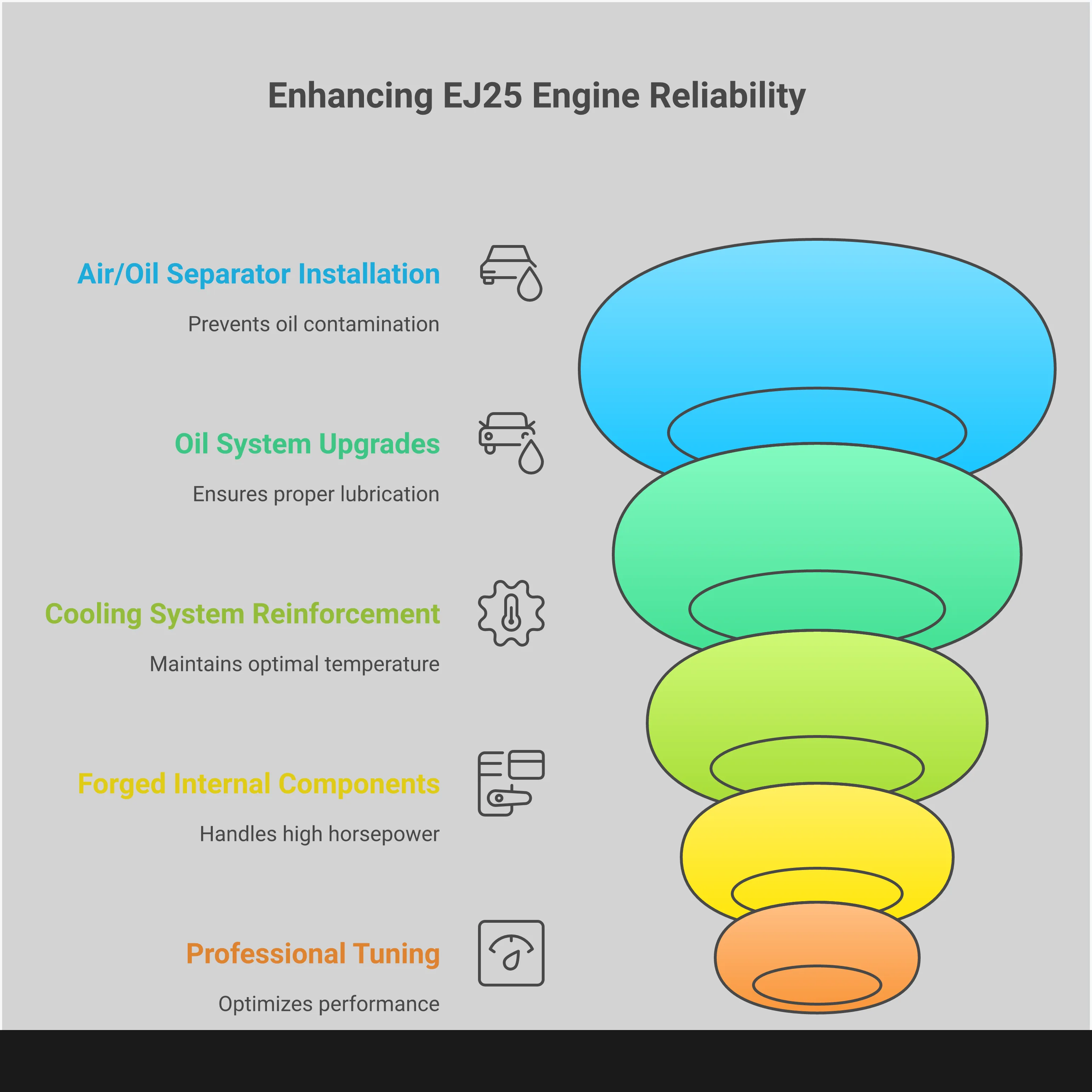
Mantenga la temperatura de su motor bajo control
El calor es el enemigo de cualquier motor de alto rendimiento, y el EJ25 no es la excepción. El sobrecalentamiento constante es una de las principales causas de fallos prematuros, especialmente en las juntas de culata. Como señala un experto: «Los fallos en las juntas de culata pueden deberse al sobrecalentamiento, al envejecimiento del motor o a un mantenimiento deficiente». Mantener estable la temperatura del motor es una de las medidas más eficaces para prolongar su vida útil. Un radiador de aluminio mejorado ofrece una capacidad de refrigeración significativamente mayor que el de serie, mientras que un termostato de menor temperatura puede ayudar a regular la temperatura con mayor eficacia durante una conducción intensa. Combinar estos elementos con un refrigerante de alta calidad y la inspección regular de las mangueras creará un sistema de refrigeración robusto que protegerá el motor del estrés del calor excesivo.
Por qué las piezas de alta calidad no son negociables
Al aumentar la potencia, se exponen los límites de los componentes originales del motor. Los pistones, bielas y cojinetes de fábrica fueron diseñados para una potencia específica, y forzarlos mucho más allá de esa capacidad puede provocar fallos. Invertir en piezas de calidad superior es crucial para la fiabilidad. Para quienes planean aumentar significativamente la potencia, un bloque corto EJ25 fabricado "reemplaza las piezas originales con componentes internos forjados de alta resistencia, diseñados para soportar considerablemente más potencia y tensión de forma fiable". Incluso si no se trata de una fabricación completa, elegir piezas de repuesto de alto rendimiento para cualquier reemplazo o mejora garantiza que el motor esté preparado para soportar las exigencias que se le imponen. Este enfoque convierte los posibles puntos débiles en fortalezas.
¿Debería instalar un separador aire/aceite (AOS)?
Si tiene un Subaru turboalimentado, un separador de aire/aceite (AOS) es una mejora indispensable para la protección del motor. El sistema de ventilación del cárter de fábrica puede permitir la entrada de vapor de aceite en la admisión, lo cual tiene graves consecuencias. Este aceite se mezcla con el aire y el combustible entrantes, reduciendo el octanaje del combustible y aumentando el riesgo de detonación. Para cualquier motor EJ turboalimentado, debería considerar la instalación de un separador de aire/aceite (AOS). Esto ayuda a mantener el aceite fuera del sistema de admisión, lo que mejora la refrigeración y previene la detonación del motor. Al capturar este vapor de aceite y devolverlo al cárter, un AOS mantiene limpia la carga de admisión, garantizando un rendimiento constante y seguro.
¿Por qué debería actualizar su tubo de recogida de aceite?
El tubo de toma de aceite de fábrica es un conocido talón de Aquiles del EJ25. Puede agrietarse cerca de su brida de montaje, lo que provoca que la bomba de aceite succione aire en lugar de aceite. Esto provoca una caída repentina y catastrófica de la presión del aceite. Como bien indicó un usuario del foro, muchos de estos motores "fallan por falta de flujo de aceite a los cojinetes de biela". Un motor con falta de aceite falla en segundos, a menudo destruyendo el cigüeñal, las bielas y los cojinetes. Cambiar a un tubo de toma de aceite de alta resistencia y totalmente soldado es una medida económica y esencial para protegerse contra este tipo de fallo. Es una pequeña pieza que proporciona una protección crucial para todo el conjunto del motor.
Mejoras inteligentes para un EJ25 más potente
Una vez que hayas abordado los puntos de mantenimiento comunes, puedes empezar a pensar en el rendimiento. Las mejoras inteligentes no solo aumentan la potencia; también construyen un motor más resistente y fiable. Centrarse en las debilidades conocidas del motor te permite sentar las bases para alcanzar tus objetivos de potencia futuros sin sacrificar la durabilidad. Estas modificaciones buscan construir un EJ25 equilibrado y robusto en el que puedas confiar, ya sea en la pista, en un sendero o en tus desplazamientos diarios.
Por qué los componentes internos forjados son revolucionarios
Los pistones de serie de un EJ25 son un punto débil conocido, especialmente al aumentar la sobrealimentación y la potencia. Cambiar a un bloque corto con componentes internos forjados es la mejor manera de crear una base duradera para el motor. Los pistones y bielas forjados son significativamente más resistentes que los componentes fundidos de fábrica, lo que les permite soportar el mayor estrés de una mayor potencia y una puesta a punto más agresiva. Considérelo una póliza de seguro contra fallos catastróficos. Este paso es esencial si tiene objetivos de rendimiento importantes para su Subaru WRX o STI.
Actualizaciones esenciales para su sistema de aceite
La falta de aceite es una de las principales causas de fallo de los cojinetes de biela en el EJ25. El sistema de lubricación de fábrica puede tener dificultades para proporcionar un flujo y una presión de aceite constantes, especialmente en curvas con alta gravedad o al forzar el motor al máximo. Actualizar componentes clave es fundamental para la longevidad del motor. Un tubo de recogida de aceite de alta calidad previene grietas y fallos, mientras que nuestro exclusivo separador de aire/aceite (AOS) de alto rendimiento de Crawford evita que el aceite contamine el sistema de admisión. Estas mejoras se combinan para garantizar que los cojinetes del motor reciban un suministro constante de aceite limpio, protegiéndolos del desgaste prematuro.
Actualizaciones del sistema de refrigeración que no debe omitir
El calor es el enemigo de cualquier motor de alto rendimiento, y el EJ25 es particularmente sensible al sobrecalentamiento, lo que puede provocar fallos en la junta de culata. El sistema de refrigeración de serie es adecuado para un coche de serie, pero puede saturarse rápidamente al añadir más potencia. Un radiador de aluminio mejorado ofrece una disipación de calor superior a la unidad de serie con depósitos de plástico. La combinación de un radiador de mejor calidad con refrigerante de alta calidad ayuda a mantener temperaturas de funcionamiento estables, protegiendo las juntas de culata y previniendo detonaciones. Esta es una forma sencilla pero eficaz de proteger su inversión en piezas de alto rendimiento.
Ajuste para un equilibrio entre potencia y confiabilidad
Las actualizaciones de hardware son solo la mitad de la batalla. Sin una puesta a punto adecuada, incluso las mejores piezas no funcionarán correctamente e incluso podrían dañar el motor. Una puesta a punto profesional ajusta los parámetros de combustible, sincronización y sobrealimentación del motor para que se ajusten a las modificaciones específicas. Este proceso garantiza que todos los nuevos componentes funcionen en armonía, ofreciendo una potencia segura y fiable. Es fundamental trabajar con un preparador con amplia experiencia en la plataforma EJ25. Un servicio de puesta a punto del motor adecuado no solo maximizará el rendimiento, sino que también mejorará la conducción y protegerá el motor a largo plazo.
El papel de los chips de rendimiento y el ajuste de la ECU
Probablemente haya visto anuncios de chips de alto rendimiento listos para usar que prometen aumentos de potencia instantáneos. Si bien estos dispositivos a veces ofrecen cambios menores, sus resultados suelen ser inconsistentes porque se basan en mapas genéricos y universales. Una estrategia mucho más efectiva y segura es una optimización profesional de la ECU. El hardware de alto rendimiento es solo la mitad de la ecuación; una configuración exitosa depende de una optimización profesional para garantizar que todos los nuevos componentes funcionen juntos para una potencia segura y confiable. Una optimización personalizada ajusta los niveles de combustible, sincronización y presión del motor para que se ajusten a sus modificaciones específicas. Sin este paso crucial, incluso las piezas de mejor rendimiento no funcionarán correctamente e incluso podrían dañar el motor. Para aprovechar al máximo sus actualizaciones, necesita servicios de optimización de motor de un especialista que comprenda las exigencias únicas de la plataforma EJ25.
Cómo construir un EJ25 a prueba de balas
Construir un EJ25 a prueba de balas no se trata de hacerlo indestructible, sino de crear un motor robusto y fiable capaz de soportar una gran potencia sin comprometer su integridad. Se trata de un enfoque sistemático que transforma el motor de serie en un motor potente y duradero. Este proceso va más allá de simplemente instalar piezas nuevas; requiere un profundo conocimiento de las debilidades del motor y el compromiso de solucionarlas con los componentes y las técnicas de montaje adecuados.
La construcción de un EJ25 verdaderamente resistente comienza con una base sólida, seguida de un ensamblaje meticuloso, un rodaje disciplinado y un plan de mantenimiento proactivo. Cada paso es crucial para garantizar que su motor resista las exigencias de una conducción agresiva, ya sea en la pista o en un sendero remoto. Al priorizar la calidad y la precisión desde el principio, puede construir un motor que ofrezca un rendimiento emocionante y tranquilidad. Este enfoque convierte su inversión en un elemento clave para su Subaru, listo para cualquier desafío.
Cómo elegir los componentes adecuados para su proyecto
La base de un motor duradero es un bloque corto de alta calidad. Un bloque corto EJ25 fabricado es más que un simple conjunto de piezas de alto rendimiento; es una póliza de seguro contra fallos catastróficos del motor. El objetivo es sustituir los componentes de serie más débiles por componentes internos forjados que puedan soportar tensiones significativamente mayores. Esto incluye pistones forjados para resistir fallos en los anillos de transmisión, bielas forjadas para soportar presiones más altas en los cilindros y un cigüeñal equilibrado para garantizar un funcionamiento suave a altas RPM. Elegir estos componentes de un fabricante de renombre garantiza que estén diseñados para funcionar en conjunto, creando una base duradera para alcanzar sus objetivos de potencia.
Montaje del motor: mejores prácticas a seguir
Las mejores piezas del mundo son inútiles si no se ensamblan correctamente. La precisión lo es todo. Durante el ensamblaje, cada holgura, desde la tolerancia del pistón a la pared hasta las tolerancias de los cojinetes, debe medirse y ajustarse con precisión. Un entorno limpio es fundamental para evitar que los contaminantes provoquen un desgaste prematuro. Seguir las secuencias de apriete correctas para cada perno garantiza el sellado correcto del bloque y las culatas, evitando fugas y manteniendo la integridad estructural. Este meticuloso proceso es lo que distingue una construcción confiable de una que falla prematuramente. Por esta razón, muchos entusiastas confían en constructores profesionales que cuentan con las herramientas especializadas y la experiencia para hacerlo bien.
El proceso crítico de rodaje del motor
Una vez armado e instalado el motor, el período de rodaje es la fase más crítica de su vida útil. El objetivo principal es que los nuevos anillos de pistón se asienten correctamente contra las paredes del cilindro, creando un sello hermético para una compresión óptima. Para ello, es necesario variar las RPM y la carga del motor sin forzarlo demasiado. Evite velocidades constantes en carretera, aceleraciones a fondo y tirones a altas RPM. Después de los primeros kilómetros de rodaje, realice un cambio de aceite y filtro lo antes posible para eliminar cualquier partícula metálica del proceso de montaje. Durante este tiempo, preste atención a posibles problemas, como las fugas de aceite comunes que pueden aparecer alrededor de las tapas de la cadena de distribución.
Planificación para la protección del motor a largo plazo
Un motor armado no es una actualización que se instala y se olvida. Requiere atención constante para mantener su buen estado. El mayor enemigo del EJ25 es la falta de aceite, ya que estos motores pueden fallar por falta de flujo de aceite a los cojinetes de biela. Para combatir esto, instalar un tubo de toma de aceite mejorado es una decisión inteligente para evitar la falta de aceite en curvas cerradas. Un separador de aire/aceite es otra adición esencial, ya que evita que el aceite contamine el sistema de admisión, lo que ayuda a mantener el octanaje y reduce el riesgo de detonación. Estas piezas de alto rendimiento no son solo accesorios; son componentes vitales para proteger su inversión y garantizar el rendimiento confiable de su motor durante años.
Cómo crear un programa de mantenimiento proactivo
Un EJ25 confiable no se construye con esperanzas; se construye con un plan de mantenimiento sólido y proactivo. Anticiparse a posibles problemas es mucho mejor que reaccionar cuando algo sale mal. Crear un programa y cumplirlo es lo mejor que puede hacer para garantizar que su motor se mantenga en buen estado a largo plazo, ya sea para conducir a diario o en la pista. No se trata solo de seguir las instrucciones del fabricante, sino de crear un plan personalizado que se adapte a su estilo de conducción y al rendimiento que exige de su Subaru.
Definición de los intervalos de servicio clave
Empecemos por el elemento vital de su motor: el aceite. Si bien Subaru sugiere un cambio de aceite cada 9.600 km, recomendamos encarecidamente un programa más frecuente para vehículos modificados o de alto rendimiento. Procure un cambio de aceite cada 6.400 km o cada cuatro meses. Este simple paso es una protección económica contra el desgaste prematuro. El aceite nuevo mantiene su viscosidad, lubrica los componentes críticos y ayuda a controlar la temperatura del motor. Acortar el intervalo garantiza la eliminación de contaminantes antes de que puedan causar daños, brindando a su motor el mejor entorno para su rendimiento.
¿Cuáles son los puntos críticos de inspección?
Saber qué buscar es la mitad del camino. El EJ25 tiene algunas áreas bien conocidas que requieren atención regular. Acostúmbrese a inspeccionar las juntas de culata para detectar fugas, detectar ruidos inusuales en el motor que podrían indicar problemas de deslizamiento de los anillos y controlar el consumo excesivo de aceite. La correa de distribución y la bomba de agua también son componentes críticos que deben revisarse regularmente y reemplazarse con regularidad, no solo cuando fallan. Una lista de verificación sencilla le ayudará a detectar problemas a tiempo, mucho antes de que se conviertan en fallas catastróficas.
Cómo monitorear el rendimiento de su motor
Tu auto siempre se comunica contigo; solo tienes que aprender su lenguaje. Presta mucha atención a cómo suena, se siente y funciona tu motor a diario. Un ruido nuevo, como un leve tictac al arrancar en frío, podría ser una señal temprana de golpeteo del pistón. Revisa el nivel de aceite semanalmente. Si pierdes aceite entre cambios, es una señal de alerta que debe investigarse de inmediato. Un servicio profesional de ajuste de motor también puede ayudarte a establecer una referencia de rendimiento, lo que facilita detectar si algo falla.
La importancia de documentarlo todo
Lleve un registro detallado de cada servicio, inspección y modificación. Registre la fecha, el kilometraje, las piezas utilizadas y cualquier nota sobre el rendimiento del motor. Este registro es invaluable, ya que les ayuda a usted y a su mecánico a seguir el historial del motor y diagnosticar problemas con mayor eficacia. También le permite detectar patrones a lo largo del tiempo. Por último, si alguna vez vende su Subaru, un registro de mantenimiento completo es prueba de un vehículo bien cuidado, demostrando que ha invertido en piezas de alto rendimiento de calidad y un servicio constante.
Soluciones modernas para problemas clásicos del EJ25
Cómo los diseños modernos mejoran el EJ25
Un bloque corto EJ25 fabricado es más que un simple conjunto de piezas de alto rendimiento; es una póliza de seguro contra fallos catastróficos del motor. Al superar los niveles de potencia de fábrica, se exponen las limitaciones de diseño originales del motor. La ingeniería moderna aborda estas debilidades de forma directa. Actualizar a un bloque corto fabricado con componentes internos forjados crea una base duradera que puede soportar con seguridad la presión de una potencia significativamente mayor y una puesta a punto agresiva. No se trata solo de cambiar piezas, sino de rediseñar el núcleo de su motor para las exigencias del rendimiento moderno, garantizando que pueda soportar las presiones que provocarían un fallo en un bloque de fábrica. Es la forma más inteligente de proteger su inversión y, al mismo tiempo, llevar su Subaru a su máximo potencial.
Componentes modernos clave a tener en cuenta
En esencia, un bloque corto construido reemplaza las piezas fundidas de fábrica con componentes internos forjados de alta resistencia, diseñados para soportar considerablemente más potencia y tensión de forma fiable. Considere componentes como pistones forjados, bielas de perfil H o I, y cojinetes de alto rendimiento. A diferencia de los pistones de aluminio fundido de fábrica, los pistones forjados son más densos y mucho más resistentes a la detonación y a las altas presiones del cilindro. De igual manera, las bielas forjadas no se doblan ni se rompen bajo la mayor carga de una mayor sobrealimentación. Al mejorar estas piezas críticas de rendimiento, se construye un conjunto rotatorio robusto que constituye la columna vertebral de un motor potente y fiable, listo para la pista o la calle.
¿Es el bloque tipo RA adecuado para usted?
Quizás hayas oído hablar del bloque corto Subaru Type-RA como una opción mejorada de fábrica. Cuenta con pistones más resistentes y suele considerarse una buena opción para generar más potencia con un presupuesto ajustado. Si bien es un avance respecto a un EJ25 estándar, es importante comprender sus limitaciones. Algunos constructores han señalado que la calidad de la fundición puede ser inconsistente y que, aun así, no ofrece la misma resistencia que un bloque hecho a medida con componentes internos totalmente forjados. Si planeas alcanzar una potencia moderada, el Type-RA puede ser una opción viable. Sin embargo, para quienes buscan potencia considerable y máxima fiabilidad, invertir en un bloque fabricado profesionalmente ofrece materiales de calidad superior y un ensamblaje de precisión en el que puedes confiar.
Puesta a punto de un motor ya construido: lo que necesita saber
Construir un motor potente es solo la mitad de la tarea; una puesta a punto adecuada es crucial tanto para la fiabilidad como para el rendimiento. Los nuevos componentes, más robustos, cambian la forma en que el motor respira y responde, y el mapa de la ECU de fábrica ya no es adecuado. Una puesta a punto profesional ajusta el suministro de combustible, el tiempo de encendido y la presión de sobrealimentación para crear una calibración segura y potente, adaptada a su hardware específico. Este proceso garantiza que el motor funcione eficientemente sin riesgo de detonación ni desviaciones, que pueden dañar incluso los componentes internos más resistentes. Con servicios de puesta a punto de motores expertos, un motor de alta potencia puede ser perfectamente fiable para la conducción diaria, brindándole confianza cada vez que gira la llave.
Artículos relacionados
- La guía definitiva de instalación del bloque corto EJ25
- Bloque corto EJ25 construido: todo lo que necesita saber
Preguntas frecuentes
¿Cuál es la primera mejora que debería hacerle a mi EJ25 para mejorar su fiabilidad? Si empieza con un EJ25 turboalimentado de fábrica, el mejor primer paso para proteger el motor es un separador de aire/aceite (AOS). Este evita que el vapor de aceite entre en la admisión, lo que mantiene constante el octanaje del combustible y reduce el riesgo de detonación. Otra mejora crucial y económica es un tubo de aspiración de aceite de alta resistencia, que evita que la unidad de fábrica se agriete y provoque una grave falta de aceite.
¿Cuándo necesito realmente un bloque corto armado ? No hay una cifra única de caballos de fuerza, pero un bloque corto armado se hace necesario cuando se planea aumentar significativamente la sobrealimentación y la potencia más allá de lo que ofrecen las piezas básicas. Los pistones de serie son el principal punto débil y pueden fallar bajo la presión de una puesta a punto agresiva. Si sus objetivos incluyen un turbo más grande y un aumento sustancial de potencia, invertir en un bloque armado con componentes internos forjados es la única manera de lograrlo de forma fiable.
Mi EJ25 tiene una fuga en la junta de culata. ¿Puedo simplemente instalar juntas más resistentes para solucionarlo? Cambiar las juntas de culata por unas más resistentes no es una solución completa. Cuando una junta de culata falla, suele deberse a un problema subyacente, como el sobrecalentamiento, que puede deformar las culatas o la superficie del bloque del motor. Para una reparación duradera, un taller mecánico debe comprobar la planitud de ambas superficies y rectificarlas si es necesario. Usar juntas de acero multicapa y espárragos de culata mejorados sobre una superficie bien preparada es la forma correcta de solucionar el problema.
¿Por qué es tan importante una puesta a punto profesional después de montar un motor? Un motor fabricado con componentes internos forjados y otras mejoras fluye el aire y el combustible de forma completamente diferente a uno de fábrica. Una puesta a punto profesional es esencial porque recalibra la computadora del motor para que se adapte al nuevo hardware. El preparador ajustará los mapas de combustible, el tiempo de encendido y los niveles de sobrealimentación para garantizar que el motor funcione de forma segura y eficiente. Sin una puesta a punto adecuada, se corre el riesgo de una mezcla demasiado pobre o de detonaciones, que pueden destruir incluso los componentes más resistentes.
¿Es mejor comprar un bloque corto preensamblado o que un taller local construya mi motor? Elegir un bloque corto preensamblado profesionalmente por un constructor de confianza ofrece importantes ventajas en control de calidad y consistencia. Estos bloques se construyen en entornos limpios, utilizando combinaciones de componentes probadas y mediciones precisas, comprobadas en innumerables construcciones. Si bien un taller local puede hacer un trabajo excelente, un constructor especializado ofrece un nivel de experiencia y una fórmula de fiabilidad comprobada, difícil de replicar.