

Subaru Engine Builds: A Start-to-Finish Guide
You love your Subaru, but that itch for more power is getting stronger. While a few modifications can make a difference, there comes a point where the only way forward is a Subaru Built Motor. This path is where true performance enthusiasts separate themselves, creating a machine that is uniquely theirs. The journey involves critical decisions, starting with your platform, whether it’s the proven Subaru FA20 or the modern Subaru FA24. From there, you’ll explore the world of Subaru Engine Builds, weighing the pros and cons of a Subaru Short Block against a fully assembled Subaru Long Block. This guide will walk you through the entire process, from a complete Subaru Engine Rebuild to creating a bulletproof Forged Subaru Engine ready for the street or track.
Key Takeaways
- Build for Reliability, Not Just Power: A built engine's main purpose is to reliably handle increased power, not create it. Once you aim for over 400 horsepower, upgrading to forged internals becomes essential to prevent catastrophic failure and protect your investment.
- Factor in Supporting Mods and Tuning: A built engine is just the starting point; you must also budget for essential supporting parts like a new turbo, fuel system, and an Air-Oil Separator (AOS). A professional tune is the most critical part, as it ensures all components work together safely.
- Commit to the Entire Process: Your build's success depends on more than the engine itself. Select a builder with a proven Subaru track record and a solid warranty, then protect your investment with a meticulous break-in period and a consistent long-term maintenance schedule.
FA20 vs. FA24: Which Engine Should You Build?
Choosing between the FA20 and the FA24 engine is one of the first major decisions you'll make when planning a Subaru build. Both are fantastic boxer engines, but they have different strengths. The FA20 is a high-revving 2.0-liter powerhouse, while the newer FA24 offers 2.4 liters of torque-rich performance. Your decision will come down to your ultimate power goals, your budget, and the kind of driving experience you want. Let's break down what each platform offers so you can make the right choice for your project.
The FA20: A 2.0L Boxer Overview
Found in the 2015+ Subaru WRX and 2013+ BRZ, the FA20 is a capable engine right from the factory. With a good tune and some basic bolt-ons, it can reliably handle around 350 wheel horsepower (WHP). Pushing it toward 400 WHP on stock internals is possible, but it's risky. To make serious power, you need a built engine. This means swapping out weaker factory components, like the connecting rods, for high-performance forged parts. A properly built FA20 can handle over 600 HP, turning your car into a true track weapon. The key is to address its known weak points with the right Subaru WRX upgrades to ensure it performs reliably under pressure.
The FA24: A 2.4L Torque-Focused Platform
The FA24 is the newer, larger engine found in the latest generation of Subaru vehicles, including the WRX. With its 2.4-liter displacement, its biggest advantage is a significant increase in low-end torque compared to the FA20. This translates to a car that feels more responsive and powerful in everyday driving situations, without needing to wind the engine out. Because it was designed to produce more power from the start, the FA24 is inherently more robust. It can handle higher horsepower levels with less internal strain, making it an excellent foundation for ambitious builds where you want big power without sacrificing daily drivability. It's a modern platform with a lot of potential for serious performance parts.
Which Engine Is Right for Your Power Goals?
So, which engine should you build? If your goal is a fun street car with around 450-500 HP, a built FA20 is a great path. It will require a full suite of forged internals, but it’s a well-understood platform with tons of support. However, if your sights are set higher, aiming for 600 HP or more, the FA24 is the smarter choice. Its stronger foundation and extra displacement give you a better starting point for extreme power. Ultimately, consider your driving style. Do you love chasing high RPMs on the track (FA20), or do you want instant torque for spirited daily driving (FA24)? Answering that will point you to the right engine tuning services and build path.
When Do You Need a Built Subaru Engine?
Deciding to get a built engine is a major milestone in any car enthusiast's journey. It’s the moment you move from simple bolt-on modifications to creating a foundation for serious, reliable power. The question isn't just about how much power you want, but whether your stock engine can handle your ambitions without compromising its integrity. For many owners of performance-focused models like the Subaru WRX or STI, this question comes up sooner rather than later.
A built engine isn't just for race cars; it's for anyone who wants to push their vehicle past factory limits safely. Whether you're aiming for a high-horsepower street build, a competitive track car, or a dependable overlanding rig that can handle extra stress, understanding your engine's breaking point is the first step. This section will help you identify when your goals have outgrown your stock motor and why a built engine becomes a necessity, not just an option.
Factory Engine Weak Points
Subaru engines are impressive performers right out of the box, but they have their limits. The factory designs them to balance performance, reliability, and cost for the average driver. When you start adding significant power, you expose the inherent weak points. For example, a stock FA20 engine can typically handle around 350 wheel horsepower (WHP) with the right supporting mods and a professional tune. Pushing toward 400 WHP is where things get risky. The connecting rods are often the first components to fail under the increased cylinder pressure, leading to catastrophic engine damage. You may also notice higher oil consumption when the engine is driven hard, a sign of increased stress.
Debunking Stock Engine Myths
A common myth in the tuning community is that you can achieve massive power gains on a stock engine with just a few bolt-ons and an aggressive tune. While you can certainly get a noticeable increase in performance, the factory internals were never designed for that kind of stress. The pistons, rods, and bearings are engineered for stock power levels, not the demands of a larger turbo and high-output engine tuning services. Pushing a stock block too far is a gamble, and it’s not a matter of if it will fail, but when. A built engine replaces these factory components with forged parts designed to withstand extreme heat and pressure, giving you a reliable platform for your power goals.
The Power Threshold for a Built Motor
It’s important to understand that a built engine doesn't create power on its own; it creates a strong foundation that allows you to make more power safely. Think of it as the line between what’s possible and what’s smart. As mentioned, a stock FA20 engine’s safe limit is around 350–400 horsepower. If your goals are within that range, you may not need a built motor. However, if you dream of making 500, 600, or even more horsepower, a built engine is non-negotiable. A properly built FA20, for instance, can reliably handle over 600 horsepower, giving you the confidence to install the performance parts needed to reach your goals without worrying about engine failure.
What's Inside a Forged Subaru Engine?
When you hear the term “built engine,” it’s easy to picture a mechanic simply swapping out a few parts. In reality, building a forged Subaru engine is a comprehensive overhaul, replacing factory components with high-performance parts designed to handle intense stress. The goal is to fortify the engine against the higher cylinder pressures, heat, and rotational forces that come with making serious power. A stock engine is engineered for a balance of performance, cost, and daily-driver reliability, but its limits become clear once you start adding a bigger turbo or aggressive tune.
A truly built motor addresses weaknesses in the entire system. This process starts with the core rotating assembly, known as the internals, and extends to the engine block, cylinder heads, and all the supporting hardware that holds it together. It also includes critical upgrades to the oiling and cooling systems, which are essential for managing the extra heat generated by a high-output setup. Each component is chosen to work in harmony, creating a durable foundation that can reliably support your power goals, whether you’re aiming for 400 or 600+ horsepower.
Forged Internals: Pistons and Rods
The heart of any built engine is its forged internals. Your factory pistons and connecting rods are typically "cast," a process where molten metal is poured into a mold. This is efficient for mass production but leaves the parts more brittle and prone to failure under high stress. Forging, on the other hand, involves shaping metal under extreme pressure, creating a much denser and stronger component. This strength is exactly what you need when increasing boost and power.
Upgrading to forged pistons and rods is the single most important step in preparing your engine for high-performance applications. The connecting rods, in particular, are a known weak point in factory Subaru engines. When you push for significantly more power, these are often the first parts to fail, leading to catastrophic engine damage. By installing a robust set of forged performance parts, you create a rotating assembly that can safely handle the immense forces of combustion in a high-horsepower build.
Upgraded Hardware: Studs and Bearings
While forged internals handle the moving forces, upgraded hardware ensures the engine’s structure remains stable. One of the most critical upgrades is a set of high-strength head studs. As you increase boost, the pressure inside the cylinders can become so immense that it actually stretches the factory head bolts, allowing the cylinder heads to lift slightly off the block. This breaks the head gasket seal, causing coolant and oil to mix and leading to major engine failure. Aftermarket head studs provide significantly more clamping force, keeping your heads securely planted.
At the same time, performance engine bearings are installed to support the crankshaft. These small but crucial components sit between the spinning crankshaft and the stationary engine block, as well as between the connecting rods and the crank. Performance bearings are made from materials that can withstand higher loads and temperatures than their OEM counterparts, ensuring everything spins smoothly even under the extreme stress of track days or full-throttle pulls.
Block and Cylinder Head Modifications
Beyond the internal components, the engine block and cylinder heads themselves often require modification to support high power levels. Many Subaru boxer engines, like the FA20, feature an "open-deck" design, meaning there are gaps around the tops of the cylinder walls for coolant flow. While fine for stock power, these unsupported cylinder walls can flex or even crack under high boost. The solution is a process called "closed-decking," where a reinforcing plate is inserted to support the cylinders, drastically increasing the block's strength.
Cylinder heads are also addressed to improve airflow. To make more power, an engine needs to breathe more efficiently. Professionals can perform a "port and polish" service, smoothing and reshaping the intake and exhaust ports to reduce turbulence and allow more air to move through the engine. These modifications, combined with a proper engine tuning service, ensure your engine is not only strong but also capable of producing power efficiently.
Essential Cooling and Oiling Upgrades
Making more power generates a lot more heat, and the factory cooling system can quickly become overwhelmed. A built engine almost always requires an upgraded aluminum radiator, a high-performance thermostat, and often an external oil cooler. These components work together to dissipate heat effectively, keeping your coolant and oil temperatures stable and preventing overheating, which can quickly destroy an expensive engine build.
Just as important is upgrading the oiling system, and an Air-Oil Separator (AOS) is a non-negotiable addition. The boxer engine's design can allow oil vapor from the crankcase to be recirculated into your air intake. This oily mist lowers your fuel's octane rating, which can lead to detonation, and coats your intake valves with carbon buildup. An AOS captures this oil vapor, returning it to the oil pan and ensuring only clean air enters your engine. This simple device is one of the best investments for protecting your engine's long-term health and performance.
Short Block vs. Long Block: What's the Difference?
When you decide to build your Subaru's engine, you'll quickly run into two key terms: short block and long block. Understanding the distinction is the first step in planning your build, as it impacts your budget, timeline, and final power output. Both options serve as the foundation for a high-performance engine, but they represent different levels of assembly and completeness. Choosing between them depends entirely on your specific goals, the condition of your existing engine components, and how much of the assembly you want to handle yourself. Let's break down what each term means so you can make an informed decision for your project.
What Is a Short Block?
Think of a short block as the bottom half of your engine. It’s a partially assembled unit that includes the engine block itself, plus the core rotating assembly. This means it comes with the crankshaft, connecting rods, and pistons already installed. A short block does not include the cylinder heads, camshafts, or any of the valvetrain components. It’s the literal foundation of your engine build. Opting for a forged short block is a common route for owners who want to strengthen the engine's core to handle more power, but may want to reuse their existing cylinder heads or use a custom head setup.
What Is a Long Block?
A long block is a more complete engine package. It starts with everything in the short block (the block and rotating assembly) and adds the cylinder heads, camshafts, and valvetrain components. Essentially, it’s a fully assembled engine from the oil pan to the valve covers. For enthusiasts seeking a reliable, high-power solution, a built long block is often the best path. It replaces the factory's weaker points with stronger, forged internals and professionally assembled heads, creating a durable core designed to handle significant power increases. This option saves you the complex work of assembling the heads and setting valve timing.
Which Option Is Best for Your Build?
The right choice depends on your power goals and mechanical comfort level. A short block is a great option if your factory cylinder heads are in good shape and you're comfortable with the technical work of swapping them over and assembling the top end. It gives you a solid foundation while allowing for more customization. A long block, on the other hand, is the preferred solution for most high-horsepower builds. It provides a complete, professionally assembled, and tested unit that minimizes installation variables. If you're aiming for power levels that far exceed stock, a built long block ensures that every internal component, from the pistons to the valves, is ready for the stress. It’s a more direct path to achieving reliable power.
How Much Does a Subaru Engine Build Cost?
Building a Subaru engine is a serious investment, and understanding the full financial picture is the first step to a successful project. This isn't just about buying an engine; it's about creating a complete, reliable performance package. By planning carefully, you can avoid surprises and ensure your build delivers the power and durability you're looking for without unexpected costs. Let's get into the numbers so you can create a realistic budget for your dream build.
Core Engine Costs: Short vs. Long Block
First, you need to decide between a short block and a long block. A short block is the bottom end of the engine and typically runs between $5,000 and $6,000. A complete long block, which includes the cylinder heads, can range from $9,000 to over $19,000 depending on the components and builder. It's important to know that a built block itself doesn't add horsepower; it creates a durable foundation for it. While a stock FA20 engine can safely handle around 350-400 horsepower, a properly built engine can reliably manage over 600 horsepower, giving you a much higher ceiling for future power upgrades.
Budgeting for Hidden Costs
The price of the block is just the starting point. Several other costs can pop up, and it’s smart to plan for them. One major item is the core charge, which is a refundable deposit for your old engine. To get this deposit back, your old engine needs to be in a usable condition. You also need to factor in shipping costs for both the new engine arriving and your old core being sent back. Beyond that, you'll need special break-in oil for the new engine's first few miles. Most importantly, you must budget for professional tuning services. This isn't an optional step; it's essential for optimizing performance and ensuring your new engine runs safely and reliably.
How to Create a Realistic Build Budget
Building an FA20 is a significant project, so a detailed budget is your best friend. A pre-built short block with forged internals can cost between $5,000 and $6,000 and will support over 600 horsepower, making it a solid foundation. However, the engine can't work alone. You must also budget for the necessary supporting parts that allow the engine to make and handle that power. This includes upgrades to the cooling system, fuel management, and oil management systems. As mentioned before, professional tuning is non-negotiable and should be a dedicated line item in your budget. Planning for these components from the start ensures you build a balanced and reliable performance machine.
Essential Supporting Mods for Your Built Engine
Dropping a built engine into your Subaru is a huge step, but it’s only part of the equation. To truly achieve your power goals and protect your investment, you need to upgrade the components that support the engine. Think of it like a professional athlete; you can have the strongest legs in the world, but without strong lungs and a solid core, you won’t win the race. These supporting modifications aren't just suggestions; they are essential for creating a balanced, reliable, and powerful vehicle. From the air your engine breathes to the fuel it consumes, every surrounding system must be prepared to handle the increased demand. Neglecting these parts can lead to bottlenecks that limit power or, even worse, cause catastrophic failure. Let's walk through the critical upgrades your built engine needs to perform at its peak.
Choose the Right Turbocharger
A built engine can handle a lot more boost, which means you’ll likely need a bigger turbocharger to reach your power targets. If you're aiming for 600 horsepower or more, the stock turbo simply won't keep up. Choosing the right turbo involves matching its size and flow characteristics to your engine's displacement and your desired powerband. A turbo that’s too large can result in significant lag, while one that’s too small will choke the engine at high RPMs. Remember that a larger turbo also requires a larger intercooler to cool the compressed air, an upgraded radiator to manage engine temps, and a stronger clutch to handle the extra torque.
Upgrade Your Fuel System
More air and more boost demand more fuel. Your stock fuel system was designed for factory power levels, and it will quickly become a weak link. To prevent your engine from running lean, a dangerous condition that can cause detonation and engine damage, you must upgrade your fuel delivery. This typically involves installing a higher-flow fuel pump, larger fuel injectors, and sometimes upgraded fuel lines and rails. If you plan on running E85, your fuel demands will increase by about 30%, making these performance parts even more critical. Always ensure your chosen components are compatible with your fuel type.
Improve Airflow: Intake, Intercooler, and Exhaust
Your engine is essentially a complex air pump. The more efficiently you can get air in and out, the more power it can make. A restrictive stock intake will starve your new engine and larger turbo of the air they need. Upgrading to a high-flow cold air intake is a great first step. On the other side, a performance exhaust system reduces backpressure, allowing exhaust gases to exit quickly. This helps the turbo spool faster and improves overall engine efficiency. Don't forget the intercooler, which is vital for cooling the air charge after it leaves the turbo, resulting in denser air and more power for your Subaru WRX.
Why an Air-Oil Separator Is Non-Negotiable
If there's one supporting mod that is absolutely essential for any modified Subaru, it's an Air-Oil Separator (AOS). The flat-four boxer engine design is prone to introducing oil vapor into the intake system through the PCV system, especially under high-RPM and high-G conditions. This oil vapor lowers the effective octane of your fuel, which can lead to detonation and severe engine damage. A quality Air-Oil Separator is not just a performance part; it's a critical reliability component that separates the oil from the air and returns it to the crankcase, ensuring only clean air enters your engine.
Strengthen Your Drivetrain and Brakes
All the horsepower in the world is useless if you can't transfer it to the ground or stop safely. A built engine producing double or triple the factory horsepower will put immense strain on your stock drivetrain. The clutch is usually the first component to fail, so upgrading to a performance clutch and flywheel is a must. Depending on your power level, you may also need to strengthen the transmission, driveshaft, and axles. Just as important is your braking system. Upgrading your brake pads, rotors, and fluid is crucial for managing the higher speeds your car will be capable of, ensuring you can stop as impressively as you accelerate your Subaru STI.
Why Tuning Is More Important Than Parts
You can have the best forged internals, the most efficient turbo, and a top-of-the-line fuel system, but without a proper tune, they are just a collection of expensive parts waiting for a problem. Think of it this way: your built engine is a team of all-star athletes, and the tune is the coach who designs the plays. It ensures every component works together in perfect harmony to achieve peak performance safely and reliably. Simply bolting on new hardware without recalibrating the engine’s computer is one of the fastest ways to damage your investment.
The factory engine control unit (ECU) is programmed to manage a stock engine. When you introduce new variables like increased airflow or more fuel, the stock map can’t compensate. This can lead to dangerous conditions like engine knock, lean air-fuel ratios, or excessive cylinder pressures, all of which can cause catastrophic failure. A professional tune is not just an optional final step; it is the critical process that unlocks the potential of your performance parts and safeguards the engine itself. Whether you're building a high-horsepower WRX or a capable overlanding Crosstrek, the tune is what makes it all work.
The Role of a Professional Tune
A professional tune is about much more than just making maximum horsepower. Its primary role is to ensure engine reliability. A skilled tuner adjusts your car's ECU to make sure all your new parts work together safely and efficiently. They meticulously calibrate dozens of parameters, including fuel delivery, ignition timing, and boost pressure, to create a custom map tailored specifically to your hardware, fuel type, and performance goals.
This process establishes a safe operating window for your engine, preventing the dangerous conditions that can arise from mismatched components. Skipping a professional tune is like asking a world-class sprinter to run a marathon without any training; the results are predictably disastrous. Investing in expert engine tuning services is the most important step you can take to protect your built motor and enjoy it for years to come.
ECU Tuning for FA20 and FA24 Engines
Modern Subaru engines like the FA20 and FA24 are incredibly sophisticated, but their factory ECUs are not designed for extensive modification. When you install aftermarket parts, your engine needs a new "brain" to control them. The stock computer is programmed for the original components and cannot manage the demands of a larger turbo or high-flow injectors. This is where a standalone ECU or a programmable device like the Cobb Accessport comes in.
However, the device itself is just a tool. The real magic comes from the professional tuner who uses it to write a new set of instructions for your engine. They create a custom calibration that ensures every component, from the intake to the exhaust, functions as a cohesive unit. This step is non-negotiable for making reliable power with your built FA20 or FA24 engine.
How to Monitor Your Engine's Health
Once your engine is built and tuned, your role as the owner is to become its first line of defense. A tune is not a "set it and forget it" solution; you must actively monitor your engine's health to catch small issues before they become major failures. After installation and tuning, keep a close eye on important engine readings like oil pressure, coolant temperature, and air-fuel ratios (AFR).
Installing a quality set of gauges is one of the smartest supporting modifications you can make. Low oil pressure can signal a critical lubrication issue, high coolant temps can indicate a cooling system problem, and an incorrect AFR can warn you of a potential fuel delivery issue. By regularly checking these vitals, you can protect your investment and ensure your Subaru WRX upgrades continue to perform as intended.
How to Choose a Subaru Engine Builder
Selecting an engine builder is one of the most important decisions you'll make for your Subaru. This isn't just about buying a part; it's about trusting a team with the heart of your vehicle. The right builder brings expertise, quality components, and a commitment to performance that ensures your investment pays off for years to come. A great engine build is a partnership, and finding the right partner requires a little homework.
When you start your search, you'll find many shops that claim to be Subaru experts. Your job is to look past the marketing and find a builder with a proven track record, a solid warranty, and a transparent process. Think of it like a job interview where you're the one asking the questions. By focusing on their experience, understanding their warranty, and knowing what red flags to look for, you can confidently choose a builder who will help you achieve your power goals without the headaches.
Verify Their Platform Experience
The first thing to check is a builder's specific experience with Subaru platforms. Boxer engines have unique characteristics, and a shop that primarily works on V8s won't have the specialized knowledge needed for a reliable build. Look for a builder with a long history of working on engines like the FA20 and FA24. Check their website for project galleries, read customer reviews on forums, and see what kind of reputation they have in the community. A reputable builder will be transparent about their process and the performance parts they use. If they can’t or won’t answer detailed questions about their assembly methods and component choices, that’s a sign to walk away.
Understand the Warranty
A warranty is more than just a piece of paper; it’s a builder’s vote of confidence in their own work. A shop that stands behind its engines will offer a clear, comprehensive warranty. For example, at Crawford Performance, we provide a 12-month/12,000-mile warranty on our builds. When evaluating a builder, ask for their warranty details upfront. Pay close attention to the fine print. Many warranties require the engine to be installed and tuned by a certified professional. This is a reasonable requirement, as a bad installation or tune can easily damage even the best-built engine. Make sure you understand all the conditions before you make a purchase.
Red Flags to Watch For
Knowing what to avoid is just as important as knowing what to look for. Be cautious of any builder who offers a price that seems too good to be true, as it often is. Another major red flag is a shop that downplays the importance of supporting modifications or professional engine tuning services. A built short block alone won't get you to 500 horsepower; you need a complete system of upgraded fuel, air, and cooling components to support it. Finally, be wary of hidden costs. Ask for a complete out-the-door price that includes any core charges, shipping fees, and taxes, so you can budget accurately and avoid surprises.
How to Maintain Your Built Subaru Engine
Investing in a built engine is a huge step, but the work doesn't stop once the motor is in the car. A high-performance engine requires a higher level of care than a stock one, and overlooking this can lead to disappointment and costly repairs. Proper maintenance is what ensures your engine performs reliably for years to come, protecting your investment and letting you enjoy all that extra power without worry. The first few miles are just as important as the thousands that follow. It all starts with a careful break-in process, followed by a consistent long-term maintenance schedule that’s tailored to your specific build and how you drive.
Think of it as a partnership with your car; give it the attention it needs, and it will deliver the performance you crave. This isn't about being overly cautious, it's about being smart and proactive. A built motor with forged internals and tighter tolerances operates differently than a factory engine. It's more sensitive to oil quality, temperature fluctuations, and fuel quality. By understanding and respecting these needs, you're not just maintaining a machine, you're preserving a piece of high-performance engineering. This section will walk you through the essential steps to keep your built Subaru engine running strong, from the moment you first turn the key.
The Break-In Period: What to Do
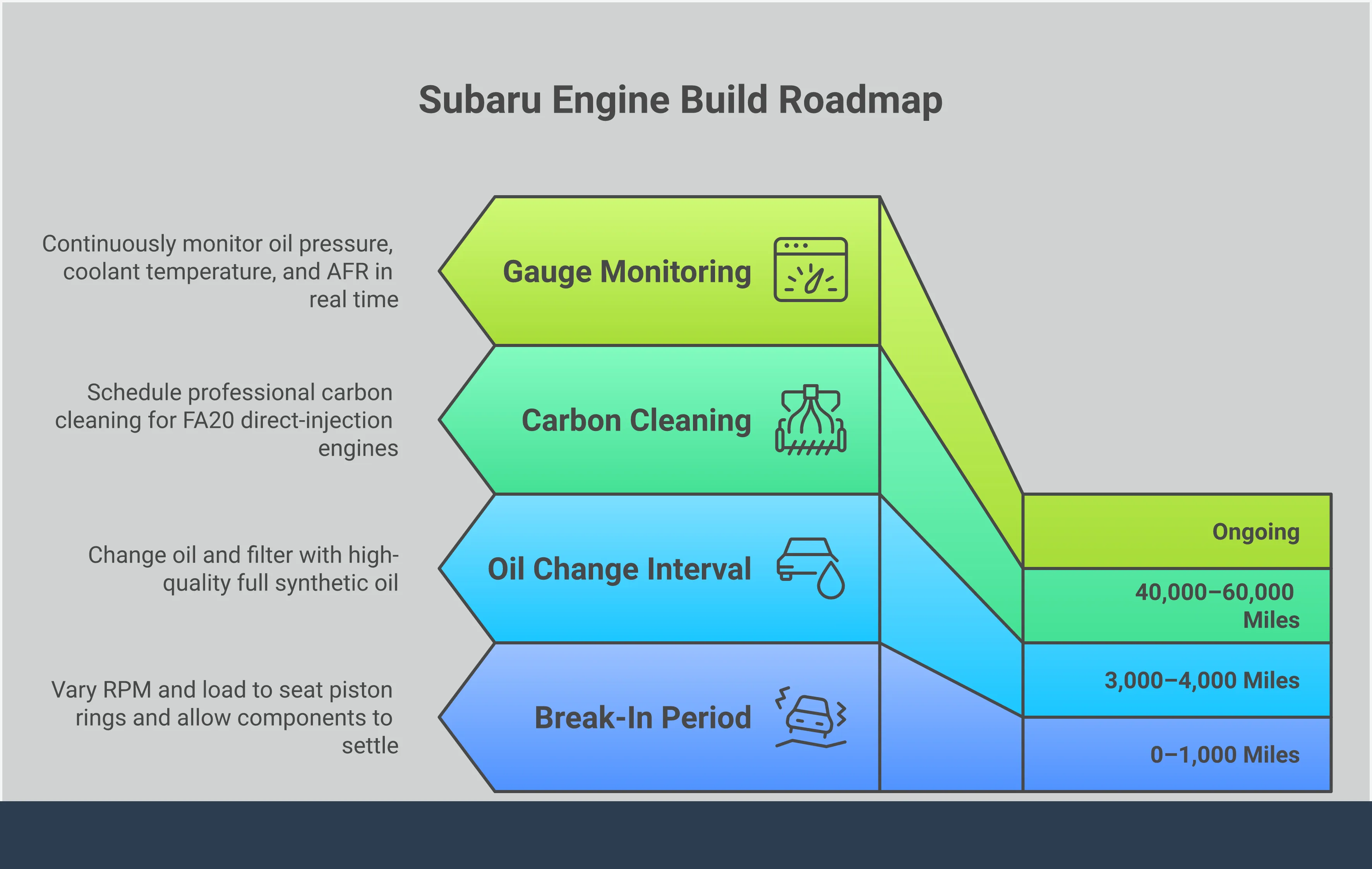
The first 1,000 miles on your new engine are the most critical. This is the break-in period, where all the new, precision-machined internal components settle in together. The primary goal is to properly seat the piston rings against the cylinder walls, which creates a tight seal for optimal compression and oil control. To do this, you need to vary the engine speed and load. Avoid holding a constant RPM on the highway, and resist the temptation to go full-throttle. Drive the car gently, running it through the gears and avoiding both high RPMs and heavy engine load. Patience during this phase is key to a long and healthy engine life.
Long-Term Maintenance Schedule
Once your engine is broken in, a diligent maintenance routine is your best defense against premature wear. Built engines generate more heat and stress, so they require more frequent attention. Plan on changing your oil and filter every 3,000 to 4,000 miles using a high-quality synthetic oil. It’s also smart to regularly check your fluid levels and inspect for any leaks. For direct-injection engines like the FA20, which powers many modern Subaru WRX models, professional carbon cleaning is also a necessary service every 40,000 to 60,000 miles to maintain performance. Watching your air-fuel ratios, boost levels, and temperatures helps you catch small issues before they become big problems.
Match Your Power Goals to Your Driving Style
The best maintenance plan is one that aligns with your engine's purpose. A 500+ horsepower track build has very different needs than a 400-horsepower daily driver. Before you even begin a build, you should have a clear idea of how you plan to use the car. This decision influences everything from your choice of performance parts to your long-term upkeep. A track-focused engine may require thicker oil and more frequent inspections, which can be impractical for a street car. Using a high-strung build for short, stop-and-go trips can cause unnecessary wear, as the engine rarely reaches its optimal operating temperature. Being realistic about your driving habits ensures you build an engine you can properly care for and enjoy.
Explore Crawford Performance Engine Builds
When you're ready to move from theory to reality, a professionally built engine is the most reliable path to serious power. At Crawford Performance, we specialize in creating engines that are much stronger than what comes from the factory. We achieve this by replacing weaker stock components with high-strength forged parts, building a solid foundation that can handle significant power increases without sacrificing reliability. Our performance-built long blocks are complete engine assemblies, including the engine block, cylinder heads, and critical internals like forged pistons and connecting rods, all engineered to handle more stress. This isn't just a repair; it's a fundamental upgrade to the heart of your Subaru.
This approach ensures your engine is prepared for whatever you throw at it, from track days to spirited daily driving. A performance build isn't just about swapping parts; it's about meticulous assembly and precision from technicians who live and breathe Subaru performance. Every engine we build is assembled by experts and is designed to work seamlessly with professional engine tuning services. This comprehensive process is why we can confidently offer a unique 12-month/12,000-mile warranty on our engine builds. That warranty is our promise, backed by decades of engineering, that you're getting a motor built for peace of mind and incredible performance. If you're considering a build for your WRX, STI, or BRZ, exploring our performance parts takes the guesswork out of the equation, so you can focus on your power goals while we handle the engineering.
Related Articles
Frequently Asked Questions
I want to build my engine for more power, but what’s a realistic total budget? The engine block itself is just the starting point. A forged short block can cost between $5,000 and $6,000, while a complete long block can range from $9,000 to over $19,000. To create a realistic budget, you must also account for the essential supporting systems. This includes a larger turbo, an upgraded fuel system, a professional tune, and installation labor. You should also set aside funds for a stronger clutch, better brakes, and cooling upgrades. A successful build is a complete, balanced system, so planning for these parts from the beginning is the key to avoiding costly surprises.
Is a built engine less reliable than a stock one? This is a common concern, but a professionally built engine is designed specifically for reliability at power levels far beyond what a stock motor can handle. Your factory engine is reliable within its intended limits. When you push it past 400 horsepower, you are operating outside those limits, and failure becomes a risk. A built engine replaces the weak points, like cast connecting rods, with strong forged components. When paired with a professional tune and proper maintenance, a built engine provides a safe and durable foundation for making high power.
Why is an Air-Oil Separator (AOS) so important for a built Subaru engine? An Air-Oil Separator is one of the most critical reliability parts you can install, especially on a built motor. Due to the boxer engine's design, oil vapor can get into your intake system, which lowers your fuel's octane rating and can lead to engine knock (detonation). This is extremely dangerous for any engine, but especially for a high-compression, high-horsepower build. An AOS captures this oil vapor and returns it to the engine, ensuring only clean air enters the combustion chamber. Think of it as essential insurance for your investment.
Should I build my current FA20 engine or just swap to an FA24? This decision comes down to your ultimate power goals and budget. A properly built FA20 is a fantastic and well-understood platform that can reliably handle 500 to 600 horsepower, making it a great choice for many high-performance street and track builds. However, if your goals exceed 600 horsepower or you prioritize low-end torque for daily driving, starting with the FA24 is often the smarter path. Its larger displacement and more robust design provide a stronger foundation from the start, potentially making it more efficient to reach extreme power levels.
After reading all this, what is the very first step I should take? Before you buy a single part, the most important first step is to clearly define your goals. Ask yourself two questions: what is my target horsepower, and how will I actually use the car? The needs of a 600-horsepower track car are completely different from a 450-horsepower daily driver or a capable overlanding rig. Your answer will guide every decision that follows, including your choice of engine builder, your budget, and the specific supporting modifications you'll need. A clear plan is the best way to ensure you build a car you love to drive.