

La guía completa sobre el rendimiento del motor FA20
El motor FA20 tiene una reputación compleja. Algunos ven una plataforma frágil, mientras que otros ven una potencia a la espera de la mejor mano de obra. Aquí está el secreto: ambos tienen razón . Una construcción mal planificada es una receta para el desastre, pero una ensamblada profesionalmente es algo completamente distinto. Si busca un motor FA20 en venta, su objetivo no es solo potencia, sino una potencia confiable . Esta guía es su hoja de ruta para lograr un rendimiento impresionante y consistente del motor FA20 , abordando los puntos de falla comunes con las piezas adecuadas desde el principio.
Conclusiones clave
- Adapte el motor a su ambición : Decida si necesita un vehículo confiable para el día a día, un coche de calle enérgico o un coche de pista. Esta elección determinará si necesita un reemplazo original, una versión Stage 2 con componentes internos más resistentes o un motor completamente armado diseñado para máxima potencia.
- Priorice los componentes internos forjados para aumentar la potencia : Las bielas FA20 de serie son lo primero que falla al añadir potencia significativa. Antes de buscar potencia, invierta en un bloque corto fabricado profesionalmente con componentes forjados para crear una base duradera que pueda soportar la tensión adicional de forma fiable.
- Exija documentación y garantía : Un motor de buena calidad viene con pruebas. Exija siempre una hoja de construcción completa, registros de servicio y recibos de piezas para verificar su calidad. Una garantía clara protege su inversión y es señal de un fabricante confiable.
Su guía para el motor FA20
Si has estado en el mundo de Subaru, seguro que has oído hablar del FA20. Este motor bóxer de cuatro cilindros y 2.0 litros es una potencia moderna presente en algunos de los modelos de alto rendimiento más populares de Subaru desde 2012. Como sucesor de la legendaria serie EJ, el FA20 incorporó nuevas tecnologías, como la inyección directa, que establecieron un nuevo estándar de eficiencia y potencia.
El diseño "boxer" es un sello distintivo de Subaru. Coloca los cilindros horizontalmente, de modo que los pistones se acercan y se separan como un boxeador lanzando golpes. Esta disposición le da al motor un perfil plano y bajo, lo que ayuda a crear un centro de gravedad más bajo para el vehículo. El resultado es una mejor estabilidad y maniobrabilidad, ya sea recorriendo un cañón o conduciendo un circuito de autocross estrecho. Para los entusiastas, el FA20 representa una plataforma fantástica para construir un auto ágil y capaz, con una enorme comunidad de posventa dedicada a superar sus límites.
Análisis de las especificaciones y el rendimiento del FA20
El motor FA20 es conocido por su versatilidad, presentándose en dos versiones principales. La versión de aspiración natural, el FA20D, se encuentra en el Subaru BRZ y sus hermanos Toyota/Scion. Produce alrededor de 200 caballos de fuerza y es reconocido por su respuesta precisa del acelerador y su capacidad de alcanzar altas revoluciones. La segunda variante es el FA20F turboalimentado, también conocido como FA20 DIT (Turbo de Inyección Directa), que impulsa al WRX. Esta versión entrega 268 caballos de fuerza más agresivos de fábrica y ofrece un amplio margen para mejorar el rendimiento mediante servicios de optimización del motor y modificaciones adicionales. Ambos motores comparten la misma cilindrada de 2.0 litros y dimensiones de diámetro/carrera cuadradas, lo que crea una base equilibrada para una potencia confiable.
Entendiendo las características únicas del FA20
Cada motor tiene su propia personalidad, y el FA20 no es la excepción. Si bien es una plataforma fantástica, viene con algunas peculiaridades bien conocidas desde el primer momento. Comprender estas características es el primer paso para construir una máquina confiable y potente. En lugar de verlas como defectos, considérelas como oportunidades de mejora. Abordar estas características específicas con las modificaciones adecuadas es lo que distingue una construcción estándar de un auto de alto rendimiento. Veamos los comportamientos clave que debe conocer antes de comenzar a planificar sus mejoras.
La caída del par en el rango medio y la potencia en el rango bajo
Una de las quejas más comunes sobre el FA20 de serie es su caída de par a medio régimen. Se trata de una notable caída de potencia que se produce a mitad del rango de RPM, justo cuando se espera que el coche siga tirando con fuerza. Puede hacer que la aceleración se sienta algo plana y sin respuesta, especialmente a bajas velocidades o al intentar salir de una curva. Esta caída se debe principalmente a la puesta a punto de fábrica y al diseño del colector de escape. La buena noticia es que es totalmente corregible. Con servicios profesionales de puesta a punto del motor y piezas cuidadosamente seleccionadas, puede suavizar esa curva de potencia y lograr una aceleración mucho más lineal y satisfactoria.
Rendimiento "Knock Limited"
El FA20 se describe a menudo como "limitado en detonación". Esto significa que la computadora del motor (ECU) está programada para ser muy sensible a la detonación y reducirá rápidamente la potencia para evitar daños. Si bien esta es una característica de seguridad crucial, también puede limitar el rendimiento, especialmente en climas cálidos o bajo carga pesada. Esta sensibilidad es una razón clave por la que pueden surgir problemas de fiabilidad, como el detonación de biela, si el motor se somete a un esfuerzo excesivo sin las modificaciones de soporte adecuadas. Construir un motor resistente implica instalar componentes de alto rendimiento de alta calidad que creen una base más sólida, lo que permite una puesta a punto más agresiva sin comprometer la salud del motor a largo plazo.
FA20 vs. FA24: Una evolución en el rendimiento
Para quienes estén considerando un Subaru más nuevo, es útil comparar el FA20 con su sucesor, el motor FA24, presente en el BRZ de segunda generación y el WRX de la generación actual. Muchos entusiastas consideran el FA24 una mejora significativa, ya que soluciona en gran medida la pérdida de par y otros problemas asociados con su predecesor. Subaru aplicó claramente las lecciones aprendidas del FA20 para crear un motor más refinado y potente de fábrica. Esto no significa que el FA20 esté obsoleto; más bien, resalta la importancia de elegir la plataforma adecuada para sus objetivos. Un FA20 bien construido puede seguir ofreciendo un rendimiento increíble, especialmente con mejoras específicas para el Subaru WRX diseñadas para superar sus limitaciones de fábrica.
¿Qué modelos de Subaru tienen el FA20?
El motor FA20 fue clave en la línea de Subaru durante casi una década. Encontrará el motor turboalimentado FA20F en el Subaru WRX (2015-2021) y el Forester XT (2014-2018). Estos modelos se benefician del par motor a bajas revoluciones y del potencial de ajuste, lo que los convierte en plataformas increíblemente populares para modificaciones. Si busca mejoras para el Subaru WRX , el FA20F es un excelente punto de partida. El FA20D de aspiración natural es el corazón del Subaru BRZ (2013-2020), así como del Scion FR-S y el Toyota 86. Su diseño ligero y equilibrado convierte a estos cupés en algunos de los coches más atractivos del mercado.
¿Dónde puedo comprar un motor FA20?
Una vez que haya decidido comprar un FA20 nuevo, el siguiente paso es averiguar dónde encontrarlo. Su elección dependerá de sus objetivos de rendimiento y presupuesto. Puede encontrar desde un reemplazo OEM estándar hasta un motor completamente armado y diseñado para la pista. Cada opción tiene sus ventajas y desventajas, por lo que es importante saber qué busca antes de empezar a comprar. Analicemos los tres lugares principales donde puede encontrar un motor FA20 para su Subaru.
Contratación de un especialista: Crawford Performance
Si busca potencia y fiabilidad de verdad, un motor fabricado profesionalmente es su mejor opción. Nos especializamos en la creación de motores de alto rendimiento listos para aplicaciones exigentes. Nuestro bloque corto FA20 está diseñado específicamente para configuraciones sobrealimentadas en los modelos BRZ, FR-S o GT86, con capacidad para generar hasta 660 caballos de fuerza. No es solo un reemplazo; es la base para un motor de alto rendimiento. Al elegir un motor fabricado, obtiene un motor ensamblado profesionalmente con componentes mejorados diseñados para soportar las exigencias de una mayor potencia, lo que le ahorra las conjeturas y los posibles inconvenientes de construirlo usted mismo.
Búsqueda en mercados y minoristas en línea
Para quienes buscan una selección más amplia o un motor usado, los mercados en línea pueden ser un recurso valioso. Plataformas como eBay ofrecen una gran variedad de motores FA20 de diferentes vendedores, incluyendo motores OEM usados, importaciones JDM y, a veces, incluso unidades reconstruidas. La principal ventaja es la posibilidad de comparar precios y, potencialmente, encontrar una excelente oferta. A menudo se pueden encontrar motores con bajo kilometraje extraídos de autos usados. Sin embargo, es crucial investigar a fondo. Investigue cuidadosamente al vendedor, revise sus calificaciones y lea la descripción completa para comprender exactamente lo que está comprando y qué tipo de garantía, si la hay, incluye.
Comprar un vehículo nuevo en un concesionario Subaru autorizado
Si necesita un motor nuevo con especificaciones de fábrica, su mejor opción es un concesionario Subaru autorizado o un proveedor de piezas OEM de buena reputación. Esto le garantiza obtener una pieza original que se adapta perfectamente a su vehículo. Por ejemplo, puede encontrar un bloque corto turbo FA20 DIT OEM , diseñado específicamente para los modelos WRX 2015-2021. Si bien esta suele ser la opción más cara, le brinda la tranquilidad de saber que el motor es nuevo y cumple con los estándares de Subaru. Es la opción ideal para un reemplazo de fábrica o para quien busca un punto de partida nuevo y confiable para una construcción ligera.
¿Cuánto cuesta realmente un motor FA20?
El precio de un motor FA20 puede variar drásticamente según lo que busques. Los costos van desde un par de miles de dólares por un motor usado hasta más de cinco mil dólares por uno de alto rendimiento. Tu presupuesto y tus objetivos de potencia serán los factores más importantes para determinar el precio final. Ya sea que necesites un simple reemplazo OEM o un motor completamente armado y listo para la pista, comprender los diferentes rangos de precios es el primer paso para hacer una compra inteligente. Analicemos los costos típicos que puedes esperar para motores FA20 nuevos, usados y de alto rendimiento.
El precio de un nuevo motor OEM
Si busca un reemplazo directo con especificaciones de fábrica, un motor OEM (Fabricante de Equipo Original) nuevo es la opción más sencilla. Esto le garantiza un motor completamente nuevo fabricado según los estándares exactos de Subaru. Por ejemplo, un Subaru FA20 DIT Turbo de bloque corto nuevo para un WRX 2015-2021 suele costar alrededor de $2,700. Si bien es una inversión considerable, le brinda tranquilidad gracias a la fiabilidad de fábrica. Tenga en cuenta que este precio suele ser solo por el bloque corto, lo que significa que aún deberá considerar las culatas, otros componentes y la mano de obra para completar la instalación.
Costos de motores usados vs. reconstruidos
Para quienes tienen un presupuesto más ajustado, el mercado de motores usados y reconstruidos ofrece precios más accesibles. Puede encontrar una amplia gama de motores FA20 usados en mercados en línea, con precios que varían según el kilometraje, el estado y lo que incluye. Si bien puede encontrar un motor usado completo por menos que un bloque corto OEM nuevo, esta opción requiere una evaluación exhaustiva. Un motor reconstruido puede ser una buena opción intermedia, pero la calidad depende completamente del fabricante. Siempre investigue la reputación del vendedor, solicite un historial detallado y comprenda los términos de la garantía antes de comprometerse.
Presupuesto para su desarrollo de rendimiento
Si su objetivo es superar los niveles de potencia de fábrica, un motor diseñado específicamente para este propósito es una inversión necesaria. Un FA20 estándar tiene sus limitaciones, pero un bloque corto fabricado profesionalmente puede alcanzar con fiabilidad más de 600 caballos de fuerza. Prepárese para invertir entre $5,000 y $6,000 en un bloque corto prefabricado, diseñado para aplicaciones de alta potencia. Este precio refleja el costo de los componentes internos forjados, el ensamblaje de precisión y la ingeniería necesaria para gestionar una sobrealimentación considerable. Esto es más que una simple compra; es una inversión en piezas de rendimiento duraderas que protegerán su vehículo cuando lo lleve al límite.
Planificación de plazos de entrega y costes inesperados
El precio del motor en sí es solo el punto de partida. Para construir un auto de alto rendimiento y confiable, necesita presupuestar todo el ecosistema de piezas que lo respaldan. Esto incluye un sistema de combustible mejorado, un turbo potente y un sistema de refrigeración robusto para gestionar el calor adicional. Además de las piezas, debe considerar una instalación profesional y, lo más importante, una puesta a punto adecuada. Un preparador experto garantizará que todos sus nuevos componentes funcionen juntos de forma segura y eficiente, por lo que los servicios profesionales de puesta a punto de motores son innegociables. Además, prepárese para posibles "tarifas básicas" (un depósito reembolsable que paga por su bloque de motor antiguo) y los tiempos de espera, o "plazos de entrega", para las piezas personalizadas. Un motor construido profesionalmente suele tardar de dos a cuatro semanas en completarse, así que planifique su proyecto en consecuencia.
La importancia de documentar su construcción
Considere su construcción como una inversión a largo plazo y mantenga registros meticulosos de todo. Cree una carpeta o archivo digital con cada número de pieza, recibo y registro de servicio. Esta documentación es invaluable para el mantenimiento futuro, ya que facilita el pedido de las piezas correctas o la solución de cualquier problema que surja en el futuro. Si alguna vez decide vender su auto, un historial de construcción completo es una de las herramientas más poderosas que tiene. Demuestra la calidad del trabajo y los componentes utilizados, lo que puede aumentar significativamente el valor de reventa del vehículo. Un constructor de motores con buena reputación siempre proporcionará pruebas de su trabajo, así que asegúrese de solicitar una hoja de construcción completa que detalle cada componente y las medidas utilizadas en su motor.
Qué buscar al comprar un FA20
Una vez que hayas definido tu presupuesto, comienza la verdadera búsqueda. Encontrar el FA20 adecuado no se trata solo del precio, sino de obtener una base sólida para tus objetivos de rendimiento. Ya sea que compres un motor OEM usado o uno completamente armado, prestar atención a los detalles te ayudará a hacer una inversión inteligente y a evitar sorpresas costosas en el futuro. Es esencial una evaluación exhaustiva del historial del motor, las políticas del vendedor y su compatibilidad con tu auto. Considéralo una inspección previa a la compra para el corazón de tu Subaru.
Inspección del estado y el kilometraje de un motor
La historia de un motor cuenta una historia, y el kilometraje es un capítulo clave. Encontrará FA20 usados con un amplio rango de kilometraje, desde menos de 10,000 hasta más de 75,000. Para un reemplazo directo, un kilometraje menor suele ser más seguro. Sin embargo, si planea una versión de alto rendimiento, un motor con mayor kilometraje puede ser un punto de partida rentable, ya que de todos modos reemplazará los componentes internos. Lo más importante es obtener un historial claro y evaluar el estado general. Un motor bien mantenido con mayor kilometraje suele ser una mejor opción que uno con bajo kilometraje que haya sufrido maltrato o mal mantenimiento.
No se salte la letra pequeña: garantía y devoluciones
Nunca complete una compra sin comprender la garantía y la política de devoluciones del vendedor. Muchos vendedores particulares o plataformas en línea ofrecen protección limitada, a veces de tan solo 30 días, y pueden cobrar una tarifa de reposición considerable por las devoluciones. Aquí es donde comprar a un fabricante de confianza marca la diferencia. Por ejemplo, respaldamos nuestro trabajo con una garantía integral de 12 meses/19.000 km para los motores que fabricamos. Este tipo de garantía le brinda tranquilidad y protege su inversión, asegurándose de que reciba un motor listo para las exigencias de la conducción de alto rendimiento y que refleja la calidad de la fabricación.
¿Este FA20 se adaptará a tu Subaru?
No todos los motores FA20 son iguales. El FA20DIT del WRX 2015-2021 es un motor turbo de inyección directa, mientras que el FA20D del BRZ/FR-S/86 es de aspiración natural con un sistema de combustible y una relación de compresión diferentes. Es fundamental confirmar que el motor que está comprando sea la variante correcta para su modelo específico. Siempre verifique los números de pieza y consulte con el vendedor para garantizar la compatibilidad. Un motor incorrecto puede causar problemas de instalación y rendimiento. Si tiene alguna duda, le recomendamos consultar con expertos especializados en mejoras para el Subaru WRX y otros modelos.
Consideración del envío y la inspección posterior a la entrega
Un motor es un equipo grande, pesado y delicado, por lo que la logística es importante. Antes de comprar, confirme los costos y plazos de envío. Cuando llegue el motor, inspeccione la caja para detectar cualquier daño externo antes de firmar el recibo de entrega. Una vez que lo acepte, desempaquételo inmediatamente y verifique si hay algún daño que pueda haber ocurrido durante el transporte, como grietas en el bloque o sensores rotos. Tome fotos de todo. La mayoría de los vendedores tienen un plazo breve para reportar daños durante el envío, por lo que debe actuar con rapidez. Planificar una entrega sin problemas y una inspección exhaustiva le garantiza que podrá solucionar cualquier problema de inmediato.
Stock vs. Rendimiento: ¿Qué configuración FA20 es la adecuada para usted?
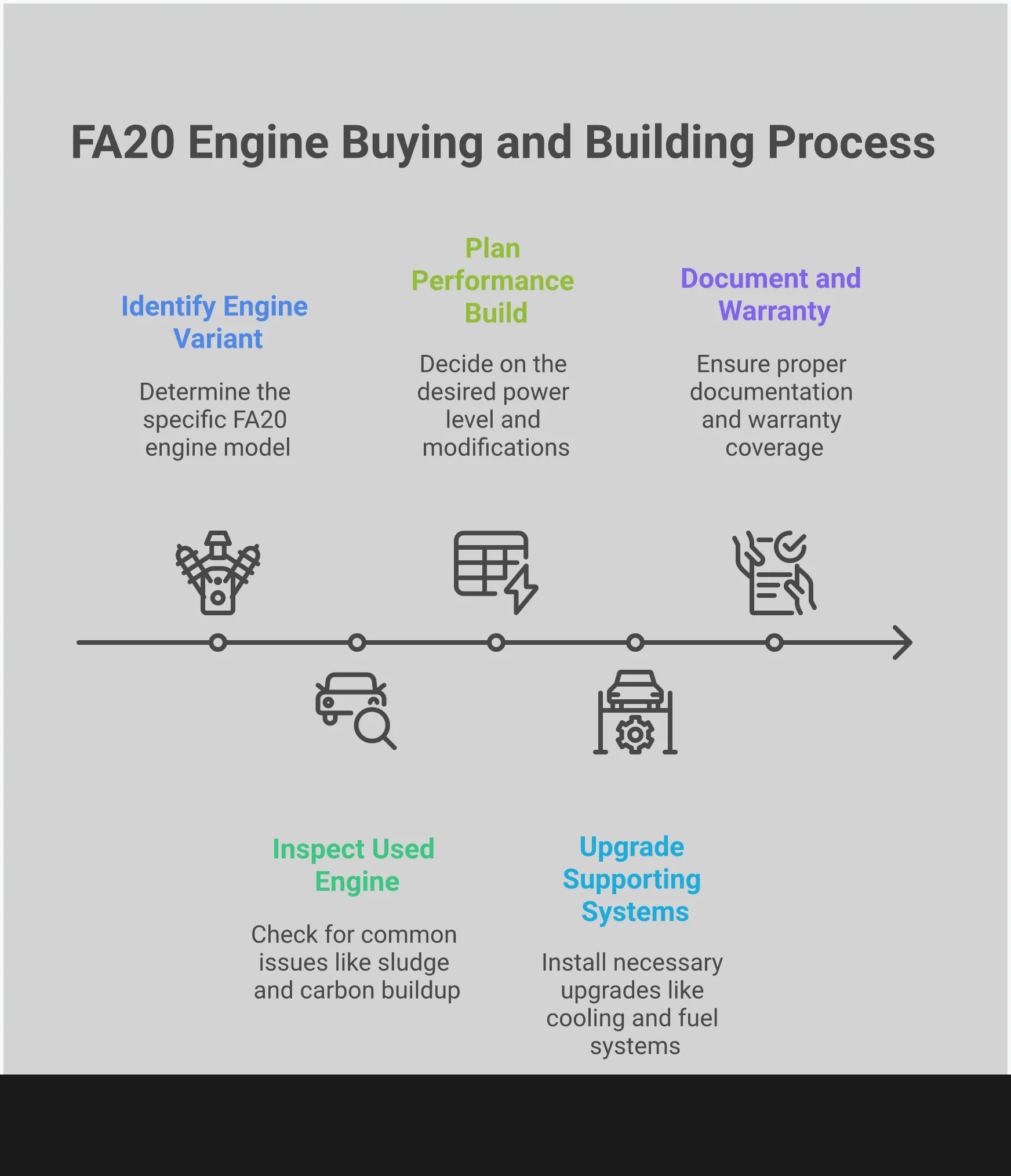
Decidir por un nuevo motor FA20 no se trata solo de reemplazar una pieza; se trata de definir el futuro de tu Subaru. El camino que elijas dependerá completamente de tus objetivos, tu presupuesto y el uso que le darás a tu auto. ¿Buscas un vehículo confiable para el día a día, un auto enérgico para el fin de semana o un vehículo dedicado a las pistas? Cada objetivo requiere un enfoque diferente para la construcción del motor. Analizar tus necesidades ahora te ahorrará posibles dolores de cabeza y costos adicionales en el futuro. Analicemos las tres opciones principales que puedes tomar, desde un simple reemplazo de fábrica hasta un motor potente y completo. Comprender estas opciones te ayudará a invertir en un motor que se adapte perfectamente a tus ambiciones de conducción y te brinde confianza cada vez que giras la llave.
Opción 1: El reemplazo del OEM original
Si su objetivo principal es restaurar el rendimiento y la fiabilidad de fábrica de su Subaru, un reemplazo OEM es la solución más directa. Esta opción es perfecta para conductores diarios o para propietarios que estaban perfectamente satisfechos con la potencia de fábrica antes de que fallara su motor original. El motor Subaru FA20 fue diseñado para lograr un excelente equilibrio entre eficiencia y rendimiento desde el primer momento. Elegir un reemplazo OEM significa obtener una calidad garantizada: un motor fabricado según las especificaciones exactas del fabricante, lo que garantiza un ajuste perfecto y un comportamiento predecible. Es la manera más sencilla de que su auto vuelva a la carretera sin las complejidades ni los costos de las modificaciones de rendimiento.
Opción 2: Construcciones de rendimiento de etapa 1 y 2
Para el entusiasta que busca más potencia sin sacrificar la usabilidad diaria, una configuración Etapa 1 o Etapa 2 es la solución ideal. Este enfoque implica reforzar los puntos débiles conocidos del FA20 reemplazando componentes de fábrica con piezas de alto rendimiento y duraderas de posventa. Normalmente, esto implica actualizar los pistones y bielas de serie a alternativas forjadas que puedan manejar más potencia con seguridad. Una configuración Etapa 2 bien ejecutada puede impulsar su WRX o BRZ a la gama de 400-450 caballos de potencia, transformando su experiencia de conducción. Es la opción perfecta para una conducción urbana intensa y días de circuito ocasionales, ofreciendo una mejora significativa del rendimiento a la vez que mantiene un buen nivel de confort para el uso habitual.
Opción 3: El motor de alto rendimiento totalmente construido
Cuando lo único que importa es el máximo rendimiento, un motor de alto rendimiento completamente construido es la solución definitiva. Esta opción es para competidores serios y entusiastas que construyen un coche de competición o de pista. Un bloque corto FA20 de construcción profesional puede generar más de 600 caballos de fuerza, pero alcanzar esa cifra de forma fiable es el verdadero objetivo. Un motor de alto rendimiento es mucho más que una simple cifra de potencia máxima; se trata de crear un sistema robusto y equilibrado que pueda soportar un estrés extremo vuelta tras vuelta. Esto requiere un montaje meticuloso, componentes de primera calidad y servicios de puesta a punto del motor precisos para garantizar que todo el conjunto funcione en armonía, evitando fallos costosos al llevar el motor al límite.
Establecer objetivos de potencia realistas
Antes de gastar un solo dólar, es crucial definir lo que quieres lograr. Tus objetivos de potencia determinarán cada decisión que tomes, desde las piezas que elijas hasta el tipo de motor que necesites. Ser honesto con tus expectativas y comprender las capacidades del motor te permitirá lograr un motor exitoso y confiable, ayudándote a evitar los problemas comunes que provocan fallas en el motor.
Limitaciones del bloque de serie: 350-400 HP
El motor FA20 de fábrica ofrece un rendimiento excelente, pero su límite está bien documentado. Para la mayoría de los FA20, el límite fiable de potencia en un bloque de serie se sitúa entre 350 y 400 CV. El principal punto débil son las bielas, que no fueron diseñadas para soportar la tensión de un aumento significativo de potencia. Superar este umbral sin mejorar el sistema interno del motor es una apuesta arriesgada. Aunque temporalmente se vean valores más altos en una hoja de dinamómetro, se aumenta drásticamente el riesgo de una avería catastrófica del motor. Si valora la longevidad, considere 400 CV como el límite absoluto para un bloque de serie.
Potencial del bloque construido: más de 500 HP
Si sus ambiciones superan los 400 caballos de fuerza, un motor fabricado no es solo una opción, sino una necesidad. Un FA20 ensamblado profesionalmente con componentes internos forjados cambia por completo la ecuación. Al reemplazar los pistones, bielas y otros componentes clave de fábrica con piezas de alto rendimiento y alta resistencia, la base del motor se vuelve lo suficientemente sólida como para soportar una potencia inmensa con fiabilidad. Un FA20 bien construido puede soportar cómodamente más de 600 caballos de fuerza, transformando su Subaru en una auténtica máquina de alto rendimiento. Este enfoque va más allá de la simple búsqueda de cifras máximas y se centra en crear un motor duradero y resistente que pueda soportar las exigencias de la calle o la pista.
Construir vs. Comprar vs. Intercambiar: Cómo elegir tu camino
Una vez que tengas en mente tus objetivos de potencia, te enfrentas a una decisión fundamental: ¿cómo alcanzarlos? Puedes construir el motor tú mismo, comprar un motor prefabricado por un profesional o considerar cambiarlo por uno diferente. Cada opción tiene sus propios costos, beneficios y desafíos. Tus habilidades técnicas, tu presupuesto y tu cronograma influirán en la elección de la mejor ruta para tu proyecto.
Motores de construcción propia vs. motores prefabricados profesionales
Construir un motor uno mismo ofrece control total sobre cada componente, lo cual puede ser una experiencia gratificante si se cuenta con la experiencia y las herramientas necesarias. Sin embargo, también puede ser un proceso lleno de costos ocultos, retrasos inesperados y una curva de aprendizaje pronunciada. Un solo error durante el montaje puede ser catastrófico. En cambio, comprar un motor fabricado profesionalmente ofrece un precio fijo y la garantía de un montaje experto. Si bien el costo inicial es mayor, se eliminan las conjeturas y se incluye una garantía, que es la mejor protección. Por eso los servicios profesionales de puesta a punto de motores son tan cruciales: garantizan que todas esas piezas de alta calidad funcionen a la perfección.
Reconstrucción del FA20 vs. un cambio de motor
Para quienes buscan una gran potencia, la idea de cambiar el motor, como instalar un FA24, puede ser tentadora. Sin embargo, un cambio no suele ser un proceso sencillo. Suele implicar una fabricación a medida compleja, modificaciones del cableado y problemas de compatibilidad de la ECU que pueden aumentar rápidamente el coste y la complejidad. Reconstruir su FA20 actual suele ser una solución más directa y rentable. Puede alcanzar niveles de potencia increíbles con un FA20 fabricado, conservando un equipamiento similar al de fábrica, evitando los problemas de un cambio a medida. Para la mayoría de los propietarios, invertir en una construcción robusta para su plataforma actual ofrece el mejor equilibrio entre rendimiento, fiabilidad y practicidad para las mejoras de su Subaru WRX .
Problemas del motor FA20: Qué tener en cuenta
Cada plataforma de motor tiene sus propias peculiaridades, y el FA20 no es la excepción. Saber qué buscar puede ahorrarte muchos dolores de cabeza y ayudarte a hacer una compra más inteligente. Ya sea que compres un motor de serie usado o un motor de alto rendimiento totalmente armado, comprender estos problemas comunes te preparará para la compra y te ayudará a identificar una inversión sólida. Considéralo como tu lista de verificación previa al vuelo antes de comprometerte. Un FA20 bien mantenido y modificado correctamente es un motor fantástico, pero uno descuidado puede convertirse en un proyecto que no te habías propuesto. Repasemos los aspectos clave a tener en cuenta para que puedas comprar con confianza y sacar el máximo provecho de tu Subaru.
El acuerdo sobre el consumo de petróleo y la acumulación de carbono
Uno de los problemas más comentados del FA20 es su tendencia a consumir aceite, especialmente al conducir a alta velocidad. Es fundamental controlar de cerca los niveles de aceite entre cambios para evitar que se agote, lo que puede causar graves daños al motor. Este consumo de aceite también puede contribuir a la acumulación de carbonilla en las válvulas de admisión, una característica común de los motores de inyección directa. Con el tiempo, esto puede restringir el flujo de aire y reducir el rendimiento. Instalar un separador de aire/aceite de calidad es una de las mejores opciones preventivas de rendimiento para mitigar ambos problemas, manteniendo el motor más limpio y funcionando con mayor eficiencia.
Entendiendo los puntos débiles del FA20
El motor FA20 de serie es confiable para la conducción diaria, pero sus bielas son un punto débil conocido al aumentar significativamente la potencia. Si planea aumentar significativamente la potencia, actualizar los componentes internos de fábrica no es solo una sugerencia, sino una necesidad. Existe la idea errónea de que los motores FA20 de fábrica son frágiles. Sin embargo, con un mantenimiento adecuado y fabricados con piezas forjadas de calidad, pueden funcionar de manera confiable y manejar una potencia considerable. Invertir en un bloque corto de fabricación profesional con bielas y pistones forjados es la base de cualquier plan de mejora serio para su Subaru WRX , ya que garantiza que su motor pueda soportar la presión adicional de un turbo más grande y una configuración más agresiva.
No olvides la transmisión
Es fácil obsesionarse con la potencia, pero toda esa potencia es inútil si no se puede llevar al suelo. Un motor potente requiere sistemas de soporte igualmente robustos, y la transmisión de serie suele ser el primer componente que se queja al añadir una potencia significativa. Piensa en la transmisión de tu coche como una cadena; el motor es solo un eslabón. Si planeas una construcción que supere los límites de fábrica, también debes incluir en tu presupuesto un embrague mejorado o piezas de transmisión más resistentes. Descuidar este paso crítico puede provocar una avería frustrante y costosa, dejando a tu nuevo y potente motor sin posibilidad de mover el coche. Asegurarse de que toda la transmisión pueda soportar la nueva potencia es fundamental para una construcción de alto rendimiento exitosa.
Banderas rojas al comprar un motor usado
Al considerar un FA20 usado, especialmente uno que ya haya sido modificado, proceda con precaución. Una señal de alerta importante es un vendedor que no puede proporcionar un historial de servicio detallado ni recibos de trabajos de rendimiento. Tenga cuidado con la idea de que un motor armado no requiere un mantenimiento minucioso; a menudo requiere más. Inspeccione el motor para detectar cualquier signo de fugas de aceite, residuos de refrigerante o lodo debajo del tapón de aceite. Pregunte sobre su historial, quién lo armó y quién lo ajustó. Una respuesta imprecisa no es una buena señal. Un servicio de afinación de motor adecuado es esencial para la salud del motor, por lo que una afinación desconocida o cuestionable puede ser un factor decisivo.
Cómo verificar la calidad de un FA20 antes de comprarlo
Al invertir en un motor de alto rendimiento, necesita hacer más que simplemente probarlo. Verificar la calidad de un FA20 , especialmente de un motor ensamblado, requiere un análisis detallado de su historial, componentes y condiciones de venta. Un bloque de motor brillante puede ocultar multitud de problemas, por lo que sus mejores herramientas son la documentación y una buena dosis de escepticismo. Un motor bien documentado de un fabricante de confianza siempre será una apuesta más segura que un motor misterioso con un historial solo verbal.
El objetivo es encontrar un motor correctamente fabricado y con un cuidado meticuloso. Esto implica revisar a fondo la documentación, comprender su historial de servicio y aclarar cada detalle de la transacción antes de realizar cualquier intercambio. Seguir estos pasos protege su inversión y le garantiza la potencia confiable que está pagando. Una excelente fabricación es una combinación de piezas de calidad, ensamblaje experto y mantenimiento diligente, y es su responsabilidad como comprador verificar los tres.
Su lista de verificación previa a la compra: inspecciones y trámites
Existe la idea errónea de que los FA20 prefabricados son frágiles, pero esto no es cierto si se mantienen y ensamblan correctamente con componentes de calidad. La prueba está en la documentación. Al evaluar un motor, solicite al vendedor una hoja de construcción completa que incluya todos los componentes utilizados, desde los pistones y las bielas hasta los cojinetes y los espárragos de culata. Este documento es su herramienta principal para verificar la calidad de las piezas internas de alto rendimiento.
Además de la hoja de construcción, solicite recibos de las piezas y de cualquier trabajo realizado en la máquina. Esto confirma que los componentes son los que el vendedor afirma y demuestra que el trabajo fue realizado por un taller profesional. Si el motor se ha utilizado, solicite hojas de dinamómetro, que ofrecen una visión real de su rendimiento y la estabilidad de la puesta a punto. Un vendedor organizado con documentación completa suele ser señal de un motor bien cuidado.
Por qué son importantes los registros de servicio y mantenimiento
Un mantenimiento minucioso es crucial para la longevidad de cualquier motor FA20, y una versión de alto rendimiento exige un nivel de atención aún mayor. Una revisión exhaustiva de los registros de servicio le permitirá saber qué tan bien se ha cuidado el motor desde su fabricación. Es importante tener un historial consistente de cambios de aceite con aceite sintético de alta calidad, revisiones regulares de fluidos y un registro de cualquier ajuste o reparación.
Solicite recibos de los talleres o un registro detallado si el propietario realizó el mantenimiento él mismo. Un motor con un historial de servicio irregular o inexistente es una señal de alerta importante. Este historial también le indica si el motor recibió servicios profesionales de puesta a punto, esenciales para garantizar un funcionamiento seguro y fiable. No se fíe solo de la palabra del vendedor; la documentación es la única forma de confirmar el historial del motor.
¿Cómo funcionan los cambios y devoluciones de productos básicos?
Al comprar un motor armado a un constructor profesional, es probable que se aplique un cargo por el núcleo. Algunos constructores exigen un depósito (la tarifa por el núcleo) para el bloque de motor antiguo, que se reembolsa al devolverlo. Es importante aclarar esto antes de comprar para evitar costos inesperados. Pregunte al vendedor las condiciones exactas del cambio del núcleo. ¿Cuánto tiempo tiene para devolver el motor antiguo? ¿En qué condiciones debe estar para recibir un reembolso completo?
También debería averiguar quién se hace cargo de los gastos de envío del núcleo, ya que pueden suponer un gasto considerable. Comprender estos detalles garantiza una transacción fluida y le ayuda a presupuestar con precisión su nuevo motor. Un constructor de confianza tendrá una política de núcleos clara y justa, así que no dude en solicitar todos los detalles por adelantado.
Principales mejoras para el rendimiento del motor FA20
El FA20 de serie es un motor sólido, pero si buscas potencia de verdad, tendrás que ir más allá de la configuración de fábrica. Una construcción exitosa no se trata de instalar el turbo más grande que puedas encontrar; se trata de crear un sistema equilibrado donde todos los componentes trabajen en conjunto para lograr tus objetivos. Un enfoque cuidadoso garantiza que tu motor no solo sea potente, sino también confiable a largo plazo, ya sea que estés tomando curvas en la pista o recorriendo un sendero remoto. Para sacarle el máximo provecho a tu FA20, necesitas abordar sus limitaciones en tres áreas clave: el sistema interno del motor, los sistemas de suministro de combustible y aire, y el sistema de refrigeración. Cada una de estas áreas se basa en la anterior, creando una base sólida para un rendimiento confiable. Descuidar un área mientras te concentras en otra es una receta para el desastre, que puede provocar un desgaste prematuro o una falla catastrófica. Al actualizar estos sistemas estratégicamente, puedes transformar tu Subaru en una máquina perfectamente optimizada que ofrece potencia constante cuando la necesitas. Disponemos de una amplia selección de piezas de alto rendimiento para ayudarte a construir el motor que has soñado, desde versiones para uso urbano hasta aplicaciones de competición. Analicemos las mejoras clave que llevarán tu FA20 al siguiente nivel.
La confiabilidad es lo primero: el separador aire/aceite (AOS)
Antes de siquiera pensar en aumentar la potencia, lo primero que debe hacer es proteger su motor. El FA20, como muchos motores de inyección directa, es propenso al consumo de aceite y a la acumulación de carbonilla en las válvulas de admisión. Esto ocurre cuando el vapor de aceite del cárter se recircula hacia la admisión, donde puede reducir el octanaje del combustible y adherirse a las válvulas, restringiendo el flujo de aire. Instalar un separador de aire/aceite (AOS) de alta calidad es una de las piezas preventivas de alto rendimiento más efectivas que puede agregar. Un AOS intercepta estos vapores de aceite, separando el aceite y devolviéndolo al motor, a la vez que permite el paso de aire limpio. Esta sencilla mejora mantiene la admisión limpia, conserva el rendimiento y es fundamental para la salud del motor a largo plazo.
Comience aquí: Fortaleciendo el interior
Antes de buscar altas cifras de potencia, es necesario construir una base sólida. Los pistones y bielas de serie del FA20 son los principales puntos débiles al empezar a aumentar significativamente la potencia. Para crear un motor fiable y de alta potencia, sustituirlos por versiones forjadas es fundamental. Existe el mito de que los FA20 fabricados son frágiles, pero eso solo es cierto si se fabrican o mantienen de forma inadecuada. Al empezar con componentes internos forjados de alta calidad, se crea un motor que puede soportar con seguridad el aumento de tensión y potencia que se le va a aplicar. Este es el primer paso esencial para cualquier motor de alto rendimiento, ya que garantiza que el motor pueda soportar las exigencias de una mayor presión en el cilindro y mayores RPM sin comprometer su rendimiento.
Espárragos principales y de culata de alta resistencia
Una vez que hayas mejorado los pistones y las bielas, el siguiente paso es asegurar todo el conjunto. Los pernos de culata y de bancada de fábrica están diseñados para los niveles de potencia de fábrica, pero pueden estirarse bajo las mayores presiones de los cilindros de un motor modificado. Este estiramiento puede provocar fallos catastróficos, como una junta de culata reventada o el desplazamiento de los cojinetes de bancada. Para evitarlo, necesitas usar espárragos de culata y bancada más resistentes para reforzar el bloque del motor. Los espárragos de alta resistencia proporcionan una fuerza de sujeción significativamente mayor, lo que garantiza que las culatas permanezcan selladas y el cigüeñal perfectamente alineado, incluso con sobrealimentación extrema. Esta es una parte fundamental de cualquier construcción seria y un paso crítico para crear un motor duradero que pueda manejar potencia real con componentes de rendimiento confiables.
Actualización del tren de válvulas
Un bloque corto resistente es solo la mitad de la ecuación; el motor también necesita respirar eficientemente a altas RPM. El tren de válvulas controla el flujo de aire y combustible, y los componentes de fábrica pueden convertirse en una limitación. A altas revoluciones, los resortes de válvula de fábrica pueden tener dificultades para cerrar las válvulas con la suficiente rapidez, lo que se conoce como flotación de válvulas. Esto puede causar una pérdida de potencia y, en casos graves, que el pistón haga contacto con una válvula. Mejorar con resortes de válvula más rígidos, retenedores ligeros y válvulas de alto rendimiento previene este problema, permitiendo que el motor alcance mayores revoluciones y de forma más segura. Esto es esencial para cualquiera que planee usar levas agresivas o forzar el limitador de revoluciones, ya que garantiza que su FA20 pueda generar potencia de forma fiable en todo el rango de RPM.
Modificaciones avanzadas de bloques: pisos cerrados y trazos
Para quienes buscan la mayor potencia, quizás sea necesario ir un paso más allá y reforzar el propio bloque motor. El FA20 presenta un diseño de plataforma abierta, ideal para la refrigeración, pero que deja las paredes del cilindro sin soporte en la parte superior. Con una sobrealimentación muy alta, estas paredes pueden flexionarse o incluso agrietarse. La solución es el "bloque cerrado", un proceso en el que se inserta una placa de refuerzo en el bloque para sujetar los cilindros. Esta modificación es crucial para quienes aspiran a más de 500 caballos de potencia. Para un rendimiento aún mayor, algunos constructores optan por modificar la carrera del motor, utilizando un cigüeñal diferente para aumentar la cilindrada y obtener más par. Estas modificaciones avanzadas requieren mecanizado de precisión y son clave en los servicios profesionales de puesta a punto de motores, que distinguen una construcción estándar de un motor de competición verdaderamente robusto.
Más potencia: mejoras en el turbo y el sistema de combustible
Una vez que el sistema interno de tu motor esté reforzado, puedes concentrarte en generar más potencia. Esto significa introducir más aire y combustible en los cilindros. El sistema de combustible de fábrica puede convertirse en un cuello de botella, especialmente si buscas más de 450 caballos de fuerza. Para superar esto, probablemente necesitarás un sistema de combustible secundario, como la inyección directa, para suministrar el volumen necesario. Por supuesto, también necesitarás un turbo más grande para suministrar el aire adicional. Para gestionar el aumento de tensión, es posible que también debas reforzar el bloque y mejorar las culatas para un mejor flujo de aire. Estas modificaciones requieren servicios profesionales de puesta a punto del motor para garantizar que todo funcione en armonía y que las relaciones aire-combustible estén perfectamente ajustadas para una potencia segura y fiable.
Turbocompresor vs. Supercargador
La inducción forzada es la clave para liberar la potencia de tu FA20, y tienes dos opciones principales: turbocompresor o sobrealimentador. Los turbocompresores utilizan los gases de escape para hacer girar una turbina, impulsando más aire al motor. Son conocidos por producir importantes aumentos de potencia, especialmente en el rango de RPM medio-alto, lo que los convierte en los favoritos de los entusiastas que buscan maximizar la potencia para los circuitos. Por otro lado, los sobrealimentadores son accionados directamente por el cigüeñal del motor, proporcionando potencia instantánea en todas las revoluciones. Esta entrega lineal es ideal para la conducción diaria y las aplicaciones de calle donde se prefiere una respuesta suave e inmediata del acelerador. La elección entre ambos depende de tu estilo de conducción y de lo que desees sentir al pisar el acelerador.
Actualización del sistema de combustible para E85 y alta potencia
Añadir un turbo más grande o un supercargador es solo la mitad de la ecuación. Para generar más potencia de forma segura, se necesita suministrar más combustible. Si se aspira a más de 450 caballos de fuerza, es fundamental mejorar el sistema de combustible, lo que a menudo requiere un sistema de inyección de puerto secundario para garantizar un suministro adecuado de combustible. Esto es especialmente cierto si se planea usar combustible E85, que requiere aproximadamente un 30 % más de volumen que la gasolina regular. Para satisfacer esta demanda, se necesitarán inyectores de combustible más grandes y una bomba de combustible de alto flujo. No se debe escatimar en este aspecto; un sistema de combustible robusto es fundamental para evitar mezclas pobres que pueden provocar una falla catastrófica del motor. Se requieren servicios de ajuste del motor adecuados para recalibrar el sistema para estos nuevos componentes.
Manteniéndolo fresco: radiadores, enfriadores de aceite y modificaciones de soporte
Más potencia genera más calor; es un hecho. El sistema de refrigeración de fábrica está diseñado para la potencia de serie y puede saturarse rápidamente en aplicaciones de alto rendimiento. Para proteger su inversión y mantener una potencia constante, es fundamental actualizar su sistema de refrigeración. Instalar un radiador más grande y un enfriador de aceite de motor dedicado ayudará a controlar las temperaturas y a evitar el sobrecalentamiento durante la conducción agresiva o los días de pista. Estos sistemas de apoyo son tan importantes como los componentes que aumentan la potencia. Garantizan un funcionamiento fiable del motor, especialmente en aplicaciones exigentes como nuestras soluciones todoterreno, donde la fiabilidad es fundamental. No permita que el calor excesivo afecte al rendimiento o, peor aún, dañe su nuevo motor.
Mejorando el sistema de lubricación
El sistema de lubricación de su motor es fundamental, especialmente cuando busca más potencia. Al tomar curvas agresivas en circuitos o carreteras con cañones, las altas fuerzas G pueden provocar problemas en el sistema original, dejando el colector de aceite sin cubrir. Esto provoca una falta de aceite, una forma rápida de causar una falla catastrófica del motor. Antes de aumentar significativamente la potencia, debe abordar este punto débil. Instalar un cárter de aceite con deflectores y un tubo de recolección de aceite mejorado son los primeros pasos esenciales para un suministro de aceite constante. Además, una de las mejores piezas de rendimiento preventivo que puede instalar es un separador de aire/aceite (AOS) de calidad. Este evita que el vapor de aceite entre en la admisión, lo que reduce la acumulación de carbonilla y ayuda a que el motor funcione de forma limpia, un factor crítico para la salud de cualquier motor.
Instalación de su nuevo motor FA20
Una vez que tenga su nuevo motor FA20, la siguiente fase crucial es la instalación. Este paso es tan importante como seleccionar la configuración correcta, ya que una instalación deficiente puede perjudicar incluso al motor de mayor calidad. Una instalación correcta garantiza que su inversión rinda como se espera y se mantenga confiable durante años. No se trata solo de cambiar piezas; se trata de integrar correctamente el nuevo corazón de su Subaru para que pueda manejar la potencia que planea liberar.
Desglose de mano de obra y costos de instalación
El costo de instalar un motor FA20 puede variar significativamente según la complejidad del montaje y el taller elegido. Un cambio sencillo de un motor de serie suele ser más económico y suele requerir una cantidad determinada de horas de mano de obra. Sin embargo, si se instala un motor de alto rendimiento, el proceso se vuelve mucho más complejo.
Un bloque corto FA20 bien construido puede alcanzar más de 600 HP, pero lograrlo requiere más que simplemente instalar el motor. La instalación implicará la instalación de componentes mejorados, la posible fabricación de piezas a medida y la garantía de que todos los sistemas funcionen en armonía. Esta complejidad adicional aumenta el tiempo de mano de obra y, en consecuencia, el costo. Al solicitar presupuestos, asegúrese de encontrar un taller de confianza con experiencia demostrada en configuraciones de alto rendimiento para Subaru. Su experiencia justifica la inversión.
No olvides las piezas de soporte y un ajuste profesional
Un motor de alto rendimiento es tan fuerte como su punto más débil. Mejorar los sistemas de apoyo, como la refrigeración, el combustible y la gestión del aceite, es tan importante como mejorar las piezas internas del motor. Los componentes originales se diseñaron para niveles de potencia estándar y se verán rápidamente superados por las exigencias de un motor ya fabricado. Antes de la instalación, planifique su construcción en función de la potencia deseada y el uso que le dará al coche.
Las mejoras clave a considerar incluyen una bomba de combustible e inyectores de mayor flujo, un radiador mejorado y un sistema de refrigeración de aceite robusto. Un separador de aire/aceite también es indispensable para proteger el motor de las fugas de aceite. También podría ser necesario reforzar la transmisión con un embrague y un volante nuevos para absorber el mayor par motor. Una vez instalado todo el hardware, es esencial un servicio profesional de puesta a punto del motor. Un preparador recalibrará la ECU para optimizar el rendimiento y garantizar que el motor funcione de forma segura con su nuevo conjunto de piezas de alto rendimiento.
El papel de los límites de seguridad en una puesta a punto profesional
Una buena puesta a punto no solo hace que tu coche sea más rápido; lo hace inteligente. Piensa en una puesta a punto profesional como un conjunto de instrucciones que incluye límites de seguridad críticos para proteger tu motor. No se trata solo de limitar tu límite de potencia. Un preparador experto programa mecanismos de seguridad en la computadora del motor que monitorean parámetros cruciales como la presión de sobrealimentación, la relación aire-combustible y la temperatura. Si un sensor detecta una condición peligrosa, como una falla en la bomba de combustible que provoque una mezcla pobre, la puesta a punto intervendrá automáticamente cortando la sobrealimentación o reduciendo la potencia para evitar daños catastróficos. Esta es la mayor diferencia entre una puesta a punto barata y un servicio profesional de puesta a punto de motor. No solo pagas por la potencia; inviertes en una sofisticada red de seguridad que protege tu nuevo motor en caso de un problema inesperado.
¿Debería hacerlo usted mismo o contratar a un profesional para la instalación?
Si bien la instalación de un motor por cuenta propia puede ser un proyecto gratificante para un mecánico experimentado con las herramientas adecuadas, es una tarea enorme. Para la mayoría de los propietarios, especialmente para quienes invierten en un motor de alto rendimiento, la instalación profesional es la opción recomendada. Construir un motor no se trata solo de obtener una alta potencia, sino de que sea lo suficientemente potente como para manejar esa potencia con fiabilidad.
Los instaladores profesionales cuentan con las herramientas especializadas y la experiencia necesarias para afrontar los desafíos únicos de la plataforma FA20. Pueden solucionar problemas inesperados, garantizar que cada perno tenga el par de apriete especificado y brindar asesoramiento sobre el crucial proceso de rodaje del motor. Un error común es creer que un motor prefabricado no requiere un mantenimiento minucioso, pero la realidad es la contraria. Un taller profesional le garantizará el éxito con una instalación sólida e instrucciones claras para el cuidado a largo plazo, a menudo respaldadas por una garantía de mano de obra para mayor tranquilidad.
Mantenimiento y supervisión de su FA20 construido
Su nuevo motor ya está instalado y el período de rodaje ha terminado. Ahora comienza el verdadero trabajo de ser propietario. Un motor de alto rendimiento no es una actualización que se instala y se olvida; es una máquina de precisión que requiere un cuidado minucioso para ofrecer la potencia confiable en la que invirtió. Imagínese que es como un atleta de alto rendimiento: necesita un régimen específico para mantenerse en óptimas condiciones. El mantenimiento constante y la monitorización activa son claves para la longevidad. Al mantenerse al tanto del estado de su vehículo, puede detectar pequeños problemas antes de que se conviertan en fallas catastróficas, lo que le garantiza disfrutar de todo el rendimiento que su FA20 le ofrece durante años.
Programa de mantenimiento esencial
Un FA20 fabricado opera bajo un estrés mucho mayor que un motor de serie, lo que significa que sus necesidades de mantenimiento son más exigentes. El programa de mantenimiento de fábrica es un buen punto de partida, pero no es suficiente para proteger su inversión. Necesitará un plan de mantenimiento más frecuente y exhaustivo para compensar el aumento de calor, presión y potencia que produce su motor. Seguir un programa estricto de cambios de fluidos y servicios preventivos es la manera más eficaz de garantizar que su motor se mantenga en buen estado, ya sea en la calle, en la pista o en senderos. Este enfoque proactivo es su primera línea de defensa contra el desgaste prematuro.
Intervalos de cambio de aceite para motores fabricados
Para un motor fabricado, los cambios de aceite frecuentes son indispensables. El calor intenso y las mayores presiones en los cilindros de un motor de alto rendimiento hacen que el aceite se degrade mucho más rápido que en uno de serie. Recomendamos cambiar el aceite y el filtro cada 4800 a 9600 kilómetros, utilizando únicamente aceite totalmente sintético de alta calidad. Este mantenimiento sencillo y constante es lo más importante que puede hacer para proteger los componentes internos forjados de su motor. Un aceite limpio lubrica, enfría y limpia adecuadamente los componentes críticos, previniendo el desgaste prematuro de cojinetes y pistones. Considérelo la mejor póliza de seguro para su inversión en alto rendimiento.
Limpieza de carbón de la válvula de admisión
El sistema de inyección directa del FA20 es excelente para la eficiencia, pero tiene una desventaja: la acumulación de carbonilla en las válvulas de admisión. Dado que el combustible se inyecta directamente en el cilindro, nunca pasa por las válvulas para limpiarlas. Con el tiempo, el vapor de aceite del sistema de ventilación del cárter se deposita sobre las válvulas calientes, formando depósitos de carbonilla duros que restringen el flujo de aire y pueden reducir la potencia del motor. Para que el motor respire libremente, debe programar un servicio profesional de limpieza de carbonilla, como un chorreado con arena de nogal, cada 64.000 a 96.000 km. Instalar piezas de alto rendimiento de calidad, como un separador de aire/aceite, también puede reducir significativamente la tasa de acumulación.
Monitoreo del motor en tiempo real
Más allá del mantenimiento programado, convertirse en un conductor observador y comprometido es crucial para el buen estado de su FA20. Esto significa prestar mucha atención a cómo suena, se siente y funciona su auto a diario. También significa usar herramientas modernas para monitorear las constantes vitales del motor en tiempo real. Un motor armado suele dar menos señales de advertencia antes de que ocurra un problema grave, por lo que la monitorización activa le permite detectar cambios sutiles en el rendimiento o los parámetros del motor. Esta vigilancia puede marcar la diferencia entre un pequeño ajuste y una reconstrucción completa del motor, lo que le permite proteger su inversión.
Instalación de indicadores para controlar el estado del motor
Los medidores y dispositivos de monitoreo no son solo estéticos; son herramientas de diagnóstico esenciales para cualquier vehículo de alto rendimiento. Un dispositivo como un Cobb Accessport o un conjunto de medidores específicos para la presión y temperatura del aceite, y la relación aire-combustible (AFR) proporciona un flujo constante de datos sobre el estado de su motor. Estas herramientas le permiten verificar si su motor funciona dentro de los parámetros de seguridad establecidos por su técnico. Si nota que la presión del aceite baja o que la temperatura sube más de lo normal, puede apagar el auto e investigar antes de que se produzcan daños graves. Esta información es invaluable para quienes confían en servicios profesionales de ajuste de motores para optimizar su vehículo de forma segura.
Comprobación frecuente de los niveles de aceite
Es perfectamente normal que un motor de alto rendimiento consuma una pequeña cantidad de aceite entre cambios. Las temperaturas y presiones de funcionamiento más altas pueden provocar que parte del aceite traspase los anillos del pistón y se queme en la cámara de combustión. Por ello, no puede esperar hasta su próximo cambio de aceite programado para comprobar el nivel. Acostúmbrese a comprobar el nivel de aceite cada dos veces que llene el depósito. Esta sencilla rutina de dos minutos es una de las maneras más fáciles y eficaces de prevenir fallos catastróficos del motor por falta de aceite. Mantener el nivel de aceite al máximo garantiza que su motor siempre tenga la lubricación necesaria para funcionar de forma fiable bajo presión.
Artículos relacionados
- Motor FA20 construido: potencia, costo y mejores fabricantes
- Guía definitiva para actualizar el motor de Subaru
- Modificaciones del motor Subaru: 7 mejoras para mejorar el rendimiento
- 4 modificaciones para aumentar la fiabilidad del motor FA20
Preguntas frecuentes
¿Es un motor FA20 armado lo suficientemente confiable para el uso diario? Totalmente. Existe el mito de que un motor armado es solo para la pista, pero no es así. La confiabilidad se basa en la calidad de la construcción, la puesta a punto y el mantenimiento. Un motor ensamblado profesionalmente con componentes internos forjados de alta calidad es significativamente más resistente que uno de fábrica. Junto con una puesta a punto profesional y un mantenimiento minucioso, un FA20 armado puede ser un motor perfectamente confiable para tus desplazamientos diarios, a la vez que te ofrece potencia de sobra para el fin de semana.
¿Cuál es la diferencia entre un bloque corto y un bloque largo? Esta es una gran pregunta que a menudo causa confusión. Piense en un bloque corto como la mitad inferior del motor; generalmente incluye el bloque, el cigüeñal, las bielas y los pistones. Un bloque largo incluye todo el bloque corto más la mitad superior del motor, lo que significa que las culatas, los árboles de levas y el tren de válvulas ya están ensamblados e instalados. Conocer la diferencia es clave al comprar, ya que determina cuántas piezas de su motor antiguo necesitará transferir.
¿Por qué es tan importante un Separador Aire/Aceite (AOS) para el FA20? El FA20 es un motor de inyección directa, lo que significa que el combustible se inyecta directamente en el cilindro en lugar de regar las válvulas de admisión. Por ello, el vapor de aceite del cárter puede recircular hacia la admisión y adherirse a las válvulas, provocando la acumulación de carbonilla que perjudica el rendimiento. Un Separador Aire/Aceite intercepta este vapor, separando el aceite y devolviéndolo al motor, lo que mantiene limpias las válvulas de admisión y reduce el consumo total de aceite. Es una de las modificaciones de apoyo más importantes que se pueden realizar para la salud del motor.
¿Puedo instalar el FA20F turboalimentado de un WRX en mi BRZ? Aunque parezca un cambio sencillo, ya que comparten el nombre "FA20", es un proyecto muy complejo y costoso. Los motores del WRX y del BRZ tienen sistemas de combustible, arneses de cableado y computadoras de motor (ECU) diferentes. Lograr que funcionen juntos requiere un extenso trabajo de fabricación y electrónica a medida. Para la mayoría de los propietarios, es mucho más práctico y rentable añadir un kit de turbo o supercargador al motor BRZ existente, especialmente si ya lo han reforzado con un bloque corto.
¿Qué tan importante es el rodaje del motor? El rodaje es el momento más crítico en la vida de su nuevo motor. Este proceso permite que los nuevos segmentos del pistón se asienten correctamente contra las paredes del cilindro, lo cual es esencial para crear una compresión fuerte y garantizar la salud y el rendimiento del motor a largo plazo. Omitir o apresurar este paso puede provocar un consumo excesivo de aceite y una reducción de potencia a largo plazo. Siga siempre las instrucciones específicas de rodaje proporcionadas por el fabricante del motor, ya que contará con un procedimiento preciso para variar las cargas del motor y los cambios de aceite para garantizar un asentamiento perfecto.