

Unequal Length Headers: Rumble vs. Real Performance
That legendary Subaru rumble comes directly from unequal length headers, but is the iconic sound worth the performance trade-offs? For a fun street car, the improved low-end torque and classic exhaust note are a perfect match. But if you're building for the track, their inherent design can limit your top-end power. This guide cuts through the endless forum debates to give you a straightforward look at the pros and cons, so you can decide if they truly align with your goals for your car.
Key Takeaways
- Choose UEL for the Classic Rumble and Daily Driving Gains: Unequal length headers are the source of the signature Subaru exhaust note. They also improve low-end torque and turbo response, making your car feel more engaging and responsive in city and street driving.
- Select Headers Based on Your Ultimate Power Goals: UEL headers are perfect for most street-focused builds, but their design limits top-end power. For high-horsepower track or race applications, the efficient flow of equal length (EL) headers is the superior choice.
- Factor in a Professional Tune as Part of the Upgrade: Installing headers fundamentally changes your engine's airflow. A professional tune is essential to adjust your car’s ECU, ensuring you get safe, reliable power and protect your engine from potential damage.
What Are Unequal Length (UEL) Headers?
If you’ve ever heard that distinctive, throbbing exhaust note from a WRX or STI, you’ve heard unequal length headers (UEL) in action. Unequal length headers are a type of exhaust manifold where the individual pipes, or runners, connecting each cylinder to the central collector are different lengths. This isn't a design flaw; it's a direct result of the Subaru boxer engine's architecture. On turbocharged models, the cylinders on one side of the engine are naturally farther from the turbo than the ones on the other side. A UEL manifold takes the most direct path for each runner, resulting in mismatched lengths.
This configuration causes the exhaust pulses from each cylinder to arrive at the collector at uneven intervals. The result is a pulsing, off-beat sound that has become synonymous with the Subaru brand—the iconic "Subaru rumble." While many owners choose UEL headers specifically for this sound, the design also has distinct effects on engine performance and turbo response. Understanding how these performance parts work is the first step in deciding if they’re the right fit for your build, whether you're upgrading a daily driver or a track-focused machine.
UEL vs. EL Headers: What's the Difference?
The direct counterpart to UEL headers is, unsurprisingly, equal length (EL) headers. With an EL setup, engineers use complex bends and routing to ensure every runner from the cylinder to the collector is the exact same length. This synchronization allows exhaust pulses to merge smoothly and evenly, creating a more balanced flow. The most noticeable difference is the sound; an EL header produces a higher-pitched, more uniform exhaust note, similar to what you'd hear from an inline-four engine. Because they require more intricate manufacturing, EL headers are typically more expensive than their UEL counterparts, which are simpler to produce.
How UEL Headers Change Exhaust Flow
The design of UEL headers directly impacts how efficiently your engine expels exhaust gases. Because the exhaust pulses arrive out of sync, they can collide and create turbulence within the collector. This inefficiency can make it harder for the engine to "breathe" at higher RPMs, potentially limiting top-end horsepower compared to a more streamlined EL system. This less efficient scavenging can also lead to slight variations in temperature between cylinders. However, this same inefficiency can sometimes contribute to a quicker turbo spool at lower RPMs, giving the car a more responsive feel in city driving. The choice between the two often comes down to a trade-off between the signature rumble and low-end response of UELs versus the smooth, high-RPM power delivery of ELs.
Common Header Designs: 4-2-1 vs. 4-1
Beyond the UEL and EL debate, you'll often see headers described with numbers like 4-2-1 or 4-1. These numbers describe the pipe configuration. A 4-2-1 header, also known as a "tri-Y," merges the four primary runners into two secondary pipes before combining into a single collector. This design is engineered to improve exhaust scavenging at lower engine speeds, which generally translates to better low- and mid-range torque. It's a popular choice for street cars because it enhances responsiveness in everyday driving situations. In contrast, a 4-1 header merges all four primary runners directly into one large collector. This setup is all about maximizing high-RPM airflow, making it the go-to for race applications where peak horsepower is the main objective. While the UEL vs. EL choice is most prominent for Subarus, understanding these configurations helps you evaluate the specific design of various performance parts and align them with your power goals.
Why Choose Unequal Length Headers?
Choosing UEL headers is about more than just performance numbers; it's about enhancing the character of your Subaru. This design offers a unique combination of sound, responsiveness, and practicality that many drivers find irresistible. If you're looking to bring out that classic Subaru personality while gaining tangible performance benefits for daily driving, UEL headers are an excellent choice. They deliver a distinct auditory experience and a more engaging feel behind the wheel, making every drive more exciting. Let's break down exactly what makes them such a popular upgrade for models from the WRX to the Forester.
Get Faster Turbo Spool and Response
One of the most immediate benefits you'll feel with UEL headers is how they help your turbocharger spool up faster. Because the exhaust pulses arrive at the turbo at different intervals, it can help the turbine start spinning sooner at lower RPMs. For you, the driver, this translates to a more responsive throttle and reduced turbo lag. Your car will feel more eager to accelerate, especially in stop-and-go traffic or when you're powering out of a corner. This quicker response makes your Subaru feel more alive and connected, providing a noticeable improvement in everyday drivability for your WRX or STI.
Achieve the Signature Boxer Rumble
Let's be honest: for many enthusiasts, this is the main event. The iconic "Subie rumble" is a direct result of the unequal length header design. Because the exhaust runners have different lengths, the exhaust pulses from the engine cylinders exit unevenly, creating that deep, burbling sound that is unmistakably Subaru. This sound is a core part of the driving experience for many owners, giving the car an aggressive, head-turning character that a stock or equal-length system just can't replicate. If you want your car to sound as powerful as it feels, installing a set of UEL performance parts is the definitive way to achieve that signature exhaust note.
Save on Cost and Weight
Performance upgrades don't always have to break the bank. UEL headers are generally simpler to design and manufacture than their equal-length counterparts. This less complex construction often means they are a more cost-effective upgrade, allowing you to get a significant sound and performance improvement for a smaller investment. Additionally, the simpler design can sometimes result in a lighter component. While the weight difference may not be massive, every pound saved contributes to better handling and overall performance. This combination of affordability and efficiency makes UEL headers a smart and accessible first step for many Subaru modification projects.
Upgrading from Heavy Stock Headers
Your factory headers are designed for mass production, not peak performance. They are typically made from heavy cast iron, which adds unnecessary weight and restricts the flow of exhaust gases, holding back your engine's true potential. By switching to a set of quality aftermarket UEL headers, you’re not just chasing a sound; you’re making a tangible performance upgrade. These headers are usually built from lighter, more durable stainless steel, which reduces weight and improves heat management. The smoother, mandrel-bent tubing allows for much better exhaust flow, which helps your turbo spool faster and gives you that responsive feel. It’s a foundational modification that replaces a heavy, restrictive component with efficient performance parts that unleash both power and personality.
Improve Your Low-End Torque
Beyond the sound, UEL headers provide a tangible performance gain where you use it most: in the low-to-mid RPM range. The design characteristics that contribute to faster turbo spool also help the engine produce more torque at lower speeds. This means you'll feel more pulling power when you accelerate from a standstill or navigate city streets. This improved low-end grunt makes the car feel stronger and more capable during daily driving, without needing to rev the engine to its limit. To fully capitalize on this, a professional tune is essential to optimize your engine's parameters for the new hardware, ensuring you get the most out of your engine tuning services.
Correcting the Mid-Range "Torque Dip"
Many Subaru owners are familiar with the frustrating "torque dip," a noticeable flat spot in the powerband that occurs in the mid-RPM range. While UEL headers excel at building low-end power, they don't automatically fix this issue on their own. In fact, without proper adjustments, the change in exhaust flow can sometimes leave the factory torque dip unchanged. The solution lies in professional tuning. By recalibrating your vehicle's ECU, a skilled tuner can adjust the fuel and ignition timing to match the new airflow characteristics of the headers. This process smooths out the entire torque curve, eliminating that mid-range hesitation and creating a more linear, predictable power delivery. A proper tune ensures you get the full performance benefit from your new hardware, transforming how your car feels throughout the entire rev range.
What Are the Downsides of UEL Headers?
That iconic Subaru rumble is undeniably cool, but it comes at a price. Unequal length headers, the very parts responsible for that sound, introduce a few performance compromises that are important to understand before you make a decision. While they offer some great benefits in the low-to-mid RPM range, their design creates inefficiencies that can limit your engine's ultimate potential. The core of the issue lies in the name itself: "unequal length." Because the exhaust runners from the engine to the collector are all different lengths, exhaust gases don't flow as smoothly or evenly as they could. This creates a few specific trade-offs related to power, engine dynamics, and high-RPM performance. For many daily drivers and enthusiasts, these compromises are a small price to pay for the sound and low-end response. But if you're aiming for maximum power and peak efficiency, it's crucial to weigh these cons carefully against the pros. Choosing the right performance parts always starts with understanding your end goal and aligning the hardware with your vision for the car, whether that's a fun daily driver with a great soundtrack or a track weapon built for pure speed.
Dealing with Uneven Flow and Power Limits
The primary drawback of UEL headers is their inherent inefficiency in managing exhaust gas. Because the runners are different lengths, exhaust pulses from each cylinder arrive at the collector at uneven intervals. This disrupts a process called exhaust scavenging, where the flow from one pulse helps pull the next one out. Without this smooth, timed sequence, the engine has to work harder to push out exhaust gases. This uneven flow creates a bottleneck, especially as engine speed increases, which can limit your engine's ability to breathe efficiently and ultimately cap its peak horsepower potential. For a track-focused Subaru WRX, this can be a significant limiting factor.
Potential Performance Loss in FA20DIT Engines
This performance trade-off is particularly significant for the FA20DIT engine found in 2015+ WRX models. Unlike the older EJ-series engines, Subaru designed the FA20 with a sophisticated twin-scroll turbo and equal length headers right from the factory. This system relies on separated, evenly timed exhaust pulses to spin the turbo with maximum efficiency. When you install UEL headers, you disrupt this carefully engineered harmony. The uneven pulses interfere with the twin-scroll turbo's operation, which can negate the quick spooling benefits and, in some cases, lead to a net loss in performance compared to the stock setup. It's a critical distinction to make when considering upgrades for your WRX.
The data supports this. In-depth analysis has shown that switching to UEL headers on an FA20DIT can cause a notable decrease in engine performance across the most usable part of the powerband. Because less exhaust energy effectively reaches the turbo, it spins slower and produces less pressure. This inefficiency can make it harder for the engine to breathe at higher RPMs, potentially limiting top-end horsepower. For many owners, the decision comes down to priorities. If the classic rumble is your primary goal, you might accept this compromise. However, if you're chasing maximum power and efficiency, you're essentially sacrificing the engine's modern design for acoustics.
Managing High-RPM Turbulence
That uneven flow doesn't just limit power; it also creates turbulence. Think of it as multiple lanes of traffic merging chaotically instead of in an orderly fashion. When those unevenly timed exhaust pulses collide in the collector, they create messy, turbulent airflow. This turbulence increases backpressure in the exhaust system, which is the enemy of high-RPM performance. While it might not be noticeable during your daily commute, this effect becomes much more pronounced when you're pushing the engine hard. The engine struggles to expel exhaust gas quickly, which can stifle performance right when you need it most, making UEL headers less than ideal for builds that will live near the redline.
Understanding Cylinder Temperature Imbalances
A more technical consequence of the unequal runner lengths is the potential for imbalanced cylinder temperatures. Since exhaust gases from some cylinders have a longer journey to the collector, they linger in the header tubes for a fraction of a second longer. This can cause the corresponding cylinders to run slightly hotter than the others. For a stock or lightly modified car, this temperature difference is usually manageable. However, in a high-performance build, consistent and even temperatures across all cylinders are critical for engine health and tuning precision. A proper engine tuning service can help manage these imbalances, but it’s a factor to consider for long-term engine reliability.
The Risk of Ringland Failure in EJ Engines
For owners of EJ-powered Subarus, particularly the WRX and STI, the term "ringland failure" is a well-known concern, and the temperature imbalances from UEL headers can directly contribute to this risk. Because the exhaust runners for cylinders two and four are significantly longer, those cylinders consistently run hotter than the others. This sustained, excess heat places significant stress on the pistons and the delicate ringlands that hold the piston rings in place. Over time, this thermal stress can lead to cracking and failure, a serious issue for any engine. While this is a more pronounced danger in high-performance Subaru STI builds pushing for maximum power, it's a fundamental vulnerability of the EJ platform that UEL headers can aggravate without a precise tune.
Why They're Not for High-HP Builds
When you add it all up, the conclusion is clear: UEL headers are not the best choice for maximum-effort, high-horsepower builds. If your goal is to push your engine to 500, 600, or more horsepower, the inherent inefficiencies of the UEL design will become a major roadblock. At that level of performance, every ounce of flow and efficiency matters. This is why you'll see Equal Length (EL) headers on nearly every serious track or drag racing Subaru. They are simply better at moving a massive volume of exhaust gas efficiently, allowing the turbo to work optimally and the engine to produce maximum power. For ambitious Subaru STI upgrades, an EL header is almost always the right call.
A Warning for Modern Twin-Scroll Turbos
If you drive a newer WRX with an FA series engine, this is especially important. These modern engines use a sophisticated twin-scroll turbo designed to work in perfect harmony with an equal-length exhaust manifold. The turbo relies on precisely timed exhaust pulses from paired cylinders to spool quickly and efficiently. When you install UEL headers, you disrupt that entire system. The uneven pulses essentially confuse the turbo, making it less effective at its job. This can lead to worse fuel mileage, a noticeable drop in power and torque, and a higher risk of engine issues due to increased and uneven heat. For these specific models, the trade-off for the rumble is a direct compromise of the advanced engineering you paid for.
Increased Cabin Noise and Drone
While the aggressive exhaust note is a major selling point for UEL headers, it's important to consider how that sound translates to the inside of your car. UEL headers are known for being louder and creating more "drone"—that low-frequency hum that can fill the cabin at cruising speeds on the highway. For some, this is part of the raw, connected experience. For others, it can become tiresome on long trips or daily commutes. This drone is a direct byproduct of the turbulence created by the uneven exhaust flow. While you gain the iconic rumble on the outside, you also have to be prepared for a louder, and potentially more fatiguing, experience on the inside when choosing these performance parts.
How Unequal Length Headers Will Change Your Drive
Swapping your stock manifold for a set of UEL headers does more than just change your exhaust note—it fundamentally alters how your Subaru feels and performs on the road. From the moment you turn the key, you’ll notice a difference in sound, throttle response, and power delivery. These changes stem from how UEL headers manage the flow of exhaust gases from the engine to the turbo. Let's look at exactly what you can expect when you make the switch.
How They Affect Horsepower and Torque
One of the most immediate benefits of installing UEL headers is the improvement in low-end and mid-range power. By optimizing exhaust flow, these headers help your turbo spool up faster—often 200-300 RPMs sooner than with the stock setup. This translates to quicker throttle response and a more engaging drive, especially when accelerating out of corners or navigating city traffic. While equal length headers might produce higher peak horsepower numbers, UEL headers deliver a satisfying bump in torque right where you feel it most. This makes them a fantastic first modification for daily drivers and anyone looking to enhance their Subaru WRX's performance without sacrificing streetability.
Realistic Power Gains: Stock vs. Tuned
So, what kind of power can you actually expect? Installing a set of UEL headers and pairing it with a professional tune can typically add around 15-20 horsepower over the stock setup. However, the tune is the critical part of that equation. Simply bolting on the headers without adjusting the ECU is a recipe for trouble, as it can cause your engine to run lean and risk significant damage. A professional tune is essential to recalibrate your car’s fuel and timing maps to account for the increased airflow, ensuring you get safe, reliable power. This is why we always emphasize that a tune should be considered a mandatory part of the header installation process, not an optional extra. To get the most out of your hardware safely, you need expert engine tuning services to dial everything in perfectly.
The Science Behind the Rumble
That iconic, rumbling exhaust note is the number one reason many drivers choose UEL headers. The sound isn't just for show; it's a direct result of the header's design. Because the exhaust runners are different lengths, exhaust pulses from each cylinder arrive at the collector at uneven intervals. This staggered timing creates the deep, burbling sound that has become synonymous with high-performance Subarus. In contrast, equal length headers synchronize these pulses, resulting in a smoother, higher-pitched tone. For enthusiasts who want their Subaru STI to sound as powerful as it feels, the signature rumble from a UEL header is the only way to go.
What Happens to Exhaust Velocity and Pressure?
The unequal design directly influences exhaust gas dynamics. Gases traveling through the longer runners have a farther distance to cover, which can slightly increase temperatures in those specific cylinders. This uneven flow also creates a unique pressure dynamic that helps spin the turbocharger more quickly at lower engine speeds. However, these same characteristics can become a limitation at very high RPMs, where the turbulence can restrict maximum power output. To get the most out of your new headers and ensure your engine runs safely and efficiently, a professional tune is essential. Proper engine tuning services will adjust your car’s parameters to account for the new airflow characteristics, maximizing performance gains.
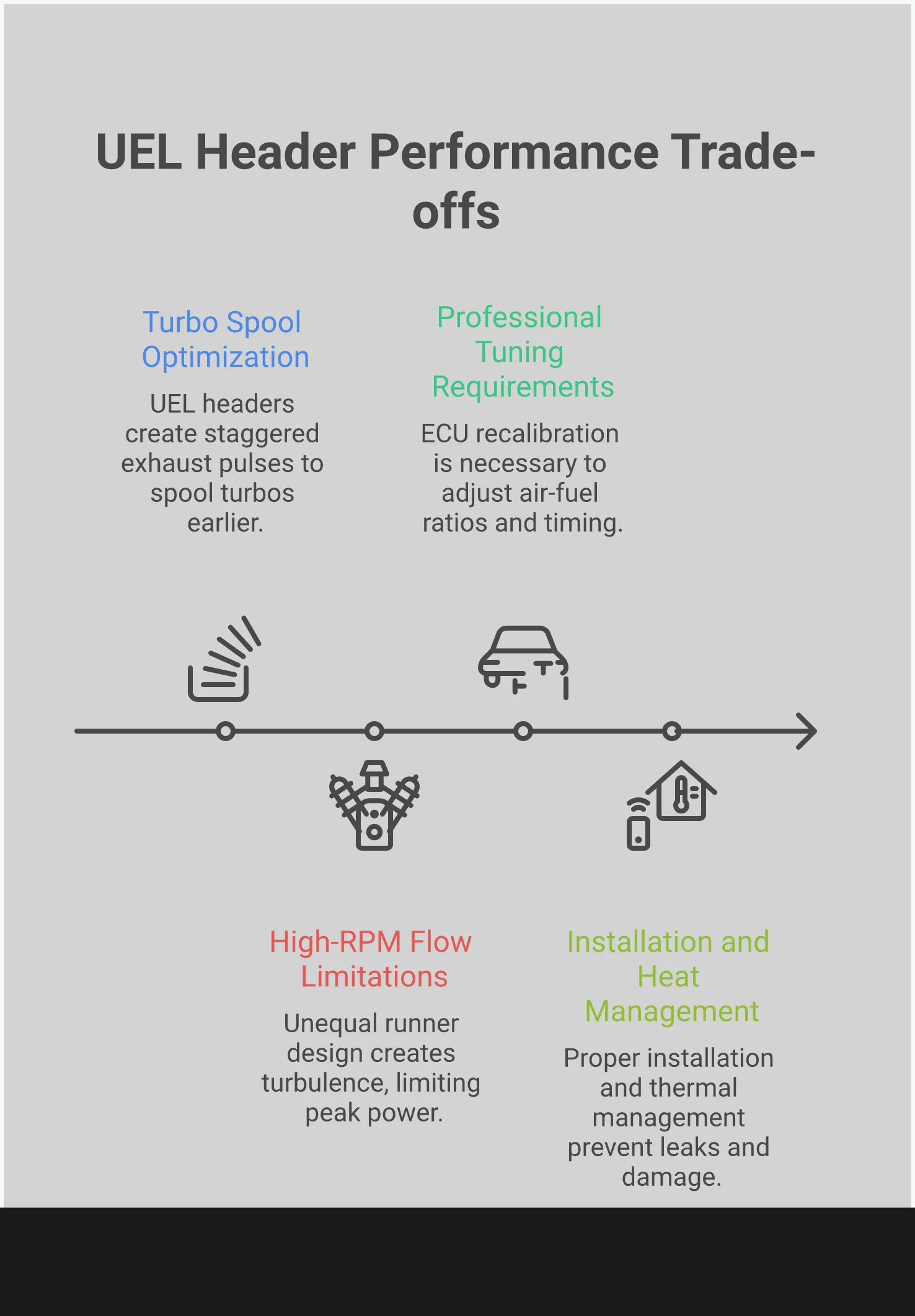
UEL vs. EL Headers: Which Should You Choose?
Deciding between unequal and equal length headers comes down to a classic trade-off: sound versus peak performance. There’s no single right answer, but understanding your priorities will make the choice clear. It’s about matching the hardware to your specific goals for your Subaru, whether you’re building a daily driver, a track weapon, or an overlanding rig. Let’s walk through the key factors to help you find the perfect fit for your build.
Define Your Performance Goals
Your ultimate horsepower target is the biggest factor here. If you’re planning a high-horsepower build—think 600 HP and beyond—equal length headers are the more efficient choice. Their design ensures exhaust gases from each cylinder reach the turbo at the same time, creating a steady flow that supports maximum power at high RPMs. For most street cars and moderately modified Subarus, UEL headers provide a satisfying bump in low-end torque and quicker turbo spool, which feels great in daily driving. But for those chasing every last bit of power for the track, EL headers are the way to go for top-end performance.
Comparing Top-End Power Trade-Offs
The trade-off for that satisfying low-end torque and iconic rumble is a noticeable drop in top-end power. The design of UEL headers means exhaust pulses arrive out of sync, colliding and creating turbulence within the collector. This inefficiency makes it harder for your engine to breathe at higher RPMs, disrupting the exhaust scavenging process where one pulse helps pull the next one out. As engine speed climbs, this uneven flow creates a bottleneck that can limit your engine's peak horsepower potential. For a daily driver, this compromise is often worth it, but if your goal is a high-horsepower track build, the streamlined flow of an equal length header is essential for maximizing your performance parts.
Match Your Header to Your Driving Style
This is where your heart might overrule your head. Do you live for that iconic, off-beat "Subi rumble"? If so, unequal length headers are your only option. That signature sound is a direct result of the staggered exhaust pulses created by the different-length runners. It’s a core part of the Subaru enthusiast identity. If you prefer a smoother, more refined exhaust note similar to a traditional inline-four engine, or if you’re building a sleeper, then equal length headers will deliver. Your choice here really defines the character of your car, so think about what kind of experience you want every time you turn the key.
Sound Profile: The Rumble vs. The Rasp
The sound profile is arguably the most significant factor for many drivers. The classic Subaru rumble is produced exclusively by unequal length headers. Because the exhaust runners are different lengths, the exhaust pulses arrive at the collector at uneven intervals, creating the deep, burbling sound that has become synonymous with the brand. It’s an aggressive, head-turning note that defines the car's character. In contrast, equal length headers synchronize these pulses, resulting in a smoother, higher-pitched, and more uniform exhaust note—often described as more "raspy" and similar to what you'd hear from a high-performance inline-four engine. The choice is purely subjective: do you want the iconic, off-beat rumble that screams Subaru, or a more refined, high-RPM wail?
What's Your Budget and Fitment Plan?
Practicality plays a role, too. Unequal length headers are generally less complex to manufacture, which often makes them the more affordable option. This can free up funds for other performance parts or a professional tune. UEL headers are also a direct replacement for the stock manifold on many EJ-series engines found in models like the WRX and STI, making for a straightforward installation. While EL headers can require more complex routing and sometimes modifications to fit, the performance gains can justify the extra cost and effort for serious builders.
Typical Costs and Popular Brands
When you start shopping for unequal length headers, it’s helpful to know the typical costs and which brands the Subaru community trusts. Because UEL headers have a simpler design than their equal-length counterparts, they are often a more budget-friendly upgrade. This less complex construction means you can get a significant sound and performance improvement for a smaller investment. Generally, you can expect to find UEL headers priced anywhere from $500 to $1,200, depending on the brand and materials. Some of the most respected names in the space include GrimmSpeed, HKS, IAG Performance, and Tomei. Choosing the right set comes down to balancing your budget with your performance goals to find the perfect fit for your Subaru.
Common UEL Header Myths, Busted
Let’s clear the air on a common misconception: the rumble does not equal more power. Many enthusiasts believe UEL headers are superior for performance because of their aggressive sound, but that’s not the full story. The rumble is a byproduct of exhaust inefficiency. While UELs can improve low-end response, their uneven flow limits peak horsepower potential. The idea that they are universally better for performance is a myth. To truly get the most out of either setup, a professional tune is non-negotiable. Proper engine tuning services will optimize your air-fuel ratio and timing to match your new hardware, ensuring you get reliable power without compromise.
Myth: UEL Headers Will Destroy Your Turbo
Let's tackle one of the most persistent myths in the Subaru community: that UEL headers will kill your turbo. This idea is largely unfounded. In fact, some in-depth analysis suggests the turbocharger may actually do less work with a UEL setup because the turbine spins at a lower speed. The real concern isn't mechanical harm to the turbo, but the impact of inefficient exhaust flow on the engine itself. The poor exhaust scavenging inherent to the UEL design can lead to higher temperatures inside the combustion chambers and create backpressure that restricts airflow at high RPMs. While your turbo is safe, these new dynamics must be managed. This is why a professional tune is non-negotiable after installation. Proper engine tuning services will adjust your car's parameters to protect your motor and ensure you get safe, reliable power from your upgrade.
How to Install and Maintain UEL Headers
Once you’ve chosen your UEL headers, the next step is getting them on your Subaru and keeping them in top shape. Proper installation and maintenance are just as important as the quality of the part itself. A sloppy install can lead to exhaust leaks, power loss, and a lot of frustration, completely undermining the performance gains you were hoping for. Think of this as the final, critical phase of your upgrade, where your attention to detail directly translates into sound and performance.
Taking the time to do it right ensures you get that signature rumble and responsive power you want, without any of the headaches. It’s about creating a perfect seal, managing the intense heat generated by exhaust gases, and making sure your engine’s computer understands the new hardware it’s working with. A little attention to detail during the installation process and some simple, periodic checks will protect your investment and keep your engine running strong. From using the right gaskets to getting a professional tune, each step plays a vital role in maximizing the benefits of your new headers and ensuring they perform reliably for years to come. This isn't just about bolting on a part; it's about integrating it seamlessly into your vehicle's ecosystem.
Tips for a Flawless Installation
A successful header installation starts before you even pick up a wrench. Following instructions carefully is the key to ensuring correct fitment and getting the performance benefits you expect. First, make sure you’re working on a completely cool engine to avoid burns and warped parts. Use new, high-quality gaskets; reusing old ones is a guaranteed way to create an exhaust leak. When tightening the bolts, follow the manufacturer's recommended torque sequence and specifications precisely. Over-tightening can damage the flange and cause leaks just as easily as under-tightening. A little anti-seize on the threads can also make future removal much easier.
Checking for Additional Required Parts
Bolting on a new set of headers is more than a simple parts swap; it's a fundamental change to your engine's respiratory system. The single most important "part" you'll need after the installation isn't a physical component, but a professional tune. Because headers alter your engine's airflow so significantly, your car's ECU needs to be recalibrated to account for the change. Without this adjustment, you risk running lean or rich, which can lead to engine damage and poor performance. A proper tune optimizes your air-fuel ratios and timing to work with the new hardware, ensuring you get safe, reliable power. To fully capitalize on the upgrade, investing in professional engine tuning services is not just recommended—it's essential for protecting your engine and unlocking the full potential of your new parts.
Creating Clearance for Other Upgrades
One of the practical advantages of UEL headers is their straightforward fitment. For many EJ-series engines found in models like the WRX and STI, UEL headers are designed as a direct replacement for the stock manifold, which simplifies the installation process. Their less complex routing generally means fewer clearance issues with other engine bay components. In contrast, equal length headers often require more intricate piping to achieve their uniform length, which can sometimes interfere with the oil pan, subframe, or other parts, potentially requiring modifications to fit correctly. If you're planning a build with multiple upgrades, the simpler packaging of UEL headers can make your life a little easier, leaving more room for future modifications without creating a spatial puzzle.
How to Manage Heat and Prevent Leaks
Unequal length headers operate under intense heat, and managing it is crucial for protecting surrounding components and ensuring the longevity of the headers themselves. High-quality performance parts are designed with features like robust welds and thick flanges to handle thermal stress and minimize leaks. To further reduce under-hood temperatures, consider using a thermal wrap or getting your headers ceramic coated. After the first few drives (heat cycles), it’s a good practice to re-check the torque on all mounting bolts, as they can sometimes loosen slightly as the metal expands and settles. Regularly inspect the gaskets for any signs of black soot, which indicates a leak that needs to be addressed.
Why a Proper Tune is Crucial
Installing UEL headers isn't a simple bolt-on-and-go modification. A professional tune is absolutely essential to get the most out of your new hardware and keep your engine safe. Changing the exhaust flow fundamentally alters your engine's air-to-fuel ratio and timing parameters. Without a tune, your engine could run too lean or too rich, leading to knocking, reduced power, and potentially catastrophic damage. Professional engine tuning services will recalibrate your ECU to match the new exhaust characteristics, ensuring your Subaru runs efficiently, makes reliable power, and remains healthy for the long haul. Skipping this step is simply not worth the risk.
Your Long-Term Maintenance Checklist
To ensure your UEL headers deliver optimal performance over time, a few periodic checks are all you need. Every few months or during your regular oil change, take a moment to give them a quick inspection. Look closely at the welds and collector area for any signs of stress or cracking. Listen for any new or unusual ticking or hissing sounds when the engine is running, as this is often the first sign of a developing exhaust leak. If you used a thermal wrap, check its condition to make sure it isn't becoming brittle or unraveling. A quick visual check and listening ear can help you catch small issues before they become bigger problems.
Legal and Emissions Considerations
Before you commit to an upgrade, it’s essential to consider the legal and emissions requirements in your area. Many aftermarket performance parts, including UEL headers, are designed and sold for "off-road use only." This designation means they may not be legal for use on public roads and could cause your vehicle to fail a smog test or visual inspection. States with strict emissions standards, like California, have very specific rules, and a non-compliant header can result in a failed test even if your tailpipe emissions are within limits. It is always your responsibility to verify that any modification complies with your local, state, and federal laws. Doing this research beforehand can save you from costly fines and the headache of having to reinstall your stock parts.
Related Articles
- High-Performance Subaru Rally Exhaust: A Buyer's Guide
- The Ultimate Subaru Aftermarket Exhaust Guide
- The Ultimate Subaru WRX Exhaust System Guide
Frequently Asked Questions
Do I absolutely need a professional tune after installing UEL headers? Yes, a tune isn't just recommended; it's essential. Installing UEL headers changes how your engine breathes by altering the exhaust flow and backpressure. Without a professional tune, your engine's computer won't know how to adjust, which can lead to running too lean or rich. This not only robs you of the performance you were hoping for but can also put your engine's health at risk. Think of the tune as the final step that syncs your new hardware with your car's brain, ensuring you get safe, reliable power.
Will UEL headers make my daily commute better or worse? For most drivers, UEL headers make daily driving more enjoyable. The quicker turbo spool and improved low-end torque mean your car will feel more responsive and eager, especially in stop-and-go traffic or when accelerating from a light. You'll feel more power in the RPM range you use most often. The trade-offs, like slightly lower peak horsepower, are rarely noticeable on public roads, making UEL headers a great upgrade for enhancing the feel of a street-driven car.
Are UEL headers compatible with all Subaru models, like the Crosstrek or Forester? While unequal length headers are most famously associated with turbocharged models like the WRX and STI, they are not exclusive to them. The key is matching the part to your specific engine and model year. Always confirm the product fitment before purchasing to ensure it’s designed for your vehicle, whether it's an Impreza, Forester, or another model in the Subaru lineup.
Besides the rumble, how much louder will UEL headers make my car? The headers themselves primarily change the tone and character of your exhaust note, creating that signature rumble. While they can contribute to a slight increase in volume, the overall loudness of your car is determined more by the rest of your exhaust system, specifically your catalytic converter and muffler setup. If you keep your stock cat-back, the change in volume will be modest, but the sound will be much deeper and more aggressive.
If I’m not chasing huge horsepower numbers, are there any real downsides to UEL headers for a street car? Honestly, for a daily driver or a moderately modified street car, the downsides are minimal. The primary "con" of UEL headers is that they limit peak horsepower at very high RPMs, which is a trade-off that most drivers will never even notice during normal driving. For a street-focused build, you are simply choosing the iconic sound and responsive low-end torque over the high-RPM efficiency of an equal length system.