

Subaru Transmission Cooler Guide: Track, Tow, and Daily Use
A Subaru transmission cooler can be a useful performance upgrade when repeated track laps, towing, high ambient temperatures, or a modified powertrain place more heat into the transmission fluid than the original system was designed to manage. The correct solution depends on your transmission type, model year, factory heat exchanger, fluid specification, and available airflow. A cooler is not a universal replacement part, and adding one without a fitment and circuit plan can create new problems.
Contact Crawford Performance today for Subaru transmission cooler fitment guidance
What does a Subaru transmission cooler do?
A Subaru transmission cooler manages heat in automatic, continuously variable, or manual-transmission lubricant. Depending on the vehicle, the factory system may use a liquid-to-liquid heat exchanger, an air-to-oil cooler, or a combination of components. A targeted performance upgrade adds heat rejection or capacity while preserving the warm-up behavior, pressure control, and fluid routing the transmission requires.
Transmission fluid does more than lubricate gears. In an automatic or CVT, it also transfers hydraulic force and carries heat away from clutches, pulleys, bearings, and other internal components. In a manual transmission, gear oil protects gears, synchronizers, and bearings under load. As temperature rises, the fluid and the parts around it experience more thermal stress. A cooler cannot fix incorrect fluid, low fluid level, a failing transmission, or poor calibration, but it can be part of a complete heat-management plan.
That distinction is important for Subaru owners. A cooler should be selected around the complete vehicle, not installed because a universal core looks large enough. Crawford's Subaru WRX cooling system guide covers engine coolant and engine-oil heat management. This article stays focused on the transmission circuit and the decisions that make a transmission-cooling upgrade safe and useful.
When is a Subaru transmission cooler worth considering?
A transmission cooler is most relevant when the vehicle sees a sustained heat load that is different from ordinary commuting. That can include a track car that spends several sessions at high load, a Subaru used for towing within its approved limits, an overland vehicle carrying additional weight in hot conditions, or a modified car whose power and tire grip increase drivetrain demand.
- Track driving: repeated acceleration, braking, cornering, and limited cooling time can raise transmission temperatures session after session.
- Towing: additional mass and long grades increase drivetrain load. Follow the owner's manual for tow limits, hitch requirements, and operating conditions before planning a cooler.
- High ambient temperatures: hot air reduces the temperature difference available for a cooler to reject heat, especially at low vehicle speed.
- Modified powertrains: more torque, stickier tires, and aggressive launches can increase the heat entering the transmission even when the engine cooling system is healthy.
- Observed temperature rise: a reliable sensor or data log can show whether the transmission is the thermal bottleneck instead of relying on guesswork.
Use the vehicle's actual duty cycle to decide. A daily-driven Subaru that never tows or sees sustained high load may not need an auxiliary cooler. Conversely, a car that seems fine on the street can show a very different thermal pattern during a track session. The goal is not to make the fluid as cold as possible. The goal is to keep the transmission within the operating range specified for its design and fluid.
Which Subaru transmissions need different cooling strategies?
The phrase "Subaru transmission cooler" covers several different jobs. Automatic and CVT systems generally use a transmission fluid circuit that may pass through a factory heat exchanger. Manual Subaru transmissions use gear oil and typically need a different approach if a dedicated cooler is required. Treating these systems as interchangeable is a common fitment mistake.
| Transmission type | Primary cooling question | Common planning priority |
|---|---|---|
| CVT | How does the proposed cooler integrate with the factory heat exchanger and specified CVT fluid? | Confirm cooler presence, line routing, thermostatic strategy, and year-specific fitment. |
| Automatic | What fluid circuit and fittings does the specific transmission use? | Match the cooler and adapters to the factory circuit without creating leaks or restrictions. |
| Manual | Is the need for gear-oil cooling proven by the vehicle's use and temperature data? | Plan a pump, core, reservoir, and return circuit as a complete system if required. |
Fitment also changes with the chassis, model year, engine, transmission code, radiator arrangement, front bumper, skid plates, and other modifications. A cooler that fits a 2015-2021 WRX CVT application should not be assumed to fit a Crosstrek, Forester, Impreza, or a manual-transmission WRX. Start with the vehicle identification information and the factory service information, then confirm the proposed parts against the actual car.
For manual drivetrain planning, Crawford's STI 6-speed swap guide explains why transmission, differential, clutch, axle, and driveshaft compatibility must be considered as one package. The same systems approach applies to cooling: identify the fluid circuit first, then choose the cooler.
Should you retain the factory Subaru transmission heat exchanger?
In many Subaru applications, the factory heat exchanger serves two jobs. It can remove heat when the transmission is hotter than the engine coolant, and it can help warm the fluid during cold operation. Replacing or bypassing it without understanding that behavior can delay warm-up, change the intended thermal balance, or create an installation that works in one season and performs poorly in another.
A common performance strategy is to add a properly sized air-to-oil cooler while retaining the factory heat exchanger, but that is not automatically correct for every model or transmission. The circuit may need a thermostat, bypass, adapter, or other component to prevent excessive cooling and to preserve the factory function. The correct layout depends on the transmission manufacturer's requirements and the kit's instructions.
Do not choose a design solely by advertised core size. Ask these questions first:
- Does the vehicle already have a transmission cooler or heat exchanger?
- Is the proposed part designed for the exact transmission type and year range?
- Will the circuit retain the factory warm-up function?
- Does the design require a thermostat, bypass, pump, or filter?
- Can the installation be serviced and inspected without removing unrelated hardware?
If the answer to those questions is unclear, pause before ordering. Crawford Performance's technical team asks owners to include their year, make, model, and relevant build details when requesting advice, which is the right level of information for a transmission-cooling conversation.
How should you choose cooler placement and airflow?
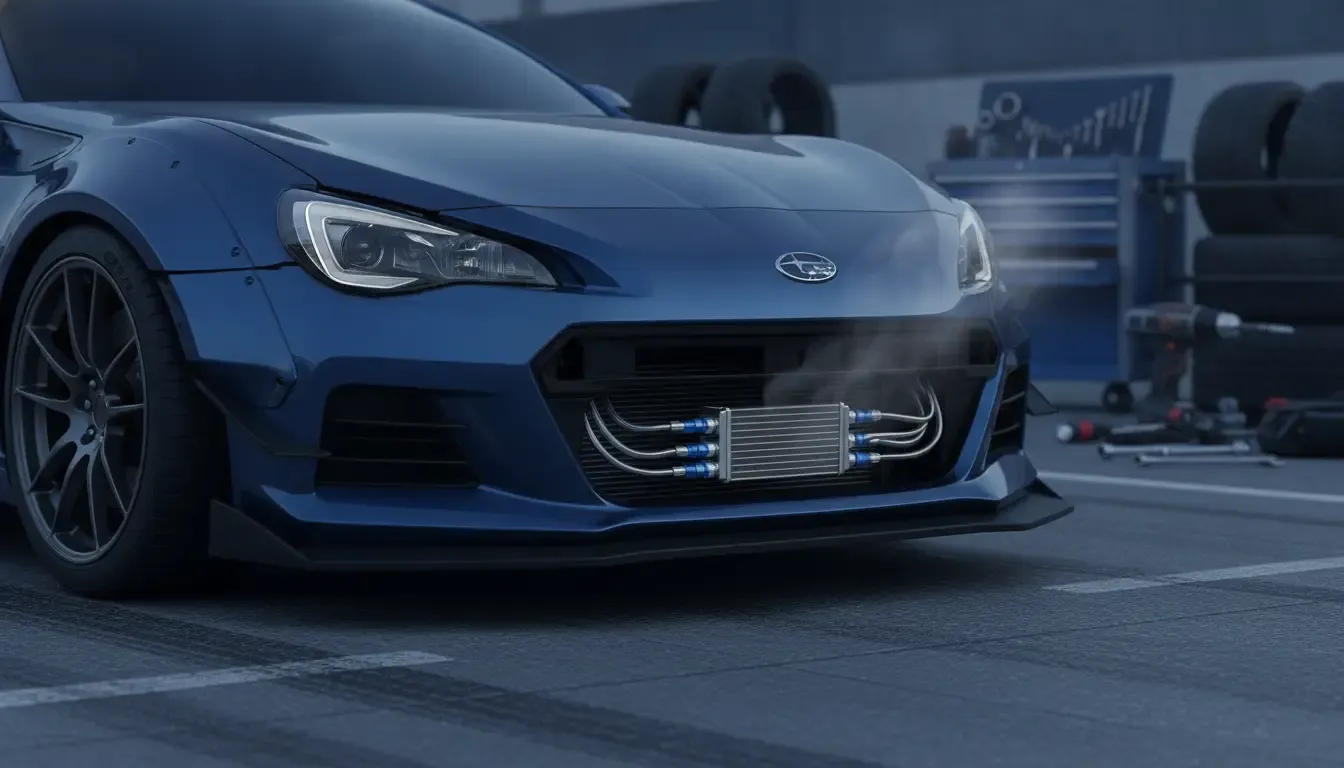
Cooler placement determines how much heat the core can reject and how well it survives the vehicle's environment. The best location has dependable airflow, enough clearance for fittings and lines, protection from debris, and a mounting method that does not rely on a fragile plastic panel. A front-mounted cooler can work well when it receives clean air, but it should not block the radiator, intercooler, or another component that has a higher priority for the build.
Consider the full airflow path rather than the front face alone. A core needs air entering it and a low-resistance path for that air to leave. Ducting or sealing around the core can improve effectiveness, while a cooler sitting behind a solid bumper reinforcement or tightly packed heat exchanger may receive less air than its position suggests. At low speed, airflow may be limited, so the installation should be evaluated for the actual use case, not just highway conditions.
Track and off-road vehicles also need different protection. A track car may prioritize maximum airflow and easy inspection between sessions. A Subaru used on gravel, snow, or overland routes may need a guarded location that resists rocks, mud, and branches. The cooler should be protected without completely sealing the airflow path. Keep enough space around the core for cleaning and inspection.
Use the Subaru track-day build checklist when evaluating the rest of a track setup. Transmission cooling should be coordinated with braking, engine cooling, tires, suspension, and data collection. A single upgrade rarely solves a system-level thermal problem by itself.
What matters in transmission cooler line routing?
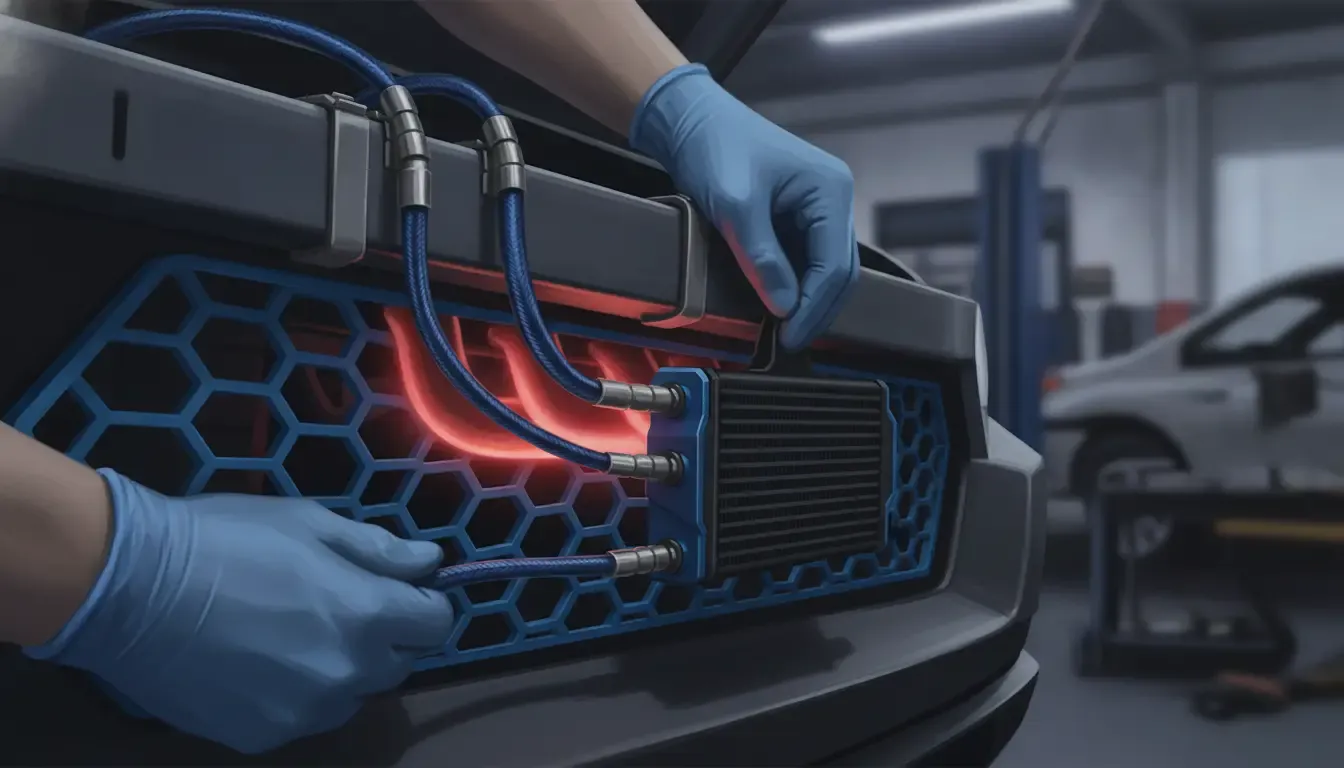
Line routing is a reliability issue, not just an installation detail. Transmission fluid lines should be rated for the fluid, pressure, temperature, and environment they will experience. They need secure fittings, appropriate clamps or brackets, and enough clearance from exhaust heat, sharp edges, steering movement, suspension travel, and rotating components.
Plan the route before cutting or tightening anything. Follow the lines from the transmission to the cooler and back, then inspect the path through the entire range of steering and suspension movement. Leave room for engine or drivetrain movement where the vehicle's design requires it. Avoid tight bends that can kink a hose, and do not allow a line to rub against a bracket until the outer layer wears through.
Use heat shielding where the route passes near a hot component, but do not use a heat sleeve to justify placing the line directly against an exhaust. Keep fittings accessible for inspection. After installation, check for seepage at operating temperature, then recheck the hardware after the first heat cycle and again after the first drive. A small fluid leak can become a major transmission problem quickly.
Cleanliness matters as well. Keep open lines capped during installation, use clean tools, and follow the cooler manufacturer's flushing and priming instructions. A new cooler should not introduce debris into a precision fluid circuit. If the system uses a filter, confirm its service interval and make sure the filter can be replaced without draining the entire vehicle unnecessarily.
Talk to Crawford Performance about routing, fittings, and Subaru build compatibility
Which fluid should you use after installing a cooler?
Use the fluid specified for the exact transmission and model year. CVT fluid, automatic transmission fluid, and manual gear oil are not interchangeable categories, even when they are all described as transmission lubricant. A cooler upgrade does not change the required fluid specification. It also does not make a fluid suitable for a different transmission.
Before service, identify the transmission code and confirm the approved fluid in the owner's manual or factory service information. Check the required fill procedure, temperature range, level-check method, and whether the vehicle needs a scan tool or a specific sequence. Overfilling and underfilling can both create problems, and the correct level may need to be checked at a defined temperature.
For manual Subaru applications, choose gear oil based on the transmission and the use case, not a generic viscosity label alone. Crawford's Motul synthetic gear oil collection is a relevant starting point for owners comparing available gear-oil options, but the transmission specification remains the authority. For CVT or automatic applications, confirm the required fluid separately before purchasing or filling the system.
How can you monitor a Subaru transmission cooler upgrade?
Monitoring turns a cooler decision into an engineering decision. If the vehicle already has a reliable transmission-temperature signal, record baseline data under the same conditions you plan to use after the upgrade. Compare warm-up behavior, peak temperature, recovery between sessions, and temperature stability during towing or sustained climbs. One isolated number is less useful than a repeatable trend.
If the vehicle does not expose a useful temperature signal, ask a qualified technician about a sensor location that does not compromise the circuit. The sensor should measure a meaningful point, and its wiring should be protected from heat and movement. A sensor placed in a stagnant or unrepresentative location can create false confidence.
Use a controlled test plan:
- Inspect fluid level, fluid condition, leaks, and line clearance.
- Record the baseline on a representative drive or session.
- Install the cooler according to the vehicle and kit instructions.
- Bleed, prime, or fill the circuit as specified, then inspect for leaks.
- Repeat the same route, load, ambient conditions, and driving pattern when possible.
- Review peak temperature, warm-up, recovery, and any pressure or drivability changes.
Do not use a cooler to hide a transmission that is slipping, shuddering, leaking, or showing fault codes. Diagnose those symptoms first. A cooler may reduce heat, but it cannot repair worn clutches, damaged bearings, incorrect calibration, a restricted line, or a mechanical failure.
Targeted performance upgrade or stock replacement?
A stock replacement restores the function of the original part for the original application. A targeted performance upgrade changes the vehicle's thermal capacity or airflow for a defined use case. Those are different goals. If the original cooler is damaged, leaking, or blocked, the first priority is a correct replacement and a healthy fluid circuit. If the transmission is healthy but repeatedly overheats under a documented load, an auxiliary or higher-capacity solution may be appropriate.
| Decision | Stock replacement is usually the priority | Targeted performance upgrade may be appropriate |
|---|---|---|
| Problem | Leak, damage, corrosion, or failed heat exchanger. | Repeatable high temperature under a defined load. |
| Use case | Normal street driving and factory operating conditions. | Track sessions, approved towing, hot-weather load, or a modified drivetrain. |
| Design goal | Restore factory routing and warm-up behavior. | Add measured heat rejection while preserving safe fluid control. |
| Fitment | Exact original part or approved equivalent. | Transmission-specific cooler, adapters, thermostat, lines, and mounts. |
The right answer can also be staged. Repair a leak, verify the fluid, improve monitoring, and test the vehicle before adding hardware. That sequence prevents an expensive cooler from becoming a substitute for diagnosis. It also gives you a clearer baseline for deciding whether the upgrade changed the problem.
What should you confirm before buying a Subaru transmission cooler?
Before ordering, collect the information a technician needs to evaluate the system. At minimum, record the Subaru model, model year, engine, transmission type, transmission code if known, current modifications, and intended use. Add the tire and wheel setup, towing or cargo demands, climate, and any measured temperature data. Photos of the front of the vehicle and the existing lines can also reveal packaging constraints.
- Exact year, model, trim, engine, and transmission.
- Whether the vehicle is CVT, automatic, or manual.
- Whether a factory cooler or heat exchanger is already present.
- How the vehicle is used: street, track, towing, off-road, or a combination.
- Any radiator, intercooler, skid plate, bumper, turbo, or engine changes.
- Fluid specification and the most recent service history.
- Available temperature data, warning lights, leaks, or drivability symptoms.
Crawford's synthetic fluids and oil collection can help you review fluid options, while Crawford's Subaru performance collection provides a broader view of build hardware. Availability and fitment can change, so confirm that a product is currently offered for your exact application before making a claim or placing an order.
Request a Subaru transmission cooling plan from Crawford Performance
Frequently Asked Questions
Is a Subaru transmission cooler worth it for a daily driver?
Usually, not automatically. A daily-driven Subaru that stays within its factory operating conditions may not need an auxiliary cooler. Consider one when measured temperatures, approved towing, sustained grades, hot-weather load, or significant drivetrain modifications show a repeatable need. Confirm the transmission-specific design before adding hardware.
Does every Subaru with a CVT need an external cooler?
No. CVT cooling varies by model year and factory configuration. Some applications already use a heat exchanger, and adding an external cooler must preserve the required fluid circuit and warm-up behavior. Confirm whether a factory cooler is present, what fluid is specified, and whether the proposed kit is designed for that exact Subaru.
Can I use automatic transmission fluid in a Subaru CVT?
Do not assume that automatic transmission fluid and CVT fluid are interchangeable. Use the fluid specified for the exact transmission and model year, then follow the correct level-check and service procedure. A cooler upgrade does not change the required fluid specification.
Should a manual Subaru transmission have an oil cooler?
It depends on the transmission, use case, and measured temperatures. Manual gear-oil cooling is a different system from CVT or automatic fluid cooling and may require a pump, core, reservoir, filter, and return circuit. Track use can justify a dedicated design, but a universal cooler is not a complete fitment plan.
Where should a Subaru transmission cooler be mounted?
Choose a location with dependable airflow, clearance from hot and moving parts, protection from debris, and access for inspection. Avoid blocking the radiator or intercooler. The best position depends on the chassis, bumper, other heat exchangers, and whether the Subaru is used on pavement, track, or rough terrain.
How do I know if the cooler is working?
Compare repeatable temperature data before and after installation under similar load and ambient conditions. Review warm-up, peak temperature, recovery, leaks, and drivability. If the vehicle has warning lights, slipping, shuddering, or other faults, diagnose those issues instead of relying on a cooler to mask them.
For a fitment-specific recommendation, contact Crawford Performance with your Subaru year, model, transmission, and intended use.