

The Ultimate Guide to the Subaru STI Engine
With the final EJ-powered STI rolling off the line, an era of raw, analog performance is over. For those of us lucky enough to own one, we're now the custodians of a modern classic. This means understanding your Subaru STI engine is more critical than ever. This guide cuts through the noise. We'll explore the history, compare the different EJ models, and give you a straightforward plan for maintenance and smart modifications. Let's make sure these rally-bred icons continue to deliver the performance we love for years to come.
Key Takeaways
- Understand the Platform's Purpose: The STI engine, particularly the EJ257, isn't just a more powerful WRX motor; it's a rally-bred platform with stronger internals and a more robust drivetrain designed for higher stress, making it an ideal foundation for serious performance modifications.
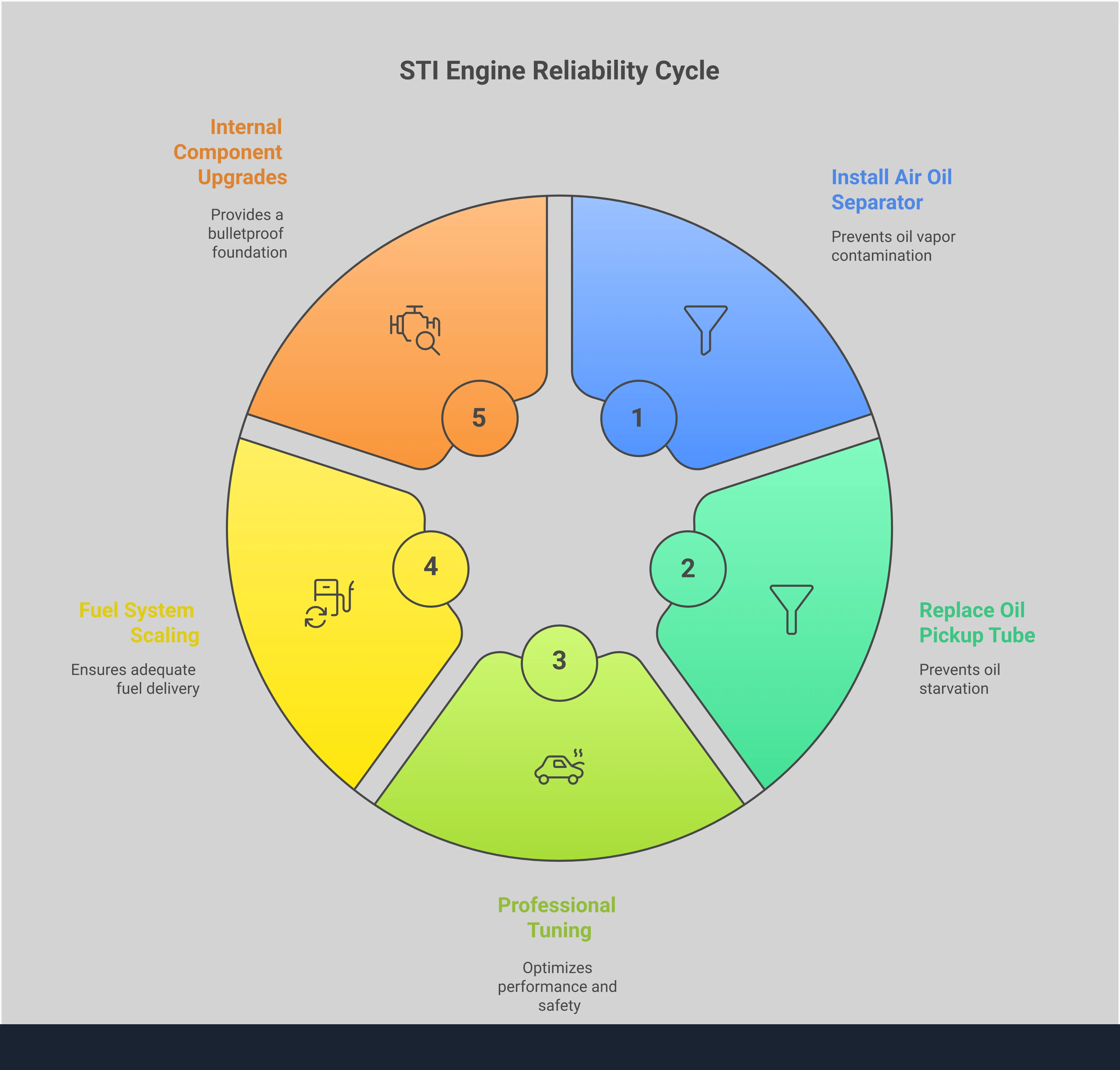
- Prioritize Engine Health Over Peak Power: Common issues like piston ringland failure and oil starvation are often preventable. A professional tune, high-octane fuel, and essential reliability upgrades like an Air Oil Separator are non-negotiable steps to protect your engine before you add significant power.
- Build a Balanced Performance System: Increasing horsepower reliably requires a systematic approach where every component, from the intake and exhaust to the fuel system and forged internals, works in harmony. A professional tune is the final, critical step that synchronizes all your upgrades to deliver safe, consistent power.
What Makes a Subaru STI Engine So Special?
When you hear the rumble of an STI, you’re hearing more than just an engine—you’re hearing a piece of motorsport history. The STI motor isn't just a standard Subaru engine with a bigger turbo; it's a purpose-built powerplant designed from the ground up for performance. It represents the pinnacle of Subaru's engineering, refined over decades of rally racing and track dominance. Understanding what makes an STI motor special is the first step to appreciating its potential and learning how to get the most out of it.
At its core, an STI motor is defined by its robust construction, high-flow components, and aggressive tuning. From the legendary EJ series to the newer FA engines, each one carries a legacy of power and reliability when properly maintained. Whether you're looking to build a weekend track car or a daily driver with serious attitude, the STI engine provides a formidable foundation.
From Rally Stages to Your Driveway
The "STI" in Subaru WRX STI stands for Subaru Tecnica International, the brand's in-house performance division. Founded in 1988, STI's original mission was to prepare Subaru vehicles for the grueling World Rally Championship (WRC). This racing heritage is baked into the DNA of every STI motor. The road-going cars were often developed to meet strict racing regulations, meaning they were built with competition-grade engineering from the factory.
This is why the STI is celebrated as the ultimate high-performance version of the WRX. It’s not just an appearance package; it’s a complete system where the engine, drivetrain, and suspension are all designed to work in harmony under extreme conditions. That rally-bred toughness is what gives the STI its legendary reputation and makes it such a capable platform for modification.
A History of Evolution: From Impreza to WRX
The journey from a practical sedan to a performance icon began with the standard Impreza. While a capable car in its own right, its true potential was realized when Subaru entered the World Rally Championship. To compete, they needed a production car to base their rally car on, and the WRX—or "World Rally eXperimental"—was born. This model introduced the legendary combination of a turbocharged boxer engine and symmetrical all-wheel drive to the masses. But the evolution didn't stop there. The STI took that formula and perfected it, creating a machine that was less of a modified Impreza and more of a street-legal race car. Every component, from the beefier 6-speed transmission to the driver-controlled center differential and stronger engine internals, was engineered for the sole purpose of performance, creating a clear distinction between it and the standard WRX. This lineage is why even today, owners of the base Impreza have a direct upgrade path inspired by its more powerful siblings.
What's Unique About the Boxer Engine Design?
The heart of every STI is its signature boxer engine. Unlike traditional inline or V-shaped engines, a boxer’s pistons move horizontally, like a boxer throwing punches. This design gives the engine a flatter profile, lowering the car's center of gravity for improved handling and stability. It’s also responsible for that iconic "Subaru rumble" that enthusiasts know and love.
For North American models from 2004 to 2021, the go-to engine was the EJ257, a 2.5-liter turbocharged boxer-four. This powerhouse became an icon, delivering around 310 horsepower and a thrilling torque curve right out of the box. Built with a semi-closed deck block for added strength, the EJ257 was designed to handle the pressures of forced induction, making it a favorite among tuners looking to add serious performance parts.
A Guide to Every STI Engine Code
The Subaru STI has a rich history rooted in rally racing, and at the heart of every model is a legendary boxer engine. Over the years, Subaru has developed several distinct motors for its flagship performance car, each with its own unique characteristics, strengths, and quirks. For any owner looking to get the most out of their car, understanding the engine under the hood is the first and most critical step. Whether you have a classic "Blobeye" or one of the final EJ-powered models, knowing the difference between an EJ205 and an EJ257 can make all the difference in your modification journey.
These engines aren't just random assortments of letters and numbers; they represent different eras of Subaru's performance engineering. From the high-revving 2.0-liter JDM legends to the torque-heavy 2.5-liter powerhouses found in North American models, each engine offers a different platform for building your dream car. Let's walk through the key players in the STI engine lineup, from the originals to the modern motors that carry the torch forward. This will help you identify what you're working with and plan your performance parts strategy accordingly.
EJ205: Where It All Began
The EJ205 is a 2.0-liter turbocharged boxer engine that set the stage for much of what was to come. While it was primarily used in Japanese Domestic Market (JDM) STIs and early US-market WRX models, it holds a special place in the community. Known for its eagerness to rev and its strong aftermarket support, the EJ205 has become a popular choice for engine swaps. Enthusiasts often seek it out for its unique power delivery and classic Subaru rumble. For those building a project car from an older chassis, the EJ205 offers a reliable and tunable foundation for creating a truly personalized performance machine.
EJ257: The North American Icon
If you’ve driven a North American WRX STI made between 2004 and 2021, you’ve experienced the EJ257. This 2.5-liter turbocharged boxer is the engine that defined the STI for an entire generation of enthusiasts. Producing between 300 and 310 horsepower from the factory, the EJ257 is celebrated for its low-end torque and muscular feel. Its robust design has made it a favorite in the tuning world, with a massive ecosystem of Subaru STI upgrades available to push its performance far beyond stock levels. Its long production run means it's well-understood, making it a reliable and powerful heart for any build.
EJ207: The Coveted JDM Legend
The EJ207 is the stuff of legends for many Subaru fans. This 2.0-liter turbocharged flat-four was built specifically for the Japanese market and is renowned for its performance-focused engineering. Compared to its 2.5-liter counterpart, the EJ207 features a stronger internal design, a higher redline (often around 8,000 RPM), and a twin-scroll turbo setup in many versions. This results in a completely different driving dynamic—one that rewards drivers who love to chase the redline. It’s a highly sought-after engine for swaps, favored by those who want to build a track-focused STI with a true JDM soul.
FA24F: The Modern Successor
While the STI as we knew it ended with the 2021 model, its spirit lives on in the latest engine technology from Subaru. The FA24F is a 2.4-liter turbocharged boxer engine that powers the current generation of the WRX. Although it isn't technically an STI motor, the performance community is buzzing with its potential. Featuring modern direct injection technology and a broader torque curve, the FA24F represents a new chapter in Subaru performance. Many owners are already exploring Subaru WRX upgrades for this platform, and there’s constant speculation that a high-output version could power a future STI model.
Why Are the EJ257 and EJ207 So Legendary?
When you talk about modern Subaru performance, two engine codes immediately come to mind: the EJ257 and the EJ207. These powerplants are more than just metal and pistons; they represent a golden era of rally-bred engineering that captured the hearts of enthusiasts worldwide. Their legendary status comes from a proven track record of power, reliability, and a massive potential for modification. While both are icons, they offer distinct experiences, making the debate over which is "better" a favorite topic in the STI community. Let's break down what makes each of these boxer engines so special.
EJ257 Specs: What Makes It So Powerful?
The EJ257 is the heart of the North American WRX STI from 2004 to 2021. This 2.5-liter turbocharged boxer-four is famous for its impressive low-end torque and a factory output of around 300-310 horsepower. Its larger displacement gives it a punchy, responsive feel that makes it incredibly fun for daily driving and a monster on the track. The EJ257’s design and widespread availability have made it a favorite canvas for tuners. With the right Subaru STI upgrades, this engine can reliably handle significant power increases, solidifying its reputation as a true performance powerhouse.
Horsepower and Torque Figures
The EJ257 is famous for its impressive low-end torque and a factory output of around 300-310 horsepower. But the spec sheet only tells part of the story. What truly defines the EJ257 is its thrilling torque curve, which delivers a powerful surge of acceleration right off the line. This immediate response makes the car feel alive and aggressive, whether you're pulling away from a stoplight or powering out of a corner on the track. This characteristic is a direct result of its larger displacement, giving it a distinct advantage over smaller, higher-revving engines. It’s this accessible power that makes the EJ257 such a satisfying engine for daily driving and a formidable base for adding Subaru STI upgrades.
Stronger Castings in Later Models
One of the key reasons the EJ257 can handle so much power is its physical construction. Built with a semi-closed deck block for added strength, the engine was specifically designed to handle the pressures of forced induction. This design provides extra support for the cylinder walls, which is critical when you start increasing boost with aftermarket performance parts. This inherent toughness is why the EJ257 became a favorite among tuners looking to build high-horsepower street and track cars. Its robust design has fostered a massive ecosystem of available upgrades, allowing owners to push performance far beyond stock levels with confidence.
What Gives the EJ207 Its High-Revving Edge?
While North America got the EJ257, the Japanese Domestic Market (JDM) received the EJ207. This 2.0-liter turbocharged flat-four is often celebrated for its high-revving nature and incredible balance. Despite its smaller displacement, the JDM EJ207 often produced similar or even higher horsepower figures from the factory, boasting around 304 horsepower and 311 lb-ft of torque in later versions. Enthusiasts praise the EJ207 for its smoother power delivery and stronger internal components straight from Subaru, making it a highly sought-after engine for swaps and builds. It’s a testament to precision engineering, delivering a spirited and refined driving experience.
Smoother Performance at High RPMs
The real magic of the EJ207 reveals itself when you push the tachometer past 5,000 RPM. Where the larger EJ257 can start to feel a bit strained at the very top of its rev range, the EJ207 feels right at home, pulling smoothly and eagerly all the way to its 8,000 RPM redline. This characteristic isn't an accident; it's a direct result of its purpose-built design. With stronger factory internals and a more balanced rotating assembly, the engine operates with less vibration and more refinement at high speeds. This inherent smoothness, combined with the quick-spooling twin-scroll turbo found on many versions, delivers a linear and predictable power curve that track drivers adore. It’s this high-RPM stability that makes the EJ207 a prime candidate for serious Subaru STI upgrades, as it provides a rock-solid foundation for building a responsive, high-revving track weapon.
EJ257 vs. EJ207: How They Differ on the Inside
The core distinction between these two engines lies in their internal architecture. The 2.5-liter EJ257 achieves its larger displacement with a wider cylinder bore and a longer piston stroke compared to the 2.0-liter EJ207. This design allows for larger valves, which can improve airflow for greater torque. However, the EJ207 is often noted for having a stronger factory setup, including a more robust crankshaft and connecting rods designed for higher RPMs. Both engines are built tough, but understanding these internal differences is key when planning a build and selecting the right performance parts to achieve your power goals.
Factory-Forged Internals
One of the most significant distinctions between the EJ257 and EJ207 lies in their factory-installed internal components. The JDM EJ207, in particular, is famous for its robust factory-forged parts, including a stronger crankshaft and connecting rods. This superior metallurgy is a key reason it can safely handle higher RPMs and is often considered a more durable platform for aggressive builds straight from the factory. While the EJ257 is also a tough engine designed for performance, its cast pistons can be a weak point when pushing for significant horsepower gains. For owners aiming to build a high-powered STI, upgrading the stock internals is a crucial step toward ensuring long-term reliability and getting the most out of your performance parts.
STI vs. WRX: What's the Real Difference Under the Hood?
At a glance, the Subaru WRX and its high-performance sibling, the STI, share a lot of DNA. They both have that iconic hood scoop, a boxer engine rumble, and an all-wheel-drive system. But pop the hood and look closer at the drivetrain, and you’ll find two very different machines. The STI isn't just a WRX with a bigger wing; it's a purpose-built performance car with a more powerful engine, a more advanced drivetrain, and a suite of track-ready components that set it apart. Understanding these core differences is key to appreciating what makes the STI so special and why it has become a legend in the performance world.
Power and Torque: A Head-to-Head Comparison
The most significant difference starts with the engine. Most US-spec WRX models from 2002 onward used a 2.0-liter turbo (EJ205), while the STI received the larger 2.5-liter turbocharged EJ257. This displacement advantage gives the STI a major head start in power. An older WRX might produce around 230 horsepower, whereas a comparable STI puts out closer to 300 horsepower from the factory. This isn't just about peak numbers; the larger engine delivers more torque across the powerband for a stronger pull and more immediate response. It's the foundation upon which all other Subaru STI upgrades are built.
More Than a Tune: Turbos and Core Components
More air equals more power, and the STI’s turbocharger proves it. Early WRX models often used a smaller TD04 turbo, which is great for daily driving but loses efficiency at higher RPMs. The STI, however, came with a larger IHI VF-series turbo (like the VF39 or VF52). This bigger unit forces more air into the engine, allowing it to generate much higher horsepower. To handle that extra muscle, the STI’s engine also features stronger internal components, like more robust pistons, making it a more durable platform for adding serious performance parts.
Turbocharger Models: TD04 vs. VF Series
The turbocharger is a critical piece of the puzzle, and the choice between the TD04 and the VF series highlights the different philosophies behind the WRX and STI. The TD04, standard on many WRX models from 2002-2014, is a small, quick-spooling turbo that feels responsive around town. However, its small size becomes a limitation at higher RPMs, where it can't flow enough air to keep making power. In contrast, the STI comes equipped with a larger IHI VF-series turbo, such as the VF39 or VF48. This unit is designed for higher performance, pushing significantly more air for a massive surge of power that pulls hard all the way to redline. This core hardware advantage provides a much higher ceiling for performance and is a key reason why the STI is the ideal platform for serious Subaru STI upgrades.
How the Drivetrain and Transmission Differ
Getting power to the ground is just as important as making it, and this is where the STI truly shines. It features a famously durable 6-speed manual transmission designed to handle aggressive driving. The centerpiece of its drivetrain is the Driver Controlled Center Differential (DCCD), an advanced system that lets the driver adjust the torque split between the front and rear wheels. This allows for fine-tuning the car's handling for any condition. Combined with front and rear limited-slip differentials, the STI’s drivetrain provides incredible grip and control that the standard WRX system can't match.
Beyond the Engine: Interior and Exterior Cues
The STI experience isn't confined to what's under the hood. Subaru designed the entire car to be a cohesive performance machine, where every detail, from the seats you sit in to the wing on the trunk, serves a purpose. The interior and exterior aren't just afterthoughts; they are functional extensions of the car's rally-bred soul. They provide the crucial connection between the driver and the road, ensuring that the power from the engine and the grip from the drivetrain are translated into a thrilling, controlled experience. These cues are what make an STI feel special even when you're just sitting still.
Signature STI Interior Touches
Inside the STI, you’re not just a passenger; you’re a pilot. The cabin is designed to keep you firmly in control during spirited driving. Many models feature aggressive Recaro performance seats, often wrapped in a combination of Ultrasuede and leather with signature red stitching. These aren't just for looks; they provide exceptional support to hold you in place through tight corners. The driver-focused cockpit is further enhanced by a leather-wrapped, flat-bottom steering wheel that offers a confident grip. Every element is intentionally placed to connect you directly to the car's performance, making the interior a functional part of the driving experience.
The Four-Door Sedan Body Style
The STI’s iconic four-door sedan shape is a direct nod to its rally heritage. This design isn't just about practicality; it provides a rigid chassis and a low center of gravity, which are essential for sharp handling and stability. The aggressive stance is defined by functional aerodynamic elements, like the prominent hood scoop that feeds air to the intercooler and the massive rear wing that generates downforce for high-speed stability. This body style serves as the perfect platform for further modification, allowing owners to build upon its rally-bred foundation with additional performance parts that enhance both its look and its capability on the road or track.
Common STI Engine Problems (And How to Prevent Them)
The Subaru STI is a performance icon, but its high-strung nature means it requires attentive ownership. Like any performance vehicle, certain issues can arise, especially when modifications are introduced without the right supporting parts or tuning. Understanding these common problems is the first step toward preventing them and ensuring your STI’s engine remains a reliable powerhouse for years to come. By being proactive, you can address potential weak points before they become catastrophic failures.
Most issues stem from a few key areas: detonation (knock), oiling system weaknesses, and the stress of increased power on stock components. The good news is that with the right knowledge, maintenance schedule, and high-quality performance parts, you can build a formidable and durable engine. Let’s look at some of the most discussed problems and, more importantly, how to solve them for good.
What Causes Piston Ringland Failure?
One of the most talked-about issues, particularly with the EJ257 engine, is piston ringland failure. The ringlands are the small metal ridges on the piston that hold the piston rings in place. In some stock STI pistons, these areas can be a weak point. When the engine experiences detonation—an uncontrolled explosion of the air-fuel mixture in the cylinder—the immense pressure spike can crack or break a ringland. This leads to a loss of compression, excessive oil consumption (blow-by), and eventually, major engine damage. The best prevention is a solid, professional engine tune that ensures safe air-fuel ratios and ignition timing, especially after adding performance modifications.
How to Prevent Head Gasket Failure
While head gasket failure is a widely known Subaru issue, in many STIs, it’s often a symptom of another problem: oil starvation. The factory oil pickup tube inside the oil pan can develop cracks at its brazed joint over time. When it cracks, the oil pump begins to suck in air instead of oil, causing a sudden drop in oil pressure. This starves critical components, like bearings and camshafts, of lubrication. The resulting friction creates extreme heat, which can lead to warped cylinder heads and, ultimately, failed head gaskets. Inspecting and replacing the stock oil pickup with a more robust aftermarket version is one of the most effective preventative measures you can take.
Why Oil Starvation Happens (And How to Fix It)
Proper oil flow is the lifeblood of your STI’s engine. Beyond the oil pickup issue, the boxer engine design can be susceptible to oiling problems during high-G cornering on the track or even spirited driving. Oil can slosh away from the pickup, momentarily starving the engine and causing premature wear on the rod bearings. Furthermore, high crankcase pressure can force oil vapor into your intake system, lowering your fuel's octane rating and increasing the risk of detonation. An Air Oil Separator (AOS) is a critical upgrade that solves both problems by removing oil from crankcase gases and returning it to the engine, ensuring a clean intake charge and a steady supply of oil.
Spotting the Early Warning Signs
Being in tune with your car is key to catching problems early. It’s not uncommon for even well-maintained STIs to need attention as they approach higher mileage, so vigilance is crucial. Listen for any unusual sounds, especially a rhythmic knocking that could indicate a bearing issue. Keep a close eye on your oil level between changes, as a sudden drop can signal ringland or other internal problems. Following best practices like letting the engine warm up properly before driving hard, using high-octane fuel, and adhering to a frequent oil change schedule will go a long way. Most importantly, trust your Subaru STI upgrades and maintenance to a specialist who understands these engines inside and out.
Which STI Model Has Which Engine? A Buyer's Guide
The Subaru STI has a rich history, with each generation offering a unique driving experience built around the legendary Boxer engine. Understanding the key differences between model years can help you choose the right platform for your performance goals. Whether you own one or are in the market, here’s a breakdown of the STI's evolution.
The "Blobeye" & "Hawkeye" Era (2002-2007)
When the STI officially landed in the United States in 2004, it made a massive impact. Known affectionately by their headlight designs as the "Blobeye" (2004-2005) and "Hawkeye" (2006-2007), these models brought rally-bred performance to the streets. US models were equipped with the 2.5-liter EJ257 engine, a departure from the 2.0-liter JDM version. These early STIs were celebrated for their raw, mechanical feel and lightweight chassis, making them incredibly responsive. They established a reputation for being potent machines right out of the box, and they remain a fantastic foundation for building a true performance monster with modern Subaru STI upgrades.
The Hatchback Generation (2008-2014)
The third generation marked a significant design shift, launching exclusively as a 5-door hatchback in 2008 before reintroducing a 4-door sedan in 2011. While the body style was new, the heart of the US-market STI remained the trusted EJ257, delivering around 305 horsepower. This generation offered a more refined ride and a stiffer chassis, providing a stable platform for both daily driving and track use. The wider body and updated suspension geometry made these cars handle beautifully, and they respond exceptionally well to a thoughtful selection of performance parts designed to enhance the engine's capabilities and sharpen the car's reflexes.
The Final EJ-Powered Models (2015-2021)
The final chapter for the iconic EJ engine came with the VA generation STI. Produced from 2015 to 2021, these models represented the most advanced and powerful iteration of the platform. The EJ257 engine was refined for its last run, paired with a sophisticated drivetrain and a chassis that was the stiffest yet. This generation is prized by enthusiasts as the end of an era. With a strong aftermarket supporting it, this STI is an incredible base for a high-horsepower build. To safely unlock its full potential, professional engine tuning services are essential to optimize performance while maintaining reliability for years to come.
The 2018 Model Year Updates
For the 2018 model year, Subaru gave the STI a significant refresh that sharpened both its looks and its performance. The car received a more aggressive front fascia, steering-responsive LED headlights, and a revised suspension setup aimed at improving ride quality without sacrificing handling. The real story for enthusiasts, however, was in the mechanical upgrades. Subaru equipped the 2018 STI with larger 19-inch wheels and a more powerful Brembo brake system featuring 6-piston front calipers for superior stopping power. They also transitioned to a fully electronic control for the Driver Controlled Center Differential (DCCD), making the system quicker and more responsive. These changes made the STI an even more formidable track weapon straight from the showroom, providing a stronger base for owners planning future Subaru STI upgrades.
The 2019 Model Year Updates
Building on the previous year's momentum, the 2019 STI received a noteworthy power increase. The EJ257's horsepower was bumped from 305 to 310, thanks to a new high-flow air intake, a less restrictive exhaust system, and a retuned ECU. More importantly, Subaru addressed a known weak point by fitting the engine with stronger pistons. This factory reinforcement was a clear acknowledgment of the engine's performance capabilities and a welcome improvement for the tuning community. This small but meaningful update not only made the stock engine more robust but also provided a better starting point for those looking to add serious performance parts and extract significantly more power through professional tuning.
Rare Finds: Special and Limited Editions
While the US received a consistent lineup, Japan was home to several highly sought-after special editions. Models like the S202, S203, and S204 were factory-tuned machines featuring extensive STI parts, unique wheels, and significant power increases—the S204 boasted 324 horsepower from its 2.0L EJ207 engine. These "S-series" cars represent the pinnacle of what the EJ platform could achieve, showcasing STI's engineering prowess. While importing one is a serious undertaking, they serve as incredible inspiration for what's possible when modifying any STI, demonstrating the engine's immense potential when pushed to its limits with precision components.
The S209 (US Market)
For years, American enthusiasts could only dream of owning one of Subaru's legendary "S-series" models. That changed in 2019 with the arrival of the S209, the first-ever S-line STI officially sold in the US. This wasn't just a special edition; it was a factory-built monster. The S209 pushed the EJ257 engine to its limits, producing an incredible 341 horsepower and 330 lb-ft of torque right from the dealership. It featured a larger turbo, a high-flow intake, and a unique exhaust system, showcasing what was possible with a curated selection of high-end performance parts. The S209 was a statement piece, proving that the EJ platform still had plenty of fight left in it.
The Series.Gray Edition
Also released in 2019, the Series.Gray edition was a lesson in exclusivity. Limited to just 250 units for the US market, this model was defined by its unique Cool Gray Khaki paint and blacked-out badging. While it didn't receive the massive power bump of the S209, it retained the updated 310-horsepower engine from the standard STI of that year. The Series.Gray was for the discerning owner who valued rarity and style as much as raw performance. For owners of these limited-run cars, choosing the right Subaru STI upgrades is about enhancing the driving experience while respecting the car's unique identity as a modern collectible.
JDM Special Editions (S208)
While the S209 was a milestone for the US, Japan continued to receive its own incredible special editions, like the S208. These JDM-only models were the pinnacle of STI engineering, often featuring hand-assembled engines and bespoke performance components. They were powered by the legendary 2.0-liter EJ207 engine, which was factory-tuned to produce incredible power figures, like the 324 horsepower seen in the earlier S204. These cars serve as the ultimate inspiration for builders, demonstrating the incredible potential of the EJ platform when paired with precision-engineered parts and expert engine tuning services to create a perfectly balanced machine.
The EJ25 Final Edition
All good things must come to an end, and in 2021, Subaru marked the end of an era with the EJ25 Final Edition. This model served as a farewell to the iconic EJ257 engine that had powered the North American STI for nearly two decades. While mechanically similar to the standard STI, the Final Edition was a collector's piece, featuring unique badging and exclusive trim. For owners of these last-of-their-kind vehicles, the focus shifts from aggressive modification to preservation and enhancement. Ensuring the longevity of this legendary engine becomes the top priority, making reliability upgrades and meticulous maintenance more important than ever.
How to Get More Power From Your STI Engine
The Subaru STI engine is a formidable platform right from the factory, but its true potential is unlocked with the right modifications. If you're looking to go beyond stock performance, a thoughtful, systematic approach is key to building a car that is both powerful and reliable. Simply adding parts without a clear plan can lead to frustrating results and, in some cases, catastrophic engine damage. The goal is to create a balanced system where every component works in harmony to support your power goals.
Building more power is about more than just chasing a peak horsepower number; it's about improving the entire driving experience. Whether you're aiming for a responsive street car, a competitive track build, or a capable overlanding rig, the principles are the same. You need to improve the engine's ability to breathe, ensure it has enough fuel to support the extra air, and strengthen its core components to handle the increased stress. When done correctly, you can significantly increase the output of your STI while maintaining the dependability you expect. This guide covers the essential steps for safely extracting more performance from your engine with high-quality Subaru STI upgrades.
First Steps: Upgrading Your Turbo and Fuel System
A larger turbo is often the first thing that comes to mind for making big power, but it's useless without a fuel system that can keep up. Pushing for more boost without upgrading your fuel delivery is a recipe for disaster. It can cause the engine to run lean—a condition where there's too much air and not enough fuel—which can quickly lead to detonation and severe damage to your pistons. To prevent this, upgrading to larger fuel injectors and a higher-flow fuel pump is essential. These performance parts ensure your engine receives the proper amount of fuel to make power safely and consistently.
Building a Bulletproof Bottom End
As you start making significantly more power than stock, the factory engine internals become the next weak point. The stock pistons and connecting rods in an EJ257 are strong, but they have their limits. For high-horsepower builds, upgrading to forged pistons and stronger connecting rods is a critical step for long-term reliability. This is especially important if you plan on tracking your car or pushing it to its limits regularly. For those with serious power ambitions, a fully built short block provides a bulletproof foundation, giving you the peace of mind to enjoy all that newfound power without worrying about engine failure.
Let Your Engine Breathe: Intake and Exhaust Mods
Think of your engine as a giant air pump: the more efficiently you can move air through it, the more power it can make. This process starts with a cold air intake, which allows the engine to breathe in cooler, denser air for better combustion. On the other side, a high-flow exhaust system, including a downpipe and cat-back exhaust, reduces backpressure. This lets the exhaust gases escape more freely, allowing the turbo to spool faster and operate more efficiently. These foundational Subaru WRX upgrades work together to improve throttle response and unlock horsepower across the entire powerband.
Why Professional Tuning is Non-Negotiable
Installing performance parts is only half the battle. The final, and most critical, step is a professional tune. Your engine's computer (ECU) is calibrated for the stock hardware, and it has no idea how to manage the changes you've made. A professional tune recalibrates the ECU's parameters—like fuel maps, ignition timing, and boost targets—to optimize performance for your specific set of modifications. Investing in expert engine tuning services ensures all your new components work together safely and efficiently. It’s the step that ties everything together, protecting your investment and delivering the smooth, reliable power you're after.
Keep Your STI Engine Running Strong: Maintenance Essentials
Owning a Subaru STI means you have a piece of rally-bred engineering at your command. But with great power comes the responsibility of great maintenance. These engines are built to perform, but they need consistent care to deliver that performance reliably for years to come. It’s not about waiting for something to go wrong; it’s about a proactive routine that keeps your engine healthy and responsive.
Think of it like an athlete’s training regimen. You can’t just show up on game day and expect to win. You need the right fuel, consistent conditioning, and smart habits to stay at the top of your game. The same principles apply to your STI’s engine. By sticking to a service schedule, using the right fuel, installing key protective parts, and adopting good driving habits, you’re not just maintaining your car—you’re preserving the very thrill that made you want an STI in the first place. Let’s get into the essentials that will keep your boxer engine running strong.
Don't Skip Your Service Schedule
The single most important thing you can do for your STI is to stay on top of routine maintenance. These turbocharged engines work hard, and fresh fluids are their lifeblood. Plan on changing your oil every 3,000 to 5,000 miles with high-quality synthetic oil. This prevents sludge buildup and ensures all those high-friction internal components are properly lubricated. Don’t stop there, though. Your service plan should also include changing the spark plugs, transmission fluid, differential fluid, and coolant every 30,000 miles. Following these intervals religiously is the best insurance policy you can have for your engine’s longevity and is a great time to consider other performance parts that can be installed during service.
Fueling for Performance: Why High-Octane Matters
Your STI was designed and tuned from the factory to run on premium, high-octane fuel (91 or higher). Using anything less is asking for trouble. High-octane fuel is more resistant to detonation, or "engine knock," which is an uncontrolled explosion in the cylinder that can damage pistons and other components. When your car’s ECU detects lower-octane fuel, it pulls ignition timing to protect the engine, which kills performance. To get the power and reliability you expect, always fill up with the good stuff. This is especially critical if you’ve invested in professional engine tuning services, as a custom tune is calibrated specifically for high-quality fuel to deliver maximum safe power.
Why Your STI Needs an Air Oil Separator (AOS)
If there’s one modification every STI owner should consider for reliability, it’s an Air Oil Separator (AOS). During normal operation, your engine produces crankcase pressure that contains oil vapor. The factory system vents this vapor back into your intake, which isn’t ideal. This oily mist can lower your fuel's effective octane rating, leading to potential detonation, and it coats your intake valves with carbon buildup over time. An AOS intercepts this vapor, separating the oil and returning it to the crankcase while allowing clean air to pass through. It’s a simple, effective upgrade that keeps your engine cleaner and safer, making it one of the most valuable Subaru STI upgrades you can make.
How You Drive Matters: Tips for a Healthy Engine
How you drive your STI every day has a huge impact on its long-term health. First, always let the engine warm up before you start driving aggressively. Give the oil time to reach operating temperature and circulate properly—your bearings will thank you. Similarly, after a spirited drive, let the car idle for a minute or two before shutting it off to allow the turbo to cool down. Avoid "lugging" the engine by keeping it in too high a gear at low RPMs, as this puts immense stress on the connecting rods and pistons. Smart driving habits don't cost a thing, but they pay huge dividends in engine life and performance.
What's Next for the Subaru STI?
With Subaru’s announcement that the EJ-powered STI has reached the end of its road, the enthusiast community is buzzing with questions about what the future holds. The discontinuation of the iconic model marks a significant turning point, but it also opens the door to new technologies and engineering philosophies. While the classic STI as we know it is gone, the spirit of performance is evolving, driven by both Subaru's future plans and the dedicated aftermarket community that keeps these cars on the road and track.
Is a Hybrid STI on the Horizon?
Subaru has confirmed that there will be no new STI model based on the current WRX platform, signaling a major pivot toward electrification. While this was disappointing for many, it aligns with the broader automotive industry's move to hybrid and electric powertrains. The good news is that the performance spirit is far from gone. There is widespread speculation about a new, potentially hybrid, STI model being revealed in the coming years. In the meantime, Subaru continues to offer "tuning by STI" performance parts for the current WRX, keeping the brand's performance DNA alive. This shift suggests the next chapter for the STI will likely involve electric motors working alongside a gasoline engine to deliver instant torque and new levels of performance.
What the Future Holds for Performance Engineering
As we look toward a hybrid future, the core principles of building a powerful and reliable car remain the same. For current STI owners, this means focusing on a balanced build. The stock EJ257 internals are generally considered reliable up to about 350-400 wheel horsepower for a daily driver. Pushing past that threshold requires a thoughtful approach that goes beyond just adding a bigger turbo. To build a truly high-performance machine, you need to upgrade the components that support that new power. Investing in quality fuel system, cooling, and engine internal upgrades is critical. Most importantly, professional engine tuning is essential to ensure all your new components work together in harmony, giving you the safe, dependable power you paid for.
Related Articles
- Everything You Need to Know About Your Subaru Engine
- All About Subaru Engines: Power, Parts, and Maintenance
- Complete Subaru Engine Guide | Models, Parts & Diagrams
- Subaru Short Block: The Ultimate Buyer's Guide
Frequently Asked Questions
How much power can my stock STI engine safely handle? This is the million-dollar question for any enthusiast. Generally, a stock EJ257 engine can reliably handle around 350 to 400 wheel horsepower for a daily driven car. Pushing beyond this range on stock internal components, like the pistons and connecting rods, significantly increases the risk of failure. The key to longevity at any power level is a professional tune and the right supporting modifications, such as an upgraded fuel system and cooling components, to ensure the engine isn't being starved or overworked.
What's the first upgrade I should make for my STI? Before you chase big horsepower numbers, your first modification should focus on reliability. Installing a high-quality Air Oil Separator (AOS) is one of the smartest initial investments you can make. It prevents oil vapor from contaminating your intake system, which helps maintain fuel octane and reduces the risk of engine knock. After that, foundational breathing mods like a high-flow intake and exhaust system, paired with a professional tune, are a great next step for waking the car up.
Is the EJ257 engine really unreliable? The EJ257's reputation is often misunderstood. It's not inherently unreliable, but it is a high-performance engine that is sensitive to neglect and improper modification. Most of the well-known issues, like piston ringland or head gasket failure, are often the result of detonation from a bad tune, low-quality fuel, or oiling problems. With consistent maintenance, smart supporting upgrades, and a professional tune, the EJ257 can be a very strong and dependable powerplant.
Why is a professional tune so important after installing parts? Installing performance parts without a proper tune is like giving an athlete stronger legs but not teaching them how to run again. Your car's factory computer is calibrated for stock components and has no idea how to manage the increased airflow or fuel delivery from your new parts. A professional tune adjusts the engine's fuel, timing, and boost parameters to work in harmony with your upgrades. This not only maximizes performance but is absolutely critical for protecting your engine from damage.
My STI is my daily driver. Are performance upgrades still a good idea? Absolutely. Performance upgrades aren't just for building a track monster. A thoughtful selection of parts combined with a quality tune can dramatically improve your daily driving experience. You can achieve better throttle response, a more usable powerband, and a more engaging sound without sacrificing reliability. The goal is to create a balanced car that feels more responsive and fun to drive, whether you're on your morning commute or a weekend cruise.