

Choosing a Forester Lift Kit: A Complete Guide
That gut-wrenching scrape on a rough trail is a familiar sound for many Forester owners. Your Subaru is a capable all-wheel-drive vehicle, but its stock height is the one thing holding you back from true off-road freedom. A lift kit Forester owners trust is the fundamental upgrade that changes everything. It gives you the clearance for bigger tires and the confidence to tackle tougher terrain, turning your daily driver into a proper adventure rig. This guide covers all you need to know, from lift types and costs to key installation details.
Key Takeaways
- Stick to a 2-Inch Lift for Optimal Performance: This height provides the ideal balance of increased ground clearance for larger tires and trail capability without putting excessive stress on your CV axles and other critical drivetrain components.
- Your Budget Must Include Installation and Alignment: A successful lift requires more than just the parts. Plan for the cost of professional installation and a non-negotiable four-wheel alignment to ensure your Forester handles safely and your tires wear evenly.
- Prioritize Kits That Correct Suspension Geometry: A quality lift system will include essential components like subframe spacers to maintain proper driveline angles, which prevents vibrations and protects your vehicle from premature wear.
Which Forester Lift Kit Is Right for You?
When you decide to lift your Subaru Forester, you’ll find a few different paths you can take. The right lift kit depends on your budget, how you plan to use your vehicle, and how much performance you want to gain. From simple spacers to complete suspension overhauls, each option offers a unique balance of cost, capability, and complexity. Understanding these differences is the first step toward building a Forester that’s perfectly suited for your adventures, whether you’re hitting a rugged trail or just want a more aggressive stance on the road. Let's break down the main types of lift kits available for your Forester.
Spacer Lifts: The Simple, Budget-Friendly Choice
Spacer lifts are the most common and straightforward way to add height to your Forester. These kits use durable spacers, typically made of aluminum or polyurethane, that are installed on top of your factory strut assemblies. This method physically pushes the suspension down, lifting the body of the vehicle without altering the original springs or shocks. The primary advantage is that you maintain the stock ride quality you’re already used to.
While they may seem simple, installing a spacer lift correctly requires specialized knowledge to ensure everything is aligned and torqued properly. It’s an excellent entry-level choice for gaining ground clearance for overlanding solutions and fitting slightly larger tires without a massive investment.
Coilover Lifts: For Ultimate Performance and Control
If you’re looking for more than just height, coilover lift kits offer a significant performance upgrade. A coilover combines the shock absorber and the coil spring into one integrated unit, giving you control over your vehicle’s handling dynamics. Most coilover systems provide adjustable ride height, and many also allow you to fine-tune damping to dial in the perfect balance between on-road comfort and off-road stability.
This level of customization is ideal for drivers who demand more from their vehicle. Beyond simple ground clearance, a quality coilover setup improves your Forester's approach and departure angles, allowing you to tackle more aggressive obstacles without scraping your bumpers. These are true performance parts that transform how your Forester feels and performs.
Full Suspension Systems: The Complete Overhaul
For the enthusiast seeking the absolute best performance, a full suspension system is the ultimate upgrade. This comprehensive approach goes beyond spacers or coilovers by replacing multiple components, including springs, struts, control arms, and trailing arms. By redesigning the suspension geometry, these systems provide superior handling, articulation, and durability under the most demanding conditions.
Installing a lift kit of any kind impacts your entire suspension, and a full system ensures all components work together harmoniously. This is the most involved and costly option, but it delivers unmatched capability for serious off-roading and overlanding. For a project of this scale, it’s wise to explore all your Subaru Forester upgrades to build a cohesive and reliable vehicle.
How Much Lift Do You Need? 2-Inch vs. 4-Inch
One of the biggest questions is how high you should go. For most Forester owners, a 2-inch lift is the sweet spot. It provides a significant increase in ground clearance, allows for larger all-terrain tires, and enhances the vehicle’s off-road presence without drastically compromising its factory engineering. This height offers the best balance of capability and reliability for daily driving and weekend adventures.
While a 4-inch lift might seem tempting, the general rule of thumb is to avoid lifts greater than two inches. Pushing the height further puts excessive stress on critical drivetrain components, especially the CV axles, leading to premature wear and potential failure on the trail. Sticking to a well-designed 2-inch lift protects your vehicle’s longevity while still giving you the performance you need.
Considering Lifts Over 4 Inches
Let's be honest, the aggressive stance of a Forester on a 4-inch-plus lift is tempting. But before you commit, it’s critical to understand that this is a modification requiring careful planning and a solid grasp of suspension dynamics. Pushing your vehicle to this height goes far beyond a simple upgrade; it fundamentally alters its factory engineering. A lift of this magnitude puts significant stress on your vehicle’s drivetrain and demands a comprehensive solution to maintain reliability and safety, both on and off the trail.
The primary concern with such a high lift is the extreme angle it forces onto your CV axles. As mentioned, sticking to a two-inch lift is the safest way to protect these critical components from premature wear and potential failure. Anything higher forces the axles to operate at an angle they were never designed for, leading to constant strain that can cause vibrations, binding, and ultimately, a breakdown when you can least afford it. This isn't just about performance; it's about preserving the long-term health of your Subaru.
If you are set on achieving a lift over four inches, you must invest in a kit that includes geometry-correcting components. A quality system will feature subframe spacers and other parts designed to lower the drivetrain, which helps restore proper driveline angles. Without these corrections, you’re not just compromising ride quality—you’re risking the integrity of your entire vehicle. This level of modification is a serious undertaking that demands the right performance parts and expert installation to be done correctly and safely.
Is a Subaru Forester Lift Kit Worth It?
Lifting your Subaru Forester is one of the most transformative upgrades you can make, turning it from a capable all-wheel-drive crossover into a true off-road contender. While the aggressive new look is a definite plus, the real advantages are all about performance. A quality lift kit fundamentally changes how your Forester interacts with the trail, giving you the confidence to explore more demanding terrain.
This modification is about more than just height; it’s a gateway to a whole new level of capability. By raising the chassis, you create space for larger tires, improve critical off-road angles, and gain the clearance needed to clear obstacles that would stop a stock vehicle in its tracks. Whether you're planning weekend camping trips or building a serious overlanding rig, a lift is the foundation for your Forester’s off-road potential. It’s the key that unlocks tougher trails and more remote adventures.
Gain Crucial Ground Clearance for Tougher Trails
The most immediate and practical benefit of a lift kit is increased ground clearance. This is the distance between the lowest point of your vehicle's undercarriage and the ground. On a rough trail, every inch matters. Lifting your Forester gives you the extra space needed to drive over rocks, logs, and deep ruts without damaging vital components like your oil pan, exhaust, or suspension. This single upgrade dramatically expands the types of trails you can safely attempt, allowing you to explore with greater peace of mind. It’s the essential first step in preparing your Subaru Forester for serious off-road duty.
Make Room for Bigger, Better Tires
A lift kit creates the necessary room in your wheel wells to install larger, more aggressive tires—a critical component for off-road performance. Stock tires are designed for pavement, but trails demand more. Larger all-terrain or mud-terrain tires provide a bigger contact patch for superior grip on loose surfaces like dirt, mud, and sand. Their taller sidewalls also help absorb impacts and allow you to air down for even better traction. Without a lift, fitting these capable tires is often impossible due to rubbing against the fenders and suspension. This combination of a lift and bigger tires is what truly equips your Forester for the wild.
Recommended Tire Sizes and Clearance Gains
One of the biggest payoffs of lifting your Forester is the ability to run larger, more capable tires. With a well-engineered 2-inch lift, you can comfortably fit tires up to 225/65-17 on a 17x8 wheel with a +38mm offset, all without worrying about rubbing. This specific combination is a popular choice because it significantly improves traction on varied terrain, making it a foundational part of any serious overlanding solutions build. Upgrading your tires is just as important as the lift itself, as it's the final link between your vehicle and the trail, giving you the grip needed to conquer challenging obstacles.
The lift itself typically adds 2 inches of clearance in the front and 1.5 inches in the rear, bringing your total ground clearance to around 11 inches at the rockers. This extra height is what stands between your Forester's vital underbody components and trail hazards like rocks, roots, and deep ruts. It provides crucial protection for your oil pan and suspension, giving you the confidence to navigate more technical terrain. Ultimately, this setup strikes the perfect balance, enhancing your off-road capability while preserving the smooth, reliable drivability you expect from your Subaru Forester for daily use.
Tackle Steeper Terrain with Better Angles
Beyond simple ground clearance, a lift kit significantly improves your Forester’s approach and departure angles. The approach angle determines how steep of an incline you can drive up without your front bumper hitting the slope, while the departure angle does the same for your rear bumper when coming down. By raising the vehicle, you increase these angles, allowing you to navigate sharp inclines, deep ditches, and sudden drops without scraping or damaging your bumpers. This is a crucial advantage on technical trails where you’re constantly transitioning between different elevations and obstacles.
Get That Aggressive, Off-Road Look
Let’s be honest—a lifted Forester just looks better. While performance is the primary goal, the aesthetic improvement is a fantastic bonus. A lift gives your vehicle a commanding, rugged stance that signals its readiness for adventure. It moves your Forester away from its daily-driver appearance and toward a more purposeful, off-road look that stands out from the crowd. This aggressive presence isn’t just for show; it’s a direct reflection of the vehicle’s enhanced capabilities. When you pair a lift with other performance parts, you create a cohesive build that looks as capable as it performs.
How Much Does a Forester Lift Kit Cost?
Deciding to lift your Subaru Forester is exciting, but it’s important to have a clear budget in mind. The cost of a lift kit can vary significantly based on the type, height, and components included. Think of it as an investment in your vehicle's capability and style. Prices generally fall into three main tiers, not including the cost of installation. Understanding what you get for your money will help you choose the right kit for your adventures and your wallet. Let's break down the typical price ranges so you can plan your build with confidence.
What You Get with an Entry-Level Kit ($600–$1,200)
If you're just getting into off-roading or primarily want to achieve a more aggressive look, an entry-level kit is a fantastic starting point. These kits typically consist of strut spacers that sit on top of your factory suspension, providing a lift of one to two inches. They are a cost-effective way to gain extra ground clearance for larger tires and handle light trails. While they don't usually include upgraded suspension components, they give your Forester a noticeable boost in both appearance and basic capability. This price range makes modifying your vehicle accessible without requiring a massive initial investment.
Stepping Up to a Mid-Range Kit ($1,200–$1,800)
For those planning more serious off-road excursions, mid-range kits offer a significant step up in performance. In this price bracket, you’ll find more comprehensive systems that often include not just spacers but also crucial components like subframe spacers and multi-link spacers. These additions help correct suspension geometry, which is vital for maintaining proper alignment and preventing premature wear on parts like your CV axles. These kits are designed for enthusiasts who need their Forester to be reliable and capable on more demanding terrain, making them a popular choice for building out dedicated overlanding solutions.
Investing in a Premium System ($1,800+)
When maximum performance and durability are non-negotiable, premium lift systems are the way to go. These kits are engineered for the most demanding conditions and often feature complete suspension replacements, including upgraded springs and struts or fully adjustable coilovers. This allows you to fine-tune your ride height, damping, and handling characteristics for specific terrains. Investing in a premium system means you’re getting top-tier components designed to withstand serious abuse while providing superior ride quality both on and off the road. These are the ultimate Subaru Forester upgrades for enthusiasts who push their vehicles to the limit.
Don't Forget Professional Installation Costs
While many lift kits are marketed as DIY-friendly, the cost of the kit itself is only part of the equation. Professional installation is highly recommended to ensure everything is fitted correctly and safely. An experienced technician will have the right tools and expertise to handle the job efficiently, preventing potential issues with suspension geometry or drivetrain components down the line. The cost for installation can range from a few hundred to over a thousand dollars, depending on the kit's complexity and local labor rates. Budgeting for this step from the start ensures your investment is protected and your Forester performs exactly as it should.
Beyond Alignment: Other Post-Lift Costs
After your lift kit is installed, a four-wheel alignment is non-negotiable to ensure your Forester drives straight and your tires wear evenly. But the adjustments don't stop there. The change in ride height can affect several other systems that rely on precise calibration to function correctly, especially on newer models. One of the most important considerations is the recalibration of advanced driver-assistance systems, like Subaru's EyeSight. These systems use cameras to monitor the road, and lifting your vehicle changes their perspective, impacting the accuracy of features like adaptive cruise control. You'll also need to adjust your headlights to avoid blinding oncoming drivers. Factoring in the cost for a professional shop to handle these calibrations is a key part of a successful and safe lift.
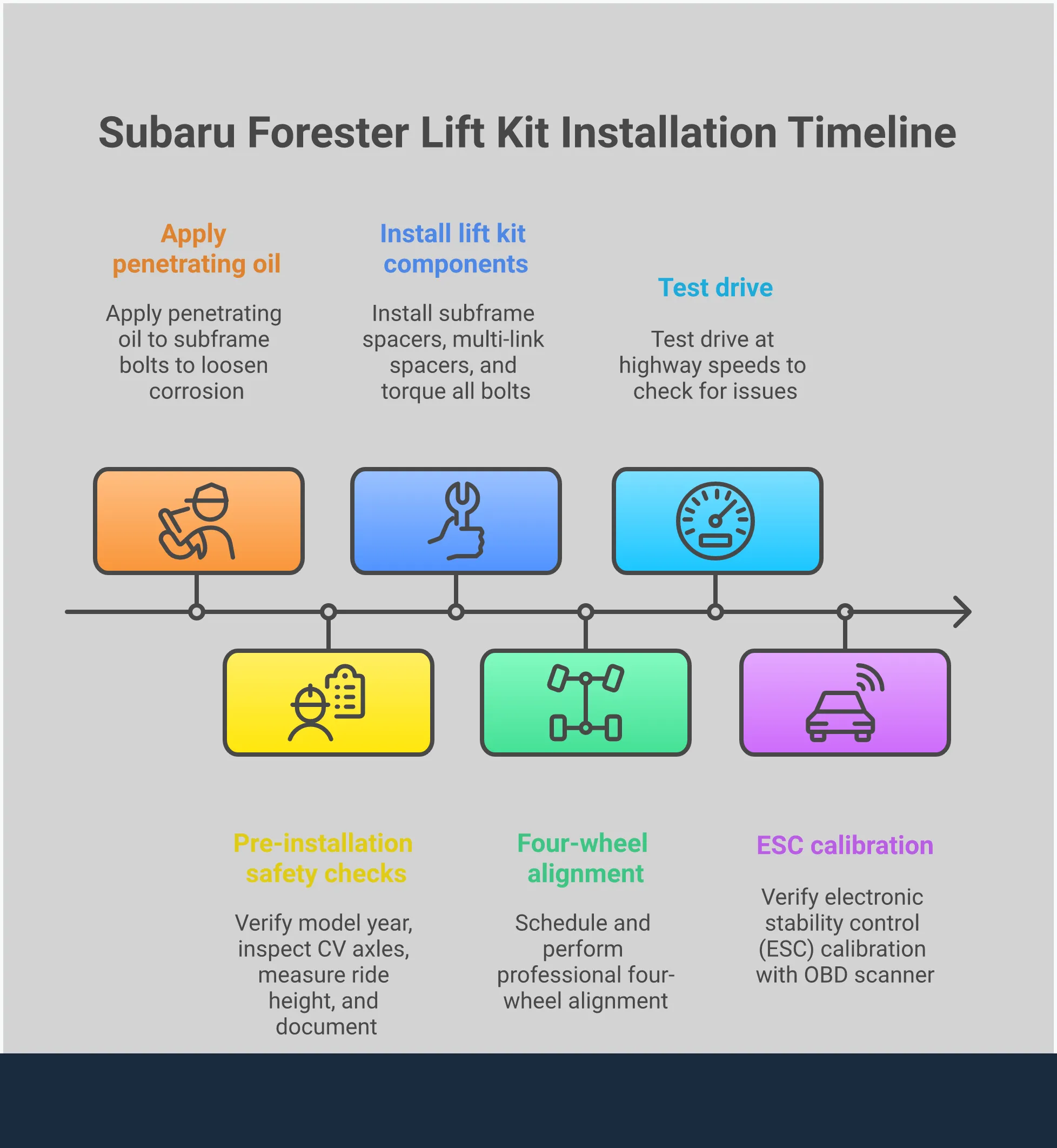
Your Pre-Installation Checklist for a Forester Lift
Once you’ve chosen your lift kit, the next step is installation. This is where the real work begins, and proper preparation is the key to a successful outcome. Whether you’re a seasoned DIY mechanic or planning to hire a professional, there are a few critical things to understand before you start turning wrenches. Getting these details right will ensure your Forester not only looks great but also performs safely and reliably on and off the road. From having the right tools to understanding your vehicle’s warranty, let’s cover the essential knowledge you need before lifting your Subaru.
The Must-Have Tools for a DIY Install
Tackling a lift kit installation yourself can be a rewarding project, but it’s not for the faint of heart. Installing a lift kit on a Subaru requires specialized knowledge and the right equipment. Before you begin, make sure your garage is stocked with more than just a basic socket set. You’ll need heavy-duty jack stands, a reliable floor jack, a torque wrench for tightening bolts to spec, and likely a set of spring compressors. A breaker bar and various pry bars will also be your best friends when dealing with stubborn suspension components. It’s also wise to have a friend on hand to help maneuver heavy parts. Being well-prepared is the difference between a smooth installation and a frustrating weekend.
Estimating Your Installation Time
If you're planning a DIY installation, be realistic about the time commitment. A professional mechanic can often complete the job in about three hours, but that doesn't account for mounting new tires or the crucial final alignment. For a home mechanic, it’s wise to set aside at least a full afternoon, if not an entire day, to work without rushing. This project requires precision and patience, especially if you run into any stubborn bolts or unexpected fitment issues. Remember, this is a significant modification to your vehicle’s suspension, and taking your time is essential for a safe and successful outcome.
While you can install a lift kit yourself, professional installation is always the recommended route. A certified technician has the proper tools, a vehicle lift, and the experience to ensure every component is fitted correctly and safely. This is especially important for maintaining correct suspension geometry and driveline angles. When you're investing in quality Subaru Forester upgrades, paying for expert installation protects your parts and your vehicle. It guarantees the job is done right, giving you peace of mind when you finally hit the trail and put your new setup to the test.
When to Call a Professional for Installation
There’s no shame in leaving the installation to the experts. In fact, it’s often the smartest move. A professional shop has the experience and specialized equipment—like a vehicle lift and a proper alignment rack—to get the job done efficiently and correctly. They can quickly troubleshoot any unexpected issues that might pop up, saving you time and potential headaches. If you’re not completely confident in your mechanical skills or simply don’t have the tools, a professional install ensures your safety and the longevity of your components. Our team offers expert tuning and installation services to ensure your Forester is ready for any adventure.
Why a Post-Lift Alignment Is Non-Negotiable
This is a step you absolutely cannot skip. Lifting your Forester alters its suspension geometry, changing the camber, caster, and toe angles of your wheels. Driving without a proper alignment will cause your vehicle to handle poorly, drift on the road, and create uneven, rapid tire wear. Think of it this way: you wouldn’t want to ruin a brand-new set of all-terrain tires in just a few thousand miles. A professional four-wheel alignment is essential to bring your suspension back within factory specifications. It ensures your Forester drives straight, handles predictably, and is safe for both daily driving and trail use. Schedule an alignment for immediately after the lift is installed.
Will a Lift Kit Affect Your Warranty?
This is a common question, and the answer is reassuring. Installing a lift kit will not automatically void your Subaru's entire factory warranty. Thanks to the Magnuson-Moss Warranty Act, a manufacturer must prove that your aftermarket part directly caused the failure of a warrantied component. For example, if your infotainment screen goes blank, the dealer can’t blame your lift kit. However, if a CV axle fails, they may argue the increased angle from the lift was the cause. To protect yourself, keep detailed records of the installation and understand that while your entire warranty isn't void, coverage for related suspension and drivetrain parts could be challenged.
How a Lift Kit Changes Your Forester's Drive
Lifting your Forester is more than just a cosmetic upgrade; it’s a significant modification that alters your vehicle's geometry and mechanics. Before you commit to a kit, it's essential to understand the downstream effects on your vehicle's safety and performance. Paying attention to these critical checks ensures your newly lifted Subaru remains reliable, safe, and fun to drive, whether you're on the highway or a remote trail. Getting these details right from the start will save you from headaches and costly repairs later on.
Keeping Your CV Axles and Drivetrain Safe
One of the most critical considerations when lifting your Forester is the health of your Constant Velocity (CV) axles. These components transfer power from the transmission to the wheels and are designed to operate at specific angles. When you lift your vehicle, you change these angles. A lift greater than two inches can put excessive stress on the CV joints, leading to premature wear and potential failure. To avoid this, stick with a well-designed kit that keeps geometry in check. Protecting your drivetrain is key to ensuring your Forester is ready for any adventure and doesn’t leave you stranded.
How a Lift Changes Your Forester's Handling
Raising your Forester’s center of gravity will inevitably change how it handles. You might notice more body roll in corners and a different feel at highway speeds. This is why a professional, post-lift wheel alignment is absolutely non-negotiable. Skipping this step can lead to dangerously unpredictable handling, uneven tire wear, and poor straight-line stability. A proper alignment resets your vehicle's camber, caster, and toe angles to compensate for the new ride height, restoring safe handling and ensuring your tires wear evenly. Many shops specializing in Subaru performance can perform a precision alignment to get your lifted Forester dialed in perfectly.
Factoring in Tire Choice and Ride Stiffness
Your new tires will play a huge role in how your lifted Forester feels on the road. Moving to larger, more aggressive all-terrain or mud-terrain tires means you're also choosing a tougher construction. These tires often have stiffer sidewalls designed to withstand trail abuse, which translates to a firmer ride on pavement compared to your original equipment. You'll feel more connected to the road, but it won't be as soft as the stock setup. This change, combined with the higher center of gravity, is part of the trade-off for gaining immense off-road capability. It's an important factor to consider as you select all the components for your overlanding solutions, as the right tire choice completes the transformation from a daily driver to a true adventure rig.
Do You Need Subframe Spacers?
If you're looking at a lift kit, you'll likely see "subframe spacers" included. These aren't optional add-ons; they are crucial for maintaining correct drivetrain geometry. The subframe holds your engine and transmission, and lifting the body without adjusting the subframe can create harsh driveline angles. Subframe spacers lower the subframe slightly to correct these angles, preventing issues like vibrations and premature wear on your axles and other drivetrain components. A quality kit will always include the necessary spacers to ensure your vehicle operates smoothly and reliably after the lift.
Why Your Forester's Model Year Matters
Not all Foresters are created equal. Subaru makes design changes with each new generation, and sometimes even between model years. A lift kit designed for a 2017 model may not fit a 2019. Using an incompatible kit can lead to serious installation problems and safety hazards on the road. Before you purchase, carefully verify that the kit is compatible with your Forester's specific year. Reputable manufacturers provide detailed fitment information, so you can confidently select the right Subaru Forester upgrades for your vehicle. When in doubt, always check with the manufacturer.
Checking Brand-Specific Model Compatibility
When you're ready to buy a lift kit, the single most important detail to confirm is its compatibility with your Forester's specific model year. Subaru frequently updates its designs between generations—and sometimes even mid-cycle—which can alter suspension geometry and mounting points. This means a kit designed for a 2017 Forester may not be suitable for a 2019 model. Taking the time to verify fitment is a critical step to ensure you purchase the right Forester upgrades for your vehicle. Reputable manufacturers always provide detailed fitment information, so carefully check the product description before you buy. This simple check will save you from major installation headaches and ensure your lift performs safely and correctly.
The Best Lift Kits for Your Subaru Forester
Once you’ve decided to lift your Forester, the next step is choosing the right kit. With so many options on the market, it can be tough to know where to start. The best choice for you will depend on your specific goals, your Forester’s model year, and your budget. Are you looking for a modest lift for weekend camping trips, or are you building a serious rig for challenging trails? Each kit offers a different balance of performance, durability, and price.
To help you make an informed decision, we’ve put together a list of four highly-regarded brands that consistently deliver quality and performance for Subaru enthusiasts. These companies have earned their reputations by engineering reliable lift kits that stand up to the demands of both daily driving and off-road adventures. We’ll break down what makes each one a solid contender, from their design philosophy to their key features. Whether you prioritize cutting-edge engineering, straightforward installation, or proven safety standards, you’ll find a great option here. Think of this as your starting point for finding the perfect lift to match your ambitions on the trail.
Crawford Performance: For Rally-Inspired Lifts
As specialists in Subaru performance, we engineer our lift kits with the same precision and passion that go into all our performance parts. The Crawford Performance lift kit is designed to give your Forester a significant boost in off-road capability without compromising its handling characteristics. We focus on creating a system that improves ground clearance, approach, and departure angles, allowing you to tackle more demanding terrain with confidence. Our kits are built from high-quality materials to ensure durability and longevity, whether you’re navigating rocky trails or loading up for an overlanding expedition. Proper installation and alignment are key, and our design ensures a seamless fit for a reliable, high-performing setup.
LP Aventure: Built for Adventure
LP Aventure has built a strong reputation in the off-road community for its rugged and reliable Subaru gear. Their 2-inch lift kit is a popular choice for Forester owners who want a proven solution that enhances both aesthetics and function. Constructed from robust, corrosion-resistant materials, these kits are designed to withstand harsh conditions. One of the standout features of an LP Aventure lift kit is its compliance with federal safety standards (FMVSS 126), which ensures the vehicle’s electronic stability control system operates correctly after installation. This commitment to safety and quality makes it a trusted option for adventurers who demand reliability from their equipment.
LP Aventure Kit Features and Pricing
The LP Aventure 2-inch lift kit is designed to give your Subaru Forester a better look while increasing its ground clearance, which is essential for off-road driving. Made from robust, corrosion-resistant materials, the kit is built to handle harsh trail conditions. A key feature is its compliance with federal safety standard FMVSS 126, which ensures your vehicle’s electronic stability control system continues to function correctly after the lift is installed—a critical consideration for safety. With a price point starting around $800, it offers a solid balance of quality, safety, and performance for Forester owners looking to confidently take their vehicle off the beaten path.
DIY Resources and Safety Information
Remember, installing a lift kit impacts your entire suspension, so it's vital to ensure all components work together correctly. If you're taking on the installation yourself, a comprehensive installation guide can be an invaluable resource. After the installation, a professional four-wheel alignment is absolutely essential. Lifting your Forester alters its suspension geometry, and an alignment is the only way to bring the camber, caster, and toe angles back to factory specifications. This step ensures your vehicle drives straight, handles predictably, and is safe for both daily commutes and trail adventures. Skipping it will lead to poor handling and rapid, uneven tire wear, so be sure to factor it into your plan and budget.
ReadyLIFT: Trusted and Trail-Tested
ReadyLIFT is known for producing well-engineered lift kits that offer a straightforward installation process. Their 2-inch SST lift kit for the Subaru Forester is a great example, typically providing a 2-inch lift in the front and a 1.5-inch lift in the rear. This configuration helps level the Forester’s factory stance while creating enough room for larger, more aggressive tires. A ReadyLIFT kit is designed to maintain a comfortable, near-factory ride quality, making it an excellent choice for those who use their Forester as a daily driver but still want improved off-road prowess. The kits often include all necessary hardware to ensure proper alignment and a hassle-free setup.
ReadyLIFT Kit Features and Pricing
The ReadyLIFT 2-inch SST lift kit is engineered for Subaru Forester models from 2019 to 2024. This kit provides a 2-inch lift in the front and a 1.5-inch lift in the rear, which effectively levels the vehicle's factory rake for a more balanced and aggressive stance. This upgrade increases ground clearance to nearly 11 inches, creating the necessary space to fit larger tires—up to 225/65-17 on a 17x8 wheel with a +38mm offset—without any rubbing. The kit includes durable, fabricated steel strut spacers and all the hardware needed for a complete installation. As a cost-effective option, it’s an excellent entry point for owners looking to enhance their Forester's trail readiness and overall look as part of their Subaru Forester upgrades.
Compatibility and Installation Notes
While the ReadyLIFT kit is designed for a straightforward installation, professional help is highly recommended to ensure everything is torqued to spec and functions safely. The kit includes essential offset spacers that are designed to maintain the factory camber and caster alignment settings, which is critical for preserving your vehicle's handling and protecting the drivetrain. After the installation is complete, a four-wheel alignment is not just a suggestion—it's a mandatory step to correct the suspension geometry and prevent premature tire wear. It's also important to note this kit is not compatible with Forester models that already have a factory lift, like the Wilderness edition, as it's engineered for the standard suspension setup. This attention to detail is key when selecting any performance parts.
Rough Country: An Affordable Off-Road Option
For those looking to enhance their Forester’s capabilities on a budget, Rough Country offers a compelling solution. Their 2-inch suspension lift kit is designed to provide a noticeable improvement in ground clearance and allows for the fitment of larger tires, giving your vehicle a more commanding presence. While known for being an accessible option, a Rough Country lift kit still delivers the functional benefits needed for light to moderate off-roading. It’s a popular entry point for enthusiasts who are new to vehicle modification, offering a solid balance of performance, aesthetics, and value that transforms the look and feel of your Forester.
### Anderson Design & Fabrication: For Maximum LiftWhile most Forester owners find their sweet spot with a 2-inch lift, some builds demand more extreme solutions. Anderson Design & Fabrication (ADF) caters to this niche, specializing in lift kits that go far beyond the standard. If your goal is to build a truly commanding off-road machine capable of clearing the most aggressive obstacles, ADF is a name you need to know. Their kits are for the serious enthusiast who understands that a lift of this magnitude is a significant undertaking, often requiring other supporting modifications to the drivetrain and suspension to maintain reliability. This is the path for builders who are intentionally pushing the boundaries of their Forester's capabilities.
ADF Kit Features and Availability
ADF is known for offering some of the largest lifts on the market, with options that can raise your Forester by 4, 4.5, or even 5 inches. These substantial kits are designed for maximum ground clearance, allowing you to fit massive tires and tackle terrain that would be impossible for most other vehicles. Their products are made in the USA and are competitively priced, typically ranging from around $1,360 to $2,360. While some of their specific kits may have limited availability, it's worth checking their website for the latest updates. You can explore their full range of Forester lift kits to see what’s possible for a truly ambitious build.
Related Articles
Frequently Asked Questions
Will a lift kit make my Forester's ride quality worse? Not necessarily, but it will change it. A simple spacer lift is designed to maintain your factory ride quality since it doesn't alter the original springs and struts. If you upgrade to a performance coilover system, you can often achieve a ride that feels more controlled and stable, especially on rough terrain. The biggest factors that lead to a poor ride are incorrect installation and skipping the post-lift wheel alignment, which is why getting both done professionally is so important.
Is a 2-inch lift really enough for serious off-roading? Absolutely. For a Subaru Forester, a 2-inch lift is the sweet spot that provides a significant improvement in capability without compromising the vehicle's long-term reliability. This height gives you the ground clearance needed to clear most obstacles and fit larger, more capable tires. Going higher puts extreme stress on your CV axles and other drivetrain components, risking a failure when you're far from help. The smartest builds focus on a balanced, reliable system, and that starts with a well-engineered 2-inch lift.
Besides the lift kit itself, what other upgrades should I plan for? The most immediate and essential follow-up to your lift is a new set of larger all-terrain tires to take full advantage of the added clearance. You must also budget for a professional four-wheel alignment immediately after the installation to correct your suspension geometry and ensure the vehicle drives safely. As you continue your build, you might also consider other performance parts that complement your new capabilities, but tires and an alignment are the two things you should plan for from day one.
How will lifting my Forester affect my fuel economy? You should expect a small decrease in your miles per gallon. A lifted vehicle has a larger frontal profile, which increases aerodynamic drag at highway speeds. More significantly, most people pair a lift with bigger, heavier all-terrain tires that have a higher rolling resistance than stock tires. This combination requires more energy to move the vehicle, resulting in a minor drop in fuel efficiency. It's a standard trade-off for gaining substantial off-road capability.
I see kits with and without subframe spacers. Are they really necessary? Yes, they are a critical component for any lift of two inches. Subframe spacers are designed to lower your engine and transmission slightly to correct the angle of your axles. Without them, the increased angle from the lift puts constant stress on your CV joints, which can lead to vibrations, accelerated wear, and eventual failure. A quality, well-engineered kit will always include them to protect your drivetrain and ensure your Forester remains reliable on any terrain.