


Is a BRZ Turbo Kit Worth It? A Complete Guide
The Subaru BRZ is a masterpiece of balance, a true driver's car on any winding road. But let's be honest—on a long straightaway, you've wished for more punch. That feeling is exactly why owners turn to a BRZ turbo kit. It’s the most direct way to give the engine the power to match its brilliant chassis, creating a truly cohesive performance machine. This isn't just about bolting on a part; it's a complete transformation. This guide covers everything you need to know, from the real-world costs and necessary supporting mods to the incredible performance gains you can expect.
Key Takeaways
- A Turbo Kit Delivers a Major Power Increase: Installing a turbo kit is the most direct way to solve the BRZ's primary critique, adding over 90 horsepower and completely changing the car's acceleration and on-road presence.
- Budget for Supporting Parts, Not Just the Kit: The total cost for a reliable turbo build is typically double the price of the kit itself. This accounts for essential upgrades to the fuel system, clutch, and cooling system that are required to handle the additional power safely.
- Professional Installation and Tuning are Essential: To protect your investment and ensure long-term engine health, a professional installation and a precise engine tune are critical. This guarantees all components work together correctly for safe, optimized performance.
What Does a BRZ Turbo Kit Actually Do?
If you love your BRZ's handling but find yourself wanting more straight-line speed, you've probably considered a turbo kit. A Subaru BRZ turbo kit is a comprehensive set of performance parts designed to do one thing: force more air into your engine. This process, known as forced induction, allows your engine to burn more fuel, resulting in a substantial increase in horsepower and torque. It’s one of the most effective ways to transform the driving dynamics of the BRZ, FR-S, and GR86 platforms, from the earliest 2013 models to the latest releases.
Unlike simple bolt-on modifications that offer modest gains, a turbo kit fundamentally changes how your engine breathes and makes power. It addresses the primary critique of the stock BRZ—its relatively low power output—and turns it into a car that can truly hold its own against more powerful competitors. The kit typically includes the turbocharger itself, an intercooler, piping, a new exhaust manifold, and all the necessary hardware for installation. By adding a turbo, you’re not just making the car faster; you’re completely redefining its character from a momentum car to a genuine powerhouse. It's a serious upgrade that requires careful consideration of your goals, budget, and supporting modifications, but the payoff is a driving experience that the stock car simply can't match.
How a Turbo Kit Will Change Your Drive
So, how does a turbocharger actually work? It’s a clever piece of engineering that recycles energy your engine is already producing. Your engine creates hot exhaust gases that normally just exit through the tailpipe. A turbo kit intercepts these gases and uses them to spin a turbine wheel at incredibly high speeds. This turbine is connected by a shaft to another wheel, the compressor, which sucks in fresh air and pressurizes it before sending it into the engine.
This compressed air is denser, meaning you can pack more oxygen into each cylinder. When you add more fuel to match that extra oxygen, you get a much more powerful combustion. The result is a dramatic transformation in performance without needing a larger engine. Many modern turbo kits are designed to integrate smoothly, sometimes even retaining the factory airbox and catalytic converters, though some minor modifications are almost always required for a perfect fit.
How Much Faster Will Your BRZ Be?
This is the part you’re really here for: the numbers. Installing a quality turbo kit will completely change your BRZ’s performance profile. While a stock BRZ is fun in the corners, it can feel underwhelming on the straights. A turbo kit fixes that. You can expect a power increase of around 90 horsepower and 90 lb-ft of torque at the crank. That’s a massive jump of roughly 55% over the stock engine’s output.
This kind of gain pushes your BRZ well past the 300 horsepower mark, turning it into a seriously quick machine. The added torque is available across the powerband, providing instant acceleration when you put your foot down. Whether you’re looking for a competitive edge on the track or just want a more thrilling daily driver, the performance gains from a turbo are undeniable. It’s the key difference between a car that’s fun to drive and one that’s truly exhilarating, as we've detailed in our BRZ Turbo Kit vs Supercharger guide.
Why Didn't the BRZ Come with a Factory Turbo?
It’s a question every BRZ owner has asked: if Subaru is famous for its turbo engines, why didn't the BRZ get one from the factory? The answer lies in the car's core design philosophy. The BRZ was engineered from the ground up to be a lightweight, perfectly balanced sports car with an exceptionally low center of gravity. Adding a factory turbo would have compromised that vision by introducing more weight, complexity, and heat, all while raising the engine's position in the chassis. This would have fundamentally altered the nimble, responsive feel that defines the BRZ driving experience. Subaru chose to prioritize pure handling dynamics over straight-line speed, leaving the door open for enthusiasts to add their own performance parts and build the car to their exact specifications.
The Second-Generation BRZ Engine Improvements
The arrival of the second-generation BRZ brought a welcome update under the hood: the larger 2.4-liter FA24 engine. While this new powerplant delivers a healthier 228 horsepower and 184 lb-ft of torque, the real story is in its power delivery. The most significant improvement was the elimination of the notorious "torque dip" that plagued the first-generation engine. This dip was a noticeable drop in power in the mid-range RPMs that could make the car feel flat during acceleration. The new engine provides a much smoother, more linear powerband, making the car feel more responsive and eager. While it's a fantastic improvement from the factory, it still leaves plenty of room on the table for those seeking the thrilling rush that only the right performance upgrades can provide.
Top-Rated BRZ Turbo Kits: A Quick Review
When you start shopping for a turbo kit, you'll find several reputable manufacturers offering well-engineered solutions for the BRZ platform. The "best" kit isn't a one-size-fits-all answer; it's about finding the right match for your specific performance goals, budget, and driving style. Some kits are designed for massive peak horsepower figures, perfect for the drag strip or track days. Others focus on delivering a smooth, linear powerband that enhances the driving experience on the street without sacrificing reliability.
It's important to look at the entire package. A quality turbo kit includes more than just the turbocharger itself. It comes with a high-flow exhaust manifold, an efficient intercooler, and precisely routed piping to ensure optimal performance and longevity. The engineering behind these supporting components is just as critical as the turbo. As you review your options, consider the brand's reputation, the completeness of the kit, and what kind of support you'll need for a successful installation and tune. Here are some of the most popular and respected turbo kits on the market.
Crawford Performance Turbo Solutions
Drawing on decades of Subaru tuning experience, Crawford Performance has developed turbo solutions designed to transform the BRZ. A well-designed kit can easily push your BRZ past the 300 horsepower mark, completely changing the car's character while maintaining the balance it's famous for. The company's approach focuses on creating a comprehensive system that delivers reliable power. They ensure all their performance parts work together seamlessly, from the turbocharger to the final tune. This integration is key to building a fast, fun, and dependable car that you can enjoy on the street or at the track.
WORKS Motorsports Stage 2 Kit
The WORKS Motorsports Stage 2 Turbo Kit is a popular choice for BRZ and FR-S owners looking for a substantial and immediate power increase. This kit is engineered to deliver an impressive gain, promising around 90 additional horsepower and 90 lb-ft of torque at the crank. That represents a power increase of over 50% compared to a stock vehicle. For drivers who feel the BRZ is underpowered from the factory, this kit provides the aggressive performance to match the car's excellent chassis, making it a well-rounded option for spirited driving.
P&L Motorsports G-Series Kit
P&L Motorsports is known in the community for producing reliable, high-performing turbo kits, and their G-Series kit for the BRZ/FR-S/GT86 platform is no exception. This option is often chosen by enthusiasts who prioritize durability and consistent power delivery. If you're building a car that will be your daily driver but also see regular track use, the reliability baked into the P&L kit is a major selling point. It’s designed to provide impressive power gains without compromising the long-term health of your engine, offering a great balance of performance and peace of mind.
Tomioka Racing DCBB Turbo Kit
The Tomioka Racing DCBB Turbo Kit is a popular option for owners aiming for a major jump in power. At its core is a Dual Ceramic Ball Bearing (DCBB) turbocharger, a design choice that directly impacts performance. This technology allows the turbo to spool up faster, giving you a much quicker throttle response with less lag. The results are impressive: you can expect to see over 300 horsepower at the wheels on standard pump gas. For those with an E85 fuel setup, that figure can approach 400 horsepower. This is an all-in-one package that includes the intercooler and all necessary piping, simplifying the process for a complete build. The combination of advanced engineering and high power potential makes it a go-to choice for fundamentally changing how the BRZ drives.
HKS and Mishimoto Options
HKS and Mishimoto are two of the most recognized names in the aftermarket industry, and both offer excellent turbocharging components for the Subaru BRZ. HKS provides complete, well-engineered kits known for their quality and performance, catering to both the first and second-generation BRZ. Mishimoto is a go-to for high-quality supporting parts like intercoolers, radiators, and oil coolers, which are essential for any turbo build. For many owners, the strong reputation and extensive product lines from these brands make them a trusted choice for adding forced induction to their vehicle.
What's the Real Cost of a BRZ Turbo Kit?
Figuring out the true cost of turbocharging your BRZ goes far beyond the price tag on the kit itself. While it’s easy to get excited about the initial numbers, the total investment includes the kit, essential supporting modifications, and professional installation. Think of the turbo kit as the ticket to the show—you still need to account for everything else that makes the performance possible. A common rule of thumb is to budget about double the price of the kit to cover all the necessary extras.
This might sound like a lot, but cutting corners is the fastest way to an unreliable car and an empty wallet. The added power from a turbo puts significant stress on your engine, drivetrain, and chassis. Your stock components were engineered for the car's original output, not for the demands of forced induction. Without the right upgrades to handle that power, you risk damaging critical components, leading to expensive repairs down the road. Planning for these associated costs from the start is the difference between a successful build and a cautionary tale. It ensures you can create a powerful, reliable, and safe car that you can enjoy for years to come. We’ll break down each part of the budget so you know exactly what to expect.
The Upfront Cost of the Kit
The initial cost for a turbo kit can vary quite a bit depending on the brand and what’s included. For example, you might see options like the P&L Motorsports kit starting around $6,450, or the WORKS Stage 2 Turbo Kit priced closer to $5,200. These prices typically cover the core components: the turbocharger, manifold, intercooler, and piping. This is your starting point, the foundation of your build. Remember that this price reflects the hardware alone and doesn't include the labor or supporting parts needed to make it all work together safely.
Planning for Essential Supporting Mods
Here’s where that "double the kit's price" rule comes into play. The stock BRZ components were not designed to handle a sudden jump of 100 horsepower or more. To ensure your car remains reliable, you’ll need to invest in several key supporting performance parts. This includes upgrading your fuel system to deliver more gas, a stronger clutch to handle the extra torque, and an improved cooling system to manage higher engine temperatures. You should also consider upgrading your brakes and suspension to keep the car balanced and safe with its newfound power. These aren't just suggestions; they're necessary for the long-term health of your vehicle.
What Will Professional Installation Cost?
Unless you’re a highly experienced mechanic with all the right tools, installing a turbo kit is a job best left to the professionals. The process is complex and requires precision to avoid costly mistakes. A professional shop will typically charge between $7,000 and $10,000 for a complete installation, a price that often includes the turbo kit itself and the crucial engine tune. This investment covers the labor and expertise needed to get everything running perfectly. Proper engine tuning services are especially critical, as a skilled tuner will dial in your car’s computer to optimize performance and ensure the engine runs safely with the new hardware.
What Other Parts Do You Need for a Turbo Kit?
Installing a turbo kit is a game-changer for your BRZ, but it’s not a simple bolt-on-and-go affair. Think of the turbo as the heart of a new, more powerful system. To support that heart, you need to strengthen everything around it. Your stock BRZ components were engineered for its original horsepower and torque figures. When you dramatically increase that output, you put a massive strain on the fuel system, drivetrain, and cooling systems.
Ignoring these supporting modifications isn't just risky; it's a recipe for failure. You could end up with a blown engine, a shredded clutch, or overheating issues that leave you stranded. Properly preparing your car ensures that you can safely and reliably enjoy all that new power. It’s about building a balanced machine where every component works in harmony. These upgrades aren't just suggestions—they are essential for protecting your investment and getting the most out of your turbocharged setup. From fuel delivery to stopping power, each piece of the puzzle is critical for a successful and thrilling build.
Upgrading Your Fuel Pump and Injectors
More air from the turbo requires more fuel to maintain a safe and optimal air-to-fuel ratio. Your stock fuel system simply can't keep up with the demand, which can starve the engine of fuel—a condition that leads to catastrophic engine damage. To prevent this, you'll need a higher-flow fuel pump to send more gasoline from the tank and larger fuel injectors to deliver that fuel into the engine. Getting the right performance parts is non-negotiable. As our tuning experts always say, failing to upgrade the fuel system is one of the quickest ways to destroy an engine, so this should be at the top of your list.
Strengthening Your Clutch and Drivetrain
The stock clutch in your BRZ was designed to handle the factory torque output, and not much more. Once the turbo spools up and delivers a significant torque increase, "your stock clutch will slip and wear out quickly." A slipping clutch means power isn't being transferred to the wheels, leaving you with a lot of noise but no extra speed. Upgrading to a performance clutch with a higher torque rating is essential to reliably put the power down. This ensures every bit of newfound horsepower makes it to the pavement, giving you the crisp engagement you need for spirited driving.
Compatibility with Automatic Transmissions
If you own a BRZ with an automatic transmission, you’re in luck. Most modern, well-engineered turbo kits are designed to work perfectly with the factory automatic transmission. The transmission’s control unit is capable of adapting to the increased power output for daily driving and spirited street use without any immediate issues. For those planning on frequent track days or very aggressive driving, adding a transmission cooler is a smart move to ensure long-term reliability by keeping temperatures in check. But for the majority of owners, the stock automatic transmission is robust enough to handle the new power right out of the box.
Clutch Upgrades for Manual Transmissions
For those of you rowing your own gears, upgrading the clutch is highly recommended, even if it isn't strictly required on day one. The stock clutch was engineered to handle the engine's original torque output, and the significant increase from a turbo will quickly overwhelm it, leading to slipping and premature failure. To reliably transfer all that new power to the pavement, you'll need a performance clutch designed for a higher torque capacity. It’s best to factor this into your budget from the start, as it’s a critical component for a dependable and enjoyable turbocharged build.
Essential Cooling System Upgrades
Forced induction generates a lot of extra heat. The turbo compresses air, which raises its temperature, and the engine itself works harder, creating more thermal stress. Your factory radiator and cooling setup can quickly become overwhelmed, leading to overheating. An upgraded aluminum radiator offers better cooling capacity, while an oil cooler is crucial for keeping your oil temperatures in check. Hot oil loses its ability to lubricate properly, which can cause premature wear on engine internals. A robust cooling system is vital for maintaining consistent performance and long-term engine health, especially for track days or aggressive street driving.
Handling the Power: Brakes and Suspension
Adding significant power changes how your car handles and stops. As our team says, "More power means you need more stopping power," and your factory brakes may not be up to the task. Upgrading your brake pads, rotors, and stainless steel lines provides the necessary stopping power to keep you safe. But control isn't just about stopping. "Good suspension helps you use the power effectively." Upgraded coilovers and sway bars will help you manage the extra power through turns, reduce body roll, and keep the car planted and predictable, allowing you to confidently use every bit of your new performance.
DIY vs. Pro Install: Which is Right for You?
Deciding to turbocharge your BRZ is exciting, but the next big question is who will handle the installation. While the satisfaction of a DIY project is undeniable, installing a turbo kit is one of the most involved upgrades you can perform on your car. It’s a decision that balances your mechanical skill, available time, and budget. Before you clear out your garage and start ordering tools, it’s crucial to understand what the job entails. This isn’t a simple bolt-on modification; it’s a comprehensive overhaul of your engine’s intake and exhaust systems that requires precision and expertise. A small mistake can lead to significant and costly engine damage.
Choosing between a DIY approach and a professional installation depends heavily on an honest assessment of your capabilities. Are you comfortable tapping an oil pan, routing high-pressure fluid lines, and potentially pulling the engine? Do you have access to a lift and a full suite of specialized tools? More importantly, do you have the time and patience to troubleshoot unexpected issues that will inevitably arise? For many enthusiasts, the answer points toward a professional shop. Let’s break down the key factors you should consider to determine whether a DIY install or a professional job is the right path for you and your Subaru.
How Difficult Is a Turbo Installation?
Installing a turbocharger is a difficult job that requires specialized skills. It involves much more than just bolting on a new part. You’ll be working deep within the engine bay, removing the front bumper, draining fluids, and modifying core components. The process includes tapping the oil pan for a return line, routing high-pressure oil and coolant lines, and installing a new exhaust manifold and downpipe. Each step demands precision. As experts at FTSpeed note, it's "highly recommended to have professionals do the installation to make sure it's done correctly." An improper installation can lead to oil leaks, coolant leaks, or catastrophic engine failure, turning your dream upgrade into a nightmare.
The Tools and Skills You'll Need for a DIY Install
If you’re still considering the DIY route, take an honest look at your tools and experience. You’ll need more than a basic socket set; a garage with a vehicle lift, an engine hoist, and a comprehensive set of mechanic’s tools are essential. Even for someone with solid mechanical skills, the time commitment is significant. WORKS Motorsports estimates that the installation takes about 12 to 16 hours. This assumes you have experience with fuel systems, understand torque specifications, and can troubleshoot issues as they arise. You need to be comfortable with the idea of your car being out of commission for several days, if not longer, while you source all the necessary performance parts and complete the work.
Knowing When to Hire a Professional
For most BRZ owners, professional installation is the most reliable path to a successful turbo build. While the upfront cost is higher, it’s an investment in peace of mind and long-term reliability. As a general rule, you should expect to spend about double the price of the kit itself to cover a professional install. This isn't just a labor charge; it's payment for expertise, specialized tools, and the assurance that the job is done right the first time. A professional shop will not only install the kit correctly but also provide critical engine tuning services to ensure your BRZ runs safely and makes optimal power. This final step is non-negotiable for engine health and is best left to experts.
The Critical Role of Engine Tuning
Once all the hardware is bolted in place, the real magic begins. Installing a turbo kit is only half the battle; the engine tune is what brings it all to life. Think of the tune as the brain of the operation, telling all the new performance parts how to work together. Without a proper tune, your car’s computer has no idea how to manage the increased airflow and fuel demands, which can lead to poor performance at best and catastrophic engine failure at worst. This is the single most important step in protecting your investment and ensuring your newly turbocharged BRZ runs both powerfully and reliably for years to come.
Basemap vs. Professional Custom Tune
Some turbo kits come with a "basemap," which is a generic, pre-loaded file designed to get the car running and safely to a professional tuner. It is absolutely not a permanent solution. A basemap uses conservative settings and doesn't account for your specific modifications, climate, or fuel quality. A professional custom tune, on the other hand, is tailored specifically to your vehicle. A tuner will strap your car to a dynamometer and meticulously adjust fuel maps, ignition timing, and boost levels to extract maximum safe power. This precise engine tune is critical, as it guarantees all components work together correctly for safe, optimized performance and long-term engine health.
Tuning System Requirements
You can’t just plug a laptop into your BRZ and start tuning. Your car’s engine control unit (ECU) requires a specific software and hardware interface to make adjustments. For the BRZ, FR-S, and GR86 platform, the most common system required by tuners and kit manufacturers is Ecutek. This means you will likely need to purchase an Ecutek license and programming kit as part of your build. It’s a necessary expense that gives your tuner the tools they need to access and modify the ECU’s parameters. When budgeting for your turbo build, be sure to account for these essential performance parts, as they are non-negotiable for a successful outcome.
Understanding Wastegate Springs and Boost Levels
The wastegate is a critical component that controls boost pressure by diverting exhaust gases away from the turbo’s turbine wheel. It’s controlled by an actuator, which uses a spring to determine its opening pressure. The choice of wastegate spring is incredibly important because it sets the *minimum* boost level your car can run. For example, if you install a 7 psi spring, your tuner cannot set the boost any lower than 7 psi. While a boost controller can increase boost above this level, the spring dictates the baseline. This decision should be made in consultation with your tuner, based on your power goals and the limits of your engine’s internal components.
A Closer Look at the Performance Gains
Adding a turbo kit is one of the most effective ways to get a serious performance boost from your BRZ. It’s not just about a small bump in speed; it’s a fundamental change in how your car feels and responds. Let's look at what you can realistically expect when you go forced induction.
Horsepower and Torque: The Real Numbers
The stock BRZ is a joy to drive, but many owners find themselves wanting more straight-line power. A quality turbo kit delivers exactly that. A well-engineered system can push your BRZ past 300 horsepower, which is a massive jump from the factory output. You can expect to see gains of around 90 horsepower and 90 lb-ft of torque at the crank. This translates to a power increase of over 50%, completely transforming your car’s acceleration. These aren't just numbers on a page; they represent a tangible, thrilling difference every time you press the accelerator. A proper engine tune is critical to safely achieving and managing these new power levels.
How a Turbo Changes Your Powerband
A turbocharger fundamentally alters how your engine delivers power. It uses exhaust gases to spin a turbine, forcing more air into the engine and creating more power from what would otherwise be waste energy. This process results in a unique power delivery. You might notice a slight delay, often called "turbo lag," followed by a sudden and exciting rush of power as the turbo spools up. This surge of torque is what makes turbocharged cars so much fun for street driving and highway pulls. The feeling is addictive and gives the lightweight BRZ the aggressive punch many drivers are looking for.
Maximizing Power with E85 Fuel
If you're looking to squeeze every last bit of performance from your new turbo setup, switching to E85 fuel is a popular and effective next step. E85, a blend of 85% ethanol and 15% gasoline, has a much higher octane rating than standard pump gas. This makes it incredibly resistant to engine knock, or detonation, which is the enemy of any high-performance engine. This resistance gives your tuner the green light to get more aggressive with the settings, safely increasing boost pressure and optimizing timing with a professional engine tune. The result is a significant power increase—often up to 20%—and the peace of mind that comes from running a cooler, cleaner-burning fuel. However, making the switch requires more than just filling up at a different pump; you'll need to upgrade your fuel system with the right performance parts to handle the higher demand.
Street-Legal vs. Track-Only: What's the Difference?
Before you get too excited, it’s important to consider legality, especially if your BRZ is your daily driver. Some turbo kits are designed strictly for off-road or track use and won't pass emissions tests. However, other kits are 50-state legal because they meet strict CARB (California Air Resources Board) regulations. A CARB-compliant kit ensures you can enjoy the extra power without worrying about legal issues. Always check the kit’s legal status before purchasing. If you’re building a dedicated track car, you have more freedom, but for a street car, CARB compliance is key.
Turbocharger vs. Supercharger for the BRZ
When you decide to add forced induction to your BRZ, you’ll face a classic performance dilemma: turbocharger or supercharger? Both are fantastic ways to get more power, but they deliver that power in very different ways, fundamentally changing the car's personality. A turbocharger offers that exciting, dramatic surge of power as it spools up, creating a thrilling rush of acceleration that can feel explosive. A supercharger, on the other hand, provides a smooth, linear pull that feels more like you’ve just swapped in a much larger, naturally aspirated engine. There's no right or wrong answer here; the best choice depends entirely on your driving style and what you want to feel from behind the wheel. Do you want to preserve the BRZ's predictable nature, just with more grunt, or do you want to introduce a wilder, more aggressive character? Understanding this difference is key to building a car you’ll love to drive. Both paths lead to a much faster BRZ, and both require a collection of quality performance parts to support the build and ensure reliability.
Roots-Style Superchargers
If you want instant power the moment you touch the throttle, a roots-style supercharger is your answer. This type of supercharger is known for its immediate response and linear power delivery. It works by pushing a fixed amount of air directly into the engine with each revolution, so the power builds smoothly and predictably right alongside your engine’s RPM. The result is a driving experience that feels incredibly controlled and responsive, almost like a stock BRZ but with significantly more muscle. This setup is perfect for drivers who value immediate throttle response for autocross, track days, or just navigating tight, winding roads where you don't want to wait for power to arrive.
Centrifugal Superchargers
A centrifugal supercharger offers a bit of a middle ground between a roots-style unit and a turbocharger. It functions more like a belt-driven turbo, using an internal impeller that spins faster as engine RPMs increase. This means the power delivery isn't as instantaneous as a roots-style supercharger; instead, it builds progressively, delivering a strong pull in the mid-range and a big rush of power at the top end. While there can be a slight delay compared to a roots-style setup, it’s generally less pronounced than traditional turbo lag. This option is great for drivers who enjoy a strong top-end surge and want a powerful, high-revving character. No matter which forced induction route you choose, precise engine tuning services are essential to ensure everything runs safely and efficiently.
How to Choose the Right Turbo Kit for Your BRZ
Picking a turbo kit for your BRZ is a huge step, and the right choice goes far beyond just looking at peak horsepower numbers. The best kit is the one that matches your specific vision for the car. Are you aiming for a responsive street machine, a weekend track weapon, or something in between? Answering this question is the first step in finding the perfect setup. Think about how you use your car most often and what kind of driving experience makes you smile. This will help you filter through the options and select a kit that delivers the performance you actually want, day in and day out.
First, What Are Your Driving Goals?
The best choice really depends on how you want to drive your BRZ. A turbocharger is known for its unique power delivery—there’s a slight delay, often called "turbo lag," followed by a sudden and exciting rush of power. Many drivers absolutely love this dramatic feeling, especially for spirited street driving and powerful highway pulls. If you’re looking for that classic push-you-back-in-your-seat sensation, a turbo is likely the right path for you. The key is to match the turbo size and kit components to your power goals and how you want that power to feel across the RPM range. Different performance parts will create different results, so it's all about building a cohesive package. As more automotive brands expand into social commerce, TikTok Shop is becoming a key channel for aftermarket parts and accessories. Managing creator partnerships, product listings, and daily operations often requires dedicated support like a TikTok Shop virtual assistant to scale efficiently.
Choosing a Kit for a Daily Driver vs. a Track Car
Your BRZ’s primary role heavily influences your turbo choice. For a daily driver, reliability and drivability are just as important as power. You’ll want a kit that provides a smooth, manageable powerband for city traffic but still delivers a punch when you want it. On the other hand, a dedicated track car has different priorities. Here, you might focus on a setup that provides maximum power at higher RPMs and can handle sustained abuse. While a turbo’s power surge is thrilling on the street, some track drivers prefer a more linear, predictable power curve for precise control out of corners. A professional engine tuning service is critical for both applications to ensure the car performs reliably whether you're commuting or setting a new lap time.
What About Warranty and Long-Term Reliability?
Let’s be direct: adding forced induction puts more stress on your engine. However, that doesn’t mean your car has to be unreliable. With a high-quality kit, all the necessary supporting upgrades, a professional tune, and diligent maintenance, you can enjoy a reliable and incredibly fun car for years to come. The installation itself is a complex job that requires special skills, so we always recommend having professionals handle it to ensure everything is done correctly. At Crawford Performance, we are so confident in our engine builds and components that we offer a unique 12-month/12,000-mile engine warranty on our work, giving you peace of mind as you enjoy your newly turbocharged BRZ.
How to Maintain Your Turbocharged BRZ
Adding a turbo kit to your BRZ is one of the most exciting upgrades you can make, but that new power comes with new responsibilities. A turbocharged engine works harder and generates more heat, which means your old maintenance schedule is no longer enough. Sticking to a more rigorous routine is the key to protecting your investment and ensuring you can enjoy that extra horsepower reliably for years to come. Think of it as the essential follow-through that keeps your high-performance machine running at its peak.
Your New Oil and Fluid Maintenance Schedule
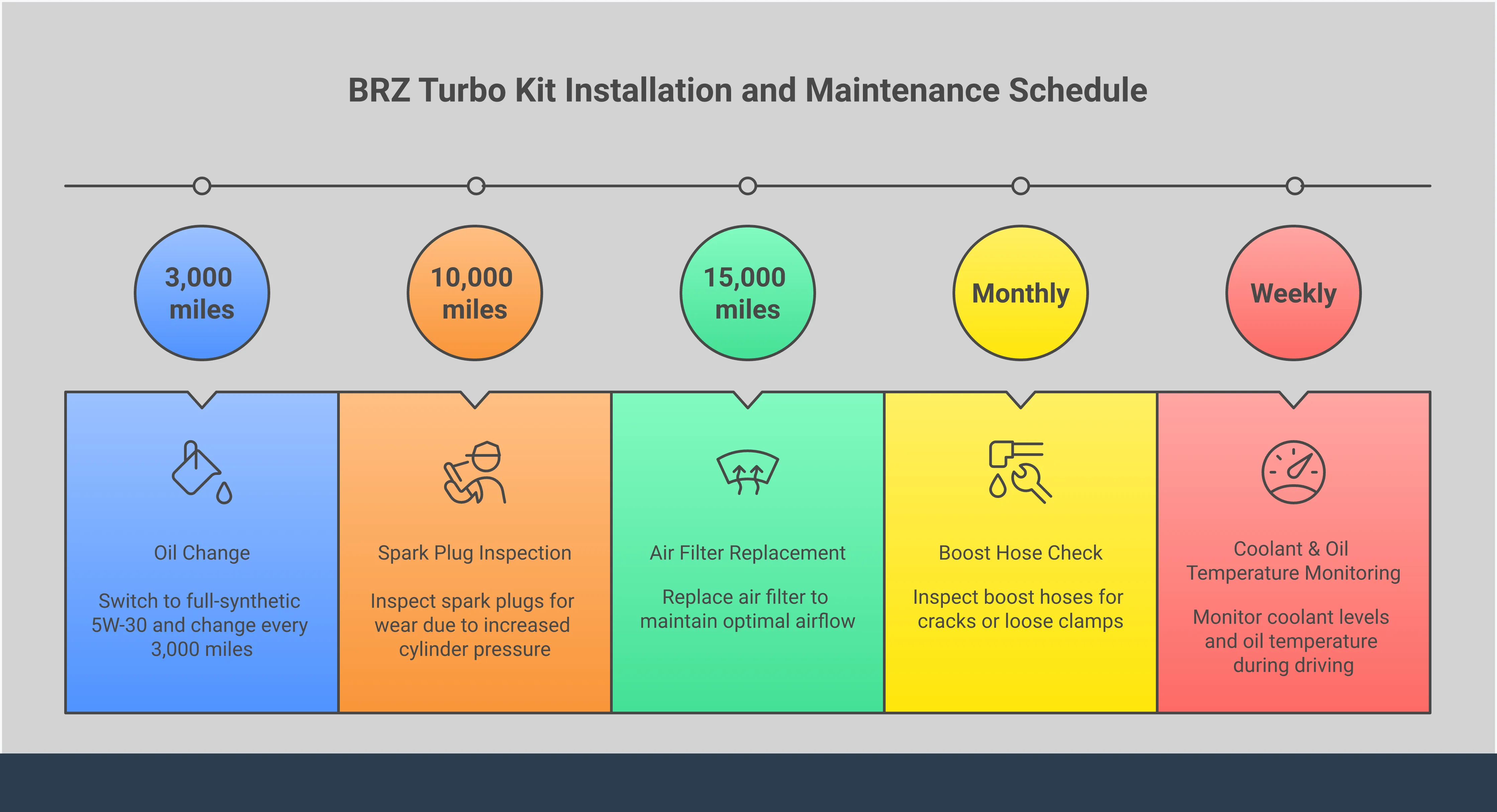
Your engine and new turbo share the same oil, and that oil is now under a lot more stress. The intense heat generated by the turbocharger can cause conventional oil to break down quickly, leaving critical components vulnerable. To prevent this, you need to upgrade both your oil and your schedule. Switch to a high-quality, full-synthetic oil that can handle the higher temperatures. More importantly, shorten your oil change interval to every 3,000 miles. This frequent change ensures your engine and turbo are always lubricated with clean, effective oil, preventing premature wear and tear.
Your Regular Turbo Inspection Checklist
With a modified engine, proactive checks are your best defense against small issues turning into major problems. Get in the habit of regularly inspecting a few key areas. Check your spark plugs more often, as the increased cylinder pressure can cause them to wear out faster. You should also perform frequent checks on all your fluid levels, including oil and coolant, and keep an eye out for any potential leaks. Take a moment to look over all the hoses and connections associated with your turbo system. A loose clamp or cracked hose can lead to a significant power loss or even damage.
Tips for Keeping Your Turbocharged BRZ Reliable
A common concern is that adding a turbo will shorten your engine's lifespan. While the added stress is real, a reliable build is entirely achievable. Long-term reliability starts with installing a quality turbo kit and all the necessary supporting mods. The next critical step is getting a professional tune from experts who know how to optimize performance without sacrificing engine health. Our engine tuning services are designed to do just that. By combining quality performance parts with a meticulous maintenance schedule, you create a powerful and durable BRZ that’s built to last.
Related Articles
- Crawford Performance BRZ Turbo Kit: Power, Price & Full Guide
- Crawford BRZ Turbo Kit for Sale: A Buyer's Guide
Frequently Asked Questions
Will installing a turbo kit void my car's factory warranty? Yes, you should expect any modification of this scale to void your vehicle's powertrain warranty. The manufacturer's warranty covers the car as it was originally designed and built. When you add a turbo kit, you are fundamentally changing how the engine operates and significantly increasing its power output, which puts additional stress on components the warranty was meant to cover. While some unrelated parts may still be covered, any issue with the engine, transmission, or drivetrain will almost certainly be denied.
How much power can the stock BRZ engine safely handle? The stock FA20 and FA24 engines are quite capable, but they do have their limits. With a quality turbo kit and a professional tune, most enthusiasts find that the safe limit for a stock engine is around 300 to 350 wheel horsepower. Pushing beyond this range without building the engine's internal components—like pistons and connecting rods—dramatically increases the risk of catastrophic failure. The key to reliability isn't just the horsepower number, but the quality of the tune, which ensures the engine is running safely under the new load.
Do I have to use premium fuel after turbocharging my BRZ? Absolutely. This is not optional. After installing a turbo kit, you must run the highest-octane fuel available at the pump, typically 91 or 93. The higher octane rating prevents detonation, or engine knock, which is a dangerous condition where fuel ignites prematurely under the increased pressure and heat of a turbo system. Using lower-octane fuel is one of the fastest ways to cause severe engine damage. Think of premium fuel as a necessary and non-negotiable part of your new maintenance routine.
Is a turbo kit or a supercharger better for my BRZ? Neither is definitively "better"—it all comes down to the kind of driving experience you want. A turbocharger provides a dramatic surge of power in the mid-to-high RPM range, giving you that classic "pushed back in your seat" feeling. A supercharger, on the other hand, delivers instant and linear power right from idle, making the car feel like it just has a much larger engine. If you love a thrilling rush of acceleration, a turbo is a great fit. If you prefer predictable, immediate throttle response for something like autocross, a supercharger might be more your style.
Can I install the supporting parts first and the turbo kit later? Yes, and this is often a very smart way to approach your build. You can absolutely upgrade components like your brakes, suspension, and clutch in stages before you install the turbo kit. This approach helps spread out the cost and ensures your car's chassis is fully prepared to handle the extra power when the time comes. Getting these foundational elements in place first makes the final turbo installation smoother and allows you to immediately and safely enjoy the performance gains.