

How to Choose the Right EJ257 Short Block
Planning a high-performance Subaru build starts with defining your goals. Are you aiming for a responsive and powerful daily driver, or are you building a dedicated track machine meant to be pushed to its absolute limits? The answer to that question directly determines the foundation your engine needs. Every other modification, from the turbocharger to the fuel system, relies on the strength of your engine’s core. This guide will help you match your ambitions to the right components, starting with the most critical choice you’ll make: the ej257 short block. We’ll explore the real-world limits of the stock engine and detail what it takes to build a reliable powerhouse for the street or the track.
Key Takeaways
- Know the Stock EJ257's Ceiling: A factory short block is reliable up to about 350 wheel horsepower with a professional tune; pushing beyond this limit risks failure of the stock cast pistons, which are the engine's primary weak point.
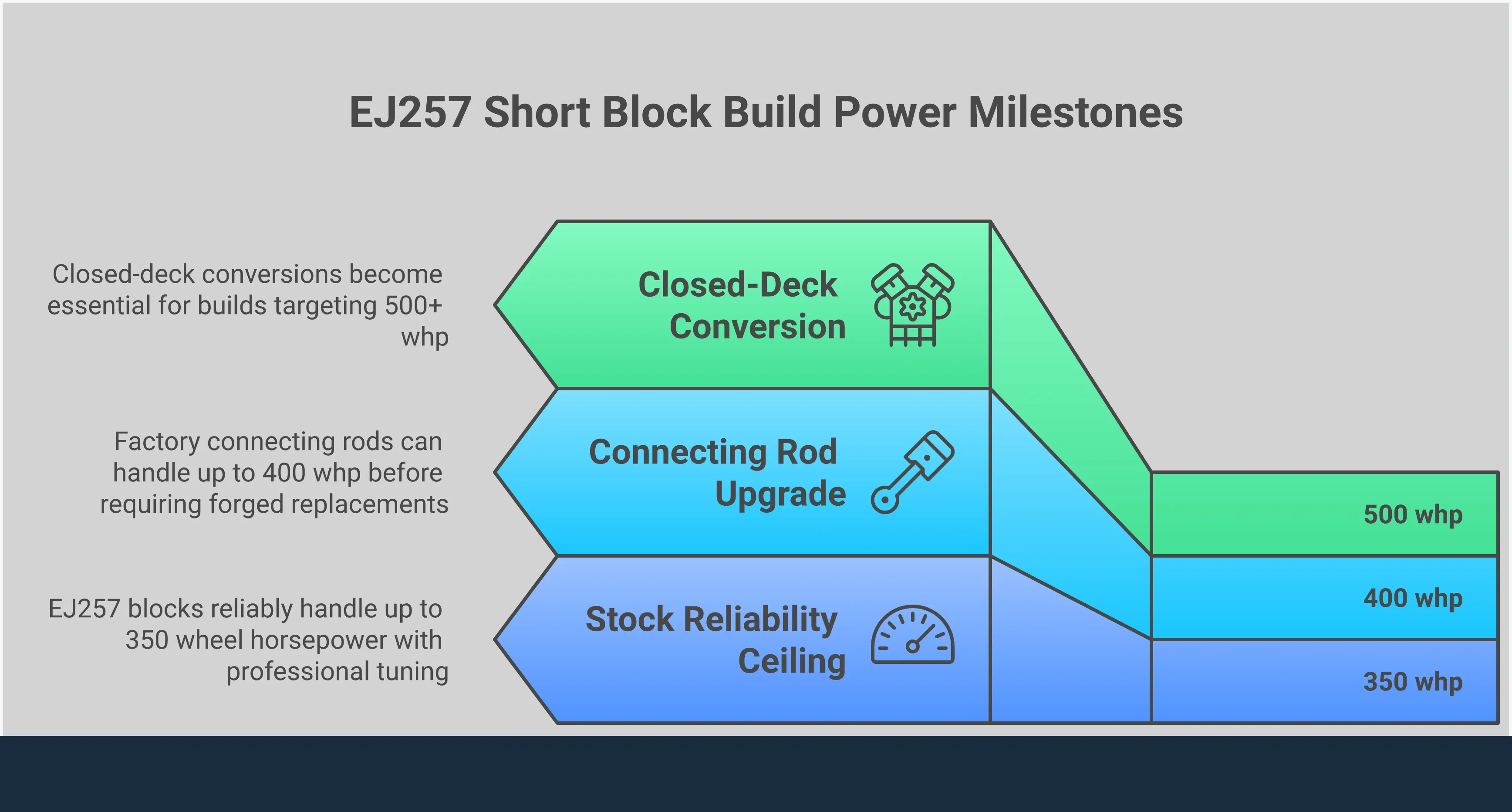
- Match Components to Your Power Goals: For builds over 350 whp, forged pistons are a must. To safely exceed 400 whp, add forged connecting rods, and for goals above 500 whp, a closed-deck block is necessary for structural integrity.
- Build a Complete System for Reliability: A built short block requires supporting upgrades to the fuel, cooling, and oiling systems. A professional tune is non-negotiable to protect your investment and ensure all parts work together safely.
Get to Know the EJ257 Short Block
Before you can choose the right short block for your build, you need to understand what you’re working with. The EJ257 is the heart of many iconic turbocharged Subarus, from the WRX STI to the Forester XT. It’s a capable platform, but like any engine, it has its limits. Knowing the fundamentals of its construction and where its weaknesses lie is the first step in planning a reliable, high-horsepower build. This knowledge will help you make informed decisions, whether you're aiming for a spirited daily driver or a dedicated track machine.
What's Inside an EJ257?
The EJ257 short block is the foundation of your engine. It includes the engine block itself, the crankshaft, connecting rods, and pistons. Think of it as the core rotating assembly that creates power. In its stock form and with a solid tune, a factory EJ257 is generally reliable up to about 350 wheel horsepower (whp). Push past that number, and you’ll find its weak point: the factory cast pistons. The ringlands, which are the small metal ridges that hold the piston rings in place, are especially prone to failure under increased pressure. For power goals beyond 350 whp, upgrading to forged pistons is essential. If you’re aiming for 400 whp or more, you’ll also need stronger forged connecting rods to handle the extra stress.
How the EJ257 Compares to Other Subaru Engines
You’ll find the EJ257 short block in a range of popular turbocharged models, including the Subaru WRX STI (2004-2021), WRX (2006-2014), and Forester XT (2004-2013). Its widespread use makes it one of the most well-known and modified Subaru engines. As mentioned, its primary vulnerability is the cast pistons, which simply can’t withstand the demands of high-performance applications. This is why many owners pursuing serious power opt for a built short block. Consider it an insurance policy for your engine. Investing in a professionally assembled short block with quality performance parts provides the durability and peace of mind you need to push your Subaru to its full potential without risking catastrophic failure.
Finding the Limits of a Stock EJ257
Before you start planning major power upgrades for your STI or WRX, it's smart to understand what the stock EJ257 can handle right out of the box. Every engine has its breaking point, and the EJ257 is no exception. While it's a capable platform, pushing it too far without the right modifications can lead to catastrophic and expensive failures. Knowing these limits isn't about holding you back; it's about helping you build a reliable engine that meets your goals. Let's look at the established power ceiling for a stock block and identify the first component that usually gives way under pressure.
The 350 WHP Ceiling
So, what's the magic number? For a stock EJ257, the widely accepted limit is around 350 wheel horsepower (whp). With professional engine tuning services, you can reliably hit this number and have a blast on the street or track. However, once you start pushing past 350 whp, the risk to your engine's internal components goes up exponentially. This isn't just a random number; it's a threshold identified through years of community experience and professional testing. Staying at or below this level with a stock block is the best way to enjoy more power without constantly worrying about your engine's health.
Identifying the Achilles' Heel: Ringland Failure
If you're wondering what fails first when you exceed that 350 whp ceiling, the answer is almost always the pistons. Specifically, the piston ringlands are the notorious weak point of the stock EJ257. These are the small metal grooves that hold the piston rings in place, and they simply weren't designed to handle the increased cylinder pressure that comes with big power gains. When a ringland cracks or fails, it can cause a loss of compression, excessive oil consumption, and eventually, complete engine failure. This is the primary reason why so many enthusiasts planning for more power invest in Subaru STI upgrades that include forged pistons.
Debunking Common EJ257 Myths
The Subaru community is full of passionate owners, and with that passion comes a lot of opinions, especially about the EJ257 engine. You've probably heard the whispers at car meets or read the debates on forums about its supposed weaknesses. While some concerns are valid, others are myths that have been repeated so often they're mistaken for fact. Let's clear the air and look at what the stock EJ257 can actually handle and when you truly need to start thinking about upgrades.
The Truth About OEM Strength
One of the biggest myths is that the stock EJ257 short block is fragile. The reality is that the standard Subaru OEM EJ25 block is much stronger than many people believe. With a professional tune, a stock engine can reliably support up to 350 wheel horsepower (whp). In fact, with proper care and precise engine tuning services, that number can even be pushed toward 400 whp. The main limitation isn't the block itself, but the factory cast pistons, which can become a failure point when you start demanding significantly more power.
Do You Really Need Forged Internals?
This brings us to the next big question: are forged internals really necessary? The answer depends entirely on your power goals. If you plan to stay at or below 350 whp, the stock components will serve you well. However, to safely make more power, you need stronger parts. For builds aiming for over 350 whp, forged pistons are a must. If you're pushing past 400 whp, you'll also need stronger forged connecting rods. Think of investing in quality performance parts as an insurance policy for your engine. Forged components are denser and far more resistant to cracking under pressure, preventing catastrophic and expensive failures down the road.
Why Upgrade to a Built EJ257 Short Block?
If you’re serious about pushing your Subaru past its factory limits, the conversation eventually turns to the engine’s foundation: the short block. While the stock EJ257 is a capable motor, its components were designed for a specific power range. Upgrading to a built short block isn’t just about chasing higher horsepower numbers; it’s about building a reliable platform that can handle the stress of increased performance without compromise. It’s the key to transforming your car from a fun daily driver into a true performance machine.
Build for Durability and Higher Power
The stock EJ257 short block has a well-known ceiling, typically around 350 wheel horsepower (WHP). Pushing beyond this point on factory internals is a gamble. To safely make more power, you need stronger parts. For builds targeting over 350 WHP, forged pistons are essential. If your goal is over 400 WHP, you’ll need to add stronger forged connecting rods to the list. For those aiming for 500 WHP and beyond, the cylinder walls themselves need reinforcement, which is usually achieved by converting to a closed-deck block. A built block provides the durable foundation required for these high-power applications, ensuring your engine can handle the added stress from more boost and aggressive engine tuning services.
The Advantage of Forged Pistons and Rods
So, what makes a built block so much stronger? The answer lies in the manufacturing process of its core components. A built short block replaces weaker factory parts, like cast pistons and connecting rods, with much stronger forged alternatives. Forged parts are created under extreme pressure, which makes them significantly denser and far less likely to crack under high-stress conditions. This superior strength is exactly what you need to manage the increased cylinder pressures that come with a larger turbo and more aggressive tuning. These robust internals are the heart of any serious Subaru STI upgrade plan, allowing your engine to perform reliably at power levels the stock components simply can't handle.
Why a Built Block is Your Best Insurance Policy
Think of investing in a quality built block as an insurance policy for your high-horsepower goals. Pushing a stock engine too far often ends in catastrophic failure, leading to expensive and time-consuming repairs that can damage other components in the process. A built short block with quality forged internals gives you peace of mind, knowing your engine’s foundation is solid enough to support your other performance parts. It protects your entire investment, from the turbocharger to the fuel system, by preventing the kind of engine failure that can sideline your project indefinitely. It’s the smartest move you can make when building a powerful and dependable Subaru.
Match Your Build to Your Power Goals
Once you know you need a built block, the next step is to define your power goals. Are you aiming for a spirited daily driver or a full-blown track monster? The answer will determine the specific components and level of reinforcement your EJ257 needs. A build designed for 450 WHP has different requirements than one built for 650 WHP. Let's break down two common power targets to help you map out your upgrade path and choose the right foundation for your Subaru.
The 400-500 WHP Build for the Street
This is the sweet spot for many enthusiasts who want a seriously fast street car that remains reliable for daily driving. With proper care and a professional tune, a standard OEM EJ257 short block can generally handle up to 400 wheel horsepower (WHP). However, pushing beyond 350 WHP puts you in a territory where factory internals become a liability. To safely make over 400 WHP, you need stronger forged connecting rods. A built short block with upgraded forged pistons and rods provides the strength needed to handle the increased cylinder pressures, giving you peace of mind while enjoying the power from your Subaru STI upgrades.
The 600+ WHP Build for the Track
If your ambitions lie on the racetrack, you'll need to go a step further. Pushing past 500 WHP requires reinforcing the cylinder walls, which is typically done by converting to a closed-deck block. For a build aiming for 600 WHP or more, specialized components like Crawford’s custom pistons or a piston and long rod kit are essential. At this level, a built short block is just the starting point. To get the most out of your engine and keep it reliable under extreme track conditions, you’ll need a full suite of supporting performance parts and a meticulous tune. This is where you build a true powerhouse.
What to Look for in an EJ257 Short Block
Once you’ve decided to invest in a built short block, the next step is sorting through your options. Not all built engines are created equal, and the details make all the difference in achieving reliable power. Making the right choice comes down to evaluating three key areas: the quality of the internal components, the design of the block itself, and the reputation of the engine builder.
Focusing on these elements will help you select a short block that not only meets your power goals but also provides a strong foundation for your entire build. A well-built engine is an investment in your car’s performance and longevity, so it pays to be thorough. Let’s break down exactly what you should be looking for.
Prioritize Quality Materials and Forged Internals
The primary reason for upgrading your short block is to replace the factory’s weaker cast components with superior forged parts. Forged pistons and connecting rods are created under immense pressure, resulting in a much denser and stronger molecular structure. This process eliminates the microscopic voids found in cast parts, making forged components significantly more resistant to cracking under the high cylinder pressures of a modified engine. When you’re shopping, make sure the builder specifies the use of high-quality forged internals from trusted brands. This is the single most important factor for ensuring your new engine can handle added power reliably.
Choose Between a Closed or Open Deck
Next, consider the block’s deck design. Stock EJ257 blocks feature a semi-closed deck, which is adequate for factory power levels. However, for high-horsepower builds, you’ll want to choose a closed-deck block. A closed-deck conversion adds material to the top of the block, reinforcing the cylinder walls. This extra support prevents the cylinders from flexing or distorting under extreme boost and combustion pressure, a critical feature for anyone planning to push their Subaru WRX or STI well beyond stock limits. While an open-deck design might be sufficient for milder builds, a closed deck provides the structural integrity needed for serious track or street performance.
Look for a Reputable Builder and Solid Warranty
The best parts in the world won’t perform correctly if they aren’t assembled with precision. The engine builder’s skill and experience are just as important as the components they use. Look for a shop with a long, proven track record of building reliable Subaru engines. A reputable builder will have strict quality control processes, including precise measurements and clean assembly practices. A great indicator of a builder’s confidence in their work is the warranty they offer. For example, we stand behind our engines with a 12-month/12,000-mile warranty, giving you peace of mind that your investment is protected by expert engine tuning services and craftsmanship.
The Crawford Performance Approach to the EJ257
At Crawford Performance, we've spent years mastering the EJ257. Our approach isn't about just selling parts; it's about building reliable power tailored to your specific goals. We combine a deep respect for the stock engine's potential with precision engineering to create builds that you can push with confidence, whether you're on the street or the track. We understand what it takes to make these engines perform reliably, and we apply that expertise to every component we design and every engine we build.
Our Specs and Proven Power Ratings
We believe in starting with a solid foundation, and the standard OEM EJ25 short block is surprisingly capable. With proper care and a professional engine tune, this engine can reliably handle up to 400 wheel horsepower (whp). For drivers who want to go further, our performance parts open up new possibilities. By adding our custom-designed pistons or a complete piston and long rod kit, that same block can be built to support up to 600 whp. This shows how the right combination of quality components and expert tuning can transform your Subaru’s performance without sacrificing dependability.
Our Unmatched 12-Month/12,000-Mile Warranty
We stand behind our work, and we have the warranty to prove it. Every built short block we produce comes with a unique 12-month/12,000-mile warranty. This isn't just a policy; it's a statement of our confidence in the durability and engineering behind every engine that leaves our shop. We know that investing in a built motor is a significant decision, and this warranty provides the peace of mind you deserve. It ensures that your high-performance engine is protected, allowing you to enjoy the power and reliability you paid for. Our built EJ25 short block guide details what makes our builds so dependable.
Tailor a Custom Build for Your Needs
A one-size-fits-all approach doesn't work for performance builds. To safely make more than 350 whp, you need to strengthen the engine's internal components. We recommend upgrading to forged pistons for builds over 350 whp and adding stronger forged connecting rods when you push past 400 whp. For serious power goals of 500 whp or more, we strengthen the cylinder walls, often by converting to a closed-deck block. A built short block replaces weaker factory cast parts with superior forged components. These parts are created under extreme pressure, making them denser and far more resistant to cracking, ensuring your engine can handle the increased stress.
Don't Forget These Supporting Mods
Installing a built EJ257 short block is a huge step toward making serious power, but it’s only one piece of the puzzle. To get the most out of your new engine and keep it running safely, you need to upgrade the systems that support it. Think of your built block as the foundation of a house; it’s incredibly strong, but it can’t do its job without the right framework around it. Neglecting these supporting modifications is a common mistake that can lead to poor performance or, even worse, engine damage. A built block can handle immense power, but it can't create it alone. It relies on the fuel system, turbocharger, cooling, and oiling systems to function correctly. If any of these supporting systems fail or can't keep up, you risk starving the engine of fuel, overheating it, or causing other critical failures that can destroy your investment in an instant. Before you finalize your build plan, make sure you’ve accounted for these essential upgrades that will allow your new engine to perform at its full potential. This isn't about just adding more parts; it's about creating a balanced, reliable setup where every component works in harmony to produce consistent and safe power.
Upgrade Your Fuel System
A more powerful engine is a thirstier engine. The stock fuel system in your Subaru was designed for stock power levels, and it simply can’t supply the volume of fuel a built motor demands. Pushing for higher power without upgrading your fuel delivery is a recipe for running lean, which can cause catastrophic engine failure. To prevent this, you’ll need to install larger fuel injectors and a higher-flow fuel pump. These components ensure your engine receives enough gasoline to match the increased airflow from your turbo, keeping your air-fuel ratios safe and your engine protected. This is a non-negotiable step for any serious power build.
Match Your Turbo and Intercooler
Your built block is designed to handle significantly more cylinder pressure, which means it’s ready for a larger turbocharger. To maximize your investment, you need to pair your engine with a turbo that can supply the necessary airflow for your power goals. A bigger turbo forces more air into the engine, and that compressed air needs to be cooled. An upgraded, larger intercooler is essential to lower the intake air temperature, creating a denser air charge for more power and reducing the risk of detonation. Together, an improved turbo, intercooler, and exhaust system allow your engine to breathe more efficiently, unlocking its true performance capabilities.
Enhance Your Cooling and Oil Systems
More power generates more heat. The factory cooling system can quickly become overwhelmed, so an upgraded radiator is a smart investment to maintain optimal operating temperatures. Just as important is the oiling system, a known weak point on the EJ257. An external oil cooler helps manage oil temperatures, while an Air/Oil Separator (AOS) prevents oil from contaminating your intake tract. To prevent oil starvation during aggressive driving, a stronger oil pickup tube and a baffled oil pan are critical upgrades. These performance parts work together to ensure your engine stays properly lubricated and cool, protecting it from the stresses of high-performance use.
Why Professional Tuning is Non-Negotiable
After you’ve installed your built block and all the supporting hardware, the single most important step is a professional tune. This is not a step to skip or cut corners on. A professional tuner adjusts your vehicle’s engine control unit (ECU) to make sure all the new components work together safely and efficiently. The tune optimizes fuel delivery, ignition timing, and boost levels to match your specific setup. Proper engine tuning services not only extract the maximum reliable power from your build but also implement safeguards to prevent engine damage. It’s the final step that brings your entire build together and ensures its longevity and performance.
Understanding the Cost of an EJ257 Short Block
When you’re planning an engine build, the budget is always a major consideration. The price of an EJ257 short block can vary widely, and it’s important to look beyond the initial price tag to understand the full scope of the investment. The final cost depends heavily on your power goals, the components you choose, and the supporting work required to make it all run smoothly. Let’s break down what you can expect to spend and where that money goes.
Comparing OEM vs. Built Block Costs
First, you’ll need to decide between a factory OEM block and a built aftermarket block. An OEM short block is a solid choice for daily drivers and street builds aiming for up to 400 wheel horsepower (whp). It’s a reliable factory component that typically costs between $2,500 and $3,100. If you’re looking for a dependable engine for moderate power levels without major modifications, this is a practical starting point.
For anything more ambitious, a built short block is essential. These engines are assembled with stronger, forged internals designed to handle the stress of high-performance applications. A built block is your ticket to serious power, but the price reflects the quality of the components. A build targeting 500 whp might start around $4,000, while a top-tier block capable of handling 1,000+ whp can easily exceed $18,000. These are the performance parts that provide the foundation for a truly powerful and durable build.
Factor in Installation and Other Mods
The short block is the heart of your build, but it’s not the only expense. A successful engine project requires a clean, professional installation and a custom tune to ensure everything works together perfectly. Cutting corners here can lead to catastrophic failure, so it’s crucial to budget for quality work. Remember to account for the small but necessary parts like gaskets, head studs, oil, and coolant, as these add up.
Beyond the installation itself, you need to factor in the cost of professional engine tuning services. A proper tune is non-negotiable; it optimizes your engine’s performance and protects your investment. Depending on your power goals, you may also need to upgrade other systems like your fuel pump, injectors, or turbo to support the new block. Thinking about the entire build from the start helps you create a realistic budget and avoid surprises down the road.
Choose the Right EJ257 for Your Build
Selecting the right EJ257 short block is the single most important decision for your engine build. This choice is the foundation for your Subaru's performance and reliability, so it pays to be realistic about your power goals and how you plan to use the car. Whether you want a dependable daily driver or a dedicated track machine, matching the block to your goals is the key to a successful build.
Let’s break down the decision. A standard OEM short block can reliably handle up to 350 wheel horsepower (whp) with a professional tune. If your goal is a fun, responsive street car that stays under this threshold, an OEM block is a solid, cost-effective option. Pushing past 350 whp on stock internals, however, puts you at high risk for ringland failure, the notorious weak point of factory pistons. You have to weigh the initial cost savings against the potential for a catastrophic engine failure down the road.
If your plans call for more than 400 whp, a built short block with forged internals isn't just a recommendation; it's a requirement. Forged pistons and connecting rods are engineered to handle the intense heat and pressure of higher horsepower. For builds targeting 500 whp or more, strengthening the cylinder walls with a closed-deck conversion is the best way to ensure the block’s integrity. Think of a built block as an insurance policy for your high-power application. Remember, the short block is just one piece of the puzzle. A professional installation and a custom tune are non-negotiable to protect your investment, and you should also budget for essential supporting performance parts like a complete gasket kit, ARP head studs, and a new oil pump to do the job right.
Related Articles
Frequently Asked Questions
How much power can my stock EJ257 actually handle? The widely accepted safe limit for a stock EJ257 short block is around 350 wheel horsepower. With a professional tune, the engine is quite reliable at this level. Pushing beyond this number significantly increases the risk of damaging the factory cast pistons, specifically the ringlands, which are the engine's most common failure point under high stress.
Do I really need a built short block for my build? This depends entirely on your goals. If you plan to stay at or below 350 wheel horsepower, the stock block is perfectly adequate. However, if you want to make more power reliably, a built block with forged internals becomes a necessity. Think of it as building a proper foundation; you can't construct a skyscraper on a foundation meant for a small house.
What's the difference between a semi-closed and a closed-deck block? The stock EJ257 block has a semi-closed deck, which provides a good balance of strength and cooling for factory power levels. A closed-deck conversion adds material to the top of the block, reinforcing the cylinder walls. This extra support is critical for high-horsepower builds (typically over 500 whp) because it prevents the cylinders from flexing under extreme pressure.
I'm getting a built block. What other parts do I absolutely need to upgrade? A built block is the heart of your build, but it needs a strong supporting cast to function correctly. You must upgrade your fuel system with a larger pump and injectors to supply enough fuel. You will also need a turbocharger and intercooler properly sized for your power goals. Finally, addressing the oiling system with an upgraded pickup tube and an external cooler is critical for protecting your investment.
Why is a professional tune so important after installing a new short block? A professional tune is the final, non-negotiable step that makes all your new components work together safely and efficiently. A tuner calibrates your engine's computer to match your specific hardware, optimizing fuel delivery, timing, and boost. This process not only unlocks the performance potential of your build but also implements crucial safeguards to prevent engine damage.