

How to Install a WRX AOS: A Step-by-Step Guide
Don't let the tight WRX engine bay intimidate you. Installing an Air-Oil Separator is a manageable and incredibly rewarding DIY job. This single upgrade is the best insurance policy for your engine, solving the boxer's oil blow-by issue to prevent performance loss and future damage. This guide is your expert partner in the garage. We'll walk you through every step of the AOS installation WRX procedure with clear instructions and pro tips, giving you the confidence to protect your engine for years to come.
Key Takeaways
- Protect Your Engine from Oil Contamination: An AOS is a foundational upgrade that intercepts oily vapor before it enters your intake. This prevents carbon buildup, maintains your fuel's octane rating, and protects your engine from harmful detonation, preserving both power and long-term reliability.
- Match the AOS to Your Driving Style: The right unit depends on your specific needs. A heated AOS is best for daily drivers to prevent sludge buildup in colder weather, while high-quality aluminum construction ensures efficient operation for any setup. Always confirm the part is compatible with your WRX model year.
- A Downhill Drain is Crucial for Success: The most critical step of the installation is routing the oil drain hose. It must have a constant, unobstructed downhill path back to the engine for the system to function. After installation, check for leaks and monitor your oil level to confirm everything is working correctly.
What an Air-Oil Separator (AOS) Is and How It Works
An Air-Oil Separator (AOS) is one of the most important performance parts you can install to protect your Subaru's engine. Think of it as a dedicated filtration system for the air circulating inside your crankcase. Its job is to intercept the oily vapor created during normal operation, separate the oil from the air, and then route clean air back to your intake and clean oil back to your oil pan. This closed-loop process prevents a host of problems that can reduce your engine's power and shorten its lifespan, all while keeping your oil where it belongs.
The factory system in your WRX has a basic method for handling this vapor, known as the Positive Crankcase Ventilation (PCV) system, but it’s not designed for the demands of a high-performance, turbocharged engine. It simply reroutes the oily mist back into your engine’s intake, where it can cause carbon buildup and reduce fuel quality. An AOS provides a far more effective solution by actively filtering out these contaminants before they can cause harm. By installing one, you’re not just adding a part; you’re investing in the long-term health and reliability of your vehicle. It’s a foundational upgrade that ensures your engine performs at its peak, whether you're on the street, track, or trail.
How an AOS Protects Your WRX Engine
Every engine experiences something called "blow-by." This is a normal occurrence where a small amount of oil vapor and unburnt fuel slips past the piston rings and enters the crankcase. The problem is what happens next. Your WRX’s factory system directs this oily vapor back into the intake manifold to be burned off. This can lead to carbon buildup on your intake valves, reduce your fuel's octane rating, and generally compromise performance. An AOS for your Subaru WRX intercepts this blow-by, acting as a catch-can and filtration system in one. It separates the oil and sends it back to the oil pan where it belongs, allowing only clean air to re-enter your intake.
Preventing Detonation and Carbon Buildup
When your PCV system sends oily vapor into the intake, it mixes with your air and fuel. This oil contamination effectively lowers your fuel's octane rating, making it more likely to ignite prematurely under pressure. This uncontrolled explosion is known as detonation, or engine knock, and it can cause catastrophic damage to your pistons and rods. At the same time, that oil bakes onto your intake valves, forming hard carbon deposits that restrict airflow and reduce performance. An AOS is your engine's best defense, intercepting the oily vapor to protect your engine from oil contamination. This keeps your intake air clean, maintains your fuel's octane, and prevents both detonation and carbon buildup from ever starting.
Aiding Against Ringland Failure and Fuel Dilution
Detonation is a primary cause of ringland failure, a notorious issue for performance-oriented Subaru engines. By preventing knock, an AOS directly reduces the stress on your pistons. Furthermore, the blow-by vapor an AOS filters out isn't just oil; it can also contain unburnt fuel. When fuel mixes with your engine oil, it causes "fuel dilution," thinning the oil and reducing its ability to lubricate properly. This leads to accelerated wear on critical components. An AOS provides a far more effective solution by actively filtering out these contaminants before they can cause harm. By installing one, you’re not just adding a part; you’re investing in the long-term health and reliability of your vehicle, making it one of the most valuable performance parts you can install.
The Problem with Oil Vapor in Your Engine
Allowing oil vapor into your intake system can cause significant issues. First, oil contaminates your fuel, effectively lowering its octane rating. This increases the risk of engine knock, a form of pre-detonation that can cause serious damage to your pistons and bearings. Second, that oil vapor bakes onto your intake valves, creating hard carbon deposits. These deposits restrict airflow, which robs your engine of power and efficiency. This is especially critical for direct-injection (DI) engines, where fuel doesn't wash over the valves to keep them clean. A quality AOS is essential for maintaining a clean system, which is the foundation for any reliable engine tuning service.
Why Your WRX Needs an AOS
Before you start adding power with bigger turbos or aggressive tunes, it’s smart to address one of the Subaru engine’s core vulnerabilities. An Air-Oil Separator (AOS) isn't just another accessory; it's a foundational upgrade that protects your engine, maintains performance, and gives you a solid platform for future modifications. Think of it as essential insurance for your WRX's heart. By managing oil blow-by, an AOS ensures your engine runs cleaner and stronger for years to come, whether you're commuting to work or pushing it on the track.
Achieve More Consistent Performance
During normal operation, your engine produces "blow-by," a mix of oil vapor and fuel that slips past the piston rings. The factory PCV system recycles this oily mist back into your intake, gumming up your manifold, valves, and intercooler with carbon. This restricts airflow and lowers your fuel's octane rating, reducing power. An AOS intercepts this blow-by, separating the oil from the air. It returns clean oil to the engine and directs cleaner air into your intake, helping your engine breathe freely and maintain its designed performance potential.
Extend Your Engine's Lifespan
An AOS is one of the best investments for your engine's longevity. By preventing an oily film from coating your intercooler, it helps the intercooler work more efficiently to keep intake air cool. More importantly, it stops oil from contaminating your fuel mixture. When oil lowers your fuel's octane, it can lead to detonation, or "engine knock," which can cause catastrophic damage over time. A quality AOS keeps your intake valves clean and prevents the gradual power loss that occurs as an engine gets clogged with carbon. It doesn't add horsepower, but it stops your engine from losing the power it already has.
Why Turbo Engines Benefit the Most
Turbocharged engines like the one in your WRX are especially susceptible to the effects of blow-by. The increased cylinder pressures create more of it, overwhelming the stock PCV system. This makes an AOS critical for preventing common and costly issues like ringland failure, a notorious problem for modified Subarus. Because of the Subaru boxer engine's design, installing an AOS is a crucial first step before adding other performance parts. It creates a healthier environment for your engine, ensuring it can safely handle the extra power from future upgrades.
Is an AOS Right for Your Build?
Deciding whether to install an Air-Oil Separator comes down to your goals for your car and your tolerance for risk. While it's a universally beneficial upgrade, its necessity shifts from "highly recommended" to "absolutely essential" depending on your setup. It’s not about adding power, but about preserving the power and reliability you already have. The main purpose of an AOS is prevention—to keep harmful oil vapor out of your engine's intake system before it can cause problems. Understanding where your vehicle falls on the spectrum, from a stock daily driver to a fully built track machine, will help you make the right call for your engine's future.
Stock vs. Modified: Assessing Your Needs
Even on a completely stock WRX, an AOS is a smart preventative measure. Turbocharged boxer engines naturally produce significant blow-by, and the factory PCV system is merely adequate for daily driving. Installing an AOS is the best way to keep your intake, valves, and intercooler clean for long-term health. However, once you start adding performance parts, an AOS becomes critical. Increased boost from a tune or a larger turbo raises cylinder pressures, creating far more blow-by than the stock system can handle. At this point, an AOS is no longer optional; it's a foundational requirement to protect your engine from oil contamination and detonation as you push for more power.
Understanding the Risks: Warranty Considerations
It’s a valid concern: will installing an aftermarket part void your warranty? The short answer is, it can be complicated. Legally, a dealer must prove that your AOS directly caused a specific failure to deny a claim. However, installing any aftermarket part gives a dealership an opening to push back on warranty work. The real question becomes one of risk management. Are you more concerned with a potential warranty dispute or with preventing the well-documented issues, like ringland failure, that an AOS is designed to solve? For many owners, especially those planning future modifications, an AOS is a calculated investment in their engine's longevity that outweighs the risk of a warranty headache.
How to Choose the Right AOS for Your WRX
Picking the right Air-Oil Separator for your WRX is a critical step in protecting your engine and getting the performance you want. Not all AOS units are created equal, and the best one for you depends on your car, your driving habits, and even where you live. Think of it as choosing the right tool for the job. A daily driver in a cold climate has different needs than a dedicated track car that only sees the summer sun.
Making the right choice from the start saves you time, money, and potential headaches down the road. You’ll want to consider a few key factors before you add one to your cart. We’ll walk through the most important decision points: the quality of the materials, whether you need a heated unit, your primary driving style, local emissions laws, and finally, confirming it actually fits your specific WRX model. Taking a few minutes to weigh these options ensures you get a part that works seamlessly with your setup and delivers the engine protection you’re looking for.
Why Material Quality Matters
When you're shopping for an AOS, the materials it's made from matter just as much as its design. Look for units constructed from high-quality, billet aluminum. This isn't just for looks; aluminum is an excellent conductor of heat. This property helps the AOS maintain a consistent internal temperature, allowing it to efficiently cool the incoming blow-by gases. As the gases cool, oil vapor condenses back into liquid, separating it from the air before it can be recirculated into your intake. A well-built aluminum unit resists corrosion and prevents the sludge buildup that can plague lesser-quality systems, ensuring your AOS performs effectively for years to come.
Heated vs. Non-Heated: Which Is for You?
One of the biggest decisions you'll make is whether to go with a heated or non-heated AOS. A heated AOS connects to your engine’s coolant lines. This feature uses hot coolant to keep the inside of the separator warm, preventing water vapor in the blow-by from condensing and mixing with the collected oil. Without heat, this mixture can form a thick, milky sludge, especially in colder weather or on short trips. If your WRX is a daily driver, a heated unit is almost always the right call. For dedicated track cars that operate at high temperatures consistently, a non-heated version can be sufficient.
Street vs. Competition: Which Is Right for You?
Your driving habits should directly influence your choice of an AOS. Most systems are designed for either street or track applications. Street-focused models are engineered for simple installation, often without requiring you to modify or remove factory emissions components. They provide excellent protection for daily driving and spirited canyon runs. Track-oriented models, on the other hand, are built for maximum efficiency under the extreme conditions of racing. These systems may have a larger capacity or more complex baffling to handle high G-forces and greater blow-by volume. They sometimes require more involved installation but are essential for anyone serious about track days or competition. You can explore a variety of performance parts to find the perfect match for your build.
A Quick Word on CARB Compliance
If you live in California or another state with strict emissions standards, this is a step you can't skip. Before buying an AOS, you must verify if it is CARB compliant. CARB, or the California Air Resources Board, tests aftermarket parts to ensure they don't increase vehicle emissions. A compliant part will have a CARB Executive Order (EO) number, which proves it's legal for use on public roads in that state. Installing a non-compliant part can lead to a failed smog check and hefty fines. Always check the product description for a CARB EO number to ensure you stay on the right side of the law.
Ensuring a Perfect Fit for Your WRX
This might sound obvious, but it’s a final check that can save you a world of frustration. The Subaru WRX has gone through several generations since 2002, and the engine bay layout, mounting points, and hose connections can vary significantly between model years. An AOS designed for a 2008 WRX won't fit a 2022 model without serious modification, if at all. Always double-check that the AOS kit you’re buying is specifically listed as compatible with your vehicle's year. Reputable manufacturers will clearly state which models their kits fit. A quick look at available Subaru WRX upgrades can help you find a part guaranteed to fit your specific car.
Preparing for the Job: A Realistic Look at the Install
Alright, you’ve chosen the right AOS for your WRX, and now it’s time to get your hands dirty. Before you start loosening a single bolt, let's talk about what this installation actually involves. Going into the job with a clear plan and realistic expectations is the single best way to ensure a smooth, successful process. The WRX engine bay is known for being a tight squeeze, but with the right preparation, this is a project you can absolutely handle in your own garage. Think of this phase as setting your foundation—a little extra time spent here will save you hours of frustration later.
Time Commitment and Difficulty Level
Let's be upfront: installing an AOS is not a quick job. You should plan to set aside several hours, or even a full day, especially if this is your first time tackling this kind of project. The main challenge isn't the complexity of the system itself, but rather the tight spaces you'll be working in. Accessing certain hoses and mounting points, particularly around the turbo and intake manifold, requires patience and a bit of dexterity. While it’s a manageable DIY task for a mechanically inclined owner, don't rush it. Give yourself plenty of time and space to work methodically through each step.
Essential Prep Work: Photos, Labels, and Videos
Before you disconnect anything, grab your phone and take pictures. Lots of them. Capture every hose connection and wiring harness from multiple angles. Next, use painter's tape and a marker to label every hose you disconnect—this simple step is a lifesaver when it's time for reassembly. While the instructions included with your kit are a good starting point, don't rely on them alone. Many installers find that watching a few video tutorials is incredibly helpful for visualizing the process. Search for a step-by-step guide for your specific WRX model year to see how others have navigated the tight spots and routed the new hoses.
Everything You Need for the AOS Installation
A smooth installation starts with having everything you need on hand before you even pop the hood. Taking a few minutes to gather your tools and parts will save you from making frantic trips to the auto parts store mid-project. Think of it as your pre-flight check. While our AOS kits are designed to be comprehensive, every Subaru has its own history and quirks. This checklist covers the essentials for a typical Subaru WRX installation, ensuring you’re prepared for the job ahead.
Tool Checklist
Beyond a standard socket set, wrenches, and screwdrivers, a few specific tools will make this installation much easier. Having these ready will help you work more efficiently and avoid damaging any components.
- Bolt Grabber: This tool can be a real lifesaver for accessing bolts in the tight confines of your WRX engine bay.
- Hose Clamp Tool: Factory Oetiker clamps require a special tool for removal and installation. If you don’t have one, you can carefully cut the old clamps off. Many owners choose to replace them with standard worm-gear clamps, which are easier to work with in the future.
Wrenches and Sockets
You’ll rely heavily on a good ratchet with a few key sockets. The 10mm and 12mm sockets will be your most-used tools, as they fit the majority of bolts and nuts holding brackets and components in the engine bay. A 19mm socket will be necessary for larger bolts, like those on the crank pulley. Make sure you have a few extensions of varying lengths; they are absolutely essential for reaching bolts buried behind other parts. You will also need a set of Allen sockets, specifically M3 and M5 sizes, for some of the smaller fittings. These tools form the core of any toolkit for working on a Subaru, so they are a great investment for future projects.
Pliers and Cutters
Working with hoses is a huge part of this installation, so the right pliers and cutters will make a world of difference. A pair of hose clamp pliers is designed to easily open and hold the factory spring-style clamps, saving your fingers and a lot of frustration. When it comes to trimming the new hoses to length, use a dedicated hose cutter instead of a utility knife. A proper cutter ensures a clean, square cut, which is critical for creating a tight seal and preventing leaks down the road. A 90-degree pick is another invaluable tool for carefully guiding hoses into tight spaces without kinking them.
Specialty Tools
A few specialized tools can turn a frustrating job into a smooth one. A bolt grabber or magnetic pickup tool can be a project-saver if you drop a bolt into the depths of the engine bay. You'll also encounter factory Oetiker clamps, which require a specific tool to remove and install. Many people opt to carefully cut these off and replace them with standard worm-gear clamps for easier service in the future. Finally, a torque wrench is highly recommended. It ensures every bolt is tightened to the exact manufacturer specification, preventing leaks and damage. Using the right tools is a key part of installing any performance parts correctly.
Parts Checklist
Your Crawford Performance AOS kit comes with the core components you need, including the separator unit and model-specific hoses and fittings. However, it’s always a good idea to review the contents and consider your specific setup.
Depending on your model year and any existing modifications, you might need a few extra items. For instance, if you plan a custom routing, having an extra length of 5/8-inch PCV hose is wise. If you have a Top Mount Intercooler (TMIC) or decide not to connect the coolant lines, you’ll need the correct ORB plugs to seal the unused ports. You can find these small but crucial items with other performance parts to complete your setup.
Your Step-by-Step WRX AOS Installation Guide
Alright, you’ve got your AOS, your tools are laid out, and you’re ready to give your WRX the upgrade it deserves. Installing an Air-Oil Separator is a totally manageable DIY project that can make a huge difference for your engine’s health and performance. It might look a little intimidating with all the hoses, but don’t worry. We’re going to walk through this one step at a time. Taking your time and following these instructions carefully is the key to a smooth installation. Before you begin, make sure you have all the necessary tools and parts listed in your AOS kit. Let’s get that engine bay prepped and ready to go.
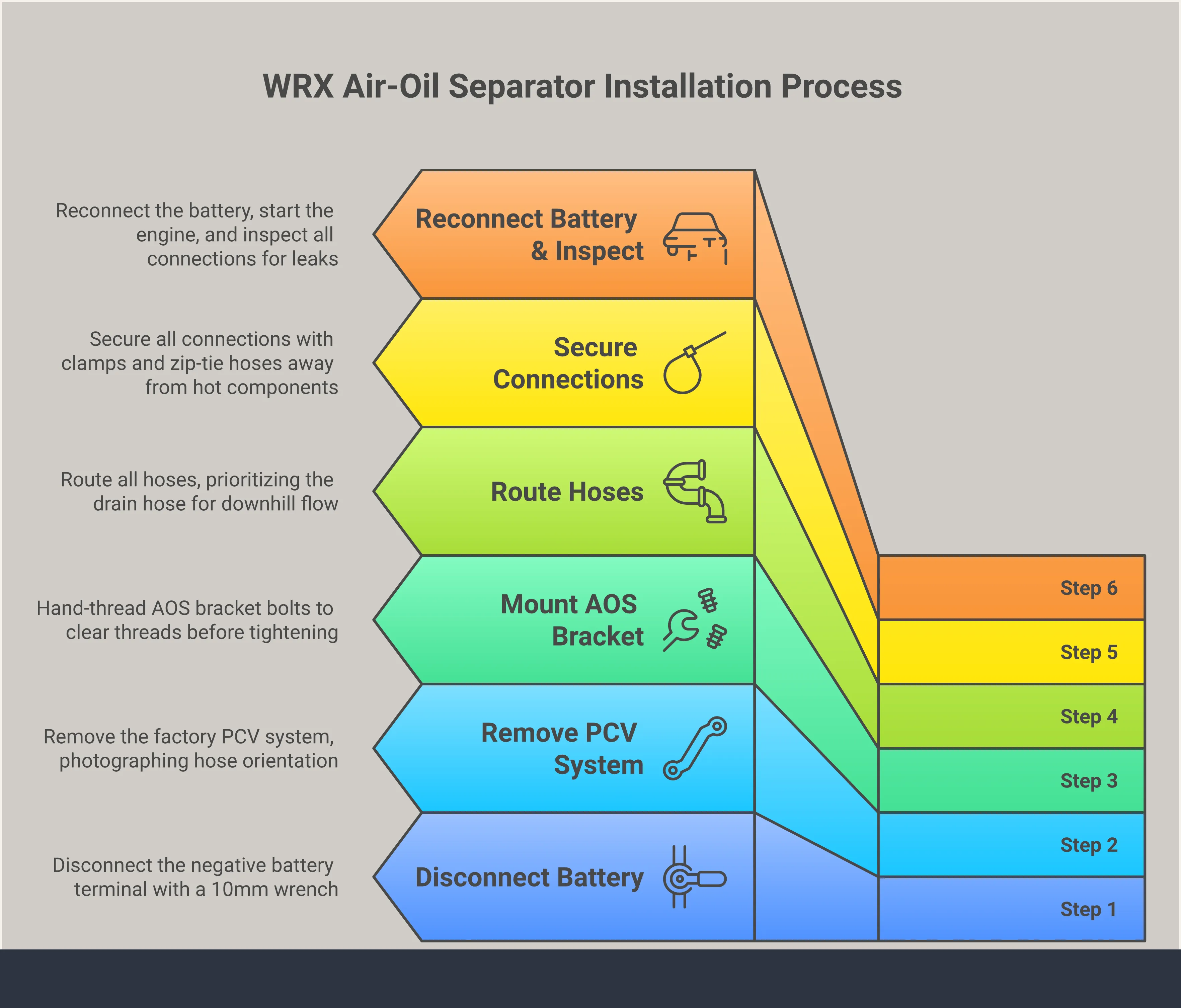
Step 1: Inspect Your Kit and Plan Your Attack
Before you even think about turning a wrench, take a moment to get organized. This initial step is your best defense against frustration and will make the entire installation process go much smoother. Lay out all the parts from your AOS kit and check them against the included list to confirm everything is there. Next, read through the installation instructions from start to finish. This helps you visualize the process and understand how the hoses will be routed in your engine bay. I can't stress this enough: take plenty of photos of your engine bay before you disconnect or remove anything. These pictures will be an invaluable reference later. Finally, gather your tools so they're ready to go. Proper preparation ensures your new WRX upgrade goes on without a hitch.
Step 1: Prep the Engine Bay and Disconnect the Battery
First things first: safety. Before you touch anything else, pop the hood and disconnect the negative terminal on your car’s battery. You’ll usually need a 10mm wrench for this. This simple step is crucial because it prevents any accidental electrical shorts that could damage your car’s sensitive electronics or, worse, cause an injury. Once the cable is disconnected, tuck it away to the side so it can’t accidentally make contact with the terminal while you’re working. This gives you a safe and clear space to begin the installation, ensuring you can focus on the task at hand without any electrical surprises.
Step 2: Remove the Factory PCV System
Now it’s time to take out the old and make way for the new. You’ll need to locate and remove the factory PCV (Positive Crankcase Ventilation) system. This involves disconnecting several hoses from the crankcase and cylinder head ports. Pay close attention to the main PCV hose, as it contains a one-way valve that isn't centered. The longer side of the valve connects to the intake, while the shorter side will eventually connect to your new AOS. Getting this backward can cause serious pressure buildup and oil leaks, so it’s worth double-checking. Take a picture with your phone before you disconnect it if you’re worried about forgetting the orientation.
Handling One-Time Use Connectors
As you start disconnecting hoses, you'll likely run into some stubborn factory clamps. The hardest part of the installation might be removing a special 'one-time use' connector, often an Oetiker clamp. These require a specific tool to remove without a fight. If you don't have the tool, you can carefully cut them off with snips, but be mindful not to damage the hose underneath. Many owners choose to replace these with standard worm-gear clamps, which you can find at any auto parts store. This makes future maintenance much simpler, as you'll only need a flathead screwdriver to loosen or tighten them. It’s a small change that your future self will thank you for.
Saving Factory Gaskets
Pay close attention as you remove components like the intercooler or blow-off valve. Don't lose the factory gaskets when you remove these parts. They are often thin metal or rubber pieces that can easily stick to the part you’re removing or fall into the engine bay. You need to reuse them to prevent frustrating air and boost leaks, which can hurt performance and cause issues that are difficult to diagnose later. A good habit is to immediately place any gaskets you remove into a magnetic tray or a clean, safe spot away from your main work area. Ensuring a perfect seal is critical for getting the most out of your engine tuning services.
Step 3: Mount the AOS Bracket
With the old system out of the way, you can mount the bracket for your new AOS. Find the designated mounting points on the engine, which are typically pre-existing bolt holes. Here’s a pro tip: before you tighten anything down, thread the mounting bolts in by hand first. This helps clean out any paint, grime, or debris that might be clogging the threads, making the final installation much smoother. Once the threads are clean, you can securely mount the bracket using your tools. A solid, wobble-free mount is essential for keeping your AOS stable, especially when you’re putting your Subaru WRX through its paces.
Step 4: Route and Connect the New Hoses
This is where your AOS system really comes together. Carefully route the new hoses from the engine ports to the AOS, and from the AOS back to the engine. The most critical part of this step is the drain hose. It absolutely must have a consistent, downhill path from the bottom of the AOS to the oil pan or crankcase connection point. If the hose has any uphill sections or kinks, oil can’t drain back properly, and the entire system will fail to work as designed. Take your time to ensure every hose has a clear, unobstructed path, connecting them to the correct ports on the AOS unit.
Step 5: Secure Clamps and Check Clearances
Once all your hoses are connected, it’s time to secure them. Use the provided clamps to tighten down every connection point, ensuring a leak-proof seal. Don’t overtighten, but make sure they are snug. Next, use zip ties to secure the hoses and keep them from moving around. This is incredibly important for preventing damage. You need to make sure no part of a hose is touching hot components like the turbo or exhaust, or interfering with moving parts like belts and fans. A loose hose can quickly lead to a melted line or a much bigger problem, so check all your clearances carefully before moving on.
Step 6: Reconnect, Start, and Check for Leaks
You’re on the home stretch! With everything mounted and secured, it’s time for the moment of truth. Reconnect your negative battery terminal and tighten it down. Before you start the engine, do one last visual inspection of all your connections. Once you’re confident, start the car and let it idle. Carefully check all the new hose connections for any signs of fluid leaks, paying special attention to the coolant lines if your AOS is a heated model. Let the engine warm up to operating temperature and check again. If everything is dry and the engine is running smoothly, you’ve successfully installed your AOS. After an install like this, consider getting professional engine tuning services to optimize your car's new setup.
Step 7: Bleed the Cooling System
If you installed a heated AOS that connects to your engine’s coolant lines, this next step is non-negotiable. Tapping into the cooling system introduces air, and air pockets are the enemy of a healthy engine. You must bleed the cooling system to remove these bubbles. If you skip this, trapped air can create hot spots and prevent coolant from circulating properly, leading to overheating and potential engine damage. The process is straightforward: with the engine cool, top off your coolant reservoir, start the car with the heat on full blast, and let it run until the cooling fans cycle on and off. This forces the air out so you can top off the coolant one last time.
Step 8: Reconnect, Start, and Monitor
With all hoses secured and the system bled, it's time for the final check. Reconnect the negative battery terminal and make sure it's tight. Start your car and let it idle for several minutes while you stay close and listen for any unusual sounds. This is also your chance to play detective. Grab a flashlight and carefully inspect every connection you made, especially where the new coolant and oil lines meet their fittings. Look for any drips, wet spots, or signs of a leak. Let the engine reach its normal operating temperature and check again. Once you’ve confirmed everything is dry and running smoothly, you can be confident in your work. A successful install provides a great foundation for future engine tuning services.
Troubleshooting Your WRX AOS Installation
Even the most straightforward install can have a few tricky moments. Don't worry, it happens to everyone. Knowing what to expect can make all the difference between a frustrating afternoon and a successful upgrade. Let's walk through some of the common hurdles you might encounter when installing an AOS on your WRX and, more importantly, how to get past them smoothly. Being prepared for these small challenges will help you stay on track and get your car back on the road with its new performance parts.
Tips for Working in Tight Spaces
The WRX engine bay is notoriously compact, and that’s probably the first challenge you’ll notice. Reaching certain bolts and hoses can feel like a game of automotive Twister. This is where your tool collection really shines. Having a good set of socket extensions, swivels, and universal joints will be a lifesaver, allowing you to access fasteners that are otherwise out of reach. A magnetic parts tray and a good headlamp can also prevent a lot of frustration from dropped bolts. A bit of patience and the right tool will help you work around the tight corners without scraping your knuckles.
How to Handle Oetiker Clamps
Your AOS kit will likely come with Oetiker clamps, which create a secure, factory-like seal. The catch? They are single-use only. Once you crimp one, there’s no going back. If you make a mistake or need to readjust, you’ll have to cut it off and use a new one. I recommend having a few spares on hand just in case. Take your time to position the hose and clamp perfectly before you commit to crimping it down. Familiarizing yourself with the proper clamping tool beforehand will make the process much less stressful.
Getting to the Hard-to-Reach PCV Hose
Getting to the PCV valve hose is another common sticking point. Depending on your WRX model year, you might find it’s easier to remove the intake manifold for better access. It sounds like a big step, but it can save you a lot of time and frustration. The most important thing to remember here is that the PCV hose has a one-way valve that isn't centered. The longer side of the valve must connect to the engine's intake, while the shorter side connects to the AOS. Getting this right is crucial for your Subaru WRX upgrades to function correctly.
How to Route the Drain Hose Correctly
This is one of the most critical steps of the entire installation. The AOS drain hose must always run downhill from the separator to the engine's oil pan. Gravity is your best friend here; if the hose has any uphill sections, oil won't drain back into the engine, and the system will fail. Double-check your routing to ensure a consistent downward slope. Also, be careful to avoid any kinks or sharp bends in the hose, as these can block flow just as easily as an uphill section. A proper installation ensures your engine is protected, which is key for getting the most out of future engine tuning services.
Dealing with Post-Installation Engine Codes
Seeing a check engine light after finishing an installation can be alarming, but it’s usually a sign of a simple issue rather than a major problem. Most often, a post-install code is caused by a vacuum leak from a hose that wasn't fully seated or a clamp that isn't tight enough. Another common culprit is incorrect routing, especially if the PCV valve was installed backward or the crucial drain line has a kink. Before you worry, go back and meticulously double-check every connection. Ensure all clamps are secure and that every hose follows the path laid out in the instructions. If the issue persists, a simple code reader can tell you the exact error, pointing you directly to the source of the problem. For complex issues, consulting with a shop that offers professional engine tuning services can provide a quick diagnosis.
How to Confirm a Successful Installation
You’ve tightened the last clamp and put away your tools, but the job isn’t quite finished. Confirming a successful installation is just as important as the installation itself. This final phase is all about ensuring your hard work pays off and that your new Air-Oil Separator is functioning perfectly to protect your engine. A few simple checks right after the install and as part of a new routine will give you peace of mind and keep your WRX running strong. By taking a few extra minutes now, you can verify that all connections are secure and that the system is ready to handle anything you throw at it. These steps ensure your investment in high-quality performance parts delivers the reliability and protection you expect. Think of it as the final quality control check before you get back to enjoying your drive.
What to Look for After Installation
The first thing to do after reconnecting the battery is to start the engine and let it idle. Before you even think about a test drive, pop the hood and perform a thorough visual inspection. Carefully check all the new hose connections, fittings, and clamps for any signs of fluid leaks, especially coolant and oil. Let the car run for several minutes to come up to operating temperature, as some small leaks may only appear under pressure. A successful installation is a dry one. Seeing no drips or weeping from any of the connections you worked on is the first positive sign that you’ve done the job correctly.
Monitoring Coolant Temperature
If you installed a heated AOS, you've tapped into your car's cooling system, which means you need to pay close attention to your temperature gauge. As the engine idles, keep an eye on the temp gauge on your dashboard. You should see it rise steadily to its normal operating position and then hold firm. If you notice the needle climbing into the red or significantly past its usual spot, turn off the engine immediately. This could indicate an air bubble is trapped in the system. Let the engine cool down completely before you check the coolant level in the overflow tank and top it off if necessary. This simple check is a vital part of the post-installation process and ensures your cooling system is working correctly.
How to Monitor Your Oil Level
An AOS is designed to capture oil vapor and return it to the engine, which can change your engine's oil consumption habits for the better. To confirm the system is working as intended, get into the habit of checking your oil level frequently for the first few hundred miles. Since the AOS is now sending oil back to the crankcase instead of letting it burn off through the intake, your oil level should remain more stable between changes. This simple check with the dipstick confirms that the AOS drain is functioning correctly and that your engine is getting the protection it needs from all your Subaru WRX upgrades.
Setting Up a Post-Install Inspection Routine
Long-term reliability comes from consistent maintenance. Make it a habit to inspect your AOS system during regular oil changes or at least once a month. This doesn’t have to be a major task; a quick five-minute check is all you need. Look over the hoses for any signs of cracking or brittleness, ensure all clamps are still tight, and check that the AOS unit is securely mounted. Catching a loose clamp or a worn hose early prevents bigger issues down the road. This simple routine is a key part of maintaining a modified vehicle and complements professional services like engine tuning by keeping the hardware in top condition.
Long-Term Maintenance: Annual Cleaning
To keep your Air-Oil Separator working at its best, it needs a little routine care. Think of it as a filter that occasionally needs to be cleaned to maintain peak efficiency. For most cars, a quick cleaning once a year is plenty. However, if you frequently push your car on the track or live in a very cold climate where sludge can build up faster, you may want to clean it more often. The process is simple: carefully disconnect the lines, remove the AOS unit itself, and flush it out thoroughly with a good quality degreaser. This small bit of annual maintenance ensures your AOS can continue to do its job, protecting your engine and supporting all the other performance parts you’ve invested in.
When to Get Professional Help
Part of being a smart owner is knowing when a job is better left to the experts. If you’ve completed your installation but are facing issues you can’t solve, it might be time to call for backup. A persistent check engine light that won’t clear, a noticeable drop in your oil level without an obvious leak, or any other engine problems you can't diagnose are all signs that you should consult a professional. These symptoms could point to an incorrect installation or a deeper issue that needs an experienced eye. Bringing your vehicle to a specialist ensures you get an accurate diagnosis and protects your engine from further harm. Our technicians can provide the expert tuning and diagnostic services needed to get your Subaru running perfectly.
What's Next? Upgrades to Complement Your New AOS
Installing an Air-Oil Separator is a fantastic move for your WRX. Think of it as a foundational upgrade, the essential first step in preparing your engine for more serious performance. By preventing oil and water vapor from contaminating your intake system, you’ve already improved your engine's reliability and efficiency. Now, with that protection in place, you can confidently consider other modifications that add power.
When you increase horsepower with performance parts, your engine naturally produces more blow-by. Your new AOS is crucial for managing this, protecting your engine from the increased risk of detonation that comes with higher output. With your engine properly safeguarded, you can focus on upgrades that work in harmony with the AOS. Consider parts that improve airflow and cooling, like an upgraded intercooler or a less restrictive exhaust system. These components help your engine breathe better, and when combined with the clean intake charge your AOS ensures, you get a more efficient and powerful setup.
One of the best things about the AOS installation is the opportunity it creates for other "while you're in there" upgrades. Since you likely had to remove your top-mount intercooler (TMIC) to get the job done, now is the perfect time to install a higher-performance one. You’ve already done half the work. The same goes for smaller components like a new pitch stop mount, which is much easier to access while the intercooler is out. Bundling these installations saves you time and the headache of taking everything apart a second time. Once your new hardware is in place, a professional tune can tie everything together, ensuring all your Subaru WRX upgrades work in perfect sync.
Related Articles
Frequently Asked Questions
Will installing an AOS add horsepower to my WRX? An AOS does not directly add horsepower; its primary job is to protect the power your engine already makes. By preventing oil from contaminating your fuel and stopping carbon from building up on your valves, it prevents the gradual power loss that happens over time. Think of it as essential engine insurance that creates a healthy foundation for any future power-adding modifications you have planned.
What's the difference between an Air-Oil Separator and a catch can? While both systems manage engine blow-by, they function very differently. A catch can is a simple container that collects oil vapor from the crankcase, which you must manually empty on a regular basis. An AOS is a more advanced, closed-loop system. It actively separates the oil from the air and automatically drains the clean oil back into your engine's oil pan, making it a true set-it-and-forget-it solution.
My WRX is my daily driver and isn't modified. Do I still need an AOS? Yes, it's still a very smart investment for your engine's longevity. Every engine, whether stock or modified, produces blow-by that the factory system can struggle to manage effectively. This is especially true for modern direct-injection (DI) engines that are prone to carbon buildup on intake valves. Installing an AOS on a stock car is one of the best ways to preserve engine health and performance for years to come.
What happens if the drain hose isn't routed correctly? A proper downhill drain path is absolutely critical. If the hose has any kinks, low spots, or uphill sections, the separated oil cannot return to the engine. The AOS will simply fill up with oil, and eventually, that collected oil will be forced into your intake system. This completely defeats the purpose of the AOS and creates the exact problem you were trying to solve in the first place.
Does an AOS require regular maintenance? A high-quality AOS, particularly a heated model, is designed to be largely maintenance-free. The heating element prevents sludge from forming inside the unit, and the system automatically drains any collected oil back into the engine. However, it is always a good practice to visually inspect the hoses for any cracks or wear during your regular oil changes. This quick check ensures the system continues to function perfectly.