

Your Step-by-Step Subaru AOS Installation Guide
There's a unique satisfaction that comes from upgrading your STI yourself. While some jobs can feel intimidating, installing an Air/Oil Separator is a rewarding project that’s completely achievable at home. Think of this guide as your partner in the garage. We are here to walk you through every part of the AOS installation Subaru process with clear, actionable steps. We’ll cover the essential tools, common mistakes to avoid, and the critical details—like proper drain line routing—that guarantee your AOS works perfectly from day one.
Key Takeaways
- Prevent Detonation and Protect Pistons: An Air/Oil Separator is your best defense against engine knock. It stops oil vapor from contaminating your intake and lowering your fuel's octane, directly protecting your pistons and ringlands from one of the most common and costly STI engine failures.
- Focus on a Flawless Installation: The success of your AOS installation hinges on two key details. First, the oil drain line must have a constant, uninterrupted downhill slope to function. Second, all hoses must be carefully routed away from hot or moving parts to avoid leaks and damage.
- Enhance Performance with No Tune Required: An AOS is a rare engine upgrade that improves reliability without needing an immediate ECU tune. By providing a cleaner air-fuel mixture, it helps your other modifications work more effectively and delivers more consistent power, making it a perfect first step in any build.
What Is an Air/Oil Separator (AOS) & Why Your STI Needs One
If you're serious about protecting your Subaru's engine and maintaining its power, an Air/Oil Separator (AOS) is one of the most important upgrades you can make. Think of it as a guardian for your engine. Its main job is to stop oil vapor from getting into your air intake system. This simple function is critical for keeping your engine running strong, preventing harmful detonation (or engine knock), and ensuring long-term reliability. While every engine produces some oil vapor, Subaru's boxer engines, especially turbocharged models like the STI, are particularly sensitive to its effects. The factory system just isn't designed to handle the demands of a hard-driven or modified engine. An AOS is a key part of the ecosystem of Subaru STI upgrades that ensures your engine stays healthy while you push its limits. By separating oil from the air before it can cause problems, an AOS makes sure your engine breathes clean, pure air, which is exactly what it needs to perform at its best.
Why Is There Oil In Your Intake?
Every time your engine fires, a small amount of combustion gas and oil vapor slips past the piston rings and into the crankcase. This mixture is called "blow-by," and it's a normal part of how an engine works. Your car's Positive Crankcase Ventilation (PCV) system is designed to pull this vapor out of the crankcase and send it back into the intake to be burned off. The problem is, this vapor is full of oil. An AOS intercepts this process. It uses a series of internal baffles to force the oily vapor to swirl and cool, causing the heavier oil droplets to separate and stick to the surfaces. This separated oil then drains safely back into the oil pan, while only clean, oil-free air continues to the intake. This is especially important when you add other performance parts that increase engine pressure and, consequently, blow-by.
How Coolant Heating Prevents Engine Sludge
One of the most critical features of a high-quality AOS is its connection to your engine's coolant system. This isn't just an extra hose; it's a vital design choice that prevents a common failure point: sludge. Your engine's blow-by contains not only oil vapor but also water vapor. In an unheated AOS, especially in colder weather, this water vapor can condense and mix with the separated oil, creating a thick, milky sludge. This gunk can clog the internal baffles and drain lines, making the AOS completely ineffective. A properly engineered AOS uses engine coolant to stay warm, a key feature you'll find in our Air/Oil Separator kits. This keeps the unit warm enough to ensure water remains as vapor and passes through to the intake, allowing only liquid oil to drain back to the pan and keeping your engine protected.
The Real Cost of Skipping an AOS on Your STI
Ignoring oil in your intake is a recipe for trouble. Over time, that oily vapor coats your intercooler, intake manifold, and valves with a thick sludge, reducing airflow and efficiency. More importantly, it contaminates your fuel mixture, effectively lowering its octane rating. This dramatically increases the risk of engine knock or detonation, which can cause catastrophic damage. For Subaru owners, this often leads to the dreaded ringland failure, a common and expensive repair. An AOS is your best defense against this. By keeping your fuel pure and preventing detonation, you protect your pistons and the overall health of your engine. If you use ethanol-based fuels like E85, an AOS is even more critical, as it helps remove harmful fuel vapors that can thin your oil and compromise lubrication. Proper engine tuning services can help, but they can't stop oil from physically entering the system in the first place.
What Performance Gains Can You Expect from an AOS?
Installing an Air/Oil Separator isn't just about adding another piece of hardware to your engine bay; it's a foundational upgrade that delivers tangible benefits for any Subaru STI from 2002 to the present. An AOS works behind the scenes to protect your engine, ensure consistent performance, and support all your other modifications. By preventing oil vapor from contaminating your intake system, you get smoother power delivery and safeguard your engine from common, and often costly, failure points. Think of it as an investment in both the performance and longevity of your Subaru.
The boxer engine is prone to producing oil blow-by, especially under hard driving conditions. This oily mist gets recirculated back into your intake, coating everything from the throttle body to the intake valves and even getting into the combustion chamber. This contamination degrades your fuel's octane, increases the likelihood of detonation, and reduces overall engine efficiency. An AOS intercepts this process, ensuring your engine breathes nothing but clean air. Whether you're building a daily driver, a track weapon, or an overlanding rig, an AOS provides the clean air your engine needs to perform reliably under pressure. It’s one of the smartest mods you can make, creating a solid foundation for any future upgrades you have planned.
Protecting Horsepower vs. Adding It
Let's address the big question: "How much horsepower does an AOS add?" The direct answer is zero, but that's not the whole story. An Air/Oil Separator is fundamentally a defensive upgrade. Its job is to protect the horsepower your engine is already capable of making. When oil vapor from blow-by enters your intake, it contaminates the air-fuel mixture and effectively lowers your fuel's octane. Your STI's ECU is smart enough to detect the increased risk of engine knock and will pull ignition timing to keep the engine safe. While this is a great safety feature, it also means you're losing power—power you paid for and expect to have on tap. An AOS stops this from happening. By ensuring only clean air enters the combustion chamber, it allows your ECU to run the optimal timing maps, giving you consistent and reliable power delivery. This makes it a critical supporting mod for any other Subaru STI upgrades you have planned. So, while you won't see a horsepower spike on a dyno chart from the AOS alone, you will prevent the power loss that happens when your engine is trying to protect itself. It’s the foundation for reliable performance.
Get a Cleaner Air-Fuel Mixture for Smoother Power
Your STI’s engine is designed to run on a precise mixture of air and fuel. When oil vapor from the crankcase enters the intake, it contaminates that mixture. An AOS separates this oil from the air, making sure only clean, dense air enters the engine for combustion. This results in a more stable and efficient air-fuel ratio. For you, the driver, this translates to smoother idling, more consistent power delivery across the RPM range, and a more responsive throttle. It ensures your engine is running on pure fuel and air, just as it was intended, allowing all your performance parts to function at their best.
Prevent Catastrophic Ringland Failure and Engine Knock
Engine knock, or detonation, is a Subaru owner’s worst nightmare. It happens when the air-fuel mixture ignites prematurely, creating a destructive shockwave inside the cylinder. Oil vapor is a major contributor to this problem. Without an AOS, oil vapor gums up the intake, effectively lowering your fuel's octane rating and increasing the risk of knock. An AOS stops this by keeping your fuel pure and preventing detonation, which directly protects your engine's pistons and ringlands from catastrophic failure. This simple device is one of the most effective preventative measures you can take to protect your investment, especially for modified Subaru STI upgrades.
Why an AOS Should Be Your First Performance Mod
If you plan on modifying your STI, an AOS should be one of your first purchases. It’s a supporting mod that makes every other performance part work better. Upgrades like a larger turbo or a high-flow intake all increase stress on the engine, which can lead to more crankcase pressure. An AOS makes these performance parts work better by keeping the intake system clean, allowing them to deliver their full potential. It also helps protect your engine's oil from getting thinned out by ethanol fuel. Properly integrating an AOS ensures your entire setup works in harmony, which is something our engine tuning services always emphasize for a reliable build.
Everything You Need for Your Subaru AOS Installation
Getting your workspace organized is the first step to a successful installation. Like any project, having the right tools and parts laid out before you start makes the entire process smoother and helps you avoid any mid-job scrambles. This isn't just about convenience; it's about setting yourself up for a clean, professional-level install right in your own garage. Taking a few minutes to gather everything you need ensures that once you get started, you can focus completely on the task at hand.
Before you touch a single bolt, remember two critical safety rules: let the engine cool down completely, and disconnect the negative battery terminal. A cool engine bay prevents burns, and disconnecting the battery protects you and your car’s sensitive electronics. This is a great project to tackle after you've already started modifying your car with other Subaru STI upgrades, as it complements many other performance enhancements.
Essential Tools for the Install
You don’t need a professional mechanic’s entire collection, but a solid set of basic tools is a must. Most of these are likely already in your toolbox. Having them within arm's reach will prevent you from having to stop and search for something.
Here’s what you’ll need to get the job done:
- A good set of screwdrivers (Phillips and flathead)
- Ratchet with 10mm, 12mm, and 19mm sockets
- Socket extensions and a set of Allen sockets
- Combination wrenches for extra leverage
- Trim removal tool to safely pop off plastic clips
- Needlenose pliers for small parts and tight spots
- Hose cutter for clean, straight cuts
- Electrical tape for securing wiring
Model-Specific Tools to Consider
While the essential list covers the basics, a few extra tools can be lifesavers, especially when dealing with the quirks of different STI model years from 2002 to the present. It’s always a good idea to have a pick tool handy for persuading old, stubborn vacuum hoses to come loose without damaging them. You might also find an 8mm nut driver useful for certain clamps, and it never hurts to have extra zip ties and hose clamps on hand, just in case. The specific tools you need can also vary slightly depending on the AOS kit you’re installing. Being prepared for these small variations is key to a stress-free installation, ensuring your AOS fits perfectly alongside any other Subaru STI upgrades you have planned.
Helpful Tools to Make the Job Easier
While you can complete the installation with the essentials, a few specialty tools can save you a lot of time and frustration. These aren’t strictly required, but they are highly recommended, especially if you plan on doing more work on your Subaru in the future. Think of them as an investment in your sanity.
Consider adding these to your collection:
- Hose Clamp Pliers: These make removing and installing spring-style hose clamps incredibly easy.
- Quality Hose Cutter: A dedicated cutter ensures your hoses have clean, square ends for a leak-free seal.
- 90-Degree Pick: This is your best friend for guiding hoses into tight, hard-to-reach places.
- Torque Wrench: Using a torque wrench guarantees every bolt is tightened to spec, preventing leaks and damage.
What Comes in the AOS Kit?
When you open your Crawford Performance AOS kit, you’ll find all the specific components engineered for your STI. We design our kits to be comprehensive, providing you with the high-quality performance parts needed for a complete installation. Familiarize yourself with each piece before you begin so you know exactly what goes where.
Your kit will typically include:
- The AOS unit itself
- A full set of pre-cut coolant and breather hoses
- An oil drain hose
- The vehicle-specific mounting bracket and hardware
- An ECU relocation bracket (if needed for your model year)
- Zip ties to keep your hose routing neat and secure
- All necessary caps and PCV fittings for a seamless connection
Your Step-by-Step Subaru AOS Installation Guide
Alright, you’ve got your AOS kit and you’re ready to get it installed. This is one of the most valuable upgrades you can make for your STI’s long-term health and performance. While it might seem like a big job, it’s completely doable in your own garage with some patience and the right tools. We’ll walk through the process step-by-step to make sure you get it right the first time. Just take your time, follow the instructions carefully, and you’ll have your STI running cleaner and stronger in no time.
Prep Work: Safety Checks and Clearing the Engine Bay
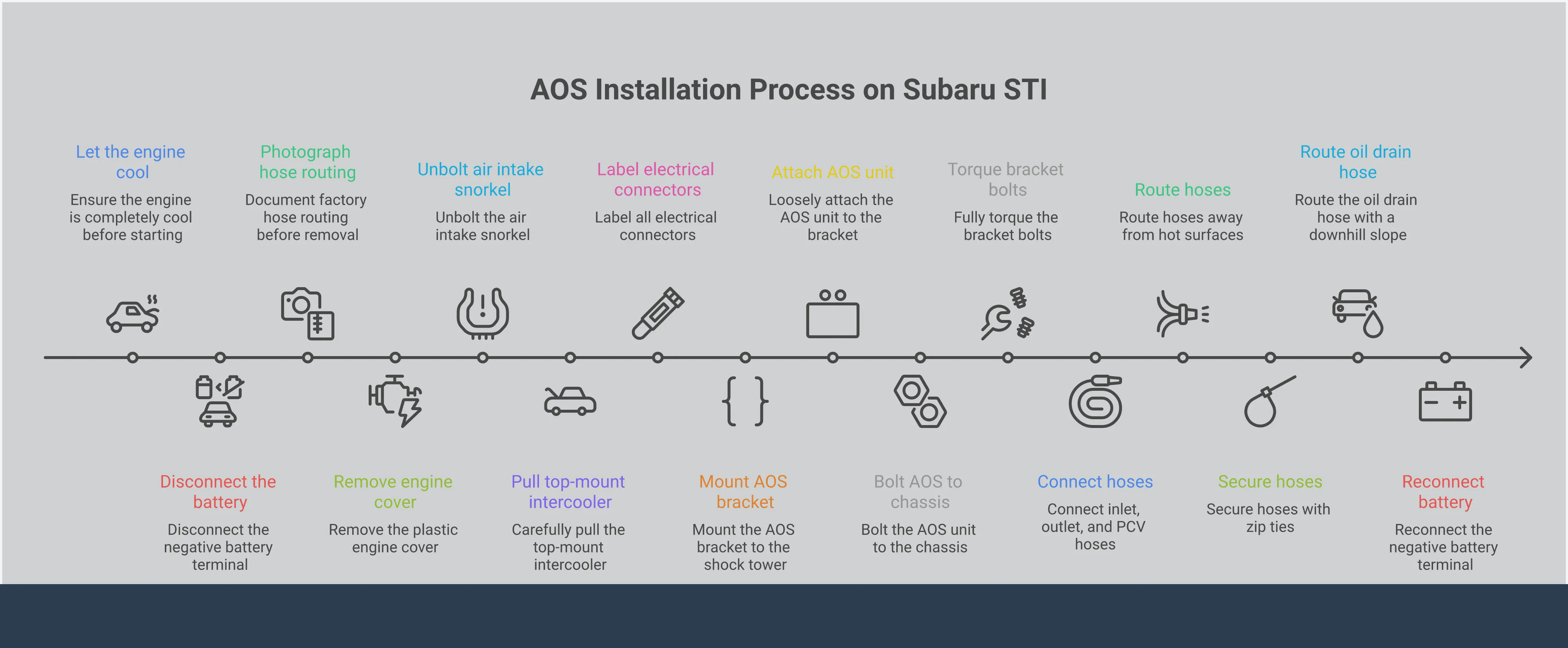
First things first, let’s set ourselves up for a smooth and safe installation. Before you touch a single bolt, make sure your engine is completely cool to avoid any nasty burns. Next, grab a 10mm wrench and disconnect the negative terminal on your battery. This is a non-negotiable step that protects both you and your car’s sensitive electronics. Finally, take out your phone and snap a bunch of pictures of your engine bay from different angles. Pay close attention to how the factory hoses are routed. A little bit of painter's tape and a marker to label hoses before you remove them will be your best friend during reassembly.
Pro Tips Before You Begin
Before you dive into your Air/Oil Separator installation, a few key tips can make the difference between a frustrating afternoon and a smooth, successful project. Taking a moment to prepare will help you work confidently and ensure your AOS performs flawlessly from day one.
- Give Yourself Time. This isn't a 30-minute job. Set aside several hours or a full afternoon, especially if it's your first time doing an install like this. Rushing leads to mistakes, so be patient and enjoy the process of working on your car.
- Prioritize Safety. Always make sure the engine is completely cool before you start, and disconnect the negative battery cable. This is a non-negotiable step that protects you from burns and your car’s sensitive electronics from accidental shorts.
- Document the Process. Grab your phone and take plenty of "before" photos of your engine bay. Pay close attention to the original routing of hoses and wiring. These pictures will be an invaluable guide during reassembly.
- Clean the Threads. Here’s a simple trick: before mounting the AOS bracket, screw a bolt into the mounting holes by hand. This cleans out any paint or dirt from the threads, making it much easier to secure the bolts later.
- Perform a Final Leak Check. After you’ve reassembled everything and start the engine for the first time, carefully check all your new connections for any fluid leaks. This final check is critical to confirm your AOS is functioning properly and protecting your engine, which is the primary goal of all performance parts.
Following these tips will set you up for a clean installation that enhances your STI's reliability and performance for years to come.
Step 1: Remove the Intercooler and Engine Covers
Now it’s time to create some working space. To get to the areas where the AOS will connect, you need to clear a path. Start by removing the plastic engine cover, which usually just pops off. Next, unbolt and remove the factory air intake snorkel that feeds air to your airbox. The biggest piece to come off is the top-mount intercooler. Carefully disconnect the hoses and any sensors attached to it, labeling the electrical connectors so you remember where they go. Once the intercooler is out of the way, you’ll have a much clearer view of the engine and the mounting points for your new AOS. This is a common starting point for many Subaru STI upgrades.
Step 2: Mount the AOS Unit and Bracket
With the engine bay opened up, you can now find the perfect home for your AOS. Begin by attaching the supplied mounting bracket to the AOS unit itself, but don’t tighten the bolts all the way just yet. Most kits are designed to mount on the passenger-side shock tower, which is a sturdy and convenient location. Position the bracket and AOS unit in place and securely bolt it to the car’s chassis. Once the unit is fixed to the car, you can go back and fully tighten the bolts connecting the AOS to its bracket. Make sure everything is solid and doesn’t wiggle; this part will be subject to engine vibration.
Step 3: Route and Connect the AOS Hoses
This is where your AOS gets plumbed into the system. You’ll be connecting several hoses between the AOS and key points on your engine. Following your kit’s specific diagram, connect the new hoses to the crankcase vents, the PCV valve, and the turbo inlet port. The most important part of this step is hose routing. Carefully guide the hoses away from anything that gets extremely hot (like the turbocharger and downpipe) or anything that moves (like the accessory belts). Use the provided zip ties to secure the hoses neatly and prevent them from rubbing against sharp edges. This ensures your new performance parts last for the long haul.
Step 4: Install and Secure the Drain Line
Pay close attention here, because this step is absolutely critical to the function of your AOS. The drain hose, which runs from the bottom of the AOS unit back to the engine’s oil pan, must have a constant, uninterrupted downhill slope. If the hose has any uphill sections or kinks, oil and condensation will get trapped instead of draining back into the engine. This will quickly fill the AOS and render it useless, defeating the entire purpose of the install. Double-check and then triple-check your drain line routing. It must always flow downward from the AOS to the engine connection point. No exceptions.
Step 5: Reassemble and Double-Check Your Work
You’re in the home stretch. Before you start putting the larger components back in, do one final, thorough check of all your work. Make sure every hose clamp is tight and secure. Confirm that all hoses are routed safely away from heat sources and moving parts. Once you’re confident in your connections, you can begin reassembly. Carefully reinstall the top-mount intercooler, making sure to reconnect its hoses and any sensors you unplugged. After that, put the air intake snorkel and the plastic engine cover back in place. Your engine bay should start to look like its old self again, just with a new piece of hardware.
Step 6: The First Start: Checking for Leaks
It's the moment of truth. Reconnect your battery’s negative terminal, get in the car, and start the engine. Let it idle for a few minutes while you stay close and watch for any immediate issues. Grab a flashlight and carefully inspect all the new hose connections for any signs of oil or coolant drips, moisture, or seeping. If everything looks dry, the final task is to bleed the coolant lines you connected to the AOS. With the engine cool but running, locate the small bleeder screw on the AOS unit. Slowly loosen it with a 1/8" Allen wrench until you see a steady stream of coolant without any air bubbles. Hand-tighten the screw, and you’re done. A proper install sets the stage for reliable performance, but consider professional engine tuning services to fully optimize your setup.
Monitoring Coolant Temperature
With the engine running, your job isn't quite done. Keep a close eye on your car's temperature gauge on the dashboard. You’re looking for normal behavior: the needle should rise steadily to its usual operating position and then hold firm. If you see the needle climbing into the red or jumping around erratically, shut the engine off immediately. This is a clear sign that there’s likely an air bubble still trapped in the system or a leak at one of your new connections. Since the AOS relies on engine coolant to function correctly, verifying the cooling system is stable is a crucial final check for the health of all your performance parts.
Topping Off Coolant After Bleeding
After you’ve run the engine and bled the system, let it cool down completely. Once it’s cool to the touch, you can perform the final step. As air was purged from the system, coolant filled the new hoses running to your AOS, so the level in your overflow tank has probably dropped. Safely remove the coolant reservoir cap and top it off to the “Full” line using the correct type of Subaru coolant. It’s always a good idea to check the level again after your first proper drive. This simple step ensures your cooling system is completely full and ready to protect your engine, whether you're on the street, track, or exploring new trails with your overlanding setup.
Avoid These Common Subaru AOS Installation Mistakes
Installing an Air/Oil Separator is a rewarding project, but a few common slip-ups can prevent it from working correctly. Getting the details right is key to protecting your engine and ensuring all your Subaru STI upgrades perform as they should. Think of this as your checklist for what not to do. By steering clear of these simple errors, you can ensure a smooth installation and get back to enjoying a cleaner, more reliable engine. Let’s walk through the most frequent mistakes so you can avoid them from the start.
Mistake: Incorrect Hose Routing
Where you run the hoses is just as important as connecting them. The engine bay is a busy place with hot surfaces and moving components. You must route new hoses under or behind other parts, keeping them away from hot areas and moving parts like cooling fans. A hose resting against the turbo or exhaust manifold will melt, creating a messy oil leak or a performance-killing vacuum leak. Likewise, a hose that gets caught in a belt or fan will be destroyed in an instant. Take a few extra minutes to visualize a safe path for each hose before securing it with zip ties.
Mistake: Running the Drain Line Uphill
This is a simple mistake that completely defeats the purpose of the AOS. The oil drain hose must always have a consistent downhill slope from the AOS unit to the engine. Think of it like a drain pipe in your house; if it goes uphill at any point, water won't flow. The same principle applies here. If the hose has a dip or an uphill section, the separated oil can't drain back into the crankcase. It will pool in the hose and back up into the AOS canister, eventually filling it and allowing oil to be sucked back into your intake.
Mistake: Installing the PCV Valve Backwards
The PCV system relies on a one-way valve to control crankcase pressure, and installing it backward will cause serious issues. The valve included in your AOS kit has a specific flow direction. Typically, the longer side connects to the engine's intake manifold, while the shorter side connects to the AOS. If you install it backward, you effectively block the flow of gases. This causes crankcase pressure to build up, which can force oil past seals and gaskets, leading to frustrating leaks. Always double-check the valve's orientation before you connect the hoses.
Mistake: Forgetting Gaskets or Skipping Leak Checks
In the rush to finish an installation, it’s easy to forget small parts like gaskets. When you remove components like the intercooler or throttle body, be careful to reuse the factory gaskets. They are essential for creating an airtight seal, and a missing or damaged gasket will result in a vacuum leak, causing a rough idle and poor engine performance. Once everything is reassembled, the final step is a thorough inspection. With the engine running, use a flashlight to inspect all your new connections for any drips or moisture. This final check ensures your system is sealed and ready for all other performance parts to function correctly.
Do I Need a Tune After an AOS Installation?
This is one of the most common questions we get, and the answer is refreshingly simple: no, you do not need a tune after installing an Air/Oil Separator on your STI. An AOS is one of the few engine modifications you can perform that works seamlessly with your factory ECU settings, making it a straightforward upgrade for any owner.
Here’s why a tune isn't necessary. The AOS is a closed-loop system that improves the quality of your crankcase ventilation. It intercepts oily vapor, separates the contaminants, and returns clean air to the intake and oil back to the pan. It doesn't alter the amount of metered air entering your engine or change the critical air-to-fuel ratio. Your ECU continues to operate as intended, just with a much cleaner air supply that helps prevent detonation and maintain performance.
This is a key difference from other performance parts like larger injectors or a free-flowing downpipe, which directly change your engine's operating parameters. Those upgrades require professional engine tuning services to recalibrate the ECU for safety and power. An AOS, on the other hand, is a pure reliability mod that enhances your engine's health without needing any software adjustments.
How to Maintain Your AOS for Long-Term Performance
Installing an Air/Oil Separator is a huge step toward protecting your engine, but it’s not a "set it and forget it" part. Like any critical component on your STI, your AOS needs regular attention to do its job correctly. A few minutes of preventative maintenance can save you from headaches down the road, ensuring your engine continues to run strong and clean. Think of it as protecting your investment. A well-maintained AOS keeps your intake free of oil, supports a clean air-fuel mixture, and helps you get the most out of all your performance parts. This routine will keep your AOS working efficiently, so it can continue to defend your engine against oil contamination and potential damage.
Your Regular Inspection Checklist: Hoses and Clamps
Make it a habit to check your AOS hoses and clamps about once a month or every time you change your oil. It only takes a minute and is one of the easiest ways to prevent problems. Run your hand along each hose, feeling for any cracks, hard spots, or mushy sections that indicate wear. Give the clamps a quick check to make sure they are snug and secure. A loose clamp or a cracked hose can create a vacuum leak, which can cause rough idling, poor performance, and even trigger a check engine light. Catching these small issues early prevents them from turning into bigger, more expensive repairs.
When to Clean Your AOS: Daily vs. Track Use
How often you need to clean the AOS unit itself depends on how you drive. For a daily driven STI, a thorough cleaning once a year is generally sufficient to clear out any accumulated gunk. However, if you frequently track your car or live in a very cold climate, you’ll want to clean it more often. Intense driving conditions and cold weather can cause more oil and water vapor to condense inside the unit, leading to faster buildup. A clean AOS operates more efficiently, ensuring it separates oil from air effectively and keeps your Subaru STI upgrades performing at their peak.
The Annual Deep Clean: Flushing with Degreaser
Once a year, it’s time to give your AOS a proper deep clean. This isn't just a quick wipe-down; it involves removing the unit from your engine bay and flushing out all the gunk that has built up over the last 12 months. A quality engine degreaser is your best tool for this job. Simply follow the degreaser’s instructions to spray it through the unit, breaking down any oily sludge and residue that has accumulated inside the baffles. This process ensures the AOS can continue to separate oil from air efficiently. A clean AOS is essential for keeping your intake system free of oil, which allows your engine to breathe clean air and helps all your other performance parts perform at their absolute best. It’s a simple but vital task for long-term engine health.
Warning Signs That Your AOS Needs Service
Your car will often tell you when something is wrong; you just have to listen. Pay close attention to how your engine feels and sounds. If you notice a rough idle, hesitation when you accelerate, or any new whistling or sucking noises coming from the engine bay, it could be a sign of a vacuum leak related to your AOS. These symptoms suggest that a hose might be disconnected, cracked, or that the unit itself is clogged. Addressing these warning signs immediately helps maintain engine stability and prevents further complications with your air intake system.
The Role of High-Quality Oil
Think of high-quality oil as the perfect teammate for your AOS. A separator can only do so much with the oil vapor it's given, and using a superior full synthetic oil makes its job significantly easier. Your STI’s turbocharged engine puts oil under intense heat and pressure, and lower-quality oils break down and form sludge. A premium synthetic, however, is engineered to resist this thermal breakdown, meaning the vapor entering your AOS is cleaner to begin with. This helps your AOS work at peak efficiency while the oil's detergents actively fight sludge buildup on critical components. It’s a simple step that supports all your other performance parts by creating a healthier, more reliable engine environment.
When Is It Time to Call a Professional?
While many AOS maintenance tasks are straightforward, some issues require a professional touch. If you’ve inspected your hoses, cleaned the unit, and are still experiencing problems like a persistent check engine light, unusually high oil consumption, or engine misfires, it’s time to consult an expert. These could be signs of a more complex issue that goes beyond simple maintenance. Don't hesitate to reach out for professional engine tuning services or diagnostics. A trained technician can accurately identify the root cause and ensure your STI gets back to running flawlessly and safely.
How to Choose the Best AOS for Your Subaru STI
Choosing the right Air/Oil Separator for your Subaru STI is a critical step in protecting your engine's performance and longevity. An AOS prevents oil vapor from entering your intake system, a problem that can lead to a coated intercooler, reduced fuel octane, and potentially damaging engine knock. While any AOS is better than none, selecting one that matches your driving style ensures you get the best protection.
Your decision should start with how you use your STI. For daily drivers and spirited street use, a unit like the Crawford V3 AOS is the ideal solution. It's engineered to operate efficiently for the 2008–2021 STI while retaining all factory emissions components, making it a compliant and effective upgrade. If you have an older model or your STI is built for the track, you need a system designed for more extreme conditions. The Crawford V2 AOS is purpose-built for racing, offering maximum oil separation during high-G cornering and sustained RPMs, though it may require removing some emissions parts for installation.
One of the best parts about installing a quality AOS is that it's a direct bolt-on modification. It works with your car's factory computer settings, so you won't need to schedule any immediate engine tuning services to get back on the road. It's a foundational upgrade that not only protects your engine but also supports all your other Subaru STI upgrades by ensuring a clean, consistent air-fuel mixture.
Related Articles
- 4 Best WRX STI Air Oil Separator Kits Reviewed
- Subaru Air Oil Separator: The Ultimate Guide
- Subaru 2.0 Air Oil Separator: The Ultimate Guide
- 2015-2021 Subaru STI Air Oil Separator V2 Performance
- 2008-2014 Subaru STI Air Oil Separator V2 Crawford Performance
Frequently Asked Questions
Is an AOS really necessary if my STI is completely stock? Yes, absolutely. While modified engines create more crankcase pressure, even a factory-stock STI benefits from an AOS. The stock ventilation system is adequate for average driving, but it still allows oil vapor into your intake. Over time, this builds up, reducing your engine's efficiency and increasing the risk of detonation. Installing an AOS is a proactive step to protect your engine's health from day one, keeping it running as cleanly and reliably as possible for years to come.
What is the difference between an Air/Oil Separator and a catch can? This is a great question that comes up often. The key difference is convenience and function. A catch can is a simple reservoir that collects oil blow-by, which you must manually drain at regular intervals. An Air/Oil Separator is a more complete, active system. It not only separates the oil from the air but also uses a drain line to automatically return the clean oil to the engine pan. This creates a maintenance-free, closed-loop system that you don't have to worry about emptying.
Will installing an AOS void my car's warranty? A manufacturer cannot legally void your entire vehicle warranty simply because you installed an aftermarket part. For a warranty claim to be denied, the dealership must prove that the specific part you installed directly caused the failure. A high-quality, properly installed AOS is designed to protect your engine from common failure points, not cause them. It is a widely accepted and respected reliability modification within the Subaru community.
I live in a very cold climate. Are there special considerations for an AOS? Yes, and this is a critical point for owners in colder regions. In freezing temperatures, condensation can mix with oil vapor and form a thick sludge, which can freeze and block the system. This is why our AOS units are designed with integrated coolant lines. These lines circulate hot engine coolant through the AOS, keeping it warm enough to prevent freezing and ensuring the separated oil and moisture drain properly, no matter how cold it gets outside.
Can I really install an AOS myself, or should I take it to a professional? You can definitely install it yourself. The process is designed to be manageable for anyone with a decent set of tools and the patience to follow instructions. The most important parts are taking your time, keeping your work organized, and double-checking all your connections, especially the drain line. However, if you are not comfortable removing parts like your intercooler or simply prefer to have an expert handle it, any reputable performance shop can complete the installation for you.