


The Ultimate Guide to STI Autocross Upgrades
In autocross, raw power doesn't guarantee a fast time. True speed comes from a car that can brake late, turn sharply, and accelerate out with total control. While the STI is an incredible platform, getting the most from it on a tight course means focusing on grip and handling first. This guide is about that balance. We'll walk through the essential STI autocross upgrades, from the tires that connect you to the track to the suspension that keeps you planted, creating a car that responds precisely to your every command.
Key Takeaways
- Prioritize handling before adding power: Start with foundational upgrades like tires, suspension, and brakes. A car that handles predictably and grips the road is faster and safer than a powerful car that is difficult to control.
- Tune for usable power and quick response: For autocross, focus engine mods on creating a smooth, responsive powerband. A professional ECU tune paired with intake and exhaust upgrades is more valuable than chasing a high peak horsepower number.
- Combine upgrades with practice and maintenance: The best parts require a skilled driver and a well-maintained car. Invest time in improving your driving technique and follow a strict maintenance schedule to ensure your STI performs reliably on race day.
Before You Modify: Understanding Autocross Philosophy
Before you start ordering parts and turning wrenches, it’s helpful to understand the culture of autocross. It’s a sport with two distinct paths: competing to win within a specific class and participating for the sheer fun and learning experience. Your approach will directly influence your modification strategy. Deciding which path you want to take early on will save you time, money, and potential frustration. Both are valid ways to enjoy your STI, but they require different mindsets when it comes to upgrading your vehicle for the cones. This initial decision is the foundation of your entire autocross build and journey.
Know Your Class: How Upgrades Affect Competition
In the world of competitive autocross, every performance part matters. Any modification you make to your STI, from stickier tires to a new exhaust system, can change the car's official classification. If you're just starting out to have fun, this might not be a major concern. However, if you plan to compete seriously, you need to be strategic. Adding certain STI upgrades could bump you into a much faster class, pitting your daily driver against highly prepared race cars. This means you need to decide what’s more important: building the exact car you envision or building a car that is competitive within a specific set of rules.
Understanding SCCA Rules
If you decide that trophies are your goal, your next step is to become familiar with the rulebook. The Sports Car Club of America (SCCA) is the primary sanctioning body for autocross in the US, and its guidelines dictate everything. The rules clearly define each competition class and outline which modifications are permitted. Reading them before you buy parts is crucial for creating a build plan that aligns with your goals. This initial research helps you avoid costly errors, like installing a part that pushes you into a class you aren't prepared for, and ensures your efforts on the track are rewarding.
It's Not Just About Winning: Autocross for Fun and Learning
While competition is a huge part of autocross, it’s not the only reason to participate. For many enthusiasts, the real reward is the experience itself. Autocross offers a safe and legal environment to explore your car's limits and sharpen your driving skills. You’ll learn more about vehicle dynamics, braking thresholds, and car control in a single event than you could in years of driving on public roads. If you're new to performance driving, focus on this aspect. Enjoy the community, listen to advice from seasoned drivers, and concentrate on becoming smoother and more consistent with each run. The clock is a tool for measuring personal progress, not just for comparing yourself to others.
What Are the Best STI Autocross Upgrades?
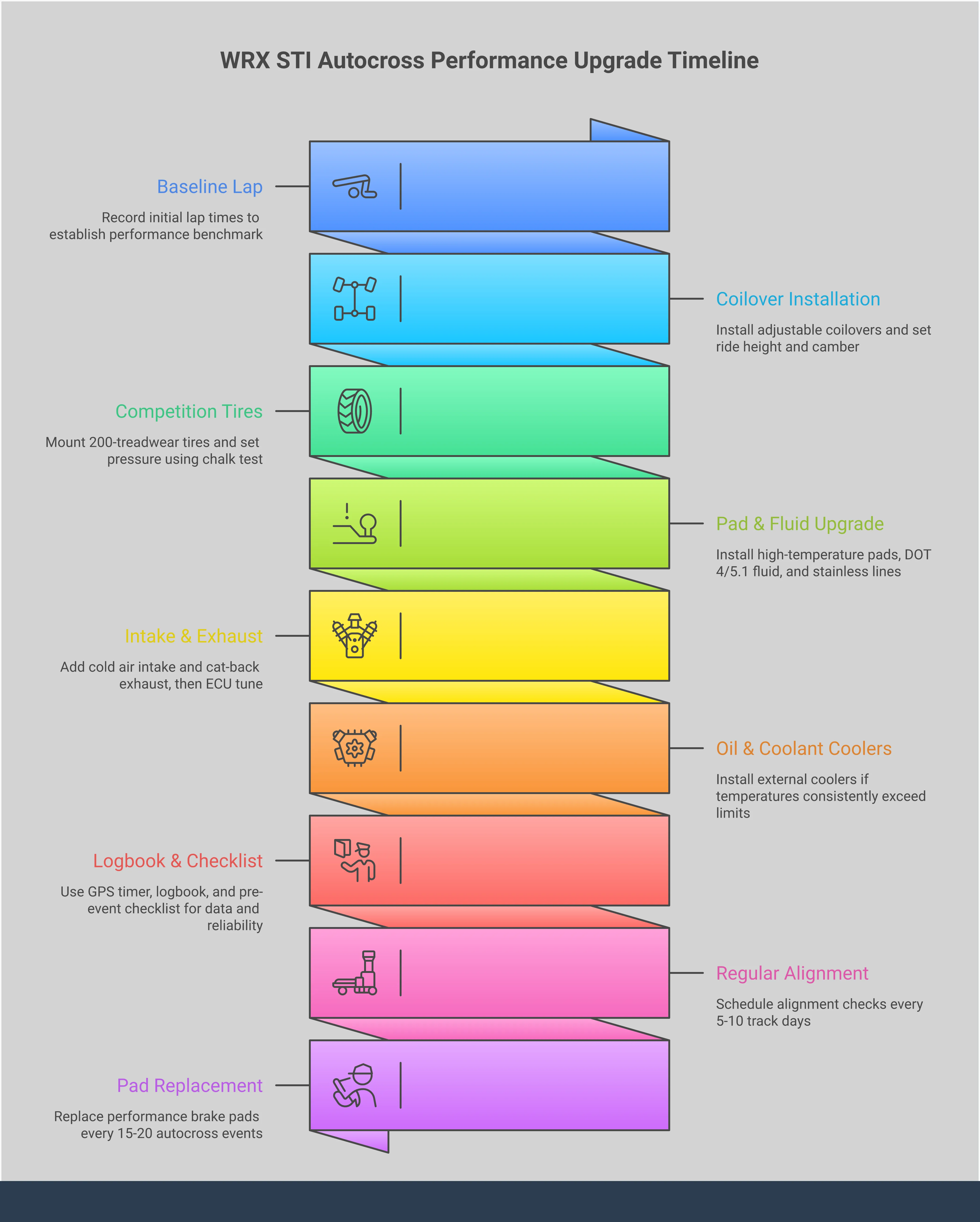
When you're ready to take your WRX STI from a daily driver to an autocross contender, a few strategic upgrades can make all the difference. It’s not about adding massive horsepower right away; it’s about creating a balanced, responsive machine that can carve through cones with precision. The best approach focuses on improving how your car connects to the pavement and responds to your inputs. We'll walk through the four key areas to upgrade for a competitive edge: suspension, tires, brakes, and engine performance.
Start with Suspension for Tighter Handling
Your first move should be the suspension. The stock setup is great for the street, but it’s too soft for the rapid, aggressive transitions of an autocross course. Upgrading components like coilovers, sway bars, and chassis bracing is the key to unlocking your STI's potential. These modifications reduce body roll, maximize the grip from your AWD system, and give you the sharp, predictable handling you need to attack the course with confidence. A well-sorted suspension allows you to carry more speed through corners and put the power down more effectively on exit. It’s the foundation of a truly competitive build, so this is where you should focus your initial efforts and budget. Explore our Subaru STI upgrades to find the right components for your car.
Find the Perfect Tire and Wheel Combo
If suspension is the foundation, tires are where the rubber literally meets the road. No other single upgrade will slash your lap times as dramatically as a set of high-performance tires. Ditch the all-seasons and invest in a quality set of 200-treadwear summer tires, which offer incredible grip in dry conditions. For serious competition, tires like the Bridgestone Potenza RE-71RS or Falken Azenis RT660 are popular choices. Pairing them with a lightweight wheel combination reduces unsprung mass, allowing your suspension to react faster and improving overall responsiveness. This is the most effective way to gain a competitive advantage, as even a stock STI can become a formidable opponent with the right performance parts and a sticky set of tires.
Build a Braking System You Can Trust
Autocross courses are short and intense, so you won't experience the same brake fade you would on a full race track. However, your brakes are still critical for control and shaving off tenths of a second. The goal is to have a system that is responsive, consistent, and gives you confidence. Start by upgrading to performance brake pads that offer a stronger initial bite and can handle higher temperatures without losing effectiveness. For a firmer, more direct pedal feel, consider installing stainless steel brake lines. These simple Subaru WRX upgrades ensure your brakes respond exactly when you need them to, allowing you to brake later and maintain precise control as you set up for each corner.
Add Power Where It Counts
Once your handling and grip are dialed in, you can turn your attention to the engine. In autocross, instant throttle response and a smooth, predictable powerband are more valuable than a massive peak horsepower number. A conservative ECU tune is one of the best ways to achieve this. A professional tune can optimize your engine’s performance, improve airflow, and make the turbo more responsive without pushing the limits of reliability. Supporting modifications like a high-flow air intake can also help the engine breathe better. The goal isn't to build a drag monster, but to refine the power delivery so you can exit corners with speed and control. Our expert engine tuning services can help you get the most out of your STI's boxer engine safely.
How Suspension Upgrades Transform Your STI's Handling
If you want to shave seconds off your lap times, start with your suspension. The stock setup on your WRX STI is designed for a balance of comfort and daily-driver performance, which means there’s a lot of room for improvement when you hit the autocross course. The goal of any suspension upgrade is to keep your tires planted firmly on the pavement, especially through tight, aggressive corners.
Upgrading key components reduces body roll, prevents the car from diving forward under braking, and minimizes squat during acceleration. This stability allows you to carry more speed through turns and get on the power sooner. A well-tuned suspension also gives you more direct feedback, helping you feel exactly what the car is doing and how much grip you have left. By swapping out soft, factory-spec parts for stiffer, more adjustable Subaru STI upgrades, you transform your car’s handling from compliant to competitive. It’s the most impactful change you can make to improve your STI’s potential on the track.
Coilovers vs. Stock: What's the Right Choice?
Your factory suspension consists of separate shocks and springs that are built to absorb bumps on public roads. They do their job well, but they’re too soft for the demands of autocross. Coilovers, on the other hand, combine the shock and spring into a single, adjustable unit. This integrated design provides a more direct and responsive feel. Upgrading to a quality set of coilovers allows you to lower your car’s center of gravity by adjusting the ride height, which immediately reduces body roll and improves stability. For many drivers, replacing worn-out OEM shocks with a performance coilover kit is the foundational step toward building a capable autocross machine.
Upgraded Struts and Performance Springs
If a full coilover system feels like too much of a leap, pairing upgraded struts with performance springs is an excellent alternative that delivers serious results. Performance springs are designed to be shorter and stiffer than your factory springs, which lowers your STI’s center of gravity. This change alone significantly reduces body roll during aggressive cornering and enhances stability. However, those stiffer springs need a strut that can keep up. Upgraded performance struts provide the necessary damping to control the spring's motion, preventing the car from feeling bouncy and ensuring the tires stay in contact with the pavement. By swapping your factory setup for these performance-oriented Subaru STI upgrades, you transform your car’s handling from compliant to competitive, giving you the precise control needed to attack any corner.
Why You Need Adjustable Damping
One of the biggest advantages of coilovers is adjustable damping. Damping controls how quickly your suspension compresses and rebounds after hitting a bump or entering a corner. With adjustable coilovers, you can fine-tune this setting to match the track conditions and your driving style. On a smooth, grippy surface, you can stiffen the damping for maximum responsiveness. If the course is bumpy, you can soften it to help the tires maintain contact with the pavement. This level of control allows you to dial in your car’s handling precisely, giving you a significant advantage over a fixed, non-adjustable stock setup. It’s how you get the car to feel like an extension of yourself.
Don't Forget Anti-Roll Bars
Anti-roll bars, often called sway bars, are another critical piece of the handling puzzle. These bars connect the suspension on opposite sides of the car, working to keep the chassis flat during cornering. The factory bars are relatively thin and allow for a fair amount of body roll to maintain ride comfort. By upgrading to stiffer, thicker anti-roll bars, you drastically reduce this roll, forcing the inside and outside tires to remain more evenly loaded. This keeps your tire contact patches flat on the ground, giving you more grip and making the car’s steering response feel much sharper. Combining upgraded anti-roll bars with coilovers is a powerful way to refine your car’s handling characteristics.
Supporting Mods: Upgraded End Links
When you upgrade to stiffer anti-roll bars, the factory end links become the weakest link in your suspension system. These small but crucial parts connect the anti-roll bar to the rest of the suspension, and the stock ones are often made of plastic or thin metal with soft rubber bushings. They simply aren't designed to handle the increased forces from a performance anti-roll bar. Upgrading to sturdy, adjustable performance end links ensures that every bit of force is transferred correctly, allowing your new anti-roll bars to function at their full potential. This simple change prevents flex and ensures your suspension responds as a cohesive unit, giving you the sharp, direct feedback you need to feel confident pushing the limits on the course.
Dialing In Your Alignment for Maximum Grip
Once you have adjustable suspension components installed, you can perfect your alignment for autocross. Camber is the vertical angle of your wheels. For daily driving, it’s set near zero, but for autocross, you want negative camber. This means the top of the tire tilts inward toward the car. During a hard turn, the car’s body rolls, and negative camber allows the outside tire to flatten out and maintain its full contact patch on the pavement for maximum grip. A good starting point is often around -2.5 degrees in the front and -1.8 in the rear, but you’ll need to test and adjust to find what works best for your specific setup and driving style.
Installing an Anti-Lift Kit (ALK)
When you accelerate hard out of a corner, you might notice the front end of your STI feeling light. This is "lift," and it reduces the grip your front tires have on the pavement right when you need it most. An Anti-Lift Kit (ALK) is a smart modification that adjusts your front suspension geometry to counteract this tendency. By keeping the nose of the car from rising under power, an ALK ensures your front tires stay firmly planted on the ground. This translates to better traction, more stable handling during hard cornering, and the ability to get back on the throttle earlier. It's a subtle but highly effective upgrade that refines how your car puts power down, making it a must-have among performance parts for any serious autocross build.
Using Adjustable Rear Control Arms
Perfecting your alignment is key, but you can't adjust what the factory hardware won't allow. This is where adjustable rear control arms become essential. The stock arms offer limited to no adjustment, making it difficult to achieve the aggressive negative camber settings needed for autocross. By swapping them out, you gain precise control over your rear suspension geometry. This allows you to dial in the exact camber and toe settings that maximize your tire's contact patch during cornering. More contact means more grip, improved stability, and a car that feels more predictable at the limit. For drivers looking to extract every bit of handling potential, these are non-negotiable Subaru STI upgrades.
Which Tires Offer the Best Autocross Grip?
Tires are your car's only connection to the pavement, making them the single most impactful upgrade for autocross performance. All the power from your engine and control from your suspension mean nothing if your tires can't translate those forces into grip. The right set of tires will dramatically shorten your lap times, improve cornering stability, and give you the confidence to push your STI to its limits. Before you even think about adding power or stiffening the chassis, investing in a proper tire and wheel setup provides the foundation for every other modification you make. It’s the difference between a car that feels sloppy and one that feels like it’s glued to the track.
Choosing the right tire involves more than just picking the stickiest option available. You need to consider your specific autocross class rules, as many have strict limitations on tire type and size. You also have to decide if these will be dedicated track wheels or if you'll be driving them on the street, which affects choices around wear life and wet-weather performance. Finally, how the tires pair with your wheel size is critical for optimizing the contact patch and sidewall stiffness. Getting this combination right is the key to unlocking your car's true handling potential on the course.
Your Starting Point: High-Performance Summer Tires
For most autocross competitors, especially those who also drive their STI daily, high-performance summer tires are the perfect starting point. These tires use soft rubber compounds and aggressive tread patterns designed for maximum grip in dry, warm conditions. Unlike all-season tires, they aren't compromised by trying to handle snow or ice. This focus allows them to deliver the sharp steering response and incredible traction you need to navigate a tight autocross course. Models like the Bridgestone Potenza series have long been favorites in the community for their ability to provide near-competition levels of grip while remaining street-legal and predictable. When you're ready to get serious about handling, a set of dedicated summer tires is one of the best performance parts you can buy.
Ready for More? Try Competition Compounds
When you're ready to chase every last tenth of a second, it's time to look at tires with a 200 treadwear rating. This number indicates the tire's wear rate; a lower number generally means a softer, stickier compound that wears out faster. The 200tw category is the sweet spot for many competitive autocross classes, offering phenomenal grip that's a significant step up from standard summer tires. While dedicated racing slicks offer more grip, they often aren't street-legal and perform poorly in wet conditions. A top-tier 200tw tire gives you the competitive edge you need on race day without forcing you to trailer your car to every event, striking an ideal balance between ultimate performance and real-world usability.
Popular Tire Choices for Every Budget
When you step into the world of 200tw tires, you'll find excellent options across various price points. For those chasing podium finishes, the Bridgestone Potenza RE-71RS is often considered the benchmark, known for its incredible grip and immediate response right out of the box. The Falken Azenis RT660 is another top contender, offering similar levels of performance and often favored for its durability over a race weekend. If you're looking for a more budget-conscious entry into this category without sacrificing much performance, tires like the Yokohama Advan Neova AD09 provide fantastic grip for the cost. Remember, any of these choices will transform your car's handling. Pairing them with the right suspension is key to building a competitive car, and these tires are a crucial component of our recommended Subaru STI upgrades.
How Wheel Size and Weight Affect Performance
Your wheels play a critical role in how your tires perform. A lighter wheel reduces unsprung mass, allowing your suspension to react more quickly to changes in the road surface and improving overall handling. Wheel width is also crucial. A wider wheel provides better support for the tire's sidewall, which prevents it from flexing excessively during hard cornering and helps maintain a consistent contact patch. For STIs with 17-inch factory wheels, a 225/45R17 tire is often a great fit, offering a solid balance of grip and responsiveness. When selecting your setup, always check your class rules to ensure your chosen wheel and tire combination is compliant. Matching the right tires with the right wheels is a key part of your overall Subaru STI upgrades strategy.
Finding the Perfect Tire Pressure
One of the most effective and affordable ways to fine-tune your car's handling is by adjusting tire pressure. The right pressure ensures your tire's contact patch is flat against the pavement, maximizing grip. Too little pressure causes the sidewalls to roll over in corners, leading to a vague steering feel and accelerated shoulder wear. Too much pressure can cause the center of the tread to bulge, reducing the contact patch and making the car feel skittish. A great way to find the right pressure is to draw a chalk line from the tread onto the sidewall. After a run, check the chalk mark. If it's completely worn off the sidewall, you need more air. If it's barely touched, you may have too much. Experiment in small increments to find what works best for your car and driving style.
What Brake Upgrades Does Your STI Need for Autocross?
Your WRX STI has impressive Brembo brakes from the factory, but the intense, repetitive braking of an autocross course generates extreme heat. This heat is the biggest enemy of consistent stopping power. To maintain a firm pedal and reliable braking from your first run to your last, you need to address the key components of your braking system. Upgrading your pads, fluid, and cooling will give you the confidence to brake later and harder, which is essential for shaving seconds off your lap times. These three areas work together to create a system that can handle the demands of competitive driving.
Choosing the Right Performance Brake Pads
This is your first and most critical braking upgrade. Stock brake pads are designed for street driving, prioritizing low noise and dust over high-temperature performance. In autocross, they will quickly overheat and experience "brake fade," where the pedal feels firm but the car doesn't slow down effectively. Performance brake pads use compounds formulated to work consistently at much higher temperatures. This gives you a stronger initial bite and predictable stopping power lap after lap. For the best results, explore a range of Subaru STI upgrades like stainless steel brake lines to improve pedal feel and ensure all your braking force gets to the calipers.
Why Upgraded Brake Fluid is Non-Negotiable
Brake fluid is hygroscopic, meaning it absorbs moisture from the air over time. This moisture lowers the fluid's boiling point. During heavy braking, your brake fluid can boil, creating air bubbles in the lines. Since air is compressible, this results in a spongy, ineffective brake pedal, a dangerous condition known as vapor lock. Upgrading to a high-temperature fluid with a higher boiling point is essential for any track-driven car. Make sure to completely flush the old fluid from the system and bleed the brakes properly. This isn't a one-time fix; you should plan to replace your brake fluid more frequently than you would on a street-only vehicle.
How to Keep Your Brakes from Fading
Even with the right pads and fluid, managing heat is the key to brake longevity and performance. Your brakes work by converting kinetic energy into thermal energy (heat), and you need a way to get rid of that heat quickly. The factory dust shields behind your rotors can trap heat, and while removing them helps, a dedicated cooling solution is far more effective. Brake cooling kits use ducts to channel high-pressure air from the front bumper directly onto the brake rotors and calipers. This constant airflow dramatically lowers operating temperatures, preventing fade and extending the life of your performance parts during intense autocross sessions.
Which Engine Mods Make a Real Difference in Autocross?
While suspension and tires are the foundation of a great autocross setup, smart engine modifications can give you a serious competitive edge. In autocross, it’s not about chasing massive horsepower numbers. Instead, the goal is to improve throttle response, create a wider and more usable powerband, and ensure your engine can handle the demands of quick, repetitive acceleration. The best approach is to think of your engine as a complete system where air comes in, is used for combustion, and then exits. Improving the efficiency of this process is key.
The most effective engine mods for autocross focus on helping your engine breathe better and use fuel more efficiently. A well-chosen cold air intake, a high-flow exhaust system, and a professional ECU tune work together to deliver sharper response and more accessible power right when you need it. These upgrades won't just make your STI faster on the straights; they'll make it more responsive and predictable as you power out of tight corners. When done correctly, these modifications provide a noticeable improvement in performance without compromising the reliability you need to drive home after the event.
Protect Your Engine with an Air/Oil Separator (AOS)
When you push your STI hard in autocross, the high G-forces and RPMs can cause oil blow-by, where oil vapor from the crankcase gets sucked into your intake. This contaminates your air-fuel mixture, lowers its octane rating, and increases the risk of detonation—a major threat to your engine's health. An Air/Oil Separator (AOS) is the definitive solution to this problem. Think of it less as a power mod and more as essential engine insurance that protects the investment you've made in your car by preventing long-term damage.
An AOS intercepts those oil-laden vapors, separates the oil out, and returns it to the engine, ensuring only clean air enters your intake manifold. This is especially critical for modified builds, as it keeps your intake, valves, and intercooler free from performance-robbing sludge. By installing an AOS, you preserve the power and reliability you've gained from your other Subaru STI upgrades. It’s a proactive measure that lets you focus on hitting your apexes instead of worrying about engine health.
Does a Cold Air Intake Really Help?
One of the first engine upgrades many STI owners consider is a cold air intake, and for good reason. The factory intake system is designed for quiet, everyday driving, but it can be restrictive when you’re pushing your car to its limits. A performance cold air intake allows your engine to draw in cooler, denser air more efficiently. This improved airflow leads to better throttle response and a welcome increase in horsepower. In an autocross environment, where you're constantly on and off the throttle, that quicker response can make a real difference. It helps the engine breathe more freely, especially at the high RPMs you’ll hit between cones.
What to Look for in an Exhaust Upgrade
After you’ve improved how air gets into your engine, the next logical step is to improve how it gets out. A high-performance cat-back exhaust system replaces the more restrictive factory components, reducing backpressure and allowing exhaust gases to exit more freely. This directly translates to better engine response and quicker acceleration, which is exactly what you need on a tight autocross course. While the aggressive sound is a great bonus, the real benefit comes from the performance gains. By making it easier for the engine to exhale, you’re helping it work more efficiently, giving you more power to put down on the pavement. You can find a variety of Subaru STI upgrades that fit your specific model year.
Beyond the Cat-Back: Headers and Down-Pipes
While a cat-back exhaust is a solid starting point, the real gains in exhaust efficiency come from upgrading the components closer to the engine. The factory exhaust manifold and down-pipe are significant bottlenecks. Performance headers replace the restrictive manifold, allowing exhaust gases to exit the cylinders more freely and improving throttle response for faster acceleration out of corners. A high-flow down-pipe then reduces backpressure right after the turbo, which helps it spool up quicker for more immediate power delivery. When you combine these performance parts with a cold air intake and a professional ECU tune, you create a synergistic effect that maximizes your engine's efficiency and responsiveness on the course.
Get an ECU Tune for Sharper Throttle Response
A cold air intake and exhaust system are great starting points, but an ECU tune is what ties them all together and maximizes their potential. An ECU tune recalibrates your car's computer, adjusting critical parameters like fuel delivery, ignition timing, and boost pressure. This process optimizes your engine’s performance to take full advantage of your new hardware. For autocross, a professional tune ensures you get smooth, predictable power delivery across the entire RPM range. This is essential for maintaining control and shaving seconds off your time. Without a tune, you’re leaving performance on the table and could even risk running the engine unsafely. Professional engine tuning services are the best way to ensure your STI performs at its peak.
Improve Driver Feel with Drivetrain Upgrades
A fast car is one you can control with confidence. Beyond raw power and grip, the physical connection you have with your STI plays a huge role in your performance. Drivetrain upgrades are all about refining this connection, making the car feel like a direct extension of your inputs. When you can shift gears with speed and precision, and feel the power being transferred to the wheels without hesitation, you can focus on your line and your timing. These modifications bridge the gap between you and the machine, tightening up any slack in the system and providing the crisp, immediate feedback you need to push the limits on an autocross course.
Short-Throw Shifters and Transmission Mounts
Upgrading to a short-throw shifter is one of the most satisfying changes you can make. It reduces the physical distance your hand travels to change gears, allowing for faster, more decisive shifts. In the fast-paced environment of autocross, those saved milliseconds add up. To complement this, a performance transmission mount is essential. The stock mount has soft rubber bushings that allow for significant drivetrain movement during hard acceleration and shifting. A stiffer mount locks everything in place, eliminating that slop and ensuring power is transferred directly to the wheels. Together, these Subaru STI upgrades create a mechanical, connected feel that gives you precise control over your car.
How to Prioritize Your STI Autocross Upgrades
Deciding where to start with your WRX STI upgrades can feel overwhelming, but a strategic approach will give you the best results on the track. Instead of chasing maximum horsepower right away, focus on creating a balanced and reliable car that you can drive consistently. A well-rounded setup will always be faster than a powerful car that’s difficult to control. Prioritizing your mods correctly ensures you spend your money where it counts and build a car that evolves with your driving skills. This method helps you build a competitive car step-by-step, making sure each new part complements the last.
First Things First: Foundational Upgrades
Before adding significant power, you need to ensure your car can handle it. The best approach is to start with foundational upgrades that improve reliability and handling. By learning your engine's limits and investing in the right supporting parts, you can build a car that is both powerful and dependable. Upgrading your fuel delivery, cooling, and oil systems is non-negotiable for protecting your engine and ensuring your power is safe and consistent. These performance parts create a solid platform, allowing you to add more aggressive modifications later without risking engine damage. A reliable car finishes races, and a car that finishes races is a car that can win.
How to Budget for Your Build
Autocross doesn't have to break the bank, but it does require a smart budget. Identify your goals and allocate your funds to the upgrades that offer the most significant impact on handling and driver feedback first. For example, a quality set of tires and brake pads will often shave more time off your laps than a minor power increase. It's also essential to consider the supporting components for each upgrade. Adding a larger turbo means you'll also need to account for fuel system improvements and professional engine tuning services to keep everything running safely. A well-planned budget helps you build a cohesive package instead of a collection of mismatched parts.
Setting Realistic Cost Expectations
Let's be real: building a competitive autocross car is an investment. It's easy to get caught up in chasing horsepower, but the fastest drivers know that true speed comes from control. A well-rounded setup is always faster than a powerful car that's hard to manage. This means your initial budget should be focused on the parts that have the biggest impact on handling: tires, suspension, and brakes. A quality set of these performance parts will shave more time off your laps than a minor power increase ever could. By setting realistic expectations and prioritizing foundational upgrades, you build a car that grows with your skills, ensuring your money is spent where it truly counts.
The Cycle: Test, Adjust, and Repeat
Autocross is more about driving skill than raw horsepower. The best way to get faster is to install an upgrade, then immediately get back on the track to test it. This iterative process allows you to feel how each change affects the car's balance and behavior. After installing new coilovers, for instance, you’ll need to experiment with different settings to find what works for your driving style and the specific track. This holistic approach, combining quality Subaru STI upgrades with seat time, helps you fine-tune your setup for smoother power delivery and sharper response. Each adjustment should be a deliberate step toward making the car an extension of you.
How Do You Know if Your Upgrades Are Working?
Installing new parts is exciting, but the real satisfaction comes from seeing measurable improvements. To truly understand the impact of your upgrades, you need to move beyond "seat-of-the-pants" feel and start tracking hard data. This is how you confirm that your investments are paying off and make informed decisions about what to modify next. By systematically tracking key metrics, you can fine-tune your setup for the best possible performance on the autocross course.
The most effective approach is to establish a baseline with your stock or current setup and then measure again after each modification. This isolates the effect of each new part, showing you exactly what it contributes to the car's overall performance. The most important metrics to watch are your lap times, handling characteristics, power and torque output, and engine temperatures. Each one tells a different part of the story, and together, they give you a complete picture of how your WRX STI is evolving.
It's All About Lap Times
In autocross, the clock is the ultimate judge. Your lap time is the single most important metric for gauging success, and every upgrade should be aimed at lowering it. The Subaru WRX STI is a formidable machine right out of the box, but the right Subaru WRX STI upgrades are designed to shave precious tenths, or even full seconds, off your runs.
To get reliable data, use a GPS-based lap timer app on your phone or a dedicated timing device. Record your times on a familiar course before making a change, then run the same course again after the upgrade. This before-and-after comparison provides clear evidence of whether a modification worked as intended. Consistency is key, so always try to test in similar weather conditions to ensure your data is as accurate as possible.
Feel the Difference in Handling
While lap times tell you the outcome, analyzing your car's handling tells you why you’re faster. How your STI responds to steering inputs, braking, and cornering forces is critical. After installing new suspension components, pay close attention to changes in understeer or oversteer. Does the car turn in more sharply? Is it more stable through slaloms and sweepers?
Keep a detailed logbook for each event. Note your alignment settings, tire pressures, and damper adjustments, along with your subjective feedback on how the car felt. This qualitative data is just as valuable as your lap times. It helps you understand the connection between a specific adjustment and the car's behavior, allowing you to dial in a setup that perfectly matches your driving style.
Tracking Your Power and Torque
In autocross, it’s not about peak horsepower; it’s about usable power. You need sharp throttle response and a strong mid-range to accelerate quickly out of tight corners. A holistic approach that combines quality performance parts with a professional tune is the best way to achieve a smooth, responsive powerband that you can actually use on course.
The most accurate way to measure gains is on a dynamometer, which provides precise horsepower and torque figures. A dyno chart will show you exactly where in the RPM range your upgrades have made a difference. Even without access to a dyno, you can feel the results. A proper engine tuning service will make your STI feel more eager and responsive, helping you put the power down more effectively between cones.
What a Professional Tune Can Achieve
A professional tune is what brings all your engine upgrades together, acting as the brain that tells your new hardware how to perform. This process involves a specialist recalibrating your car’s ECU to optimize critical parameters like fuel delivery, ignition timing, and boost pressure. The goal isn't just to chase a high horsepower number, but to create a smooth, predictable powerband that you can actually use on an autocross course. This refined power delivery gives you the sharp throttle response needed to accelerate out of tight corners with maximum control and confidence. Investing in professional engine tuning services ensures your engine runs safely and efficiently, maximizing the gains from your performance parts.
Keep a Close Eye on Your Temps
Pushing your STI to its limits generates a lot of heat, and managing it is essential for both performance and reliability. As you add power, your engine works harder, placing greater demand on your cooling systems. Overheating can lead to power loss, inconsistent performance during a run, and, in worst-case scenarios, catastrophic engine damage.
Pay close attention to your oil and coolant temperatures, especially during back-to-back runs on a hot day. While the factory gauges provide a basic reading, aftermarket gauges offer far more accuracy. If you notice temperatures creeping up consistently, it’s a clear sign that you may need to upgrade your radiator, add an external oil cooler, or improve airflow to the engine bay. Staying on top of your temps ensures your car performs consistently from your first run to your last.
Common STI Upgrade Mistakes (And How to Avoid Them)
It’s easy to get excited and dive headfirst into modifying your WRX STI, but a thoughtful approach will always yield better results. Building a competitive and reliable autocross car isn't just about bolting on parts; it's about making smart, strategic choices. Avoiding a few common mistakes can save you a lot of time, money, and frustration down the road. A well-planned build focuses on balance and synergy between components, ensuring your car performs predictably and safely. By learning from the missteps of others, you can create a build plan that enhances your car’s strengths without introducing new weaknesses, letting you focus on what really matters: driving.
Don't Go Too Far, Too Fast
One of the biggest temptations is to chase huge horsepower numbers right away. However, adding a ton of power without the experience to handle it or the knowledge to install parts correctly can be a recipe for disaster. Upgrading a Subaru WRX STI requires precise installation, and a poorly executed modification can quickly reduce your engine's reliability and lifespan. Instead of going for massive power gains immediately, start with foundational mods that improve handling and driver feedback. This allows you to learn your car's behavior at each stage and grow your skills alongside your car's capabilities.
Never Forget the "Driver Mod"
The most effective upgrade you can make is improving your own ability behind the wheel. Autocross is fundamentally a test of driving skill, not just a measure of horsepower. You could have the most powerful car on the course, but it won't mean much without the technique to put that power down effectively. Before investing thousands in engine mods, invest time in yourself. Attend autocross events, walk the course, talk to experienced drivers, and consider a performance driving school. Mastering braking points, cornering lines, and car control will shave more time off your laps than any single part you can buy.
Why the Order of Your Upgrades Matters
Performance parts don't work in isolation; they are part of a complex system. A common mistake is upgrading components in the wrong order, which can create imbalances and even damage your vehicle. For example, adding a larger turbo without upgrading your fuel system and intercooler will lead to poor performance and potential engine failure. It's essential to consider the supporting components for every modification. A logical path starts with tires, brakes, and suspension before moving to power. When you do add power, ensure you get professional engine tuning services to make sure every new part works together safely and efficiently.
Ignoring Potential Issues and Error Codes
When you start adding performance parts to your STI, your dashboard can become a lot more talkative. It's tempting to dismiss a new warning light as a quirk of your modified setup, but this is a risky habit. Autocross is tough on cars, and an error code is often the first sign that something needs attention before it becomes a major problem. The factory warning systems aren't always sensitive enough for a modified engine; for example, the stock oil light might only trigger during severe oil starvation, missing the rapid pressure drops that can still damage your engine over time. Staying proactive with regular diagnostic checks and following a strict maintenance schedule is the only way to ensure your upgrades are enhancing your car, not hurting it.
Maintenance Is Not an Option
Performance driving puts significantly more stress on your vehicle than a daily commute. As you upgrade your STI and push it harder on the course, a strict maintenance schedule becomes non-negotiable. Neglecting basic upkeep is a surefire way to end your race day early. Regularly check your fluid levels, inspect your brake pads and rotors, and check the torque on critical suspension and wheel components. Investing in high-quality Subaru STI upgrades from the start ensures greater durability, but even the best parts require consistent care to deliver reliable performance lap after lap.
A Practical Tip for Oil Starvation
When you're pushing your STI through tight corners, the high G-forces can cause oil to slosh away from the engine's oil pickup. This momentary loss of pressure, known as oil starvation, is a fast track to severe engine damage. A simple but effective trick to mitigate this risk is to keep your oil level slightly above the full mark—adding an extra 1/4 to 1/2 quart can provide a crucial buffer during aggressive driving. It's also critical to understand that the stock oil light is not a preventative tool; it usually only illuminates after pressure has dropped to a dangerously low level. For this reason, many serious drivers rely on aftermarket gauges to monitor oil pressure in real-time. Combining these habits with essential reliability mods, like an Air/Oil Separator, is the best way to protect your engine and focus on your lap times.
Ready to Go Further? Try These Advanced Mods
Once you’ve mastered the foundational upgrades and honed your driving skills, you might find yourself looking for that next competitive advantage. After dialing in your suspension, tires, and brakes, it's time to explore more advanced modifications that can shave precious tenths off your lap times. These upgrades require a deeper understanding of vehicle dynamics and often involve more significant investment and installation work. But for the serious competitor, they are the key to reaching the next level of performance. Let's look at three areas where you can gain a serious edge: aerodynamics, weight reduction, and drivetrain enhancements.
Getting Started with Aerodynamics
Aerodynamics aren't just for high-speed race tracks. In autocross, a well-designed aero package can dramatically improve grip and stability through fast sweepers and slaloms. Functional front splitters, canards, and rear wings generate downforce, pressing the car onto the pavement for better traction. This allows you to carry more speed through corners and feel more confident behind the wheel. It's crucial to choose components that are designed to work together as a system. A big rear wing without a front splitter can unbalance the car, so look for complete Subaru WRX STI upgrades that are proven to enhance performance without creating instability.
Smart Ways to Reduce Weight
One of the most effective ways to make your car faster is to make it lighter. Reducing your STI's overall weight improves every aspect of its performance: acceleration, braking, and cornering. You can start with simple changes like lightweight wheels and a smaller battery. For a more dedicated build, consider replacing the stock seats with lighter racing seats or removing non-essential interior trim. Swapping heavy factory components for lighter aftermarket performance parts made from materials like carbon fiber or aluminum can also make a big difference. Just be sure any changes are done carefully to maintain the car's structural integrity and safety.
Is It Time for a Differential Upgrade?
Your engine's power is useless if you can't transfer it to the ground effectively. Upgrading your front and rear differentials with limited-slip units (LSDs) is a game-changer for autocross. An LSD ensures that power is sent to the wheel with the most grip, preventing the inside wheel from spinning as you accelerate out of tight corners. This allows you to get on the throttle earlier and harder, launching your STI toward the next cone. This kind of drivetrain modification works best as part of a comprehensive plan, so it's wise to discuss it with a specialist during your next engine tuning session to ensure your entire setup works in harmony.
How to Keep Your Upgraded STI Race-Ready
Installing high-quality performance parts is just the first step. To get consistent, reliable results on the track, you need a solid maintenance routine. A well-maintained STI is not only faster but also safer and more predictable when you’re pushing it to the limit. Neglecting maintenance can lead to poor performance, unexpected failures, and costly repairs that keep you off the track. Think of maintenance as protecting your investment and ensuring your car is always ready to perform at its peak. By creating a simple, repeatable process, you can spend less time worrying about your car and more time focusing on your driving.
Your Pre-Race Inspection Routine
Making regular inspections a habit is the best way to catch small issues before they become major problems on race day. Before and after every autocross event, take the time to give your car a thorough once-over. Check all your fluid levels, including engine oil, coolant, and brake fluid. Examine your brake pads and rotors for wear, and inspect your tires for any unusual wear patterns that might indicate an alignment issue. It’s also a good idea to check your suspension components and make sure all bolts are tight. When you install new Subaru STI upgrades, remember to consider how they affect supporting components and ensure your tune is adjusted accordingly for everything to work together seamlessly.
How Long Will Your Performance Parts Last?
While well-installed modifications improve your STI’s power and handling, it’s important to remember that autocross puts a significant amount of stress on your vehicle. High-performance parts are designed to withstand this abuse, but they won’t last forever. Aggressive driving accelerates the wear and tear on components like tires, brake pads, and your clutch. Don't wait for a part to fail mid-race. Keep a log of when you install new performance parts and be realistic about their lifespan. Proactively replacing components based on their expected life cycle will give you peace of mind and prevent a DNF (Did Not Finish) from ruining your race day.
Use a Track Day Prep Checklist
A pre-race checklist is your best friend for ensuring nothing gets overlooked in the excitement of an event. Create a list of essential checks to run through the day before or the morning of your autocross event. This should include setting your tire pressures, torquing your lug nuts to spec, and doing one last check of all your fluid levels. Pack a small toolkit with essentials for quick adjustments at the track. This holistic approach to preparation, combining quality parts with professional engine tuning services, is what delivers smooth power and sharp throttle response when you need it most. A checklist removes the guesswork and lets you arrive at the starting line with confidence.
Related Articles
- The Ultimate Guide to WRX STI Performance: Top Upgrades to Maximize Power and Handling
- STI Engine Upgrades: A Stage 1-3 Power Guide
Frequently Asked Questions
If I can only afford one upgrade right now, what should it be? Without a doubt, you should invest in a set of high-performance summer tires. No other single modification will have a more dramatic impact on your lap times. Your car’s ability to accelerate, brake, and corner is entirely dependent on the grip your tires provide. Even with a completely stock car, a sticky set of 200-treadwear tires will transform its handling and give you a significant competitive advantage on the course.
Is an ECU tune really necessary after installing basic engine parts? Yes, absolutely. Think of an intake and exhaust as helping your engine breathe better; the ECU tune is what teaches it how to use that extra air. A professional tune adjusts fuel and timing maps to safely optimize performance, ensuring all your new components work together harmoniously. Skipping the tune not only leaves power on the table but can also create a lean air-fuel condition that puts your engine at risk.
Can I still use my STI as a daily driver with these autocross upgrades? You certainly can, but it’s all about finding the right balance for your personal comfort. Upgrades like coilovers and stiffer sway bars will make the ride firmer than the factory setup. Performance brake pads might be noisier on the street than stock pads. Many enthusiasts find these trade-offs perfectly acceptable for the improved performance, but it’s important to be realistic about how an aggressive setup will feel during your daily commute.
How do I know when it's time to start adding more power? You should focus on power after you feel you have completely mastered your car's handling. When you can consistently drive at the limit of your tires' grip and feel confident that your suspension and brakes are responding exactly as you want, that's the ideal time to add power. The goal is to have a car that can effectively use the extra horsepower, not one that is difficult to control.
My car has coilovers, but it still doesn't handle right. What should I check first? Before you blame the parts, look at your setup. The two most common culprits are tire pressure and alignment. Experiment with small adjustments to your tire pressures to see how it affects grip and steering feel. More importantly, get a performance alignment from a shop that understands track setups. The right amount of negative camber can completely change how your car turns in and holds a corner, allowing your coilovers to do their job effectively.