

Subaru WRX Cooling System Upgrades: Ultimate Track Guide
Subaru WRX heat management lives or dies by the radiator, oil cooler, thermostat, and the engine builder's ability to make every part work as a system. Crawford Performance understands this reality from building and supporting track-driven EJ and FA combinations. For track-driven Subarus running high-output Crawford Performance built blocks, managing engine heat is a non-negotiable requirement. Factory cooling hardware is engineered around stock output, normal road use, and a controlled thermal load. Raise boost, add sustained high-rpm pulls, increase ambient temperature, or spend laps behind the wheel, and coolant temperature and oil temperature can move beyond the range that preserves consistent power and component life.
A proper upgrade plan begins with the heat source, not a catalog shopping list. A higher-capacity radiator adds coolant volume and heat-rejection capability. An oil cooler controls the lubricant temperature that protects turbocharger bearings, rod bearings, and piston cooling under load. A correctly selected thermostat governs coolant flow so the system reaches operating temperature without becoming a restriction when demand rises. These components must be sized around the car's power level, intended use, ducting, fan control, and the condition of the rest of the cooling system.
Browse Crawford Performance cooling system components for your WRX build. This guide explains how to evaluate radiator capacity, oil-cooler strategy, and thermostat selection as one coordinated Subaru WRX cooling system upgrade rather than three disconnected parts.
Subaru WRX Cooling System Upgrades: Radiator Options
A Subaru WRX radiator upgrade replaces the factory plastic-tank assembly with a welded aluminum core built for sustained heat rejection and track-level thermal cycling. It is the first cooling-system hard part to evaluate when your car sees repeated boost, autocross, or road-course laps.
The factory package is engineered for cost, packaging, warm-up behavior, and normal-duty heat rejection, not endless high-load cycles. Subaru performance radiator upgrades replace the crimped plastic-tank architecture with welded aluminum tanks, a larger effective core, and mounting that better tolerates heat and vibration.
The Failure Modes of OEM Plastic End Tanks
OEM radiators typically pair an aluminum core with glass-filled plastic end tanks retained by a crimped gasket seam. Heat cycling, coolant pressure, and age work the tank-to-header seal and concentrate stress around the upper hose neck, transmission-cooler fittings where equipped, and crimp tabs. A small weep may only appear at operating temperature, then become a split tank or seam leak under boost-adjacent thermal load. EJ25 blocks use a pressurized cooling circuit, so a leak is not just lost coolant. It reduces the boiling margin precisely when cylinder-head temperature is rising.
All-aluminum tanks remove the plastic-to-metal crimp interface, but material alone is not a guarantee. Inspect the filler neck, hose-bead geometry, drain provision, fan-shroud fitment, and weld consistency before treating any radiator as a track component.
| Specification | OEM Subaru radiator | Standard aftermarket (Mishimoto/Koyo) | Crawford performance radiator |
|---|---|---|---|
| Core thickness | Thin single-row, model-specific | Typically thicker multi-row; verify chassis fitment | Application-specific high-capacity multi-row core |
| End-tank material | Plastic, crimped to aluminum core | Welded aluminum on all-aluminum models | Welded aluminum |
| Weld quality | No tank weld; mechanical crimp/gasket seam | Brand and production-run dependent | Continuous tank-to-header welds; inspect bead uniformity |
| Max pressure rating | Designed around OEM cap and duty cycle | Manufacturer-specific; retain the correct cap | System-cap limited; do not exceed the specified cap pressure |
| Track durability | Limited by aged plastic tanks and crimp seam | Suitable when fitment, shroud, and mounts are correct | Built for repeated thermal cycling and rigid OE-location fitment |
Core Geometry and Fin Density over Raw Volume
Core thickness is only one variable. Tube width, tube count, louvered-fin density, brazed contact area, and the pressure drop on both the air and coolant sides determine useful heat rejection. An excessively dense core can add frontal area while starving the rear of the core of airflow at low vehicle speed. Likewise, extra coolant volume delays temperature rise but does not automatically increase steady-state heat transfer. This matters because radiator fan and coolant-pump work are parasitic loads, and both air-side and coolant-side pressure losses impose a system penalty (ScienceDirect).
Structural Rigidity on the Track
Use the OE locating pins, rubber isolators, upper brackets, and a properly seated fan shroud. A thick core that contacts the fans, A/C condenser, or hood support will eventually fatigue a weld or tank. The radiator, condenser, ducting, fans, and grille are one front-end aerodynamic module. So a cooling upgrade must preserve the airflow path instead of creating bypass around the core (ScienceDirect). Pressure-test the completed system cold, confirm both fans cycle, and recheck clamps after the first full heat cycle.
Why Does Your Track-Driven WRX Require an External Oil Cooler?
An external oil cooler separates engine-oil heat from the coolant circuit, keeping oil temperature within a safe range during sustained boost and repeated high-rpm pulls. Without one, thinned oil film can compromise bearing protection and turbocharger lubrication on a track-driven Subaru WRX.
A track-driven WRX can put far more heat into its oil than the factory oil-to-coolant heat exchanger can reject. Sustained boost and repeated high-rpm pulls elevate oil temperature, thinning the lubricant that protects turbocharger bearings, rod journals, and camshaft surfaces. An external oil cooler is one of the most effective Subaru WRX cooling system upgrades for road-course, autocross, canyon, or high-output street use.
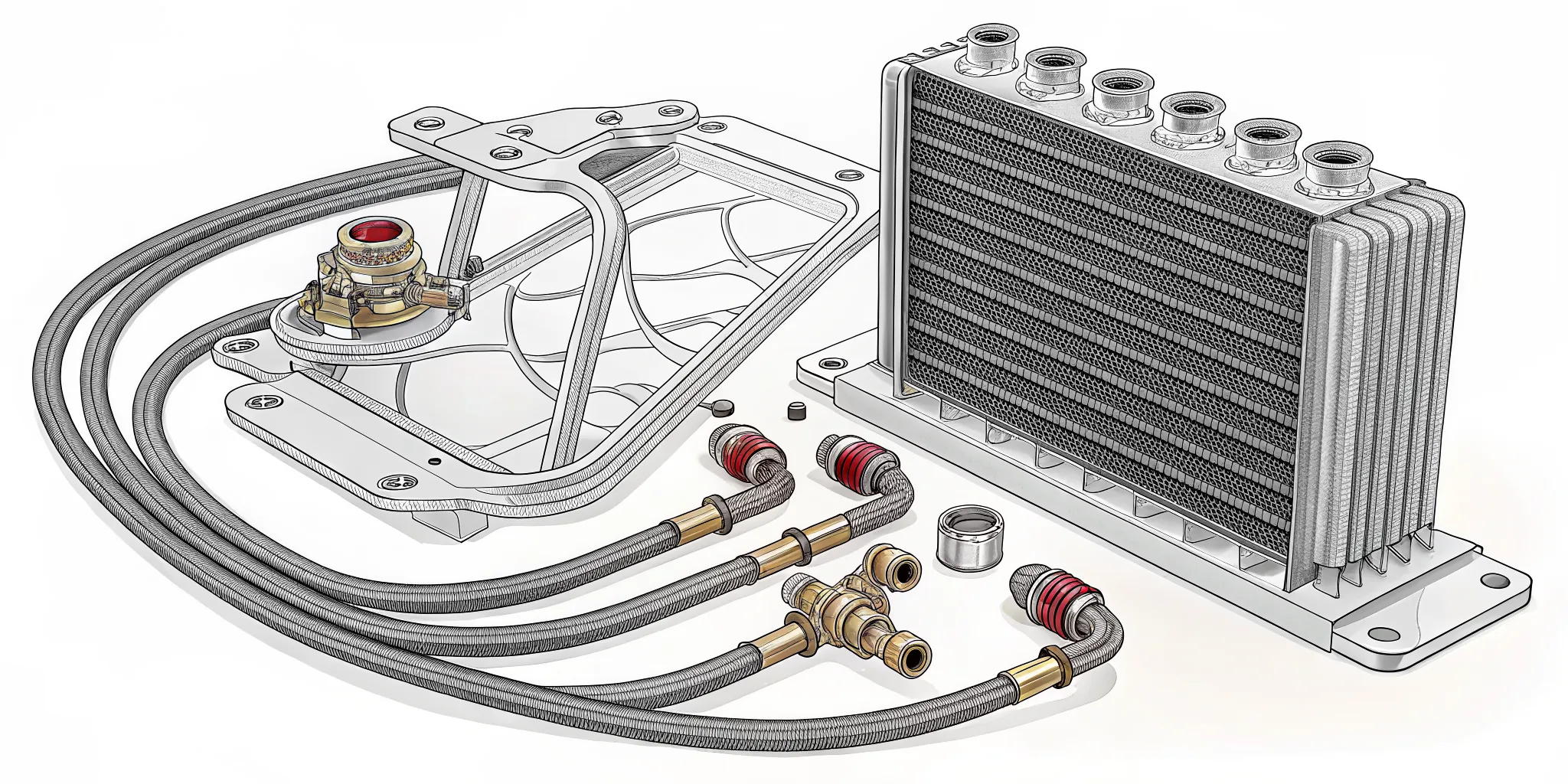
For a built EJ or FA combination, select the oil-cooling hardware as a system, not as a generic universal kit. A properly sized Setrab core, quality Earl's fittings, and a thermostatic sandwich plate give the engine controlled oil temperature without sacrificing cold-start flow.
Preventing Lubrication Breakdown Under High Thermal Load
Engine oil does more than lubricate. It carries heat away from loaded bearings, piston undersides, turbocharger components, and valvetrain surfaces. As oil temperature climbs beyond its intended operating range, viscosity falls and the oil film becomes easier to shear. On an EJ25, that can compound the consequences of sustained cylinder pressure. On an FA20DIT or FA24DIT, it adds thermal stress to an already hard-working turbocharged package.
A stacked-plate Setrab core adds surface area and airflow capacity outside the primary radiator circuit. Mount it in clean airflow, protect it from debris, and use correctly sized Earl's hose ends and lines to avoid a restrictive, leak-prone installation. The goal is stable temperature under a full session, not simply the biggest cooler that fits.
Thermostatic Sandwich Plates and Oil Flow
Do not send cold oil through a large external core on every start. A thermostatic sandwich plate routes oil around the cooler until it reaches operating temperature, then progressively opens the external circuit. That preserves warm-up behavior while allowing the Setrab core to control heat once the engine is loaded. It also makes hose routing, service access, and filter changes easier to plan around on tight Subaru engine bays.
Use fittings rated for engine-oil temperature and pressure, secure every line against vibration and abrasion. And verify clearance from the exhaust, accessory drive, and front tires at full lock. An oil cooler is only protective when its plumbing remains reliable.
Combining Oil Cooling with an Air-Oil Separator
Pair the cooler with a Crawford Air-Oil Separator (AOS) for a more complete EJ/FA protection strategy. The AOS separates oil vapor from crankcase blow-by and returns captured oil to the engine rather than allowing it to collect in the intake tract. Controlled crankcase ventilation complements stable oil temperature, while the cooler protects the oil in circulation. FA24DIT benefits from this combined approach when boost, track time, and thermal demand rise together.
What Temperature Thermostat Is Best for Performance Subarus?
For a performance Subaru, a 172F thermostat provides balanced warm-up and flow for most street-driven builds. While a 160F low-temp unit works best when the cooling package and calibration are built around sustained high-load use. The thermostat controls when coolant circulates through the radiator. It does not create cooling capacity by itself, so it must be matched to the radiator, fans, tune, and intended use.
Thermostat selection should support a stable, repeatable operating temperature, not chase the lowest number on the box. The thermostat controls when coolant begins circulating through the radiator. It must be matched to the radiator, fans, tune, and intended use of the car.
OEM Opening Thresholds vs. Low-Temp Alternatives
An OEM-style 172F thermostat is the right baseline for a street-driven EJ or FA build that reaches high load occasionally and retains a healthy factory-style cooling system. It begins opening at its rated temperature, then continues opening as coolant temperature rises. That controlled behavior helps the engine reach its designed operating range promptly, which matters for drivability, fuel control, and consistent oil temperature.
A 160F low-temperature thermostat starts coolant circulation earlier. It can be useful on a hard-driven, turbocharged Subaru where extra heat margin is needed before repeated pulls, road-course sessions, or sustained boost. The tradeoff is simple. An earlier-opening thermostat only helps if the radiator, airflow, fan strategy, and coolant volume can reject the heat once circulation begins. It will not cure combustion-gas intrusion, a restricted radiator, weak fans, or an inadequate tune.
- Choose 172F for a properly maintained street car and predictable warm-up.
- Choose 160F when the cooling package and calibration are built around sustained high-load use.
- Verify actual coolant and oil temperatures with reliable logging before changing parts.
High-Pressure Radiator Caps and Boiling Point Synergy
Thermostat choice works alongside system pressure. A 1.3 bar radiator cap raises cooling-system pressure above the OEM 1.1 bar cap, increasing the coolant's boiling-point margin. That additional margin is valuable when cylinder-head temperatures spike under boost, because coolant that remains liquid transfers heat more consistently than coolant forming vapor pockets. It is a support upgrade, not permission to ignore an overheating condition.
Use a quality cap with the correct fitment and inspect the filler neck, overflow hose, and expansion tank before increasing pressure. A compromised hose, radiator seam, or aging plastic tank may reveal itself once pressure rises. On an EJ25, the best setup is usually the one that maintains stable temperatures through a full pull and recovers quickly afterward.
Coolant Selection and Ratios for Performance Boxer Engines
Track-driven Subarus need a coolant strategy that balances boil protection with heat-transfer efficiency. A 50/50 distilled-water-to-coolant mix works for street use, while a 70/30 distilled-water-dominant fill with a Water Wetter additive improves heat rejection on dedicated track cars operated above freezing.
Coolant is a heat-transfer component in Subaru WRX cooling system upgrades. For street-driven EJ25 and FA24DIT engines, Subaru Super Coolant (Blue) is the conservative baseline. It is a phosphate-based, long-life 50/50 premix formulated to protect aluminum components, seals, and mixed-metal passages in the factory cooling system. Because it is already premixed, do not add water to the bottle.
Choosing the Right Coolant Mix Ratio
A 50/50 coolant-to-distilled-water mix provides the best all-around compromise of boil protection, freeze protection, corrosion resistance, and service life for a street car. Water transfers heat more effectively than glycol, however. In a dedicated track car operated only above freezing, a 70/30 distilled-water-to-coolant mix with a quality Water Wetter additive can improve heat rejection while retaining corrosion protection. That is not a winter-ready fill. Reduced glycol content also reduces freeze protection, so it must be changed before cold-weather storage or street use.
- 50/50 mix: Best all-around choice for street-driven performance Subarus with daily-driver duty cycles.
- 70/30 water-dominant mix: Suitable for dedicated track cars operated above freezing. Add Water Wetter for corrosion protection.
- Subaru Super Coolant Blue: Factory-spec phosphate-based premix that protects aluminum cooling passages.
Bleeding the System Properly on Boxer Engines
Never fill a performance Subaru with tap water. Minerals and dissolved solids can form deposits in radiator passages, heater cores, and turbocharger coolant circuits, reducing the flow and heat transfer the upgrade was meant to improve. Use only distilled water for mixed fills.
Bleeding matters as much as the fluid choice. Boxer engines can trap air in high points of the cooling circuit, and an air pocket can create unstable temperature readings. Poor heater output, localized hot spots, or a sudden overflow after a hard pull.
- Park the vehicle level and set the heater to hot (maximum temperature, fan on low).
- Use a spill-free funnel at the radiator or designated fill point.
- Bring the engine through heat cycles, gently massage accessible hoses, and wait for the thermostat to open before confirming the level.
- Once fully cool, recheck the radiator and overflow reservoir.
A properly burped system gives the radiator, oil cooler, and thermostat a stable foundation to do their jobs.
How Do Holistic Cooling Upgrades Protect Your EJ or FA Engine?
Coordinated cooling system upgrades protect your built EJ or FA engine by preventing ECU timing pull and maintaining safe component clearances under sustained thermal load. Each part must be sized and installed to support the others.
Subaru WRX cooling system upgrades work best as a controlled heat-management system, not as a collection of isolated parts. A larger radiator, properly selected thermostat, oil cooler, sealed shroud, capable fans, and a clear airflow path must support one another. On EJ and FA turbo engines, combustion, turbocharger, oil, coolant, and under-hood temperatures rise together during repeated boost events.
Browse Crawford Performance cooling system components and oil coolers for your build.
Preventing ECU Timing Pull and Thermal Expansion Seizure
When charge, coolant, or oil temperatures climb beyond the calibration's comfortable range, the ECU responds through its protection strategies. It can reduce ignition advance, enrich commanded fueling, and limit boost or torque. That timing pull is not a defect. It is the ECU trading power for knock margin and component survival.
The mechanical consequence is more serious when heat is allowed to accumulate. Pistons, cylinder bores, rings, bearings, and valvetrain parts expand at different rates as temperature rises. Reduced running clearance can compromise the oil film, increase friction, and progress toward scuffing or seizure. Research on engine thermal management identifies thermal expansion and component-temperature control as central durability concerns (ScienceDirect). A radiator alone cannot solve this if the oil is heat-soaked, the thermostat restricts flow unnecessarily, or hot air remains trapped behind the core.
For a build plan that treats the system as a whole, review these WRX engine cooling system upgrades. The objective is stable operating temperature under load.
Aero-Efficiency, Hood Scoops, and Front-End Airflow
Heat exchangers only reject heat when air crosses their fins. The bumper opening, ducting, A/C condenser, intercooler arrangement, radiator, and exit path deserve the same attention as core thickness. Gaps around the radiator support let high-pressure air escape around the core instead of through it. Seal the intended path and keep the stack clear of damaged fins and debris.
On top-mount-intercooler cars, hood-scoop condition and intercooler duct sealing affect under-hood temperature as well as charge-air cooling. A shroud that covers the radiator face correctly helps the fans draw through the entire core at low vehicle speed. For repeated competition use, prioritize track-driven cooling system upgrades that preserve both inlet and exit airflow.
Real-Time Telemetry and Fan Control Optimization
Use an Accessport or comparable OBDII logger to watch coolant temperature, oil temperature, intake-air temperature, boost, feedback knock. Fine knock learning, and ignition advance during the same type of pull, climb, or session that creates the problem. Trends matter more than a single peak. Rapid temperature recovery after lift, stable timing, and fan engagement indicate a system with reserve capacity.
Confirm fan commands match operation after changes. Fan control cannot replace highway-speed airflow, but it is critical at low vehicle speeds. FA24DIT benefits from this same data-led approach, so compare your log behavior with these FA24 engine cooling improvements before selecting parts.
Choosing the Right Cooling System Path for Your Build
Build type, power level, and intended use determine the right cooling system path. The following steps outline a decision process that matches each component to your specific Subaru WRX cooling system upgrade goals.
Step-by-Step Cooling System Decision Guide
- Assess your use case. Street-driven with occasional pulls? Start with a quality all-aluminum radiator and fresh coolant. Dedicated track car? Add an external oil cooler and consider a 160F thermostat.
- Evaluate your current cooling baseline. Pressure-test the system, inspect hoses, verify fan operation, and log coolant and oil temperatures during a typical drive or session before ordering parts.
- Select the radiator upgrade. Choose an application-specific all-aluminum unit with multi-row core, welded tanks, and correct chassis fitment. Match shroud, fan, and ducting to the core dimensions.
- Add oil cooling capacity. Install a stacked-plate Setrab core with a thermostatic sandwich plate. Route lines away from exhaust and moving components. Verify clearance at full steering lock.
- Choose the thermostat and cap. Select 172F for mixed use or 160F for track bias. Pair with a 1.3 bar radiator cap for additional boil margin on high-output builds.
- Fill with the correct coolant and bleed thoroughly. Use distilled water for coolant mixes. Bleed the system through multiple heat cycles until temperature readings are stable.
- Verify with data logging. Log coolant temp, oil temp, and ignition timing during a representative session. Confirm stable temperatures and rapid recovery after load.
Frequently Asked Questions About Subaru WRX Cooling Upgrades
Does a Subaru WRX require specialized coolant?
Use Subaru Super Coolant/Long-Life Blue or a high-quality, silicate-free coolant specifically compatible with Subaru aluminum cooling systems. The correct coolant mix protects the radiator, water pump, heater core, and aluminum passages from corrosion while maintaining a stable boiling point. Avoid mixing coolant types or topping off with straight water except as a temporary emergency measure.
Are all-aluminum radiators worth it for a daily driver?
An all-aluminum radiator can be worthwhile for a daily-driven WRX if you live in a hot climate. Tow, run more power, or want added durability over aging plastic end tanks. However, it is not mandatory for every stock commuter. The larger heat capacity and stronger construction matter most for repeated high-load use, such as road-course sessions, mountain driving, or a built turbo Subaru.
How can I prevent engine heat soak on track days?
Preventing heat soak requires a system, not one part. Start with a healthy radiator, fresh coolant, proper ducting, and fans that operate correctly. Add an appropriately sized oil cooler, manage intercooler and underhood airflow, and seal gaps so incoming air passes through the heat exchangers rather than around them. During sessions, monitor coolant and oil temperatures, then use cooldown laps and avoid idling in the paddock when temperatures are elevated.
What is the safe operating oil temperature for a track-driven Subaru?
Most track-capable Subaru engine oils perform best between 200F and 230F. Sustained oil temperature above 250F accelerates viscosity breakdown and should be addressed with an external oil cooler. Monitor oil temperature during your sessions and consider upgrading if you regularly exceed 240F.
Does an oil cooler reduce the need for a larger radiator?
An oil cooler reduces the thermal load on the primary radiator by removing oil heat directly to ambient air rather than dumping it into the coolant circuit through the factory oil-to-coolant heat exchanger. It is a complement to a larger radiator, not a replacement. Both upgrades work together in a complete cooling system plan.
Can I use a lower-temperature thermostat without other cooling upgrades?
A lower-temperature thermostat alone does not increase cooling capacity. It opens earlier, allowing coolant to circulate sooner, but the radiator, fans, and airflow must still be capable of rejecting the heat produced by the engine. Use a different thermostat only as part of a coordinated system upgrade.
How do I know if my WRX cooling system is overheating on track?
Watch for ECU timing pull, rising coolant temperature above 220F, oil temperature above 240F, coolant overflow after hard pulls, reduced power, and dash warning lights. Data logging with an Accessport or similar OBDII logger provides the clearest picture of thermal behavior across a full session.
Ready To Build Your Track-Ready Cooling System?
A properly planned Subaru WRX cooling system upgrade protects your built engine, preserves consistent power delivery, and extends component life under sustained load. Crawford Performance stocks application-specific all-aluminum radiators, Setrab oil cooler cores, Earl's fittings and hose, thermostats, and cooling system components for EJ and FA platforms. Contact Crawford Performance online or visit our Westminster, Maryland shop to discuss your build goals and select the right cooling components for your horsepower level and track use.