

Subaru Power Steering Cooler: Track-Day Installation Guide
Power steering heat is easy to overlook until repeated cornering, high engine-bay temperatures, and limited recovery time expose a weakness in the system. On a Subaru used for track days or competition, cooling is not an automatic upgrade; it is part of deciding how the steering system will handle sustained load.
A Subaru power steering cooler can help manage fluid heat when the system sees repeated steering load and heat soak. Its value depends on real airflow and compatible fluid, fittings, and hoses. A cooler will not correct a failing pump, rack, or damaged line, so select it around the car's components and use case.
The right decision starts with the car's duty cycle, not a universal temperature claim. From there, placement, airflow, routing, and inspection determine whether the cooler improves reliability or introduces new risks.
Talk with Crawford Performance about your Subaru track-build cooling plan.
When Does a Subaru Power Steering Cooler Make Sense?
A Subaru power steering cooler is not an automatic requirement for every street-driven car. It becomes a sensible reliability upgrade when the steering system repeatedly works hard and heat remains part of the operating environment. That often means circuit driving, autocross, drifting, long mountain descents, or a modified build that adds steering load without adding much time for the system to recover.
Look for repeated load, not one hot session
Steering assistance relies on hydraulic fluid to transmit pressure, lubricate moving parts, suppress foaming, and help protect the pump and steering gear. Those roles are outlined by the Universal Technical Institute's power steering fluid reference. A single demanding corner or short spirited drive does not, by itself, prove that a cooler is needed. The stronger case is a repeatable pattern: sustained steering effort across multiple sessions with limited cool-down time, heat soak after the car stops, fluid discoloration, or foaming that returns after service.
Use symptoms as clues, not as a diagnosis
Dark brown or foamy fluid can indicate that the fluid needs attention, but it does not identify the cause by itself. Inspect the pump, rack, reservoir, belt system, lines, and fluid level before treating a cooler as the answer. A cooler can reduce thermal load when it receives genuine airflow. It cannot repair a failing pump, a worn rack, a restricted hose, or a leak. If the system is already noisy or losing assist, diagnose that fault first.
Make the decision around the whole build
Track use makes thermal management a system decision. Consider the car's session length, steering demand, ambient conditions, airflow available at the proposed mounting location, and the condition of the existing components. A cooler needs protected airflow and must coexist with suspension movement, belts, fans, bodywork, and service access. Its hose routing also needs full-travel clearance and protection from exhaust heat and abrasion.
There is no universal temperature threshold that makes an upgrade correct for every Subaru chassis. Confirm fluid compatibility, hose material, mounting method, and fitment against the vehicle and cooler manufacturer's instructions. For broader thermal planning, see these WRX cooling system upgrades, then validate the steering-specific installation with a leak, clearance, abrasion, and airflow inspection before track use.
How to Choose the Cooler Location and Airflow Path
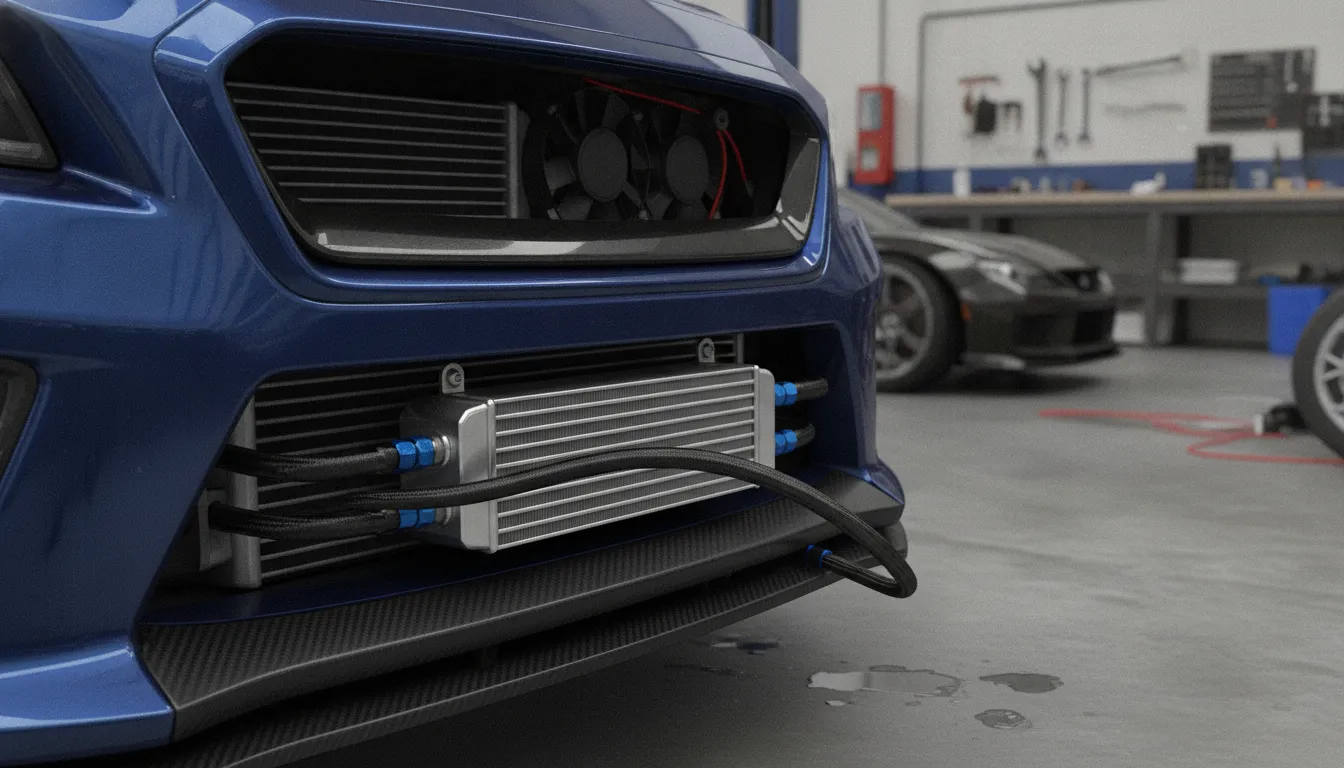
A power steering cooler only helps when the installation can reject heat consistently. A compact core hidden behind a dense panel may add capacity on paper but receive little useful airflow in motion. Start by treating the cooler as part of the Subaru's complete thermal system, not as an isolated accessory. A heat exchanger can remove heat from hydraulic fluid, but the result depends on where it is mounted and how air reaches it.
Prioritize clean, repeatable airflow
Front-facing airflow is usually the most obvious starting point for a track car, but the best location is not automatically the first open space behind the bumper. Look for a path that receives moving air without being completely masked by the bumper beam, radiator stack, ducting, or other hardware. If the cooler shares air with another heat exchanger, consider whether the surrounding components will raise inlet temperatures or restrict flow during sustained running.
Use the vehicle's actual bodywork and ducting as the reference. A cooler that fits during mock-up may lose airflow after the bumper, undertray, grille, or duct seals are installed. The mounting plan should preserve the core's exposed face while keeping brackets rigid enough to prevent vibration fatigue. Crawford's guidance is to connect supporting-system decisions to durability and repeatable track use, rather than rely on unsupported universal temperature claims. See the broader WRX cooling system upgrades guide when coordinating power-steering cooling with the rest of the thermal package.
Balance debris protection with heat rejection
A low or exposed position can receive strong airflow, but it also sees more tire debris, water, gravel, and contaminants. Protect the core without sealing it behind a solid obstruction. A suitable screen or guarded location may help, provided it does not become the primary restriction. Inspect the chosen area for nearby exhaust heat, turbo plumbing, belts, radiator fans, suspension links, and body panels. These heat sources and moving parts can turn a workable location into a reliability problem.
Validate access and chassis-specific clearance
Leave enough room to inspect fittings, clamps, and the core itself. Service access matters because a small leak or a damaged fin row should be easy to identify before the next session. Cycle the steering through full lock in both directions with the car at the relevant ride height. Check that the cooler, hoses, mounts, and protective hardware stay clear of suspension movement and cannot chafe against adjacent parts.
Do not assume one location transfers across WRX, STI, or other Subaru generations. Bumper structures, radiator packages, steering components, and undertrays vary by chassis and by modification history. Confirm airflow, clearance, abrasion protection, and mounting security on the exact car, then leak-check the installation and heat-cycle it before track use.
Hose Routing, Fittings, and Clearance Checks
A well-chosen cooler can still create a reliability problem if the plumbing is treated as an afterthought. The exact line path depends on the chassis, rack, reservoir, cooler, and surrounding hardware, so avoid copying a universal layout without checking the actual car. In a common return-line arrangement, fluid travels from the steering rack to the cooler and then back to the reservoir. That sequence is a useful planning model, not a fitment guarantee.
Plan the return line around the car
Confirm which hose is the return before cutting or disconnecting anything. Select hose and fittings that are rated for power-steering fluid and compatible with the vehicle and cooler manufacturer's instructions. Do not assume that a transmission-cooler hose, generic fuel hose, or a particular AN size is automatically suitable. Fluid compatibility and hose material should be checked against the vehicle, cooler instructions, and the builder's actual use case.
Give each connection a clean, supported transition. Fittings should seat fully, clamps should secure the hose without crushing it, and the hose should not be forced into a tight bend immediately after the fitting. A routing plan that removes unnecessary connections can reduce potential leak points, but it must still preserve service access and the required flow path.
Protect hoses from heat, movement, and abrasion
Keep lines away from exhaust components and other concentrated heat sources. They also need clearance from belts, pulleys, fans, steering shafts, suspension links, tires, and body panels. A hose that clears the car at rest can contact a moving component once the suspension compresses or the steering reaches an extreme angle. Use appropriate supports and abrasion protection where the line could rub, while leaving enough flexibility for normal movement.
Before final tightening, turn the steering through its complete range with the vehicle safely supported. Check both sides, inspect the route from underneath, and account for suspension travel rather than checking only the static ride height. Do not let a mount or tie-down place a sharp load on the cooler inlet or outlet.
Use a repeatable leak and clearance check
After filling and bleeding the system according to the vehicle and component instructions, inspect every joint at idle. Look for seepage, foaming, hose swelling, and contact marks. Heat-cycle the car, let it cool, and inspect the fittings, clamps, hose chafe, cooler mounts, and airflow path again before track use. Crawford's installation guidance specifically calls for checking leaks, clearance, abrasion, and airflow before driving on track.
- Verify the return-line direction and hose compatibility.
- Check full steering travel and suspension movement.
- Keep hoses clear of exhaust heat and moving parts.
- Secure lines without crushing or sharply bending them.
- Reinspect after heat cycling, then review the broader Subaru track car preparation checklist.
Fluid Choice and Heat-Management Strategy
A cooler is only one part of a power-steering reliability plan. The fluid still has to match the vehicle and steering components, and the system must remain free of air, leaks, and mechanical faults. Power steering fluid provides the hydraulic connection that reduces steering effort, while also lubricating internal components and helping suppress foaming. The type and condition of that fluid affect how the system operates.
| Decision area | What to verify |
|---|---|
| Airflow | Core receives useful moving air without excessive debris exposure. |
| Plumbing | Hose, fittings, direction, and fluid path match the vehicle and component instructions. |
| Clearance | Lines and mounts clear exhaust, belts, fans, suspension, tires, and bodywork through movement. |
| Validation | System is leak-checked, heat-cycled, and reinspected before track use. |
Start with the exact specification
Use the vehicle service information and the instructions for the pump, rack, reservoir, and cooler to identify the required fluid. ATF and synthetic power steering fluids are examples of different fluid categories, not interchangeable recommendations. Color alone is not a compatibility test, and topping off an unknown fluid with a different type can create a problem that a cooler will not solve. Check the specification, required viscosity range, hose compatibility, and any component-specific restrictions before filling the system.
Viscosity matters because hydraulic systems depend on fluid properties that change with temperature. Research on hydraulic oil identifies density and viscosity as important factors in hydraulic-system operation, and evaluates those properties across changing temperatures. That study concerns HL32 hydraulic oil and hydraulic actuators, not a universal Subaru power-steering-fluid recommendation, so it should inform the principle rather than dictate a fill choice. Review the hydraulic-oil research for the underlying temperature and viscosity context.
Inspect condition before extending service
Do not set a service interval by copying a number from another car or assuming that every competition build needs the same schedule. Inspect the fluid based on the vehicle's use, heat cycles, contamination, and operating symptoms. Dark brown or foamy fluid can indicate that the fluid needs attention, but those findings also justify checking for aeration, leaks, restricted return flow, and component wear. Fresh fluid will not compensate for a pump that is failing or a rack that is generating abnormal load.
A Subaru power steering cooler can reduce thermal load when it receives real airflow, but it cannot repair a noisy pump, damaged rack, loose fitting, or deteriorated hose. Confirm the underlying system is healthy first, then choose fluid and cooling hardware as part of the same application-specific plan. For a broader supporting-system review, see Crawford's Crawford Subaru long blocks and supporting hardware.
Installation Steps and Track-Day Inspection
Installation quality determines whether a Subaru power steering cooler improves repeatability or introduces a new failure point. Treat the work as part of the car's reliability plan, not as a cooler-and-hose swap. Confirm the vehicle-specific layout, component instructions, fluid requirements, and available clearance before cutting or disconnecting anything.
- Plan the system before removing parts. Identify the intended fluid path, cooler position, hose lengths, fitting types, and mounting points. The exact arrangement depends on the chassis and components, so do not assume that one Subaru generation or universal kit layout applies to another. Make sure the cooler will receive real airflow while remaining protected from debris and clear of belts, fans, suspension, bodywork, and normal service access.
- Mount the cooler securely. Use the supplied hardware or a vehicle-appropriate mounting method, following the cooler manufacturer's instructions. The cooler should not be able to contact nearby parts under vibration or movement. Check that its core and fittings are supported without being loaded by the hoses.
- Connect and route the hoses carefully. Follow the planned route between the steering system, cooler, and reservoir as specified for the application. Keep hoses away from exhaust heat, sharp edges, moving components, and tight bends. Secure them without crushing the hose, then inspect every fitting and clamp for proper seating. Do not substitute hose material or fitting sizes without confirming compatibility with the vehicle, cooler instructions, and actual use case.
- Fill and bleed the system using the service procedure. Use only the fluid specified for the vehicle and steering components. Do not mix fluids casually, and do not invent a bleeding sequence or treat a generic procedure as universal. Follow the applicable service information, keeping the reservoir at the required level while checking for abnormal aeration or other signs of a problem.
- Perform an idle leak check. With the system assembled and the vehicle safely supported as appropriate, inspect the cooler, hoses, fittings, clamps, rack connections, and reservoir area during the prescribed initial operation. Look for seepage, foaming, hose movement, or fluid loss. Resolve any issue before moving to a heat-cycle check.
- Heat-cycle the installation and recheck it. Allow the vehicle to reach its normal operating condition according to the service procedure, then inspect the installation again after it has cooled enough to work safely. Recheck leaks, mount security, hose chafe, heat exposure, and clearance. Confirm that steering travel remains unobstructed, including full lock in both directions.
- Monitor it at the track. Before the first session, inspect fluid level, fittings, hose routing, cooler airflow, and surrounding components. After each session, look for fresh leaks, abrasion, loosened hardware, fluid discoloration or foaming, and any change in steering feel. Add this inspection to your broader Subaru track car preparation checklist so the cooler supports, rather than distracts from, the complete reliability review.
Contact Crawford Performance about your Subaru cooling and track-build plan.
Common Subaru Power Steering Cooler Mistakes to Avoid
A cooler is only useful when the complete system is planned as carefully as the core itself. The common failures below are less about the brand of cooler and more about placement, compatibility, and inspection.
Installing the core where air cannot reach it
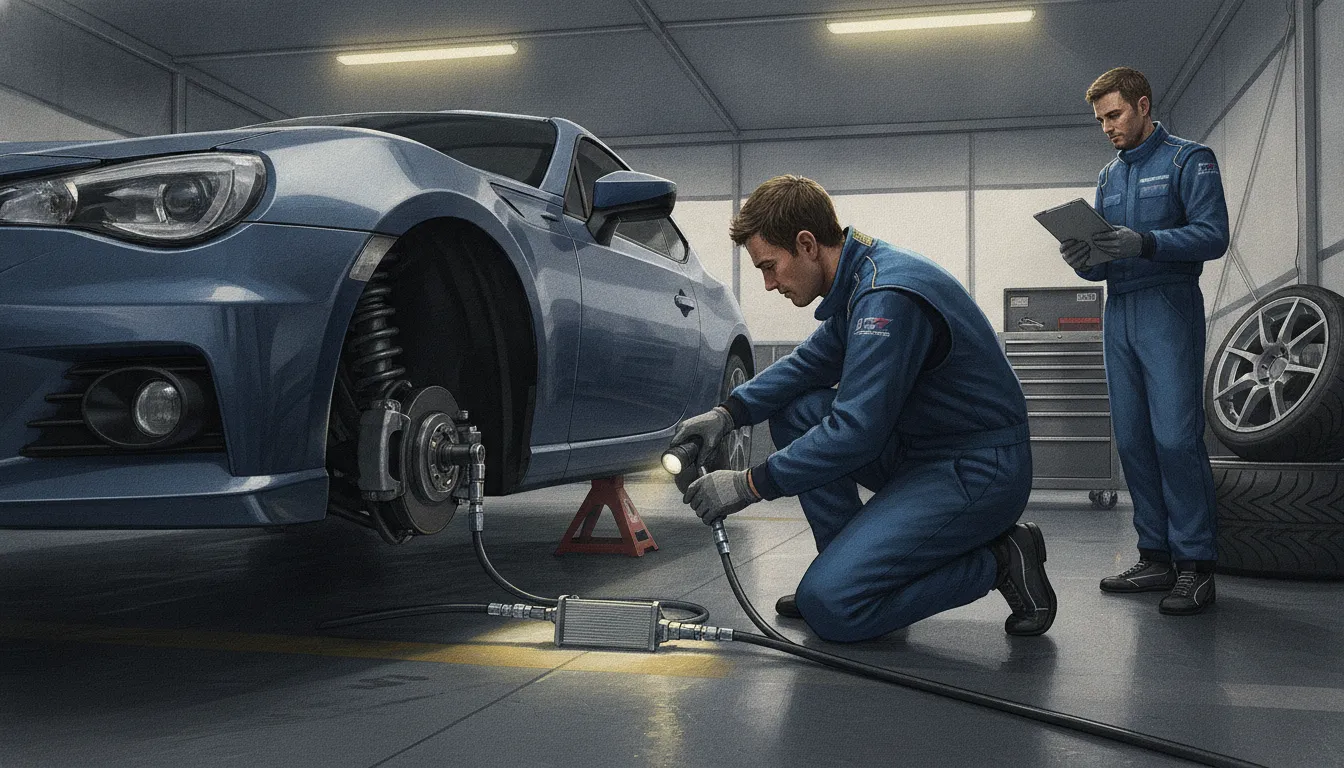
A cooler hidden behind a solid panel, packed tightly against another heat source, or placed in a low-flow pocket may add plumbing without providing meaningful heat rejection. Choose a location with a realistic airflow path, then account for debris and service access. A protected position with direct air is usually more useful than an exposed position that is vulnerable to impact.
Routing hoses as an afterthought
Power-steering hoses should not rub on brackets, belts, pulleys, tires, suspension links, or sharp body edges. They also need distance from exhaust heat and enough flexibility for the exact steering and suspension movement of the car. Secure the hoses without crushing them. After installation, inspect the route at full steering lock and through the available suspension travel.
Assuming fluid or cooling solves every problem
Power-steering fluid supports hydraulic operation, lubrication, and corrosion control, but a cooler cannot repair a worn pump, damaged rack, failing seal, or aeration problem. Fluid selection must follow the vehicle and component specifications. Do not mix fluids because their color or marketing description appears similar, and do not use a racing fluid without confirming compatibility.
- Dead-air mounting: verify the core receives airflow, not just that it fits.
- Unprotected exposure: balance airflow with debris and impact protection.
- Unverified plumbing: check fittings, hose material, abrasion, and full-lock clearance.
- No post-install inspection: leak-check, heat-cycle, and recheck before track use.
For the wider reliability context, compare this system-specific work with Crawford's Subaru track build guide. The power-steering cooler should support that broader plan, not replace it.
Contact Crawford Performance for application-specific Subaru track-build guidance.
Frequently Asked Questions
Do you really need a power steering cooler on a Subaru?
Not every Subaru needs an auxiliary cooler. It becomes more relevant when repeated steering input, sustained track use, heat soak, or the vehicle's specific steering hardware makes fluid temperature management part of the reliability plan. Evaluate the entire system, including the pump, rack, hoses, fluid specification, airflow, and intended use. A cooler is a supporting modification, not a universal requirement.
What does a power steering cooler do?
A power steering cooler transfers heat away from the hydraulic fluid as it passes through the cooling circuit. Its effectiveness depends on the cooler design, fluid flow, airflow, mounting position, and condition of the rest of the system. It cannot correct a failing pump, leaking hose, damaged rack, or aeration problem. Confirm the plumbing and component compatibility before installation.
Where should a Subaru power steering cooler be mounted?
Mount it where the core can receive useful airflow while remaining protected from debris, contact, exhaust heat, and interference with service components. The correct position depends on the chassis, bumper, ducting, and other cooling hardware. Check hose routing, fittings, steering travel, suspension movement, and clearance before finalizing the brackets.
What happens when a power steering cooler installation goes bad?
A poor installation can create leaks, hose abrasion, restricted flow, fluid aeration, or inadequate cooling. Inspect the system at idle, after a controlled heat cycle, and again before track use. Look for seepage at every connection, secure mounting, clear hose routing, and fluid condition. If steering assist changes or the fluid foams, stop and diagnose the underlying issue rather than adding more cooling hardware.
What fluid should be used with a power steering cooler?
Use the fluid specified for the vehicle and the steering components. Power-steering systems may use different fluid types, and compatibility should not be inferred from color or the word synthetic on a label. Follow the service documentation, avoid casual mixing, and inspect fluid condition after hard use. If the specification or history is uncertain, resolve that uncertainty before the car returns to competition.
Plan the Supporting Cooling System Before Your Next Event
A power steering cooler can be a sensible part of a Subaru track or competition build when it is matched to the vehicle. Fluid specification, airflow, and actual steering loads. The final decision should account for the complete system and include leak, clearance, and heat-cycle checks before the car is driven hard.
Talk with Crawford Performance before finalizing your Subaru track cooling plan.