

Cómo elegir el mejor depósito de aceite para tu WRX
Si tienes un WRX de 2015 o posterior, necesitas saber sobre su motor de inyección directa. En modelos anteriores, el combustible circulaba constantemente por las válvulas de admisión, manteniéndolas limpias. Pero tu motor DI inyecta combustible directamente en el cilindro, sin pasar por las válvulas. Esto significa que nada impide que la suciedad aceitosa del sistema PCV se acumule en las válvulas como carbonilla. Este no es un problema menor; es un conocido factor que afecta el rendimiento. Un depósito de aceite para tu WRX es la mejor defensa, lo que lo convierte en una de las mejoras más importantes para la salud y confiabilidad a largo plazo de tu motor.
Conclusiones clave
- Proteja su motor de inyección directa : un depósito de recolección de aceite es una mejora fundamental que intercepta el vapor de aceite del sistema PCV, evitando que se formen depósitos de carbón que afectan el rendimiento en las válvulas de admisión.
- Apoye cada modificación de rendimiento : al mantener el intercooler y el tracto de admisión libres de aceite, un recipiente colector garantiza que su motor funcione de manera eficiente y confiable, lo que lo convierte en una parte fundamental que lo ayuda a aprovechar al máximo cada otra actualización.
- Elija un sistema de calidad y manténgalo : Los mejores colectores de aceite se caracterizan por su construcción sólida y una filtración eficaz. Para aprovechar al máximo sus beneficios, incorpore la revisión y el vaciado del colector de aceite de forma sencilla y regular en la rutina de mantenimiento de su vehículo.
¿Cómo funciona un depósito de aceite ?
Un recolector de aceite es un dispositivo simple pero eficaz que protege la salud y el rendimiento del motor. Es como un filtro instalado entre el cárter y el colector de admisión. Su función es capturar el vapor de aceite, el combustible no quemado y otros contaminantes (conocidos colectivamente como "gases de escape") antes de que puedan recircular de nuevo al motor. Al atrapar estas sustancias nocivas, el recolector evita que cubran el sistema de admisión, las válvulas y el intercooler.
Esto mantiene el motor funcionando de forma más limpia y eficiente, lo cual es especialmente importante para los motores turboalimentados de alto rendimiento de los modelos Subaru. Instalar uno es una medida proactiva para mantener la potencia y la fiabilidad que espera de su coche. Para comprender realmente por qué esto es tan importante, primero debe comprender el sistema con el que funciona: el sistema PCV.
Cómo funciona su sistema PCV (y por qué es importante)
Todo motor de combustión interna cuenta con un sistema de Ventilación Positiva del Cárter (PCV). Durante la combustión, los gases a alta presión inevitablemente se filtran por los anillos del pistón hacia el cárter; esto es lo que mencionamos anteriormente. Esta mezcla de aire, combustible y vapor de aceite debe ventilarse para evitar la acumulación de presión que podría dañar los sellos del motor. El sistema PCV redirige estos gases desde el cárter hacia el colector de admisión para que se quemen en el ciclo de combustión. Si bien esto es excelente para las emisiones, no es ideal para el rendimiento. El problema es que estos gases transportan una fina capa de aceite. Se instala un colector de aceite en línea con la manguera PCV para interceptar este vapor aceitoso, asegurando que solo aire limpio recircule al motor.
Comprensión de los sistemas PCV y CCV
El motor de su Subaru tiene dos circuitos de ventilación: el PCV (Ventilación Positiva del Cárter) y el CCV (Ventilación del Cárter). El sistema PCV funciona al vacío (al ralentí o a velocidad crucero) y dirige los gases de escape de vuelta al colector de admisión. El sistema CCV asume el control al acelerar a fondo o con el acelerador a fondo, ventilando el exceso de presión hacia el tubo de entrada del turbo. Si bien un solo colector de admisión en el lado del PCV es una mejora común y efectiva, solo resuelve la mitad del problema. Para vehículos de pista o con ajustes agresivos, una configuración de colector doble es la solución ideal. Al instalar un colector en las líneas PCV y CCV, se asegura que no entre vapor aceitoso en el tracto de admisión, independientemente de las condiciones de conducción. Esta protección integral mantiene el intercooler y el turbo funcionando eficientemente, proporcionando una base limpia para que todos los demás componentes de alto rendimiento alcancen su máximo potencial.
Por qué los vapores de aceite son el enemigo de tu motor
Cuando el vapor de aceite del sistema PCV entra en la admisión, no se quema limpiamente, sino que recubre todo lo que toca, incluyendo el interior del colector de admisión, el cuerpo del acelerador, el intercooler y las válvulas de admisión. Con el tiempo, esta película aceitosa se endurece formando depósitos de carbón, lo que puede restringir el flujo de aire y reducir la potencia del motor. Peor aún, este aceite puede reducir el octanaje efectivo de la mezcla aire-combustible, aumentando el riesgo de detonación o "golpeteo", lo que puede causar graves daños al motor. Al instalar un colector de aceite, se evita que estos vapores lleguen al sistema de admisión, manteniendo limpias las vías respiratorias del motor. Este es uno de los componentes de rendimiento más importantes que puede instalar para proteger su inversión.
Cómo la inyección directa empeora las cosas
Si tienes un WRX de 2015 o posterior con motor de inyección directa (DI), un depósito de aceite es aún más crucial. En los motores de inyección directa más antiguos, el combustible se rocía en la parte trasera de las válvulas de admisión, lo que proporciona un efecto de limpieza constante que elimina los depósitos de carbonilla. Sin embargo, en un motor DI, el combustible se inyecta directamente en la cámara de combustión, sin pasar por las válvulas. Esto significa que no hay nada que limpie el aceite y la suciedad que recircula el sistema PCV de las válvulas de admisión. Como resultado, la acumulación de carbonilla se produce mucho más rápido y puede convertirse en un problema grave, lo que resulta en una pérdida significativa de rendimiento. Instalar un depósito de aceite es la mejor defensa para estos motores modernos, lo que lo convierte en una de las mejoras más importantes para el Subaru WRX a largo plazo.
Por qué tu WRX necesita un depósito de aceite
Si has visitado foros de Subaru o competiciones de coches, probablemente hayas oído hablar de los depósitos de aceite. Pero ¿son solo un accesorio llamativo para el compartimento del motor o cumplen una función real? En resumen: son una de las mejoras preventivas más efectivas que puedes hacer para tu WRX, especialmente con su motor de inyección directa.
Un separador de aceite, también conocido como separador de aire y aceite, cumple exactamente su función. Es un filtro diseñado para atrapar el aceite y otros contaminantes que circulan por el sistema PCV (Ventilación Positiva del Cárter) antes de que entren en la admisión y obstruyan el motor. Al instalar uno, se soluciona directamente una debilidad conocida de los motores modernos, ayudando a preservar el rendimiento, proteger componentes críticos y prolongar la vida útil de su Subaru. Analicemos cómo un separador de aceite beneficia a su WRX.
Evite la acumulación dañina de carbón en sus válvulas
Una de las principales razones para instalar un colector de aceite es evitar la acumulación de carbón en las válvulas de admisión. En un motor de inyección directa como el FA20DIT de tu WRX, el combustible se inyecta directamente en el cilindro, no en el puerto de admisión. Esto significa que la parte trasera de las válvulas de admisión nunca se limpia con gasolina. Mientras tanto, el sistema PCV expulsa los vapores aceitosos del cárter directamente al colector de admisión.
Sin un depósito de aceite, estos vapores se depositan en las válvulas calientes, formando depósitos de carbón duros. Con el tiempo, esta acumulación puede restringir el flujo de aire, perjudicar el rendimiento e incluso causar fallos de encendido. Un depósito de aceite intercepta estos vapores, garantizando que solo entre aire limpio al motor. Es una forma sencilla pero crucial de mantener el motor funcionando correctamente.
Mantenga limpio el intercooler y el sistema de admisión
La suciedad del sistema PCV no se limita a las válvulas. Cubre todo a su paso, incluyendo el intercooler, el turbo y el colector de admisión. Cuando el aceite cubre el interior del intercooler, actúa como aislante, reduciendo su capacidad para enfriar el aire que entra al motor. El aire más caliente es menos denso, lo que implica menos potencia.
Al capturar el aceite y la humedad antes de que circulen, un depósito de recogida mantiene todo el conducto de admisión limpio y eficiente. Esto garantiza el óptimo funcionamiento del intercooler y evita que el aceite contamine los sensores o el cuerpo del acelerador. Para quienes utilizan mejoras de alto rendimiento en el WRX , mantener el conducto de admisión limpio de residuos de aceite es esencial para obtener una potencia constante y fiable.
Preserve el rendimiento y la longevidad del motor
Un motor más limpio es un motor más sano y potente. Al evitar la acumulación de carbón y mantener limpio el sistema de admisión, un depósito de aceite ayuda a que su WRX mantenga su rendimiento original durante años. Cuando los vapores de aceite reducen el octanaje efectivo de la mezcla aire-combustible, pueden aumentar el riesgo de detonación, o golpeteo del motor, lo cual es sumamente perjudicial.
Piense en un depósito de recuperación como una inversión a largo plazo en la salud de su motor. Es una medida proactiva que ayuda a que su motor funcione de forma más eficiente y fiable. Este es un principio fundamental en cualquier servicio de puesta a punto de calidad: empezar con un motor en buen estado. Al garantizar que su motor solo respire aire limpio, le está dando la mejor oportunidad posible de funcionar de forma fiable, ya sea en su trayecto diario al trabajo o en la pista.
¿Es necesario para los motores de serie frente a los modificados?
Entonces, ¿realmente necesitas un colector de aceite si tu WRX es completamente de fábrica? Si bien cualquier motor de inyección directa se beneficia de uno, la necesidad se agudiza al empezar a modificar tu coche. Al aumentar la sobrealimentación con una modificación u otros componentes de alto rendimiento, también aumentas la presión del cárter. Esto fuerza una mayor cantidad de vapor de aceite a través del sistema PCV, acelerando la acumulación de carbonilla.
Para un conductor diario de serie, un depósito de recuperación es un excelente mantenimiento preventivo. Para un WRX modificado, es prácticamente esencial. Cuanta más potencia generes, más gases de escape producirás, y más crucial será proteger el motor de la contaminación por aceite. Es una modificación fundamental que complementa cualquier otra mejora de rendimiento que realices.
Motores EJ vs. FA: ¿Ambos necesitan uno?
Esta es una pregunta frecuente, y la respuesta se reduce a una diferencia clave: la inyección de combustible. Los motores EJ más antiguos, presentes en los STI (hasta 2021) y los WRX más antiguos, utilizan inyección de combustible en puerto. Esto significa que el combustible se rocía en el puerto de admisión, recorriendo la parte posterior de las válvulas de admisión antes de entrar en el cilindro. Esta pulverización constante de gasolina actúa como agente limpiador, ayudando a eliminar los depósitos de aceite que deja el sistema PCV. Si bien un depósito colector sigue siendo una mejora beneficiosa para cualquier motor turboalimentado, especialmente uno modificado con mejoras para el Subaru STI, la inyección en puerto del EJ proporciona una defensa natural contra la acumulación excesiva de carbonilla.
Sin embargo, los motores FA más nuevos del WRX 2015+ utilizan inyección directa (DI). Con la DI, el combustible se inyecta directamente en la cámara de combustión, sin pasar por las válvulas de admisión. Esto mejora la eficiencia, pero implica que no hay nada que limpie el vapor aceitoso que recircula el sistema PCV de las válvulas. Como resultado, la acumulación de carbonilla se produce mucho más rápido y puede causar una pérdida significativa de rendimiento con el tiempo. Por esta razón, un depósito de aceite no solo es una buena idea para un motor FA, sino que es una modificación esencial para mantener la salud y el rendimiento del motor a largo plazo.
Cómo elegir el depósito de aceite adecuado para el WRX
Una vez que haya decidido qué colector de aceite es el adecuado para su WRX, el siguiente paso es elegir el perfecto. Con tantas opciones en el mercado, es fácil sentirse abrumado. La clave está en centrarse en algunos factores críticos: la calidad de los materiales, el diseño del sistema y su adaptación a sus necesidades específicas y a su vehículo. Un colector de aceite barato y mal diseñado suele ser peor que no tenerlo, ya que puede generar fugas o no atrapar los contaminantes eficazmente. Una unidad de calidad será duradera, eficiente y fácil de mantener, lo que la convierte en una inversión que vale la pena para la salud de su motor. Analicemos qué debe buscar para asegurarse de obtener una pieza de alta calidad que proteja su motor durante años.
Por qué son importantes los materiales y la construcción de calidad
Lo primero que hay que inspeccionar es el material del depósito de combustible. Se busca una unidad duradera, no una que se agriete o tenga fugas bajo presión. Las mejores opciones se fabrican a partir de una pieza sólida de aluminio resistente de grado aeronáutico. Este tipo de construcción, a menudo llamada aluminio billet mecanizado por CNC, garantiza la ausencia de soldaduras molestas que podrían fallar con el tiempo. Una construcción sólida garantiza que el depósito pueda soportar el calor y la presión del compartimento del motor sin problemas. Aunque los depósitos soldados más económicos puedan parecer tentadores, presentan posibles puntos de falla. Invertir en un depósito bien fabricado de una marca reconocida significa obtener una pieza confiable que cumple su función sin requerir atención ni reemplazo constantes.
La importancia de un diseño sellado a presión para motores turboalimentados
Debido a que tu WRX está turboalimentado, todo su sistema de admisión está presurizado para gestionar la sobrealimentación. Cualquier fuga, por pequeña que sea, significa pérdida de potencia y puede afectar la afinación del motor. Un depósito de admisión se conecta directamente a este sistema, por lo que debe ser absolutamente hermético. Un depósito barato que no pueda mantener la presión provocará una fuga de sobrealimentación, lo que reducirá la eficacia de tus mejoras de rendimiento. Y la cosa empeora. Los turbocompresores tienen un sistema de sellado dinámico especial que depende de un delicado equilibrio de presión para evitar fugas de aceite en la admisión. Un depósito de admisión mal sellado altera este equilibrio, lo que puede hacer que pase más aceite por los sellos del turbo. Por eso, un diseño sellado a presión no solo es una ventaja, sino que es imprescindible para proteger el motor.
Puerto único o puerto doble: ¿cuál es el adecuado para usted?
Notarás que los colectores de escape vienen en configuraciones de uno o dos puertos. Un colector de un puerto se conecta a un punto del sistema PCV, mientras que uno de dos puertos se conecta a dos, ofreciendo una protección más completa. Para la mayoría de los modelos WRX de uso diario con modificaciones ligeras, un colector de un solo puerto es un excelente punto de partida. Sin embargo, para motores muy modificados o aquellos que se utilizan frecuentemente en pista, una configuración de dos puertos es la mejor opción. Captura el escape de gases de escape de las múltiples líneas de ventilación del cárter, asegurando la máxima eliminación de vapor de aceite y combustible antes de que llegue a la admisión. Tu elección dependerá de tus objetivos de rendimiento específicos y de la configuración del motor, así que considera el uso que le das a tu coche antes de comprarlo.
Configuraciones de doble depósito de captura para uso en pista
Si conduces tu WRX con frecuencia en circuito, un sistema de doble colector de admisión pasa de ser una ventaja a ser imprescindible. Las intensas condiciones de la conducción en circuito (altas RPM sostenidas, mayor sobrealimentación y calor extremo) generan mucha más presión en el cárter y gases de escape que la conducción diaria. Un sistema dual soluciona este problema conectándose a las líneas de ventilación del cárter (PCV) y CCV (ventilación del cárter), ofreciendo una protección integral. Esta configuración garantiza la máxima captura de aceite y vapor de combustible, manteniendo la admisión limpia y el motor a salvo de detonaciones bajo carga. Considéralo un seguro esencial que respalda todas las demás piezas de alto rendimiento en las que has invertido, brindándote la confiabilidad necesaria para lograr tiempos de vuelta consistentes.
Filtración y capacidad: lo que necesita saber
El contenido del depósito de aceite es tan importante como el exterior. Un sistema de filtración eficaz es crucial para separar el aceite del aire. Busque modelos con filtrado multietapa, a menudo con deflectores y un filtro de malla fina o de bronce. Un "sistema de filtración de salida de dos etapas", por ejemplo, está diseñado para atrapar el aceite eficazmente y permitir el paso del aire limpio. La capacidad es otro factor a considerar. Un depósito más grande contiene más gases de escape, lo que prolonga los intervalos entre cambios de aceite. Esto es especialmente útil para coches de carreras que producen más gases de escape, mientras que un depósito más pequeño y compacto suele ser suficiente para un coche de uso diario.
Comparación de capacidades: Mishimoto, Burger Motorsports y Radium
Al comparar diferentes depósitos de aceite, la capacidad es un parámetro clave. Indica la cantidad de aceite y otros residuos que puede contener el depósito antes de tener que vaciarlo. Para un coche de uso diario, una capacidad menor suele ser suficiente, pero para un coche de carreras o un motor muy modificado que produce más gases de escape, un depósito más grande implica un mantenimiento menos frecuente. Por ejemplo, Mishimoto ofrece depósitos de aceite con deflectores de ajuste directo con una capacidad de 85 ml (3 oz), una opción sólida para muchas configuraciones. Si necesita más, el depósito de aceite BMS para el WRX 2022+ tiene una capacidad de hasta 150 ml (5.5 onzas líquidas). Para quienes buscan la máxima capacidad, los depósitos de aceite de Radium tienen una capacidad de 190 ml (7 onzas líquidas) y cuentan con un diseño patentado "Fluid Lock®" que evita que el aceite acumulado se derrame en el motor durante una conducción agresiva.
Características clave a tener en cuenta: filtros, garantías y certificaciones
Más allá del tamaño, el diseño interno y la calidad general son lo que distingue a las piezas de mejor rendimiento del resto. Los mejores colectores de aceite se caracterizan por su construcción sólida y una filtración eficaz. Busque modelos con filtrado multietapa, a menudo con deflectores y un filtro de malla fina o de bronce, para separar eficazmente el aceite del aire. También debe considerar la confianza del fabricante en su producto. Una marca que respalda su trabajo ofrecerá una garantía sólida, como la Garantía de por Vida de Mishimoto, que protege su inversión. En definitiva, una unidad de calidad será duradera, eficiente y fácil de mantener, lo que la convierte en una inversión que vale la pena para la salud de su motor y un componente fundamental de cualquier sistema de alto rendimiento.
Por qué son imprescindibles las mirillas y las válvulas de drenaje
Un buen diseño va más allá del rendimiento; también se trata de la usabilidad. Las características que facilitan el mantenimiento son una gran ventaja. Un depósito con mirilla o varilla de nivel permite comprobar rápidamente el nivel de líquido sin desmontar nada. Esta sencilla característica ayuda a establecer una referencia de la rapidez con la que se llena el depósito. Igualmente importante es una válvula de vaciado rápido. Una sencilla llave de purga o válvula de bola en la parte inferior del depósito permite vaciarlo de forma limpia y sin complicaciones. Estos detalles bien pensados diferencian los kits premium de los básicos y hacen que la experiencia a largo plazo sea mucho más agradable.
Conseguir el ajuste correcto: tamaños de entrada y salida
Finalmente, asegúrese de que el colector de admisión que elija sea compatible con su vehículo. Los mejores kits son específicos para cada modelo e incluyen los soportes, mangueras y accesorios adecuados para una instalación impecable en su WRX. Esto le ahorra tener que fabricar piezas o ir varias veces a la ferretería. Un kit de calidad también debe ofrecer opciones flexibles de montaje y enrutamiento de mangueras, lo que le permite configurar la entrada/salida según sus necesidades. Esto garantiza un ajuste perfecto, independientemente de otras mejoras que haya instalado en su Subaru WRX , como un intercooler frontal o una admisión personalizada.
Nuestras mejores selecciones: Los mejores depósitos de aceite para un WRX
Una vez que hayas decidido qué sistema de escape es el adecuado para tu WRX, el siguiente paso es elegirlo. El mercado está repleto de opciones para todos los precios, lo que puede dificultar encontrar el sistema perfecto. El mejor sistema de escape para tu WRX depende completamente de tus objetivos, tu presupuesto y tu estilo de conducción. ¿Buscas protección básica para tus desplazamientos diarios o necesitas un sistema apto para circuito que soporte altas RPM y calor intenso? La respuesta te guiará hacia el producto adecuado, asegurándote la protección que necesitas sin gastar de más.
Para simplificar tu búsqueda, he dividido las mejores opciones en categorías clave según precio y rendimiento. Analizaremos desde kits económicos que cumplen su función hasta sistemas premium diseñados para un rendimiento máximo. Recuerda: cualquier colector de calidad es un paso en la dirección correcta para proteger tu motor de inyección directa. Invertir en una unidad bien diseñada te dará buenos resultados, ya que mantendrá las válvulas de admisión limpias, el intercooler eficiente y el motor funcionando a la perfección durante años. Es una de las modificaciones preventivas más valiosas que puedes hacer, así que tomarte el tiempo para elegir con cuidado vale la pena. Encontremos la adecuada para ti.
Mejor opción: Separador de aceite y aire Crawford Performance
Para proteger el motor de su Subaru, el Separador de Aire/Aceite (AOS) Crawford Performance es ampliamente reconocido como una de las soluciones más efectivas disponibles. Si bien funciona con un principio similar al de un depósito de aceite, nuestro AOS V3 es un sistema sin mantenimiento que separa el vapor de aceite y lo devuelve al motor, para que nunca tenga que drenarlo. Es una solución integral diseñada específicamente para los motores de las series FA20 y EJ. Su diseño único utiliza el refrigerante del motor para calentar la unidad, evitando la condensación y la acumulación de lodos que pueden afectar a los depósitos de aceite estándar, especialmente en climas fríos. Esto lo convierte en la mejor opción para mantener el máximo rendimiento y la limpieza del motor.
Las mejores opciones económicas (menos de $200)
Si buscas una opción básica sólida, no tienes que gastar una fortuna para obtener una protección eficaz. Varias marcas reconocidas ofrecen colectores de escape de alta calidad, perfectos para un WRX de serie o ligeramente modificado. En este rango de precios, puedes encontrar kits de empresas como Mishimoto, Boomba Racing e IAG Performance. Estas unidades suelen contar con deflectores sencillos pero eficaces para separar el aceite del aire y suponen una gran mejora respecto a no tener ninguna protección. Para quienes conducen a diario, una de estas piezas de alto rendimiento es una forma excelente y económica de empezar a proteger el motor contra la acumulación de carbonilla.
Kits sólidos de gama media ($200-$300)
Al optar por un precio medio, accederá a características más avanzadas y una construcción de mayor calidad. Los kits de esta categoría suelen incluir soportes de montaje específicos para cada vehículo y mangueras precortadas para una instalación más limpia y sencilla. También encontrará sistemas de deflectores internos más sofisticados, que mejoran la capacidad del depósito para condensar y atrapar los vapores de aceite antes de que lleguen a la admisión. Estos kits son una excelente opción intermedia para los entusiastas que han comenzado a modificar su WRX y buscan una solución más robusta que pueda soportar una conducción enérgica sin necesidad de invertir en un sistema premium.
Mishimoto y Burger Motorsports
En la categoría de gama media, dos marcas que se mencionan constantemente son Mishimoto y Burger Motorsports. Ambas ofrecen kits de alta calidad específicos para el WRX 2022 y posteriores, lo que proporciona una mejora significativa en la protección de los motores de inyección directa. El depósito de aceite Mishimoto con deflectores es una opción popular, diseñado para conectarse directamente al sistema PCV. Atrapa el aceite y la carbonilla de forma excelente antes de que se acumulen en la admisión. Su diseño duradero incluye un filtro lavable y una capacidad de 85 ml (3 onzas), lo que significa que no tendrá que vaciarlo constantemente.
De igual manera, el depósito de aceite Burger Motorsports (BMS) es otra opción fantástica, especialmente si ya has empezado a añadir otras mejoras al WRX . Al aumentar la sobrealimentación, también aumenta la presión del cárter, lo que impulsa más vapor de aceite a través del sistema PCV. El depósito de aceite BMS está diseñado específicamente para soportar estas condiciones más exigentes, garantizando que el motor se mantenga limpio incluso bajo presión. Ambos kits ofrecen una forma fiable de proteger tu inversión, evitando pérdidas de rendimiento y manteniendo el motor en buen estado a largo plazo.
Kits Premium para Máxima Protección (Más de $300)
Para quienes tienen autos altamente modificados o que conducen frecuentemente en circuito, un sistema premium es la mejor opción. Estos colectores de aceite y separadores de aire/aceite están diseñados para una máxima eficiencia en las condiciones más exigentes. Encontrará características como filtración multietapa, construcción de aluminio billet mecanizado por CNC para mayor durabilidad y diseños que se integran perfectamente en el compartimiento del motor. Estos sistemas ofrecen el máximo nivel de separación de aceite, asegurando que el tracto de admisión y las válvulas se mantengan impecables. Invertir en una de estas mejoras de primera calidad para el Subaru WRX le brinda tranquilidad, sabiendo que su motor cuenta con la máxima protección.
Ingeniería de radio, Killer B y Cusco
En la categoría premium, marcas como Radium Engineering, Killer B y Cusco son reconocidas por su ingeniería. Los colectores de aceite de Radium destacan por su diseño patentado "Fluid Lock®", una ingeniosa función que evita que el aceite acumulado se derrame en el motor, incluso si se olvida vaciarlo inmediatamente. Killer B Motorsport se centra en diseños de alta capacidad diseñados para soportar las exigencias tanto de la conducción diaria como de las intensas sesiones en pista, garantizando la protección del motor en cualquier condición. Por su parte, Cusco es conocida por crear colectores de aceite que se integran a la perfección en el compartimento del motor del WRX, priorizando la facilidad de instalación y mantenimiento. Cada una de estas marcas ofrece una solución robusta para los entusiastas que buscan la máxima protección del motor.
¿ Realmente necesitas un depósito de aceite?
Si pasas tiempo en los foros de Subaru, habrás visto el debate: ¿es un depósito de aceite una modificación imprescindible o un gasto innecesario? Lo cierto es que la respuesta depende de tu coche y de cómo lo conduzcas. Aunque algunos argumentan que el sistema PCV de fábrica es suficiente para un vehículo de serie, la realidad de los motores de inyección directa es otra. Para los propietarios de cualquier WRX desde 2002 hasta la actualidad, especialmente para aquellos que priorizan el rendimiento, un depósito de aceite es menos un accesorio y más un componente crucial para el buen funcionamiento del motor a largo plazo.
El problema principal es el escape de gases: la mezcla de aceite, combustible y vapor de agua que se filtra por los anillos del pistón. El sistema PCV de su auto está diseñado para recircular estos gases de vuelta a la admisión para su combustión. ¿El problema? Estos vapores cubren las válvulas de admisión con residuos de carbón, lo que con el tiempo reduce la potencia y la eficiencia del motor. Un depósito de recogida intercepta estos vapores, separando el aceite y los contaminantes antes de que puedan causar daños. Es una solución simple y eficaz para un problema que puede resultar en costosas reparaciones en el futuro.
Desmintiendo mitos comunes sobre las latas de recolección de basura
Uno de los mayores mitos es que los colectores de admisión solo se utilizan en motores muy modificados y de alta potencia. Si bien es cierto que un motor optimizado produce más gases de escape, incluso un WRX completamente de fábrica se beneficia de esta mejora. Los motores modernos de inyección directa son particularmente susceptibles a la acumulación de carbonilla en las válvulas de admisión, ya que el combustible se inyecta directamente en el cilindro, lo que significa que nunca las limpia. Un colector de admisión es una medida proactiva para mantenerlas limpias desde el primer día. Otro mito es que un colector de admisión solucionará los problemas existentes del motor. Es una herramienta preventiva, no una solución para problemas graves como el desgaste de los anillos de pistón que causa un exceso de gases de escape.
Conductor diario vs. coche de carreras: ¿Importa?
El uso que le das a tu WRX sin duda influye. Para un coche de uso diario, el sistema PCV de fábrica puede soportar condiciones normales, pero no detendrá la acumulación lenta y constante de carbonilla. Instalar un depósito de recuperación de combustible es una inversión en el futuro de tu motor, ya que ayuda a mantener el rendimiento y el ahorro de combustible durante años. En un coche de carreras, la cosa cambia. Llevar el motor al límite genera mucho más calor y presión, lo que provoca más escapes de gases de escape. En este entorno de alto estrés, un depósito de recuperación de combustible es esencial para proteger el motor y garantizar una potencia constante vuelta tras vuelta. Si vas a añadir otras piezas de alto rendimiento, un depósito de recuperación de combustible debería ser una prioridad.
¿Qué pasa si tu lata de pesca permanece vacía?
Puede ser preocupante instalar un depósito colector y encontrarlo casi vacío después de unas semanas. No se preocupe, esto no significa que no funcione. La cantidad de suciedad que se acumula depende de muchos factores, como sus hábitos de conducción, el clima y el estado general del motor. Los viajes cortos, por ejemplo, no permiten que el motor se caliente lo suficiente como para generar mucho vapor. Un motor de fábrica en buen estado naturalmente acumulará menos que uno modificado. Lo importante es que el sistema esté funcionando correctamente, capturando cualquier contaminante dañino presente antes de que llegue a la entrada. Con el tiempo, verá que se acumula, lo que confirma que está funcionando correctamente.
Cuando una lata de conservas puede ser una solución provisional
Si bien un depósito de aceite es una mejora invaluable para su WRX, es crucial comprender su función como medida preventiva, no como solución para problemas mecánicos existentes. Si su motor presenta un desgaste interno significativo, como anillos de pistón desgastados, producirá una cantidad excesiva de gases de escape. En este caso, el depósito se llenará extremadamente rápido y, si bien protege la admisión de la acumulación de aceite, simplemente está controlando un síntoma de un problema mucho mayor. Piénselo de esta manera: un depósito está diseñado para manejar la cantidad normal de gases de escape de un motor en buen estado. Si se encuentra drenándolo cada pocos cientos de kilómetros, es una clara señal de que su motor necesita un diagnóstico profesional para abordar la causa raíz.
Cómo usar su bote colector como herramienta de diagnóstico
Una de las ventajas más subestimadas de un depósito de aceite es su capacidad para evaluar el estado del motor. Prestar atención a lo que recoge puede detectar posibles problemas a tiempo. Un depósito que se llena inusualmente rápido es la señal de alerta más obvia de un escape excesivo de gases de escape. La consistencia del fluido también revela algo. Una pequeña cantidad de aceite oscuro es normal, pero una mezcla lechosa y fangosa indica que se está mezclando agua o refrigerante con el aceite, lo que podría indicar una junta de culata defectuosa. Si nota algo inusual, es recomendable consultar con expertos. Un servicio profesional de afinación del motor o una revisión de diagnóstico pueden ayudarle a identificar el problema antes de que se convierta en una falla catastrófica, asegurando que sus componentes de alto rendimiento mantengan un motor en buen estado.
¿Vale la pena la inversión para usted?
En definitiva, un depósito de aceite es una póliza de seguro asequible para tu motor. Para el propietario de un WRX de serie que planea conservar el coche a largo plazo, es una forma inteligente de evitar futuros problemas y mantener el rendimiento que tanto te gusta. Si planeas mejorar tu WRX o disfrutas de una conducción enérgica, un depósito de aceite se convierte en un elemento indispensable para proteger tu inversión. Ayuda a garantizar que tu motor funcione de forma más limpia, resistente y eficiente durante toda su vida útil. Considerando el posible coste de un servicio de limpieza de válvulas, un depósito de aceite de calidad se amortiza por sí solo.
Instalación y mantenimiento del depósito de aceite del WRX
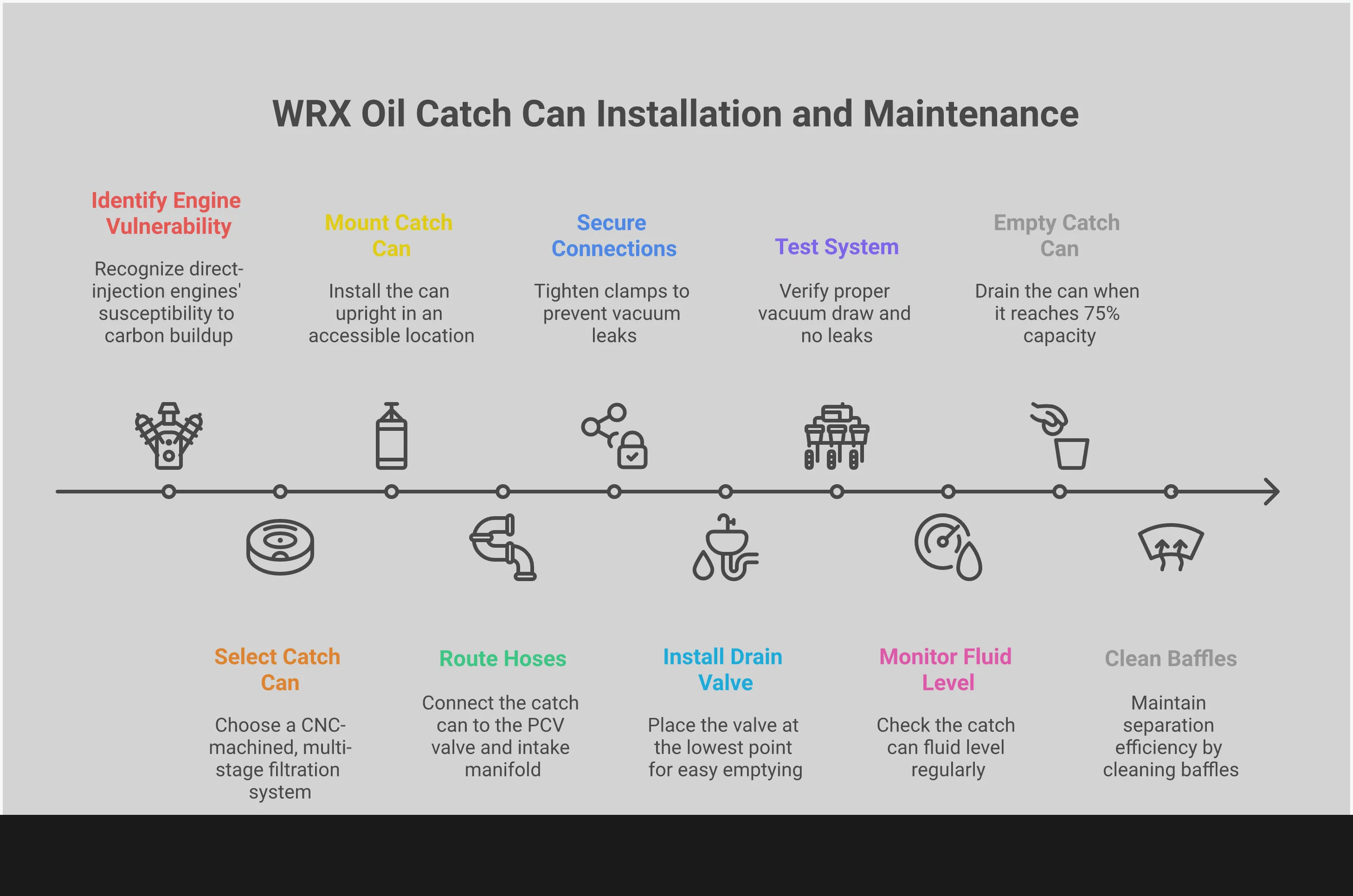
Una vez que haya elegido el depósito de aceite adecuado, una instalación correcta y un programa de mantenimiento constante son esenciales para obtener todos los beneficios. Un depósito de aceite no es una pieza que se instala y se olvida, pero su cuidado es sencillo y garantiza la protección del motor. Seguir esta sencilla rutina le ayudará a mantener el rendimiento de su Subaru y a prevenir los problemas que intenta solucionar.
Considérelo una pequeña inversión de tiempo que se traduce en una gran mejora en la salud y longevidad del motor. Siguiendo unos pasos clave para el montaje, el vaciado y la supervisión, puede asegurarse de que su depósito de aceite funcione eficazmente durante años. Este proceso es tan sencillo que cualquier propietario puede manejarlo y es fundamental para un plan completo de mantenimiento de alto rendimiento.
Tiempo de instalación y recursos disponibles
No necesitas ser un experto en mecánica para instalar un colector de aceite. La mayoría de los kits están diseñados para una instalación sencilla y atornillable que puedes completar en la entrada de tu casa en menos de una hora. Los kits de alta calidad, específicos para cada vehículo, son especialmente fáciles de instalar, ya que incluyen mangueras preformadas, conexiones de desconexión rápida y soportes personalizados que eliminan cualquier duda o perforación. Esto significa que simplemente reemplazas la línea PCV de fábrica con las nuevas mangueras y montas el colector en el lugar designado. Si tienes alguna pregunta, la comunidad Subaru te ayuda. Hay innumerables guías de instalación y videotutoriales disponibles en línea que te guían paso a paso por el proceso para tu modelo específico de WRX. Es una de las piezas de alto rendimiento más fáciles de instalar, lo que la convierte en un excelente proyecto para el fin de semana.
¿Dónde debería montar su contenedor de recolección?
Elegir el lugar adecuado para instalar el depósito de recogida es el primer paso para una instalación exitosa. Necesita una ubicación segura, que permita el tendido correcto de las mangueras y, sobre todo, que sea de fácil acceso para el drenaje regular. Un kit bien diseñado incluye un soporte de montaje específico que simplifica este proceso, a menudo colocando el depósito en un lugar apartado, pero accesible.
Al instalarlo, asegúrese de que el depósito esté montado en posición vertical y libre de piezas móviles, como correas o ventiladores. El objetivo es encontrarle un lugar que facilite al máximo el mantenimiento futuro. Las piezas de alto rendimiento están diseñadas con esto en mente, lo que garantiza que no tenga que complicarse la instalación cada vez que necesite vaciarlo.
¿Con qué frecuencia debes drenar tu depósito de recolección?
Drenar regularmente el depósito colector es la parte más importante de su mantenimiento. Es necesario vaciar el aceite, el combustible y el vapor de agua acumulados antes de que se llene. Muchos depósitos colectores están diseñados para mayor comodidad, con características como una válvula de drenaje sencilla o una base que se desenrosca para un vaciado rápido. Esto facilita y agiliza la tarea.
Para una rutina de limpieza, simplemente vacíe el contenido en un contenedor de residuos adecuado. Periódicamente, puede limpiar el interior del depósito con un paño limpio para eliminar cualquier residuo. Esto mantiene el sistema de filtración funcionando eficientemente y garantiza que el depósito esté listo para capturar más gases de escape. Este sencillo hábito es fundamental para mantener su motor en óptimas condiciones.
Cómo controlar la acumulación de aceite
Saber cuándo vaciar el depósito de recogida es fácil si sabes qué buscar. Muchos sistemas incluyen una varilla de nivel o una mirilla que permite comprobar el nivel de líquido de un vistazo sin desmontar nada. Esta función es increíblemente útil porque elimina cualquier incertidumbre en el programa de mantenimiento.
Acostúmbrate a revisar el nivel cada vez que llenes gasolina o revises el aceite del motor. Un vistazo rápido basta para ver qué tan rápido se llena. Esta revisión visual es una de las mejores maneras de estar al tanto de las mejoras de tu Subaru WRX y asegurarte de que todos los componentes funcionen correctamente.
Cómo afecta su estilo de conducción al mantenimiento
La frecuencia con la que debe vaciar el depósito de aceite depende completamente de sus hábitos de conducción. Un coche que se usa a diario podría necesitar vaciarse solo cada pocos miles de kilómetros, a menudo coincidiendo con su programa habitual de cambio de aceite. Sin embargo, un vehículo que participa frecuentemente en circuitos o que conduce agresivamente acumulará gases de escape mucho más rápido.
Tras la instalación inicial, revise el depósito después de un par de semanas para tener una referencia de la rapidez con la que se llena. El clima más frío también puede provocar una mayor acumulación de condensación. Tanto si viaja al trabajo como si planea su próxima aventura con soluciones todoterreno, adaptar su programa de mantenimiento a su uso específico es clave para una protección eficaz del motor.
Artículos relacionados
- Separador de aire y aceite vs. Catch Can: Diferencias clave
- Separador de aceite y aire para Subaru WRX 2015: Guía del comprador
Preguntas frecuentes
¿Cuál es la diferencia entre un depósito de aceite y un separador de aire/aceite (AOS)? Piense en un AOS como una versión más avanzada y automantenible de un depósito de aceite. Un depósito estándar es un depósito que recoge aceite y contaminantes, que debe drenarse manualmente a intervalos regulares. Un separador de aire/aceite, como el Crawford Performance V3 AOS, es un sistema de circuito cerrado que separa el aceite y lo drena automáticamente al cárter de aceite del motor. Esto lo convierte en una solución sin mantenimiento, ideal para quienes buscan la máxima protección sin la rutina de vaciar un depósito.
¿Con qué frecuencia debo vaciar el depósito de aceite? No hay una única respuesta, ya que la frecuencia de llenado depende del clima, el estilo de conducción y el estado del motor. Un buen punto de partida es revisarlo cada 1600 kilómetros o cada dos repostajes. Esto te ayudará a establecer una referencia. Probablemente notes que se acumula más suciedad durante los meses más fríos debido al aumento de condensación. Para la mayoría de los conductores diarios, vaciar el depósito con cada cambio de aceite es suficiente una vez que conoces los hábitos de tu coche.
¿Instalar un depósito de aceite anulará la garantía de mi auto? En Estados Unidos, la Ley de Garantía Magnuson-Moss te protege de la anulación de la garantía de tu vehículo solo por usar piezas de repuesto. El fabricante tendría que demostrar que la pieza específica que instalaste causó directamente una falla que se le solicita cubrir. Dado que un depósito de aceite de alta calidad y correctamente instalado está diseñado para proteger el motor, es muy poco probable que cause problemas. Sin embargo, siempre es recomendable elegir marcas reconocidas y asegurarse de que la instalación se realice correctamente.
¿Es realmente necesario un depósito de aceite si mi WRX es completamente de fábrica? Si bien los motores modificados producen más gases de escape y se benefician más de inmediato, incluso un motor de inyección directa de fábrica es vulnerable a la acumulación de carbonilla en las válvulas de admisión. El sistema PCV de fábrica recircula los vapores de aceite independientemente de la potencia. Instalar un depósito de aceite en un coche de fábrica es una medida preventiva inteligente que ayuda a mantener el rendimiento de fábrica y la limpieza del motor a largo plazo. Considérelo una póliza de seguro asequible contra futuras pérdidas de potencia y costosos servicios de limpieza de válvulas.
¿Qué pasa si olvido vaciar el depósito de aceite y se llena? Si el depósito se llena por completo, deja de funcionar. Los gases de escape simplemente pasarán por el depósito lleno y continuarán hacia la admisión, como si no tuviera depósito. En el peor de los casos, un cambio repentino de presión podría absorber una gran cantidad del aceite acumulado del depósito lleno directamente al colector de admisión. Esto puede dañar las bujías, los sensores y, potencialmente, provocar una detonación. Por eso es tan importante el mantenimiento regular.