


The Complete Subaru STI History: A Rally Legend
Plenty of cars have horsepower. But the STI had something more: engineering intelligence. Its legendary performance wasn't just about power. It was a specific recipe: a low-slung Boxer engine, perfectly balanced Symmetrical All-Wheel Drive, and a driver-controlled center differential. This trio wasn't just a list of features; it was a philosophy. The result was a car with unbelievable grip and near-telepathic handling. This is the technology that let the STI hunt supercars for a fraction of the price. The Subaru STI history is a masterclass in smart engineering, showing how this commitment created a performance icon that remains a tuner's dream.
Key Takeaways
- A Legacy Born from Racing: The STI's identity is inseparable from its World Rally Championship victories. This racing heritage directly influenced the development of its core technologies, like the Boxer engine and Symmetrical AWD, giving the production car its famously capable and responsive feel on any road.
- Purpose-Built Performance Technology: The STI stands out because of its intelligent engineering. The Boxer engine provides a low center of gravity for stability, while the Symmetrical All-Wheel Drive and Driver Controlled Center Differential (DCCD) work together to give you exceptional grip and precise control over the car's handling.
- A Platform for Personalization: The STI became a legend by offering track-ready performance at an accessible price, building a massive community of enthusiasts. Now that the classic model is no longer in production, these cars are prized platforms for modification, making high-quality performance parts crucial for owners looking to preserve and build upon its incredible legacy.
What is Subaru Tecnica International (STI)?
If you’re a Subaru fan, that three-letter badge means everything. It represents a legacy of rally-bred performance, precision engineering, and a driving experience that’s raw and unfiltered. But STI is more than just a trim level; it’s the high-performance division of Subaru, responsible for some of the most iconic cars to ever tear up a gravel stage or dominate a track day. Understanding its roots helps explain why these cars are so special and why they continue to be a perfect platform for Subaru STI upgrades.
The Birth of a Performance Icon in 1988
Subaru Tecnica International (STI) was officially created in 1988. Before then, Subaru’s racing activities were spread out across different teams and initiatives. The company decided it needed a dedicated, in-house division to focus its competitive energy. According to State of Speed, STI's main job was to bring all of Subaru's racing efforts under one roof. This move centralized their motorsport program, allowing them to pour all their resources and engineering talent into a single goal: winning. It was a strategic decision that laid the groundwork for decades of dominance in the World Rally Championship (WRC) and created the performance DNA found in every STI model since.
What Was STI's Founding Mission?
From the start, STI’s mission was twofold. First, it was Subaru's special division for high-performance cars and racing. As MotorTrend notes, it quickly built a rich history in motorsports, especially rally racing, which became its primary proving ground. Second, the mission was to transfer that race-winning technology to the street. Subaru used rally competitions to showcase its engineering skills and develop better high-performance cars for enthusiasts. Every victory and every challenge on the rally circuit provided invaluable data that engineers used to refine the Boxer engine, Symmetrical All-Wheel Drive, and overall vehicle dynamics for the production models you see on the road today.
From Homologation to High Performance
The first STI wasn't just a car; it was a ticket to go racing. To compete in the World Rally Championship, manufacturers had to follow homologation rules, which meant building and selling a certain number of road-legal versions of their race cars. The "STi version" that debuted in 1994 was a direct result of this. It was a race car for the road, initially sold only in Japan, which only added to its legendary status. This process perfectly aligned with STI's mission to transfer race-winning technology to the street. Every component, from the robust Boxer engine to the tenacious Symmetrical All-Wheel Drive, was battle-tested on the world's toughest rally stages. This foundation of genuine motorsport engineering is what makes the platform so capable and why enthusiasts continue to seek high-quality Subaru STI upgrades to build upon its incredible legacy.
How Rally Racing Forged the STI Legacy
The soul of the STI was forged in the dirt, gravel, and snow of rally stages. You can't separate the STI from its racing heritage because the two are one and the same. Subaru Tecnica International used the World Rally Championship as a brutal, real-world laboratory to perfect its Symmetrical All-Wheel Drive and turbocharged Boxer engine. Every slide, jump, and full-throttle sprint provided data that would directly shape the production cars we drive today. This commitment to competition is why an STI feels so connected and capable on any road; it’s a car with a pedigree earned by pushing the limits.
When you get behind the wheel, you're not just driving a car; you're piloting a direct descendant of a rally legend. This legacy is the reason so many owners are passionate about continuing its evolution with their own custom builds. The lessons learned from battling through treacherous international courses were invaluable, building the brand's legendary reputation for durability and all-weather performance. This direct link from a rally-winning chassis to a production car is what makes the platform so special, a legacy that continues as owners refine their vehicles with modern performance parts.
Early Days with PRODRIVE and the Leone
Long before the WRX STI became a household name, Subaru was cutting its teeth in the demanding world of rally racing with a different car: the Leone. This early experience in the 1970s laid the essential groundwork, but the real turning point came when Subaru partnered with the British motorsport experts at PRODRIVE. This collaboration was the catalyst that gave birth to the first official STI-tuned race car, the 1989 Legacy RS RA. More than just a competitor, this 220-horsepower machine was built to prove a point about endurance. As MotorTrend notes, STI was founded to develop a worldwide image for competitive motorsports, and the Legacy did just that by setting a grueling world record—driving 62,000 miles in 20 days—proving that Subaru's engineering was not only fast but incredibly durable.
How STI Conquered the World Rally Championship
Subaru Tecnica International (STI) was founded in 1988 with a clear mission: build cars to win on the world stage. Their chosen arena was the World Rally Championship (WRC), one of the most demanding motorsports on the planet. For STI, this wasn't just about collecting trophies. It was about proving that Subaru's core technologies could deliver unmatched performance and durability under the harshest conditions. The team's presence in the WRC wasn't a marketing gimmick; it was the very foundation of their engineering philosophy, establishing a reputation for rugged, all-terrain speed that defines the brand to this day.
A Legacy of Winning: WRC Titles and Victories
The results speak for themselves. STI's time in the WRC produced three manufacturer's titles and an incredible 47 individual rally victories. While the iconic blue and gold Impreza is what most people picture, the journey began with the Legacy RS RA in 1989. The game truly changed with the arrival of the first Impreza WRX Type RA STI in 1994, cementing the model's place in motorsport history. This direct link from a rally-winning chassis to a production car is what makes the platform so special, a legacy that continues as owners refine their vehicles with modern STI upgrades.
The Legendary Drivers: McRae, Burns, and Solberg
The STI is an incredible machine, but its legendary status was cemented by the drivers who piloted it to victory. Names like Colin McRae, Richard Burns, and Petter Solberg are etched into rally history, and their success is inseparable from the blue and gold of Subaru. It was McRae who delivered Subaru's first WRC victory in 1993, a moment that ignited the brand's legendary run. According to MotorTrend, these drivers were at the heart of STI's three World Rally Championships and 47 total wins. They weren't just behind the wheel; they were pushing the Impreza to its absolute limits, providing the real-world data that engineers used to refine the car's performance. This relentless pursuit of victory is what shaped the DNA of the production STI, creating a platform that begs to be driven hard and personalized with high-quality Subaru STI upgrades.
The Record-Breaking Legacy Turbo
Even before its WRC championships, STI was proving its engineering prowess. In 1989, the team prepared a Subaru Legacy Turbo for a grueling endurance challenge to test the absolute limits of its reliability. Over nearly 20 days, the Legacy ran continuously, covering 62,000 miles at an average speed of 138 mph. This incredible feat, documented by automotive historians, showed that STI could build machines capable of not just explosive speed, but also unwavering durability. It was a powerful statement that set the tone for decades of performance to come.
The First Official STI: The 1992 Legacy
After proving the Legacy’s endurance, STI applied that knowledge to its first official road car. In 1992, the Legacy STI was released exclusively in Japan, marking the first time the public could buy a vehicle tuned by Subaru’s performance division. While the Legacy laid the foundation, the legend was truly born in 1994 with the introduction of the Impreza WRX Type RA STI. As MotorTrend highlights, this was the car that brought rally-bred technology directly to enthusiasts. It combined the potent Boxer engine and Symmetrical AWD into a lighter, more agile package, creating the blueprint for decades of performance. This model established the STI as a giant-killer, offering a level of performance that continues to inspire owners to seek out high-quality Subaru STI upgrades today.
Beyond Rally: Conquering the Nürburgring
While its roots are in rally, STI didn't limit its ambitions to gravel stages. To prove the WRX STI's versatility, the team took on one of the most demanding road courses in the world: the Nürburgring. Starting in 2008, STI began competing in the grueling 24 Hours of Nürburgring race, securing multiple class victories over the years. The ultimate proof of its tarmac prowess came in 2010, when a production Subaru WRX STI Spec C set a new lap record for a sedan at the infamous track. This achievement demonstrated that the STI’s engineering excellence wasn't confined to one discipline; it was a world-class performance machine capable of dominating on any surface, a legacy that makes it a perfect platform for track-focused performance parts.
How Did the First WRX STI Change the Game in 1994?
The arrival of the first WRX STI was a watershed moment for performance enthusiasts. Before 1994, the idea of owning a street-legal car with the heart of a rally champion was mostly a dream. Subaru Tecnica International changed that by taking its competition-proven formula and packaging it for the public. The STI wasn't just another sports sedan; it was a statement. It proved that raw, exhilarating performance didn't have to be reserved for the racetrack or European supercars. This car democratized rally-bred engineering, creating a legacy that would inspire a generation of tuners and drivers to push the limits of what a four-door sedan could do.
From Rally Car to Street Machine
Subaru Tecnica International was founded in 1988 with a clear mission: to dominate the world of motorsports. After years of honing its craft in the World Rally Championship, STI applied its expertise to a production vehicle. The result was the 1994 Impreza WRX STI, released exclusively in Japan. This car was a direct descendant of its rally-winning sibling, featuring a hand-tuned engine, strengthened transmission, and a driver-focused suspension. It was built for drivers who craved a connection to the road that most cars couldn't offer. This philosophy of transferring race technology to the street is what allows owners today to continue enhancing their vehicles with modern performance parts.
Breaking the 300-HP Barrier
While the first Japanese-market STI in 1994 produced a very respectable 247 horsepower, the STI legend in the United States is synonymous with breaking the 300-horsepower mark. When the STI finally landed on American shores for the 2004 model year, it did so with a massive impact, delivering 300 horsepower straight from the factory. This figure put it in contention with much more expensive sports cars and instantly made it a performance icon. For many enthusiasts, this was the benchmark that established the STI as the king of affordable, all-wheel-drive performance. That quest for power continues today, with owners seeking Subaru STI upgrades to push their engines well beyond factory specs.
The "Gentlemen's Agreement" and Power Progression
The story of the STI’s power output is tied to a fascinating piece of automotive history known as the "Gentlemen's Agreement." This was an informal pact among Japanese automakers in the 1990s to limit their cars' advertised horsepower to around 276 hp (280 PS). The goal was to prevent a horsepower war that could lead to dangerously fast cars on public roads. When the first Japanese-market STI debuted in 1994, it produced a healthy 247 horsepower, a figure that was impressive for its time but still played within these unwritten rules. This agreement, however, couldn't contain the ambition of Subaru's engineers forever.
As the years went on, that "agreement" started to feel more like a suggestion. By the time the STI made its highly anticipated US debut in 2004, it arrived with a factory-rated 300 horsepower, officially leaving the old pact in the rearview mirror. This number wasn't just for show; it was a declaration that put the STI in direct competition with much more expensive sports cars and cemented its status as a performance legend. This history of pushing boundaries is why the STI became such a beloved platform for modification. That factory power was just a starting point for enthusiasts looking to install performance parts and continue the car's legacy of power progression.
The STI's Highly Anticipated U.S. Debut
American enthusiasts got their first taste of Subaru's rally-inspired performance when the WRX debuted in 2002. The car was an immediate hit, but the community knew something even better was on the horizon. Two years later, in 2004, their patience was rewarded with the arrival of the Impreza WRX STI. With its aggressive styling, giant hood scoop, iconic rear wing, and gold BBS wheels, the STI was impossible to ignore. It offered a level of performance and driver engagement that was virtually unmatched at its price point, solidifying a loyal fanbase and inspiring countless owners to personalize their cars with Subaru WRX upgrades.
The WRX STI Generations: A Complete History
When the WRX landed on US shores, it was an instant hit, but enthusiasts knew its more aggressive, rally-bred sibling was waiting in the wings. The arrival of the STI marked a new era for accessible performance in America, kicking off a nearly two-decade run that would solidify its place as a street-legal legend. Each generation brought its own unique character, building on the core formula of a turbocharged boxer engine and symmetrical all-wheel drive. This evolution created a rich history and a platform ripe for modification.
First Gen (2002-2007): The U.S. Debut
While the WRX arrived in 2002, the STI made its official US debut in 2004, and it was worth the wait. This model, known as the "Blobeye" and later the "Hawkeye," set the benchmark for what an affordable performance sedan could be. It came equipped with a powerful turbocharged engine, advanced differentials, and iconic gold BBS wheels paired with Brembo brakes. Praised for its incredible performance-to-price ratio and all-weather capability, the first-generation STI became an immediate favorite. For many owners, this was the starting point for building a true performance machine with targeted Subaru STI upgrades.
First Gen (1994–2000): The JDM Icons
For years, the STI was the stuff of legend for American enthusiasts, a piece of forbidden fruit available only in Japan. The first official "STi Version" launched in 1994 as a homologation special, a car built specifically to meet the rules for the World Rally Championship. It was raw, focused, and packed with technology like the Driver Controlled Center Differential (DCCD), which let the driver adjust the power split for ultimate control. This era also gave us the mythical 22B STi in 1998, a wide-body, two-door coupe built to celebrate Subaru's WRC dominance. These early models established the STI's identity as a no-compromise performance machine, setting the stage for its eventual global takeover.
The UK-Exclusive P1
While the US waited, the UK received its own special edition in 2000: the Prodrive One (P1). Developed by Prodrive, the same group behind Subaru's rally team, the P1 was a limited run of 1,000 two-door coupes designed to be the ultimate European-spec Impreza. It featured a unique suspension tune for British roads, anti-lock brakes, and a potent 276-horsepower engine. The P1 was a direct response to the grey-market imports popular at the time and remains one of the most sought-after classic STIs, representing a unique chapter in the car's pre-US history.
Second Gen (2000–2007): The "Bug Eye," "Blob Eye," and "Hawk Eye" Era
This generation marked a complete redesign for the Impreza platform and the STI's long-awaited arrival in the United States. Kicking off with the controversial "Bug Eye" in 2000 (for the 2002 WRX model year), the chassis was made 120% more rigid, creating a much more stable and responsive foundation. The look evolved through the "Blob Eye" (2004-2005) and "Hawk Eye" (2006-2007) facelifts, with each iteration refining the formula. This is the generation that introduced the STI to a massive new audience, cementing its status as a tuner's dream and a platform begging for high-quality Subaru STI upgrades.
Technical Upgrades and the 6-Speed Transmission
One of the most significant improvements of the second generation was the introduction of a robust 6-speed manual transmission. Replacing the older 5-speed found in previous models and the standard WRX, this new gearbox was built to handle more power and abuse. It offered closer gear ratios for better acceleration and a much more solid, mechanical feel. For drivers pushing their cars on the track or through spirited backroad drives, the 6-speed was a game-changer, providing the durability needed to support engine modifications and aggressive driving styles.
The US Debut and the EJ257 Engine
When the STI finally landed in the US for the 2004 model year, it came with a special surprise under the hood. Instead of the 2.0-liter EJ207 engine used in the Japanese models, the American version received a larger 2.5-liter turbocharged boxer engine known as the EJ257. This engine delivered a wave of low-end torque that made the car feel incredibly responsive on the street, while still providing the high-revving power the STI was known for. This decision gave the US-spec STI its own unique character and created a massive aftermarket for performance parts designed to get the most out of this iconic motor.
A Note on Engine Reliability: The Oil Pickup Issue
While the EJ257 engine is a powerhouse, early models from 2004-2007 had a known vulnerability. The factory oil pickup tube in the oil pan was prone to cracking at the brazed joint, which could cause oil starvation and lead to catastrophic engine failure. For owners of these model years, inspecting and replacing this component is one of the most important preventative maintenance jobs you can do. Upgrading to a stronger, better-designed oil pickup is a small investment that provides crucial peace of mind, ensuring your engine stays healthy whether you're on the street or the track.
Second Gen (2008-2014): The Hatchback Era
The second generation marked a significant design shift, initially launching as a five-door hatchback that stood apart from the standard Impreza with its aggressive wide fenders. This "GR" chassis aimed to refine the STI formula with improved suspension geometry and a more modern interior. By 2011, the sedan body style returned, bringing back the iconic large rear wing that fans had missed. This generation continued to be a popular platform for enthusiasts looking to enhance its capabilities. Owners often focused on dialing in the handling and engine output with a wide range of available performance parts to create a personalized driving experience.
New Chassis Concepts and the "A-Line" Automatic
This generation introduced a completely redesigned chassis that aimed for a more refined driving experience. The stiffer frame and new suspension geometry improved handling dynamics, making the car feel more planted and responsive. A major technical update was the inclusion of Variable Valve Timing (AVCS), which gave the engine better low-end power and a more flexible powerband. Perhaps the most significant change, however, was the introduction of the "A-Line" automatic transmission in some markets. This was a strategic move by Subaru to welcome a broader audience into the STI family, offering the car's legendary performance without requiring a manual gearbox. While purists debated the choice, it undeniably made the STI more accessible, and the underlying platform remained a tuner's dream, ready for a host of Subaru STI upgrades.
Third Gen (2015-2022): The End of an Era
The final generation of the WRX STI represented the culmination of everything Subaru had learned. Now a standalone model separate from the Impreza line, it featured a stiffer chassis, refined hydraulics, and the legendary EJ257 engine. This era saw the STI at its most capable right out of the box. In 2020, Subaru announced the end of production for the EJ257 engine and the WRX STI, marking the end of an era. A special "EJ25 Final Edition" was released as a tribute, featuring unique gold wheels and exclusive badging. For owners of these final models, professional engine tuning services became essential for perfecting the performance of this historic engine.
What Makes STI Technology Revolutionary?
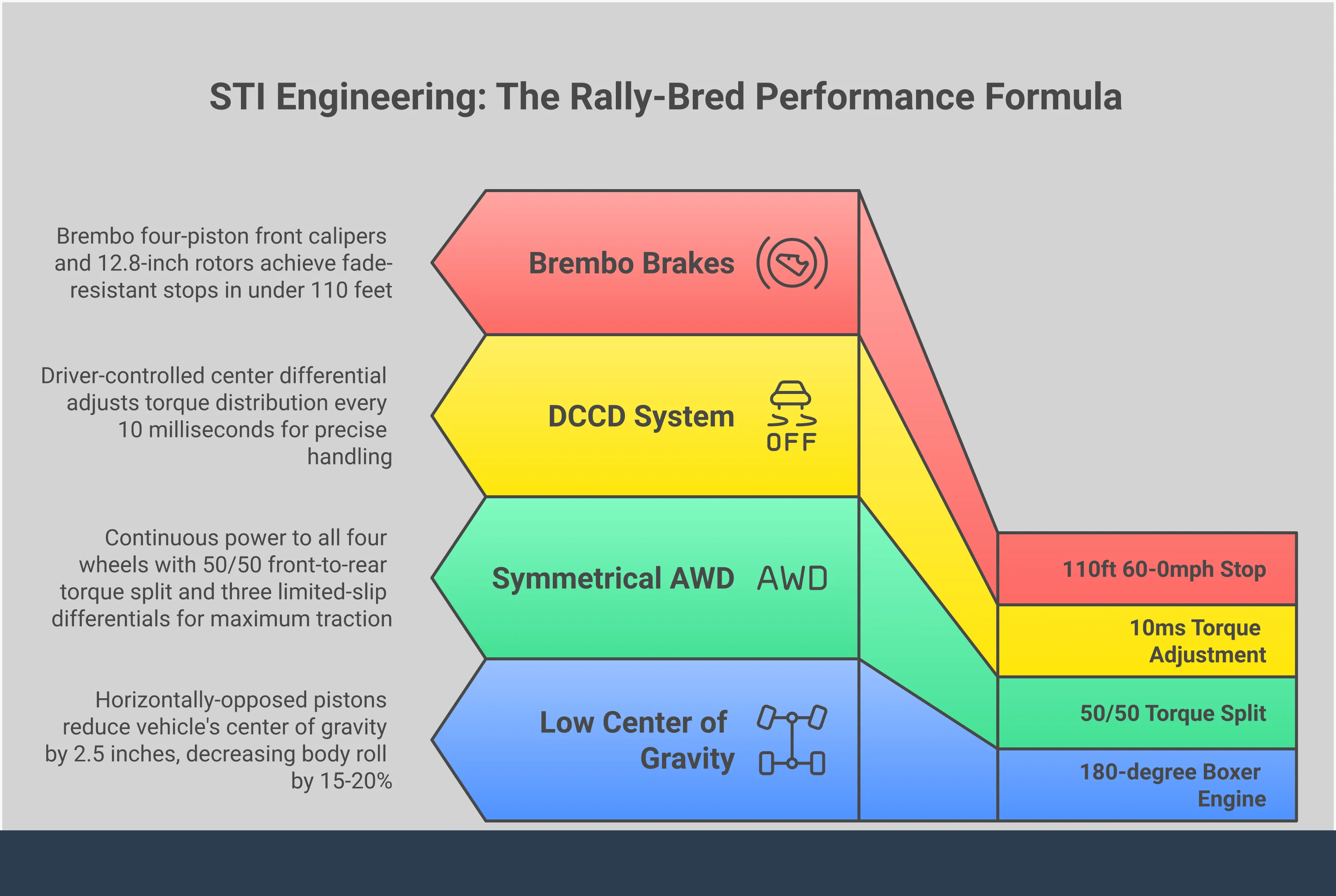
The STI wasn't just a powerful car; it was a showcase of intelligent performance technology. While its rally-bred looks turned heads, the real magic was happening underneath. Subaru Tecnica International didn't just add more horsepower. It engineered a suite of systems that worked in harmony to deliver a driving experience that was thrilling, precise, and deeply connected to the road. These innovations are what separated the STI from the pack and cemented its status as a performance icon. From the unique engine layout to the advanced drivetrain controls, every piece of technology had a purpose: to create the ultimate driver's car. Let's explore the core technologies that made the STI so revolutionary.
The Signature Rumble: Subaru's Boxer Engine
At the heart of every STI is the iconic turbocharged boxer engine. Unlike conventional engines where pistons move up and down, the boxer's pistons move horizontally, like a fighter throwing punches. This flat design gives the engine a much lower profile, allowing it to sit deep in the chassis. The result is a lower center of gravity, which is the secret sauce for the STI's incredible handling and stability in corners. When you add a turbocharger to the mix, you get the explosive power and signature rumble that defines the STI experience. This unique engine is a brilliant foundation for building a true performance machine, and it responds exceptionally well to performance parts designed to maximize its potential.
The All-Weather Advantage: Symmetrical AWD
Subaru's Symmetrical All-Wheel Drive is more than just a marketing term; it's a fundamental design philosophy. The entire drivetrain, from the engine to the rear differential, is laid out in a straight, symmetrical line. This balance ensures that power is distributed to all four wheels smoothly and continuously, providing phenomenal grip and control. Whether you're launching from a stop, carving through a wet corner, or navigating a loose gravel road, the system works to find traction everywhere. This constant engagement is what gives the STI its famously confident and planted feel, making it a formidable performer in almost any condition you can throw at it.
Putting You in Control: The DCCD System
The Driver Controlled Center Differential (DCCD) is what truly puts the "driver" in control of the STI's all-wheel-drive system. This advanced technology allows you to adjust the center differential, managing the torque split between the front and rear wheels. In Auto mode, the system intelligently adapts to changing conditions. But for those who want to fine-tune their car's behavior, Manual mode is where the fun begins. You can send more power to the rear for a classic rear-wheel-drive feel or lock the differential for maximum grip. This level of control allows you to tailor the car's handling characteristics to your exact preference, making your Subaru STI upgrades even more effective on the track or street.
Fine-Tuning Your Drive: Vehicle Dynamics Control
Vehicle Dynamics Control (VDC) is Subaru's version of an electronic stability system, but in the STI, it's anything but a simple on-or-off switch. The multi-mode system acknowledges that skilled drivers sometimes need more freedom. It offers different settings, including a "Traction" mode that reduces intervention and allows for more wheelspin, perfect for spirited driving without completely disabling the safety net. For track days, you have the option to turn the system off entirely. This approach demonstrates STI's trust in the driver, providing advanced tools that enhance the experience rather than limiting it. It’s a system designed for performance, giving you the confidence to push the limits.
What Are the Most Iconic STI Special Editions?
Beyond the standard production models, Subaru Tecnica International has a celebrated history of releasing limited-run special editions that push the boundaries of performance. These cars are the stuff of legend, often built to celebrate motorsport victories or to serve as the ultimate expression of Subaru's engineering prowess. For collectors and die-hard fans, these models represent the holy grail of the STI lineage, combining rarity with track-honed enhancements that set them apart from anything else on the road. From widebody rally monsters to lightweight track weapons, each special edition tells a unique story in the STI saga.
These aren't just STIs with a few extra badges. They are meticulously re-engineered vehicles where every component is scrutinized for performance gains. Think of them as passion projects from the engineers at STI, where they get to apply their race-winning knowledge without the constraints of mass production. This results in cars with sharper handling, more responsive engines, and an overall character that feels distinctly more aggressive and focused. Owning one is like having a piece of motorsport history in your garage. Their extreme rarity and factory-tuned nature make them highly sought-after, often appreciating in value and becoming benchmarks against which all other performance Subarus are measured.
The Holy Grail: Subaru's 22B STI
Talk about a legend. The 1998 22B is arguably the most famous STI ever made. Created to celebrate Subaru's 40th anniversary and its third consecutive WRC title, it was a rally car for the street in the purest sense. It featured a distinctive widebody design pulled straight from the WRC cars, a larger 2.2-liter EJ22 engine, and a specialized Bilstein suspension. Only 400 were produced for the Japanese market, and they famously sold out in a matter of minutes. The 22B wasn't just a car; it was a statement and a piece of history you could own. It remains the ultimate dream car for many Subaru enthusiasts.
The Legendary 2.2-Liter EJ22 Engine
The EJ22 engine is the heart of the 22B's legendary status. It was more than just a bored-out motor; it was a symbol of Subaru's commitment to rally-bred engineering. The distinctive flat-four design was crucial, creating a low center of gravity that gave the 22B its famously sharp handling and stability. This engine philosophy is a core part of the STI's performance legacy, proving that intelligent design is just as important as raw power. The larger 2.2-liter displacement produced impressive torque, making the car incredibly responsive and a thrill to drive on any road, not just a rally stage.
Japan's Finest: The S-Series Models
If the 22B was a one-off celebration, the S-Series models became a recurring tradition of excellence. Starting with the S201, these Japan-exclusive editions represented the pinnacle of what STI could achieve with each generation of the WRX STI. Each S-model received a host of upgrades, including more power from a finely tuned engine, sharper handling from bespoke suspension components, and unique aerodynamic parts. These cars are highly sought after by enthusiasts for their rarity and factory-tuned performance parts. The S-Series proved that even when the standard STI was already incredible, there was always another level of performance to find.
The Hand-Assembled S206
Among this elite family, the 2012 S206 variant stands out as a testament to pure craftsmanship. This Japan-only model featured a 2.0-liter engine that was meticulously hand-assembled to produce 316 horsepower. This level of personal attention is a rarity in modern automotive manufacturing, highlighting the precision and care that defined the S-series ethos. But the S206 was more than just a powerful engine; it was a complete performance package. STI engineers paired the engine with a specially tuned suspension and unique aerodynamic enhancements. The result was a cohesive, deeply engaging car that offered a driving experience so refined and focused, it remains one of the most coveted STI models ever built.
Record Breakers and Final Farewells: Type RA & Final Editions
For drivers who prioritize lap times above all else, STI created the Type RA models. The "RA" stands for "Record Attempt," and these cars lived up to the name. They were stripped-down, lightweight versions designed for competition, often ditching creature comforts like air conditioning and radios to save every possible pound. Fast forward to the end of an era, and Subaru released the "EJ25 Final Edition" in 2020. Based on the top-spec STI, it was a send-off for the legendary engine, featuring unique gold wheels and exclusive badging. With only 75 units made, it was an instant collector's item for those wanting to own the final chapter of the classic Subaru STI Upgrades story.
Exclusive Models for Global Markets
The UK's RB320 and Cosworth CS400
While Japan got the S-Series, other markets received their own incredible special editions. The UK, in particular, was home to some legendary STIs that made enthusiasts worldwide jealous. A prime example is the 2007 RB320, a limited run of 320 cars built in memory of rally champion Richard Burns. It wasn't just a badge; it featured a Prodrive performance pack for 320 horsepower and a specially tuned suspension. Later, the Cosworth CS400 took things to another level. This 2010 model was a collaboration with the famed engine builder Cosworth, resulting in a nearly 400-horsepower monster. These factory-tuned specials showed what was possible, inspiring owners everywhere to seek that same level of performance for their own Subaru STI upgrades.
Lighter and Faster: The Spec C Models
For the purists who believed less is more, STI offered the Spec C models. These Japan-exclusive cars were built with a singular focus: raw, uncompromised performance. The "C" stands for "Competition," and STI took that seriously by putting the car on a strict diet. They removed sound deadening, used thinner glass, and installed a lighter roof panel to shed weight and lower the center of gravity. But it wasn't just about subtraction. As noted by automotive outlets like MotorTrend, Spec C models also received enhancements like quicker steering racks, ball-bearing turbos, and dedicated engine and suspension tuning. They were the ultimate track-ready STIs, embodying a philosophy that every enthusiast understands: a better power-to-weight ratio is the key to going faster.
What Makes the WRX STI So Desirable?
The Subaru WRX STI isn't just a car; for many, it's an icon. Its appeal goes far beyond its spec sheet, creating a loyal, global community that few other vehicles can claim. So, what is it about the STI that captures the hearts of driving enthusiasts? It’s a unique combination of raw, rally-proven engineering, a cockpit that puts you at the center of the action, and a suite of high-performance components that work in perfect harmony. This blend creates an experience that feels both visceral and incredibly precise, making every drive an event.
From the moment you get behind the wheel, the STI communicates its purpose. It doesn't coddle you with excessive luxury or sound-deadening materials that isolate you from the experience. Instead, it offers a direct, unfiltered connection to the road through tactile steering, a firm suspension, and the unmistakable rumble of its boxer engine. This desirability is built on a foundation of motorsport heritage, where every component was chosen and refined for performance. The aggressive stance, the signature wing, and the functional hood scoop all hint at the car's capabilities. It’s a machine designed to be driven, felt, and experienced, which is why so many owners are passionate about personalizing and improving upon its already impressive formula.
Bringing Rally Performance to the Street
The STI’s soul was forged in the dirt, gravel, and snow of the World Rally Championship. This isn't just a marketing tagline; it's the car's origin story. Subaru Tecnica International used the intense world of rally racing as a real-world laboratory, pushing its engineering to the absolute limit. The technologies perfected on the rally stage, from the turbocharged engine to the all-wheel-drive system, were directly integrated into the street cars you could buy. This heritage is why the STI feels so responsive and capable, giving you the confidence to tackle any road with precision. It’s a legacy you can feel in every corner and acceleration, inspiring owners to install performance parts that honor its competitive spirit.
Critical Acclaim and Market Reception
When the STI finally hit the market, it wasn't just a success; it was a phenomenon. Performance enthusiasts had been dreaming of a street-legal car with the heart of a rally champion, and Subaru delivered exactly that. The US model's arrival with 300 horsepower put it in direct competition with sports cars costing twice as much, instantly cementing its status as a performance icon. This accessible power and capability fostered a massive, passionate community of owners and tuners. Now that the classic STI is no longer in production, these cars are more cherished than ever, serving as the perfect canvas for owners looking to preserve and enhance its incredible legacy with high-quality Subaru STI upgrades.
An Interior Built for the Driver
Step inside an STI, and you’ll find an interior that’s all about the business of driving. The design is purposeful, prioritizing function over flash. Your hands fall naturally onto an STI-branded shifter and steering wheel, while the sport-bolstered seats (including iconic Recaro options in some models) hold you firmly in place. The gauge cluster provides clear, essential information, often highlighted with signature red accents that underscore the car's performance-oriented nature. This driver-focused environment minimizes distractions and maximizes your connection to the vehicle and the road. It’s a cockpit built to make you feel like a part of the machine, creating an immersive and engaging driving experience every time you turn the key.
Stopping Power and Perfect Handling
The STI’s incredible handling isn't an accident; it's the result of carefully selected and tuned components. Many models came standard with high-performance Brembo brakes, renowned for their immense stopping power and resistance to fade during spirited driving. This braking capability gives you the confidence to push the car harder, knowing you have control. Complementing the brakes is a suspension system tuned specifically for performance. It works in concert with the Symmetrical All-Wheel Drive and Driver Controlled Center Differential (DCCD) to deliver exceptional grip and stability. This synergy is what makes the STI feel so planted and agile, and it’s why many enthusiasts seek Subaru STI upgrades to further refine that legendary handling.
How Did STI Change Car Culture?
The Subaru STI did more than just win rallies and set lap times; it fundamentally shifted the automotive landscape. Its influence reached far beyond the track, creating a new standard for performance, fostering a dedicated global community, and proving that world-class speed could be within reach for the everyday driver. The STI wasn't just a car; it was a movement that left a permanent mark on car culture. It inspired a generation of enthusiasts to see what was possible when rally-bred engineering met street-legal passion, a legacy that continues every time an owner turns a wrench or takes a perfect corner.
Redefining All-Wheel Drive Performance
Before the STI became a household name, all-wheel drive was mostly associated with trucks and family cars designed for snowy roads. Subaru Tecnica International completely flipped that script. By leveraging its rally-proven Symmetrical All-Wheel Drive, STI demonstrated that powering all four wheels was the key to unlocking incredible grip and cornering speed on any surface. This "offbeat" engineering focus, once seen as a quirk, became STI's greatest strength. The brand set a new benchmark, showing the world that a practical sedan could handle with the ferocity of a purpose-built sports car. This legacy inspires owners to continue pushing the limits with modern performance parts.
More Than a Car: Building a Global Community
Owning an STI has always been about more than just driving; it’s about belonging. Thanks to its rich motorsports history and unmistakable boxer rumble, the car attracted a passionate and loyal following from day one. This shared enthusiasm built a global community connected by a love for the brand and a desire to personalize their vehicles. From local meetups to sprawling online forums, STI owners created a culture of mutual respect and shared knowledge. This tight-knit community is built on the foundation of modifying and celebrating these iconic cars, with many enthusiasts seeking out specialized Subaru STI upgrades to make their vehicle uniquely their own.
Making Performance Accessible to Everyone
When the Impreza WRX STI arrived in the U.S. in 2004, it was a game-changer. It delivered blistering acceleration and track-ready handling that could challenge exotic sports cars, but for a fraction of the price. The STI made elite performance accessible. It proved you didn't need a massive budget to own a car that was both a competent daily driver and a weekend warrior. This combination of performance, practicality, and value forced competitors to rethink their own offerings. The STI, along with its sibling, the WRX, created a new category of vehicle and cemented its place in history as the people's performance hero. This spirit lives on as owners continue to enhance their vehicles with Subaru WRX upgrades.
Beyond the WRX: STI's Influence on Other Subaru Models
While the WRX STI is the undisputed star of the show, Subaru Tecnica International didn't limit its engineering genius to just one model. The same philosophy that made the STI a rally legend—a focus on balance, control, and driver engagement—was applied to other vehicles in the Subaru family. This practice not only showcased the versatility of STI's expertise but also created some of the most interesting and unexpected performance models on the market. From family wagons to practical SUVs, STI proved that its performance DNA could enhance almost any platform, creating unique driving experiences for a wider range of enthusiasts.
These special editions weren't just marketing exercises; they were genuine performance upgrades that transformed the character of the base cars. STI would often raid the WRX STI parts bin, fitting more powerful engines, stronger transmissions, and track-tuned suspensions into unassuming models. This created a lineup of "sleepers" that could surprise much more expensive sports cars. It also demonstrated a core belief at STI: that a thrilling drive shouldn't be limited to a single flagship car. This approach broadened the brand's appeal and left a lasting mark on models you might not immediately associate with high performance.
Tuning the Forester, Legacy, and BRZ
Many enthusiasts might be surprised to learn that the very first road car to wear an STI badge wasn't an Impreza. As MotorTrend points out, the first STI road car was actually a Legacy released in 1992. This set the precedent for STI to apply its magic across the lineup. Perhaps the most famous example is the Forester STI, a JDM-only model that combined the practicality of an SUV with the heart of a WRX STI, creating a cult classic. Similarly, the BRZ tS ("tuned by STI") focused on perfecting the coupe's already brilliant handling with chassis and suspension upgrades, proving that STI's expertise was about more than just raw power. These projects show how STI could tailor its approach to enhance the core strengths of any vehicle, from family haulers to nimble sports cars.
Understanding STI's Naming: "tS" and Other Variants
To truly appreciate STI's work, it helps to understand their naming conventions. The "tS" or "Tuned by STI" models, like the BRZ tS, typically feature enhancements focused on handling and driver feedback. These cars receive upgrades like stiffer springs, performance dampers, chassis bracing, and aerodynamic tweaks, all designed to sharpen the driving experience without necessarily adding horsepower. In contrast, the "S-series" models (like the S209) are the ultimate, limited-edition flagships. They receive comprehensive upgrades, including hand-built engines, more power, and exclusive components. These different tiers show that STI offered a range of performance parts and tuning philosophies, from subtle refinements to all-out track weapons.
Why Was the WRX STI Discontinued?
The news hit the car community hard: Subaru announced it would not produce a new internal combustion engine (ICE) version of the WRX STI for the current generation. For decades, the STI was the pinnacle of Subaru's rally-bred performance, a street-legal icon that offered raw power and incredible handling. So, why did Subaru decide to shelve its most legendary nameplate? The decision wasn't made lightly. It was a combination of the legendary EJ engine reaching its final chapter, tightening global regulations, and a strategic shift toward the future of automotive performance. While it marks the end of an era, it also opens the door to what's next for Subaru's performance division.
Saying Goodbye to the Legendary EJ Engine
At the heart of the STI's discontinuation was the retirement of its iconic engine. The EJ series, specifically the EJ257 in the U.S. models, had been the soul of the STI for years. However, this celebrated powerplant had reached the end of its development road. After decades of service, updating the old architecture to meet modern emissions and efficiency standards was no longer feasible. Subaru commemorated the engine's legacy with a special "EJ25 Final Edition" in 2020, a fitting send-off for a motor that defined a generation of performance. For owners looking to keep their EJ-powered cars at their peak, investing in quality Subaru STI upgrades is more important than ever.
Adapting to a Changing Automotive World
Beyond the engine's retirement, Subaru faced mounting pressure from external forces. Governments worldwide are implementing stricter emissions regulations, making it incredibly expensive and challenging to develop a new, high-performance gasoline engine from scratch. The automotive market is also rapidly shifting towards electrification. For a relatively small automaker like Subaru, investing billions into a new ICE platform for a niche model like the STI didn't align with its long-term vision. The company had to make a tough business decision, prioritizing resources for developing the next generation of performance vehicles that can thrive in a changing landscape.
What's Next for Subaru Performance?
While the gas-powered STI as we knew it is gone, the spirit of Subaru Tecnica International is far from over. Subaru continues to offer "tuning by STI" parts and accessories for the standard WRX, allowing owners to get a taste of that legendary performance. The company has also hinted at the future, with prototypes suggesting a move toward hybrid or fully electric performance models. Rally racing was always the proving ground for STI technology, and that commitment to engineering excellence will undoubtedly shape whatever comes next. In the meantime, the enthusiast community and expert tuners are keeping the legacy alive, pushing the limits of existing platforms with cutting-edge performance parts and custom builds.
Related Articles
- Subaru Engine Racing: A Pro Builder's Guide
- The Pro's Guide to Subaru Engine Racing Builds | Crawford Performance
- The Subaru Advantage: A Complete 2026 Guide
Frequently Asked Questions
What's the real difference between a WRX and an STI? Think of the WRX as the talented athlete and the STI as the Olympic champion. While both share the same core DNA, the STI is the version that Subaru’s performance division, Subaru Tecnica International, has meticulously enhanced for maximum performance. This typically includes a more powerful engine, a stronger six-speed transmission, advanced drivetrain controls like the DCCD, superior Brembo brakes, and a suspension tuned for the track. The STI is, in every sense, the ultimate factory-built expression of Subaru's rally heritage.
Why is the boxer engine so important for the STI's handling? The boxer engine is the secret sauce to the STI's famously sharp handling. Because its pistons move horizontally instead of vertically, the engine has a flat, low profile. This allows engineers to place it deeper in the chassis, significantly lowering the car's center of gravity. A lower center of gravity means less body roll in corners and a more stable, planted feel. It’s a core part of why the STI feels so connected to the road and can change direction with such confidence.
Since the gas-powered STI is discontinued, how can I get that level of performance? The end of the STI's production doesn't mean the end of its performance legacy. The spirit lives on in two key ways. First, you can take a standard WRX, which is already a capable car, and use high-quality performance parts to build it into a machine that meets or even exceeds factory STI specifications. Second, existing STI models from 2004 to 2022 are fantastic platforms for modification. With professional tuning and the right upgrades, you can refine these cars to perfectly suit your driving style.
What makes special editions like the 22B so legendary? Models like the 22B are legendary because they represent the purest connection between a rally car and a street car. They weren't just STIs with a few extra badges; they were limited-run, re-engineered vehicles built to celebrate major motorsport victories. They often featured unique components, like wider bodies and hand-tuned engines, that were pulled directly from the competition cars. This combination of extreme rarity and factory-honed, purpose-built performance makes them the ultimate collector's items for enthusiasts.
Is an STI practical for daily driving, or is it just a track car? This is one of the best things about the STI: it’s a brilliant dual-purpose car. While its suspension is firm and its nature is aggressive, it’s still based on a practical sedan or hatchback. You get four doors, a usable trunk, and the all-weather confidence of Symmetrical All-Wheel Drive. It’s a car that can handle a grocery run or a daily commute just as well as it can handle a weekend track day. That blend of thrilling performance and everyday usability is a huge part of its lasting appeal.