

The Ultimate Crosstrek Overland Build Guide
Your Subaru Crosstrek is a master of duality. It’s the efficient car you trust for your daily commute, but it has a secret: it’s built for more. If you’ve ever felt the pull to see where that dirt road leads, you already know what I'm talking about. This guide is your complete roadmap for transforming your daily driver into a confident trail machine. We’ll cover the essential modifications, from suspension and tires to armor and recovery gear, showing you exactly how to create a smart and capable Crosstrek overland build ready for your next big adventure.
Key Takeaways
- Focus on Capability Before Comfort: Prioritize the upgrades that make your Crosstrek trail-ready from the start. A quality suspension lift, all-terrain tires, and underbody skid plates are the essential foundation for safe and reliable off-road travel, long before you add camping accessories.
- Build a Balanced and Systemic Rig: Every modification impacts your vehicle's performance, especially its payload capacity. Choose parts that work together, like upgrading your brakes to handle the extra weight of gear, and always distribute heavy items low and centered to maintain stability.
- Pack for Problems, Not Just the Destination: A successful trip depends on being prepared for the unexpected. Your most critical gear includes a solid recovery kit, a comprehensive first-aid kit, and a reliable off-grid communication device to ensure you can handle challenges safely and self-sufficiently.
Why Your Crosstrek is Built for Overlanding
If you’re looking for a capable, reliable, and efficient platform for your overland build, you’ve made a solid choice with the Subaru Crosstrek. This compact SUV punches well above its weight class, offering a fantastic starting point for adventure. Before we get into specific modifications, let's cover the core features that make the Crosstrek a natural fit for life on the trail. Its smart design combines daily drivability with a surprising amount of off-road prowess, giving you a versatile vehicle ready for whatever you throw at it. From its legendary AWD system to its practical interior, the Crosstrek has the DNA of a true explorer.
Understanding Your Crosstrek's Capabilities and Limitations
The Subaru Crosstrek is a fantastic vehicle for overlanding because it strikes a perfect balance between a comfortable daily driver and a machine with serious off-road potential. To get the most out of it, you need to understand its design. The Crosstrek is a unibody crossover, which means its body and frame are a single piece. This construction gives it a smoother, more car-like ride on pavement and better fuel efficiency for those long trips to the trailhead. While it’s incredibly capable for its class, it’s important to set realistic expectations. This isn’t the vehicle for extreme rock crawling, but it’s more than ready to tackle forest service roads, muddy trails, and remote campsites with confidence.
How it Compares to Heavy-Duty Off-Roaders
It’s helpful to know where the Crosstrek fits in the broader off-road landscape. While a modified Crosstrek is a formidable crossover, it's not a heavy-duty off-road vehicle like a Jeep Wrangler or Toyota 4Runner. Those vehicles are built on truck frames and often feature solid axles and true low-range gearing, giving them an edge in highly technical, slow-speed crawling situations. The Crosstrek’s advantage lies in its versatility. It provides superior on-road handling and fuel economy, making it a more practical choice for adventurers whose journeys involve significant highway miles before the dirt begins. It’s about choosing the right tool for your specific adventure.
Factory Features That Give You an Edge
Subaru didn't just build a car and call it an SUV; they engineered the Crosstrek with a solid foundation for adventure right from the factory. One of its most significant advantages is its ground clearance, which starts at an impressive 8.7 inches and goes up to 9.3 inches on the Wilderness model. This clearance allows you to clear obstacles that would stop other vehicles in their tracks. Paired with Subaru's legendary Symmetrical All-Wheel Drive system, which constantly sends power to all four wheels for maximum traction, the Crosstrek has a built-in advantage before you even add a single modification. These core features provide a reliable and capable platform to build upon.
Dual-Function X-MODE® Explained
Think of X-MODE® as your Crosstrek’s off-road brain. Standard on all models, this system optimizes the engine, transmission, and AWD system to reduce wheelspin and improve control on slippery surfaces like mud or gravel. On the Premium trim and higher, you get "Dual-Function" X-MODE, which adds a second, more aggressive setting for "Deep Snow/Mud." This mode allows for a bit more wheelspin, which can be necessary to churn through deep, loose terrain and maintain momentum. It’s an incredibly smart feature that works with the vehicle’s mechanics to give you more grip and confidence when you need it most.
Durable Interior and Tires on Wilderness Trims
If you have a Wilderness model, you’re already a step ahead with an interior designed for adventure. The StarTex® upholstery is a game-changer; it’s water-resistant, durable, and incredibly easy to clean after a muddy hike or a day with the dogs. This material lets you live the outdoor lifestyle without worrying about ruining your seats. Furthermore, the Wilderness trim comes equipped with capable all-terrain tires from the factory. While many serious overlanders eventually upgrade their tires, the stock Yokohama GEOLANDAR®s are a fantastic starting point, offering a great balance of on-road manners and off-road grip for your initial adventures.
The Advantage of a 4-Wheel Independent Suspension
One of the Crosstrek's standout features is its four-wheel independent suspension. Unlike the solid axles found on some traditional trucks, this setup allows each wheel to move up and down on its own. When you encounter a bump or a dip on the trail, the independent suspension helps keep the other three tires firmly planted on the ground, maximizing traction and stability. This design is also the reason the Crosstrek handles so well on paved roads, providing a smooth and controlled ride. For those looking to improve this already great system, targeted Crosstrek upgrades like lift kits can provide additional ground clearance and travel, further enhancing its trail performance.
Built-In Safety: The 5-Star NHTSA Rating
Overlanding isn't just about capability; it's about getting to your destination and back home safely. The Subaru Crosstrek consistently earns a 5-star overall safety rating from the National Highway Traffic Safety Administration (NHTSA), a testament to its strong chassis and advanced safety features. This provides crucial peace of mind, especially when you’re traveling long distances on highways or navigating unfamiliar backroads. Features like Subaru's EyeSight Driver Assist Technology also add an extra layer of security for the long stretches of pavement that often bookend an off-road adventure, helping you arrive at the trail feeling fresh and ready to explore.
How Symmetrical AWD Gives You More Control
One of the biggest reasons Subarus excel off-road is their standard Symmetrical All-Wheel Drive system. Unlike many part-time or slip-then-grip systems, Subaru's AWD is always on, constantly distributing power to all four wheels. This provides incredible traction and stability on loose or uneven surfaces like gravel, mud, and snow. When one wheel starts to lose its grip, the system instantly redirects torque to the wheels that have traction, keeping you moving forward with confidence. This proactive approach is a game-changer on the trail, giving you the control you need to handle challenging terrain without hesitation.
Why Ground Clearance Matters on the Trail
The Crosstrek comes from the factory with impressive ground clearance, which is crucial for clearing obstacles on the trail. Most models boast 8.7 inches, while the Wilderness edition steps it up to a massive 9.3 inches. This generous height helps you drive over rocks, ruts, and other hazards without damaging your vehicle's undercarriage. While this is a great starting point, many overlanders choose to add even more clearance with suspension lifts. This initial advantage means you can tackle more demanding trails right away and have an even more capable rig once you start adding Crosstrek upgrades.
Making the Most of Your Cargo Space
For a compact SUV, the Crosstrek offers a surprisingly roomy and flexible interior. With flat-folding rear seats, you can open up a significant amount of cargo space for all your gear, from recovery equipment to camping supplies. The wide rear gate opening makes loading and unloading bulky items much easier. This versatility is key for overlanding, where efficient packing is everything. You can comfortably fit your essentials inside while keeping the cabin organized for long trips. This smart use of space means you don't have to compromise on bringing the gear you need for a successful adventure.
How Fuel Efficiency Extends Your Adventures
Long-distance travel is the heart of overlanding, and that’s where the Crosstrek’s fuel efficiency really shines. Its design ensures you get great gas mileage, allowing you to cover more ground between fuel stops. This is a huge advantage when you’re exploring remote areas where gas stations are few and far between. Better fuel economy means you can extend your trips, carry less extra fuel, and spend more of your budget on the adventure itself. It’s a practical benefit that makes the Crosstrek one of the most sensible choices for building out your dream overlanding solution.
Your First Essential Overland Mods
Before you start planning your trips, you need to give your Crosstrek a solid foundation for off-road travel. The right initial modifications are less about aesthetics and more about capability and protection. These first few upgrades will make the biggest impact on your vehicle’s performance, allowing you to tackle more challenging terrain with confidence. Think of these as the essentials that prepare your Subaru for the demands of the trail, ensuring you can get where you’re going—and back again—safely. By focusing on these core areas first, you build a reliable platform that you can then customize with camping gear and other accessories.
Why a Suspension Lift Should Be Your First Step
One of the first and most effective upgrades for any Crosstrek build is a suspension lift. Lifting your vehicle gives you critical ground clearance, which helps you clear rocks, ruts, and other obstacles on the trail without damaging your undercarriage. For most Crosstreks, a 2-inch suspension lift is the recommended sweet spot. Going any higher can introduce stress and potential problems with other components like your CV axles. A quality lift kit not only raises your vehicle but also allows you to fit larger, more capable tires, which is another essential step in preparing your rig for adventure. It’s a foundational mod that directly improves your off-road capability.
Add Skid Plates to Protect Your Drivetrain
Your Crosstrek’s underbelly houses its most vital components—the engine, transmission, and rear differential. On the trail, these parts are vulnerable to impacts from rocks and debris that can end your trip in an instant. Before you even think about adding camping gear, you need to focus on protection. Installing a full set of skid plates is non-negotiable for serious overlanding. These plates act as armor, shielding your vehicle’s critical parts from damage. At the same time, you should add strong, frame-mounted recovery points. These are essential for getting unstuck safely without causing damage to your vehicle’s body or frame.
Why All-Terrain Tires Are a Game-Changer
Tires are your vehicle’s only connection to the ground, and they make a massive difference in performance. The stock tires on your Crosstrek are designed for quiet, efficient highway driving, not for rugged trails. Upgrading to a quality set of all-terrain (A/T) tires is key. A/T tires provide significantly better grip on dirt, gravel, and rock while being far more resistant to punctures from sharp objects. This single upgrade will transform how your Crosstrek handles off-road conditions, giving you the traction and durability you need to explore with confidence. Don’t overlook this step; it’s one of the most important Crosstrek upgrades you can make.
Carry More Gear with a Roof Rack
The Subaru Crosstrek is a compact SUV, which means interior cargo space is at a premium, especially when you’re packing for a multi-day trip. A roof rack is the perfect solution for expanding your storage capacity. It allows you to securely carry bulky items outside the vehicle, freeing up valuable interior space. You can use smart overlanding solutions like a roof rack, cargo cases, and other organizers to keep your gear secure and easy to reach. A rack is also the mounting point for essential items like a rooftop tent, traction boards, an awning, or extra fuel and water containers, making it a versatile and indispensable part of any build.
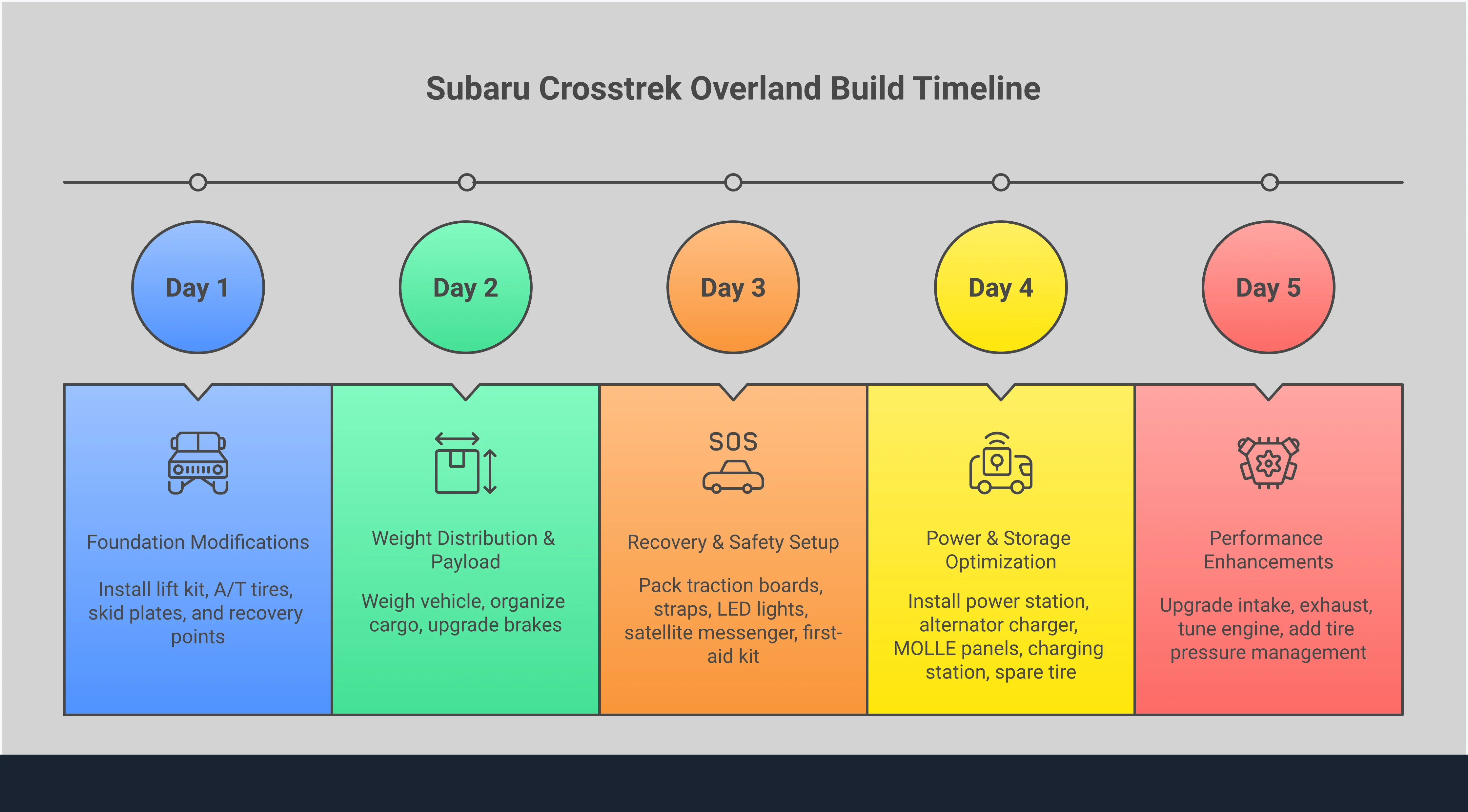
Which Performance Upgrades Offer the Best Gains?
Once you’ve handled the foundational mods like tires and suspension lifts, you can focus on enhancing your Crosstrek’s performance. These upgrades are about refining your vehicle’s power, handling, and reliability for the unique demands of overlanding. Adding weight from gear, pushing through difficult terrain, and navigating long descents all put extra strain on your vehicle’s stock components. The right performance parts don’t just make your Crosstrek more capable; they give you the confidence to push further down the trail. Let’s look at the key systems where targeted upgrades can make a significant impact on your driving experience.
Fine-Tune Your Handling with Crawford Performance Suspension
A quality suspension system does more than just lift your vehicle; it transforms how your Crosstrek feels on and off the road. Upgrading your suspension improves handling and ride quality, giving you better control and stability when navigating rough, uneven trails. Think of it as the key to unlocking the full potential of Subaru’s Symmetrical All-Wheel Drive system. A well-tuned suspension keeps your tires planted on the ground, maximizing traction where you need it most. This means a smoother, more composed ride over washboard roads and the durability to handle the extra weight of all your overlanding solutions and gear without compromising performance.
Upgrading Springs for Heavy Loads
As you add weight to your Crosstrek with bumpers, a rooftop tent, and other gear, you’ll quickly find that the stock suspension wasn't designed to handle that constant load. This extra weight can cause the rear of your vehicle to sag, which negatively affects your ground clearance, handling, and even headlight aim. The solution is to install stiffer springs specifically designed for heavy loads. These springs provide the necessary support to maintain a level ride height, preventing your suspension from bottoming out on bumps and dips. By choosing the right overlanding solutions, you ensure your Crosstrek remains stable and predictable, giving you better control on technical trails and a more comfortable ride on long highway stretches.
Getting More Power from Your Engine
While the Crosstrek is a capable vehicle, adding extra weight from bumpers, racks, and gear can make it feel a bit sluggish, especially on steep inclines. Thoughtful engine upgrades can restore that responsive feel and give you the power you need to tackle challenging terrain with confidence. A cold air intake, for example, helps your engine breathe better, improving efficiency and throttle response. For a more comprehensive approach, our expert engine tuning services can remap your engine’s computer to optimize power delivery for the specific demands of a fully loaded overland rig, ensuring you have power on tap when you need it.
How an Exhaust System Improves Performance
An engine is essentially an air pump—the more efficiently you can move air through it, the better it performs. An aftermarket exhaust system is a crucial part of that equation. By reducing the back pressure found in restrictive factory systems, a performance exhaust allows your engine to exhale more freely. This can lead to noticeable improvements in horsepower and torque, which is especially helpful when your engine is working hard on the trail. Beyond the performance gains, you’ll also get a more refined, aggressive exhaust note that enhances the driving experience without being overly loud. It’s a simple upgrade that helps your engine work smarter, not harder.
Upgrade Your Brakes for Better Stopping Power
When you add hundreds of pounds of gear to your Crosstrek, you’re asking your factory brakes to work much harder. Upgrading your brake system is one of the most important safety modifications you can make to an overland build. High-performance brake pads and rotors provide the increased stopping power needed to manage that extra weight, especially on long, steep descents where brake fade can become a serious issue. Better brakes give you more control and a much higher degree of confidence and safety on the trail. Investing in quality Subaru Crosstrek upgrades for your braking system ensures you can stop safely and reliably, no matter what the trail throws at you.
How to Choose the Right Wheels and Tires
Your Crosstrek’s wheels and tires are its direct connection to the trail, making them one of the most critical upgrades for any overland build. The right combination enhances traction, increases ground clearance, and improves overall capability on rough terrain. This isn't just about achieving an aggressive look; it's about equipping your vehicle with the grip and durability needed to safely explore remote areas. Choosing the best setup involves balancing on-road comfort with off-road performance, so let's break down what you need to consider for your specific adventure style.
All-Terrain vs. Mud-Terrain: What's the Difference?
Deciding between all-terrain (A/T) and mud-terrain (M/T) tires is your first major choice. All-terrain tires, like the popular BFGoodrich KO2s, are the go-to for most overlanders. They offer a fantastic balance of off-road grip and on-road manners, performing well on everything from gravel roads to moderate trails without being excessively loud on the highway. Mud-terrain tires are a more specialized option. They provide maximum traction in deep mud and loose dirt but come with a trade-off: significant road noise and faster wear on pavement. For a build that sees a mix of daily driving and weekend adventures, all-terrains are almost always the more practical choice.
Choosing the Right Wheel Size for Your Crosstrek
Selecting the right wheel and tire size is key to optimizing your Crosstrek's performance. A modest increase in tire size can give you a valuable boost in ground clearance. For example, moving from a stock 225/60/17 tire to a 225/65/17 can add nearly an inch of lift. However, keep in mind that larger tires will make your speedometer and odometer slightly inaccurate. Wider wheels with a more aggressive offset can also enhance stability and give your Crosstrek a more rugged stance. These choices work hand-in-hand with other overlanding solutions like suspension lifts to create a fully capable rig.
Understanding Tire Size Changes and Speedometer Impact
When you install larger tires, you're changing the overall circumference, meaning they cover more ground with each rotation than the stock ones did. The catch is that your Crosstrek's computer is still calibrated for the original, smaller tire size. As a result, your speedometer will read a bit slower than your actual speed, and the odometer will log fewer miles than you've actually driven. While this might sound like a problem, it's a well-understood trade-off for the huge benefit of increased ground clearance. It's a standard part of building a rig with serious overlanding solutions and a small price to pay for the added capability you gain on the trail.
How to Manage Tire Pressure Off-Road
Proper tire pressure management is a fundamental off-roading skill. Lowering your tire pressure—or "airing down"—when you hit the trail increases the tire's footprint, improving traction on sand, rocks, and loose surfaces. It also helps smooth out the ride. Just as important is having a reliable air compressor to air back up before you hit the pavement. Remember that every piece of gear adds weight, impacting your vehicle's payload capacity and handling. Keeping heavy items low and centered helps maintain stability, and adjusting tire pressure accordingly ensures your vehicle performs its best under load.
Why You Need a Full-Size Spare Tire
When you upgrade to larger tires, your new spare probably won't fit in the factory location under the cargo floor. This is a detail that’s easy to overlook but critical to address. Getting a flat tire miles from civilization without a usable spare can turn an adventure into a serious problem. The best solution is to invest in a hitch-mounted or roof-mounted carrier for a full-size spare. This ensures you’re fully prepared for punctures or tire damage on the trail, giving you the peace of mind to push further into the backcountry.
The Benefits of a Swing-Away Tire Carrier
Once you have a full-size spare, a swing-away tire carrier is one of the most practical overlanding solutions you can add to your build. By mounting the tire to your hitch, you move it completely outside the vehicle, freeing up a significant amount of interior cargo space for gear and supplies. This not only helps keep your rig organized but also maintains a lower center of gravity compared to a roof-mounted tire, which improves stability on the trail. Furthermore, these carriers provide incredibly convenient access to your rear hatch. Instead of having to move a heavy tire every time you need to get into your trunk, you can simply swing the carrier open, making it much easier to load and unload equipment during your trip.
Essential Accessories for Your Overland Build
With your Crosstrek’s core performance handled, it’s time to add the accessories that make your build truly capable and comfortable on the trail. These are the items that provide safety, convenience, and the confidence to explore remote areas. From lighting up a dark trail to ensuring you have power for your devices, the right accessories complete your overlanding setup and prepare you for whatever the adventure holds.
See Clearly with Off-Road LED Lighting
Stock headlights won't cut it when you’re navigating a technical trail after sunset. Investing in quality auxiliary lighting is a critical safety upgrade. Consider adding a light bar to your roof rack or bumper for broad, long-distance illumination. Ditch lights, mounted near your A-pillars, are perfect for lighting up the sides of the trail to spot obstacles or wildlife. For the best performance in dust, fog, or snow, choose lights with a versatile combo beam pattern and a yellow lens. Make sure you use a strong, reliable mount to keep them secure over rough terrain, ensuring you always have a clear view of the path ahead.
Choosing the Right Recovery Gear
Getting stuck is an inevitable part of overlanding, but it doesn't have to end your trip. Being prepared with the right recovery gear is non-negotiable. Your kit should include a set of durable traction boards to get you out of sand, mud, or snow. Also, pack a quality recovery strap (not a tow strap) with the proper weight rating for your vehicle, along with a few soft shackles. This simple setup can handle most common recovery situations. Beyond vehicle recovery, always carry a comprehensive first-aid kit. These essential overlanding solutions are your lifeline when you’re miles from the nearest town, giving you the confidence to push further.
Adding a Winch and Bumper Guard
For serious off-road travel, a winch and a heavy-duty bumper guard are a powerful combination, providing both proactive protection and reactive self-recovery. A strong front bumper acts as your first line of defense, shielding your Crosstrek’s radiator, grille, and headlights from rocks, branches, and other trail hazards. As we've covered before, investing in quality aftermarket armor is one of the most effective ways to safeguard your vehicle's critical components. A winch-compatible bumper also gives you a solid platform to mount a winch—the ultimate tool for getting yourself out of tough situations when you're far from help. This setup ensures you're prepared for the worst-case scenarios the trail can throw at you, giving you the confidence to explore more challenging terrain.
Communication and Safety Gear for the Trail
Your smartphone is not a reliable communication tool in the backcountry. Once you lose cell service, you’ll need other options to navigate and call for help. A dedicated GPS unit with pre-downloaded offline maps is essential for staying on course. For emergencies, a satellite messenger like a Garmin inReach allows you to send an SOS signal and communicate via text from anywhere in the world. If you travel with a group, a set of two-way GMRS radios is the best way to stay in contact with your convoy on the trail. These devices are a crucial part of your Crosstrek upgrades and provide peace of mind when you're truly off the grid.
How to Power Your Gear Off-Grid
From navigation apps and cameras to camp lights and laptops, modern overlanding involves a lot of electronics. A portable power station is the best way to keep everything charged without draining your car battery. Look for a unit with enough capacity to last your entire trip and a variety of outputs, including USB, 12V, and 120V AC plugs. To keep your power station topped off while you drive between campsites, consider adding a DC-to-DC alternator charger. This setup ensures you have a reliable source of off-grid power, allowing you to stay out longer and keep all your essential performance parts and gadgets running smoothly.
Using Solar Panels to Recharge
To keep your portable power station running for days on end, you'll need a way to recharge it in the field. This is where solar panels become an essential part of your kit. Portable solar panels, often called "solar blankets," are a fantastic option because they are lightweight and pack down small, saving precious cargo space. When the sun is out, you can simply unfold them at your campsite, plug them into your power station, and let them passively collect energy. This setup gives you the freedom to stay off-grid for extended periods without ever having to start your engine to charge your batteries, ensuring you always have power when you need it.
Choosing Your Sleeping Setup
Where you sleep on the trail is one of the most personal decisions you'll make for your build. Your choice will depend on your budget, the type of trips you take, and how much comfort you need. The three main options—a rooftop tent, sleeping inside your Crosstrek, or using an awning with an annex—each come with their own set of advantages and trade-offs. There's no single right answer, so let's look at what each setup offers to help you decide which one best fits your adventure style.
Rooftop Tents
Rooftop tents are a popular choice for good reason. They offer a quick and easy setup, a comfortable built-in mattress, and keep you off the ground, away from mud, critters, and uneven terrain. However, they come with significant downsides. They are expensive, heavy, and their placement on your roof will negatively impact your fuel economy and center of gravity. A rooftop tent also occupies your entire roof rack, limiting space for other gear. If you go this route, make sure your overlanding solutions include a robust suspension system capable of handling the extra weight safely.
Sleeping Inside the Vehicle
For those who prioritize stealth, security, and simplicity, sleeping inside your Crosstrek is an excellent option. You’re protected from the elements and can camp discreetly when needed. The main challenge is space; you’ll need an organized system for moving your gear out of the way each night. To maximize comfort, you can get a special air mattress designed to fit the Crosstrek's cargo area perfectly, like those from Luno. While it means less room for gear inside the car, this setup is quiet, safe, and requires no setup time when you arrive at camp late at night.
Awnings and Annexes
A vehicle-mounted awning is one of the best ways to expand your living space at camp. It provides crucial shelter from sun and rain, creating a comfortable area for cooking, relaxing, or getting organized. Many awnings also offer the option to add walls, turning the covered space into a fully enclosed annex room. This can serve as a private changing area, a bug-free lounge, or even an extra sleeping space for friends or family. An awning is a versatile addition that dramatically improves the comfort and functionality of your campsite.
Keeping Food Fresh with a 12V Fridge
If you plan on taking trips that last more than a weekend, a 12V portable fridge/freezer is a true game-changer. Unlike a traditional cooler, a 12V fridge eliminates the need for ice, which means no more soggy food and no more searching for a store mid-trip to restock. These units, like the popular models from ARB, run efficiently off your portable power station and keep your food and drinks at a consistent, cold temperature. This upgrade allows you to bring fresh ingredients for better meals on the trail, extending your adventures and making your time in the backcountry much more enjoyable. It’s an investment that pays for itself in convenience and better camp cooking.
How to Maximize Your Storage and Organize Gear
An organized overland rig is more than just satisfying—it’s safer, more efficient, and makes life on the trail much easier. The Subaru Crosstrek is a capable platform, but its compact size means every inch of space counts. Thoughtful planning is key to bringing everything you need without overloading your vehicle or making it impossible to find your gear. A well-packed Crosstrek ensures your equipment is secure on rough terrain and easily accessible when you need it most, whether you’re setting up camp for the night or grabbing recovery gear in a pinch.
Before you start loading up, create a plan for where everything will live. Group similar items together and place frequently used gear where you can get to it without unpacking the entire car. This approach not only saves you time and frustration but also helps you maintain a balanced vehicle load, which is critical for performance and safety. By strategically organizing your setup, you can transform your Crosstrek into a highly functional and comfortable basecamp for any adventure.
Organizing Your Cabin with Interior Storage
Your Crosstrek’s cabin is your command center, so keeping it organized is essential. Start by using the small spaces effectively with console organizers, glove box dividers, and seat-back panels. These simple additions can create designated spots for maps, electronics, snacks, and other small items that tend to get lost. For more extensive setups, consider MOLLE panels on the seat backs or center console to attach pouches and holders for tools, first-aid kits, and communication devices.
It’s also crucial to plan your power system for charging phones, GPS units, and other electronics. Relying solely on your car’s main battery is a quick way to get stranded. A portable power station or a dual-battery setup ensures you have a dedicated power source for your accessories without risking a dead battery. This keeps your essential gear running and your mind at ease when you’re far from civilization.
Setting Up Your Rear Cargo Area
The rear cargo area is the heart of your storage system. To make the most of it, you need to go beyond simply stacking bins. A drawer system is an excellent investment, providing organized, slide-out compartments for kitchen supplies, tools, and other gear while creating a flat surface on top for larger items. If a full drawer system isn't in your plan, high-quality cargo boxes and a secure strapping system can keep everything in place.
To free up even more interior space, move bulky but lightweight items to the roof. A roof rack equipped with weatherproof cargo cases is perfect for storing camping chairs, sleeping bags, and recovery boards. This strategy keeps your cabin clear and your rear view unobstructed. Combining a well-organized cargo area with smart rooftop storage makes your entire setup more functional and secure, which is why we offer a range of overlanding solutions to help you build the perfect system.
How to Properly Distribute Weight in Your Rig
Every piece of gear you add contributes to your vehicle’s total weight, and how you distribute that weight directly impacts your Crosstrek’s handling and off-road capability. Pay close attention to your vehicle's payload capacity—the maximum weight it can safely carry. For a Crosstrek Wilderness, this is around 1,148 pounds, which includes passengers, gear, and any modifications.
The golden rule of packing is to keep your heaviest items as low and as close to the center of the vehicle as possible. This means things like water jugs, tool rolls, and recovery equipment should be secured deep in the cargo area, ideally between the axles. Placing heavy items on the roof can raise your center of gravity, making the vehicle less stable on off-camber trails and windy highways. Proper weight distribution is a fundamental part of building a capable rig.
The Ultimate Overlanding Gear Checklist
While every trip has unique demands, a core set of gear should always be in your Crosstrek. This isn't just about comfort; it's about being prepared for the unexpected. Think of this as your non-negotiable packing list that forms the foundation of your kit. You can always add trip-specific items, but these essentials should never be left behind.
Here’s a starting point for your essential gear:
- Recovery Gear: At a minimum, carry traction boards, a recovery strap, and soft shackles. A shovel is also incredibly useful.
- First-Aid Kit: Pack a comprehensive kit that goes beyond basic bandages. Include supplies for treating common trail injuries, burns, and allergic reactions.
- Communication: When you’re outside of cell service, you need a reliable way to call for help. A satellite messenger or personal locator beacon is a must-have.
- Vehicle Essentials: A tire repair kit, a portable air compressor, and a basic automotive tool kit can save you from a long walk. Don't forget a fire extinguisher.
How to Overcome Common Crosstrek Limitations
The Subaru Crosstrek is an incredibly capable platform right from the factory, but like any vehicle, it has its limits when you push it into serious overlanding territory. Understanding these limitations isn't about getting discouraged; it's about getting smart. With the right knowledge, driving techniques, and strategic modifications, you can work around these challenges and build a rig that confidently takes you where you want to go. A successful build is a balanced system where your vehicle, your gear, and your driving style all work in harmony.
Instead of seeing these as weaknesses, think of them as opportunities to fine-tune your build and your skills. Addressing things like gearing, weight, and clearance will make you a more thoughtful builder and a more competent driver on the trail. It’s about creating a cohesive setup that enhances the vehicle's natural strengths while mitigating its inherent constraints. By focusing on the right Crosstrek upgrades, you can effectively expand your vehicle’s comfort zone and unlock its full potential for adventure.
What to Do Without Low-Range Gearing
One of the first things you’ll hear is that the Crosstrek doesn't have low-range gearing. This is true. Unlike larger, body-on-frame trucks, it lacks the secondary set of gears designed for slow, high-torque crawling over extreme obstacles. This means your Crosstrek isn't built for intense rock crawling, and that’s okay. For most overlanding adventures, which prioritize exploration over technical challenges, this isn't a deal-breaker.
The key is to choose your trails carefully and use momentum to your advantage. The Crosstrek’s Symmetrical All-Wheel Drive is excellent at maintaining traction on loose or uneven surfaces. Focus on picking a good line, keeping your speed steady, and letting the AWD system do its job. You’ll find it can handle the vast majority of trails you’ll encounter.
Understanding the CVT's Role in Off-Roading
The Continuously Variable Transmission (CVT) often gets a bad rap in off-road circles, but it’s important to understand how it performs on the trail. Instead of distinct gears, the CVT provides a smooth, continuous band of power that works incredibly well with the Symmetrical AWD system, ensuring consistent torque is delivered to the wheels with the most grip. On technical, low-traction trails, this is a huge advantage, allowing you to maintain momentum without the sudden shifts that can break traction. The primary concern with the CVT is heat. Under prolonged, heavy loads—like a long, steep climb on a hot day—the transmission can get warm. While this isn't an issue for most overlanding, it's something to be aware of. If you plan on pushing your vehicle to its limits, adding a transmission cooler is one of the many performance parts you might consider for long-term reliability.
How to Manage Your Payload Capacity
Every piece of gear you add to your build—from roof racks to recovery equipment—adds weight. It’s critical to be mindful of your Crosstrek’s payload capacity, which is the maximum weight it can safely carry. For a Wilderness model, this is around 1,148 pounds, including passengers. Exceeding this limit can strain your suspension, brakes, and drivetrain.
To manage your payload, start by choosing lightweight gear whenever possible. Pack smart by keeping heavy items low and centered between the axles to maintain a stable center of gravity. While upgraded overlanding solutions like heavy-duty springs can help manage the added weight and improve handling, they don’t increase the manufacturer’s legal payload rating. Always be conscious of what you’re adding to your vehicle.
Calculating Your GVWR and Payload
Understanding your Gross Vehicle Weight Rating (GVWR) is one of the most important parts of a safe build. This number is the absolute maximum weight your Crosstrek can handle—that includes the vehicle itself, you, your passengers, all your gear, and every single modification you've added. For a Crosstrek Wilderness, you're working with a payload capacity of about 1,148 pounds. It’s a number that gets used up faster than you think, which is why it's so important to manage your payload capacity from the very beginning of your build.
To figure out your available payload, you need to know your vehicle's curb weight—its weight when empty. Simply subtract that curb weight from the GVWR, and the number you're left with is how much you can safely add. Pushing past this limit isn't a good idea. It puts a massive strain on your suspension, makes your brakes work overtime on descents, and can lead to premature wear or even failure of critical drivetrain components. This is why upgrading your brakes and suspension is so critical for a heavily loaded rig; they help your vehicle safely handle the weight you're carrying.
When it comes time to pack, the golden rule is to keep your heaviest items low and centered. Think about things like water containers, tool rolls, and recovery equipment—they should be secured deep in your cargo area, ideally between the axles. This helps maintain a low center of gravity, which is crucial for stability on uneven or off-camber trails. Avoid the temptation to load heavy gear onto your roof rack. While it's great for bulky, lightweight items, adding too much weight up high can seriously compromise your vehicle's handling and make it feel tippy in corners.
How to Improve Your Approach and Departure Angles
Your approach and departure angles determine the steepness of an obstacle you can tackle without hitting your front or rear bumpers. The Crosstrek has respectable angles from the factory, but adding a lift kit is the most effective way to improve them. Lifting the suspension gives your bumpers more clearance from the ground, allowing you to get up and over obstacles more easily.
Beyond modifications, technique matters. When facing a steep incline, approach it at a slight angle instead of head-on. This allows one front tire to make contact first, effectively using your vehicle’s articulation and reducing the chance of scraping the bumper. Combining a modest lift with smart driving will dramatically increase the terrain your Crosstrek can handle.
Maximizing Your Available Ground Clearance
The Crosstrek boasts impressive ground clearance, with the Wilderness model offering a best-in-class 9.3 inches. This is a huge advantage on the trail, allowing you to clear rocks, ruts, and other obstacles that would stop other crossovers. However, even with great clearance, picking the right line is essential to protect your vehicle’s undercarriage.
Always scan the trail ahead and steer your tires over taller obstacles to keep the center of your vehicle clear. For ultimate peace of mind, installing skid plates is a non-negotiable mod. They provide a crucial layer of armor for your engine, transmission, and other vital components. Combining the Crosstrek’s natural clearance with a good set of performance parts and careful driving makes for a formidable trail machine.
Common Maintenance Issues to Watch For
Overlanding pushes your Crosstrek harder than daily driving ever will. The constant vibration from washboard roads, the added weight of your gear, and the strain of climbing steep grades can accelerate wear on certain components. Staying ahead of these potential issues is the key to a successful and stress-free trip. Being proactive about maintenance isn't just about fixing things when they break; it's about understanding your vehicle's specific needs under these demanding conditions. By keeping an eye on a few common areas, you can ensure your rig remains reliable and ready for the next adventure.
Oil Consumption on the Trail
It's a well-known characteristic in the Subaru community that the boxer engine can consume a bit of oil, and this can become more noticeable during long, demanding trips. When you're running at higher RPMs for extended periods on the trail, it's normal for the engine to use more oil than it would during your typical commute. The last thing you want is to be low on oil in a remote area. The solution is simple: make it a habit to check your oil level every morning before you hit the trail and always carry an extra quart or two with you. This small step is one of the easiest and most important pieces of preventative maintenance you can do.
Protecting Wiring from Rodents
This might sound strange, but it’s a real issue to be aware of when you’re camping or parking your vehicle in the wilderness for extended periods. To be more environmentally friendly, many modern cars, including the Crosstrek, use soy-based insulation for their wiring. Unfortunately, this can be an attractive snack for rodents like mice and squirrels. Chewed wires can lead to a host of electrical gremlins that are difficult to diagnose and can easily sideline your trip. To protect your vehicle, you can use rodent-repellent sprays in the engine bay or install protective wire mesh or tape over vulnerable sections of the wiring harness.
Monitoring Wheel Bearings
Your entire overland build—with its larger tires, suspension lift, and hundreds of pounds of gear—rides on your wheel bearings. The increased weight from various overlanding solutions and leverage from wider, heavier tires put significantly more stress on these components than the factory setup ever did. Worn wheel bearings can lead to poor handling, uneven tire wear, and eventually, a catastrophic failure on the trail. Make it a regular practice to check for any signs of wear, such as a humming or grinding noise while driving or excessive play when you wiggle the wheel. Addressing a worn bearing early is a critical safety measure for any modified Subaru Crosstrek.
How to Build Your Crosstrek on a Budget
Building a capable overland rig doesn't have to drain your bank account. With a smart strategy, you can transform your Subaru Crosstrek into a trail-ready adventurer without breaking the budget. The key is to be intentional with your upgrades, focusing on what provides the most value and capability first. By prioritizing your modifications, knowing when to do it yourself, and investing in quality parts, you can create a build that’s both reliable and affordable. This approach allows you to get out and explore sooner while gradually adding to your setup as your budget and experience grow.
Which Mods Should You Prioritize?
When you're working with a limited budget, the order of operations is everything. Before you even think about rooftop tents or fancy camping gear, you need to make your Crosstrek tough enough for the trail. Your first priority should always be protection and capability. Start with a quality suspension lift, rugged all-terrain tires, and essential skid plates. These three upgrades work together to give you the ground clearance, traction, and underbody protection needed to confidently tackle rougher terrain. This foundation ensures your vehicle can handle the demands of overlanding, making every subsequent modification more effective. Focus on these core Crosstrek upgrades first to build a solid base.
DIY vs. Pro Install: Which Is Right for You?
One of the biggest ways to save money is by installing parts yourself, but it’s crucial to know your limits. Simple bolt-on parts like skid plates or a roof rack are great weekend projects for a novice with basic tools. However, for more complex systems like suspension, brakes, or engine components, professional installation is often the wisest choice. A mistake during a DIY suspension lift can compromise your vehicle's safety and lead to much more expensive repairs down the road. Investing in expert services, like our engine tuning, ensures the job is done right, giving you peace of mind when you're miles from civilization.
How to Balance Quality and Cost
It can be tempting to opt for the cheapest parts available, but that’s a shortcut that often leads to trouble. When you’re off-road, part failure isn’t just an inconvenience—it can be dangerous. Always invest in high-quality performance parts from trusted brands. Well-engineered components are designed and tested to withstand the abuse of the trail, offering reliability when you need it most. Think of it as an investment in your safety and your vehicle's longevity. It’s better to save up for a reputable part than to buy a cheap alternative that could fail and leave you stranded.
Why You Should Plan Your Build in Phases
The best way to manage a budget build is to avoid buying everything at once. Create a long-term plan and tackle it in phases. Start simple with the essentials we discussed: tires, a lift, and protection. Once that's done, use your Crosstrek. Get out on some trails and learn what you truly need for the type of adventures you enjoy. Your experiences will guide your next set of purchases. Maybe you find you need better lighting, more storage, or enhanced recovery gear. By spreading your build out over time, you make the cost more manageable and ensure every part you add serves a real purpose for your overlanding solutions.
Related Articles
- Essential Subaru Crosstrek Overland Accessories
- Essential Crosstrek Overland Parts Checklist
- The Ultimate Crosstrek Overland Build Guide
Frequently Asked Questions
I'm on a tight budget. What are the absolute first three things I should upgrade? Before you buy any camping gear, focus on making your Crosstrek trail-worthy. Your first investments should be a quality set of all-terrain tires, a modest suspension lift, and a full set of skid plates. Tires provide the traction you need to handle loose surfaces, the lift gives you the ground clearance to clear obstacles, and skid plates protect your vehicle's vital organs from damage. These three upgrades form the essential foundation for a capable and reliable overland build.
Why is a 2-inch suspension lift recommended? Can I go higher? A 2-inch lift is generally considered the sweet spot for the Crosstrek because it provides a significant improvement in ground clearance without drastically altering the vehicle's suspension geometry. Going higher than two inches can put excessive strain on components like your CV axles, leading to premature wear and potential failure on the trail. Sticking to a well-engineered 2-inch lift gives you the capability you need while maintaining the reliability and handling your Subaru is known for.
Will adding all this gear and weight hurt my Crosstrek's engine or transmission? Adding weight definitely puts more demand on your vehicle's systems, which is why smart upgrades are so important. A stock Crosstrek can feel sluggish when loaded with hundreds of pounds of gear. This is where performance parts make a real difference. Upgraded brakes provide the stopping power to safely manage the extra mass, a tuned suspension improves handling under load, and thoughtful engine modifications can restore the power and responsiveness you need to confidently tackle steep grades.
Do I really need a full set of skid plates? Yes, absolutely. Think of skid plates as insurance for your adventure. Your vehicle's undercarriage houses its most critical and expensive components, including the engine oil pan, transmission, and rear differential. A single, poorly-placed rock on the trail can cause damage that ends your trip and results in a very expensive repair bill. Investing in a full set of skid plates is one of the most practical and important steps you can take to protect your vehicle.
How do I know if I'm overloading my vehicle's payload capacity? The best way to know for sure is to weigh your vehicle. You can find your Crosstrek's specific payload capacity on the tire and loading information sticker located on the driver's side door jamb. To see how close you are, take your fully loaded vehicle—with all passengers and gear—to a public scale, like those at a truck stop or landscape supply yard. Subtracting your vehicle's stock curb weight from the loaded weight will tell you exactly how much you've added.