

What is a Stage Built Engine? Your Guide to Power
The term "Stage 3" gets thrown around a lot, but what does it actually mean for your Subaru STI? It’s defined by one core component: an upgraded turbocharger. This isn't just another bolt-on. It's a fundamental shift that requires you to re-engineer your car's fueling, cooling, and engine block to handle the massive increase in power. You're moving beyond simple mods and creating a cohesive, reliable stage built engine. This guide cuts through the noise to give you a clear, no-nonsense roadmap for building it right.
Key Takeaways
- Stage 3 is a turbo-centric overhaul: This build centers on a larger turbo and requires a complete system of supporting parts, including the fuel system, intercooler, and forged engine internals, to function correctly.
- Supporting systems are just as important as the engine: To ensure reliability, you must upgrade components beyond the engine block. This includes the cooling system for heat management, the oiling system to prevent starvation, and the clutch to handle the new torque.
- Professional expertise is non-negotiable: The success of your build depends on a reputable shop for installation, a custom dyno tune to safely synchronize all components, and a proper engine break-in period to protect your investment.
What are Performance Stages? A General Guide
In the world of car modification, you’ll often hear enthusiasts talk about "stages" to describe their build. While there's no official rulebook, these stages provide a general roadmap for upgrading your vehicle's performance in a logical progression. Think of it as a tiered system where each level builds upon the last, introducing more power and requiring more supporting modifications. For Subaru owners, understanding this framework helps you plan your build, set realistic goals, and ensure you’re adding parts that work together harmoniously. Let's break down what these stages typically involve, from simple bolt-ons to a full-blown engine overhaul.
Stage 1: The Foundation
Stage 1 is your entry into the world of performance tuning. It’s all about making simple, effective changes that allow the engine to operate more efficiently without altering major hardware. For a turbocharged Subaru like a WRX or STI, this almost always starts with an ECU tune. A professional tune adjusts parameters like fuel delivery and ignition timing to optimize the engine's performance with higher-quality fuel. This is often paired with a high-flow air filter or a cold air intake system, which helps the engine breathe more freely. These foundational modifications are low-risk and provide a noticeable improvement in throttle response and a modest power increase, typically around 10-15% over stock.
Stage 2: Improving Airflow
Stage 2 builds directly on the foundation of Stage 1, focusing on improving the engine's "exhale." After making it easier for air to get into the engine, the next logical step is to make it easier for exhaust gases to get out. This is crucial for a turbocharged car, as reducing backpressure allows the turbo to spool faster and work more efficiently. The key component of a Stage 2 upgrade is a less restrictive downpipe and a full turbo-back exhaust system. To take full advantage of this improved airflow, a new, more aggressive ECU tune is required. These Subaru STI upgrades work together to deliver a more significant power gain, often in the range of 20-25% over the stock configuration.
Stage 3: Increasing Displacement
This is where things get serious. While the term can sometimes refer to increasing engine displacement with a big bore kit, in the Subaru community, Stage 3 is defined by one major change: a larger, upgraded turbocharger. A bigger turbo can force much more air into the engine, but it also demands a complete overhaul of supporting systems to handle the stress. This means you'll need larger fuel injectors, a higher-flow fuel pump, and a much bigger intercooler to cool the compressed air. At this power level, the stock engine internals are at their limit, so forged pistons and connecting rods become necessary for reliability. A custom dyno tune from a specialist is non-negotiable to ensure all these new performance parts work together safely, often resulting in power gains of 40% or more.
Stage 4 & 5: The All-Out Build
Stages 4 and 5 represent the pinnacle of performance modification, moving far beyond bolt-on parts into the realm of custom engine building. This is where you’re preparing a car for the track or a specific racing application. These builds involve extensive internal work, such as ported and polished cylinder heads for maximum airflow, high-performance camshafts, and a high-compression big bore kit to increase displacement and power potential. The fuel and cooling systems are completely replaced with race-spec components, and every aspect of the engine is blueprinted for extreme performance. Power gains can easily exceed 60-70% over stock, but this level of modification requires deep expertise and a significant investment. It’s a fully integrated project where every component is chosen to support a specific power goal, often requiring professional engine tuning services from start to finish.
What Exactly Is a Stage 3 STI Engine?
If you’ve been exploring the world of Subaru modifications, you’ve likely heard the term “Stage 3.” Unlike Stages 1 and 2, which focus on basic bolt-on parts and tuning, a Stage 3 build represents a significant leap in performance. It’s where you move beyond enhancing the stock setup and start replacing core components to handle a serious increase in power. While the exact definition can vary from shop to shop, a Stage 3 STI engine build generally involves a comprehensive overhaul centered around a larger, upgraded turbocharger.
To support the new turbo, a Stage 3 setup requires a host of other performance parts. This typically includes a complete fuel system upgrade with higher-flow injectors and a more robust fuel pump. You’ll also need a high-flow downpipe and a larger intercooler to manage the increased air and exhaust flow. Essentially, you’re re-engineering the engine’s breathing and fueling capabilities to create a balanced, powerful, and reliable system. These extensive modifications are what set Stage 3 apart, transforming your STI from a quick street car into a true performance machine ready for the track or spirited driving.
What Power Gains Can You Expect?
So, what kind of power can you expect from a Stage 3 STI? With the right combination of parts and a professional tune, the results are impressive. A safe and reliable setup running on 93 octane fuel can produce around 340 horsepower and 351 lb-ft of torque at the wheels. This level of performance delivers a thrilling driving experience without pushing the engine to its absolute limit.
For those aiming higher, a well-executed Stage 3 package has the potential to reach up to 400 wheel horsepower (whp). Achieving these numbers safely depends entirely on the quality of the components and the precision of the engine tuning services. A custom tune is not just recommended; it’s essential for synchronizing all the new hardware and ensuring your engine runs smoothly and reliably under pressure.
Stage 3 vs. Stage 1 & 2: What's the Difference?
The progression through tuning stages is a logical path of increasing power and complexity. Stage 1 is the starting point, typically involving just an ECU tune to optimize the stock hardware. It’s a simple way to get a little more response from your car. Stage 2 builds on this by adding parts that improve airflow, most commonly a high-flow downpipe, which requires a corresponding tune.
Stage 3 is a completely different league. The defining factor is the upgraded turbocharger. This single component change creates a domino effect, requiring you to upgrade the entire fuel system, intercooler, and intake to keep up. While Stage 1 and 2 are about maximizing the efficiency of the stock turbo, Stage 3 is about building a new, more powerful system around a bigger one. It’s a fully integrated package of Subaru STI upgrades designed to work together for a massive performance gain.
What Parts Do You Need for a Stage 3 STI?
A true Stage 3 build is more than just a collection of bolt-on parts; it’s a carefully curated system where every component works together to produce reliable power. When you push your STI to this level, you’re fundamentally changing how the engine breathes, fuels, and handles stress. Each upgrade supports the next, creating a balanced package that delivers thrilling performance without compromising the engine's integrity. Think of it as building a team where every player has a critical role. Below, we’ll walk through the core components that form the foundation of a solid Stage 3 setup. These are the non-negotiable parts you'll need to source for your build.
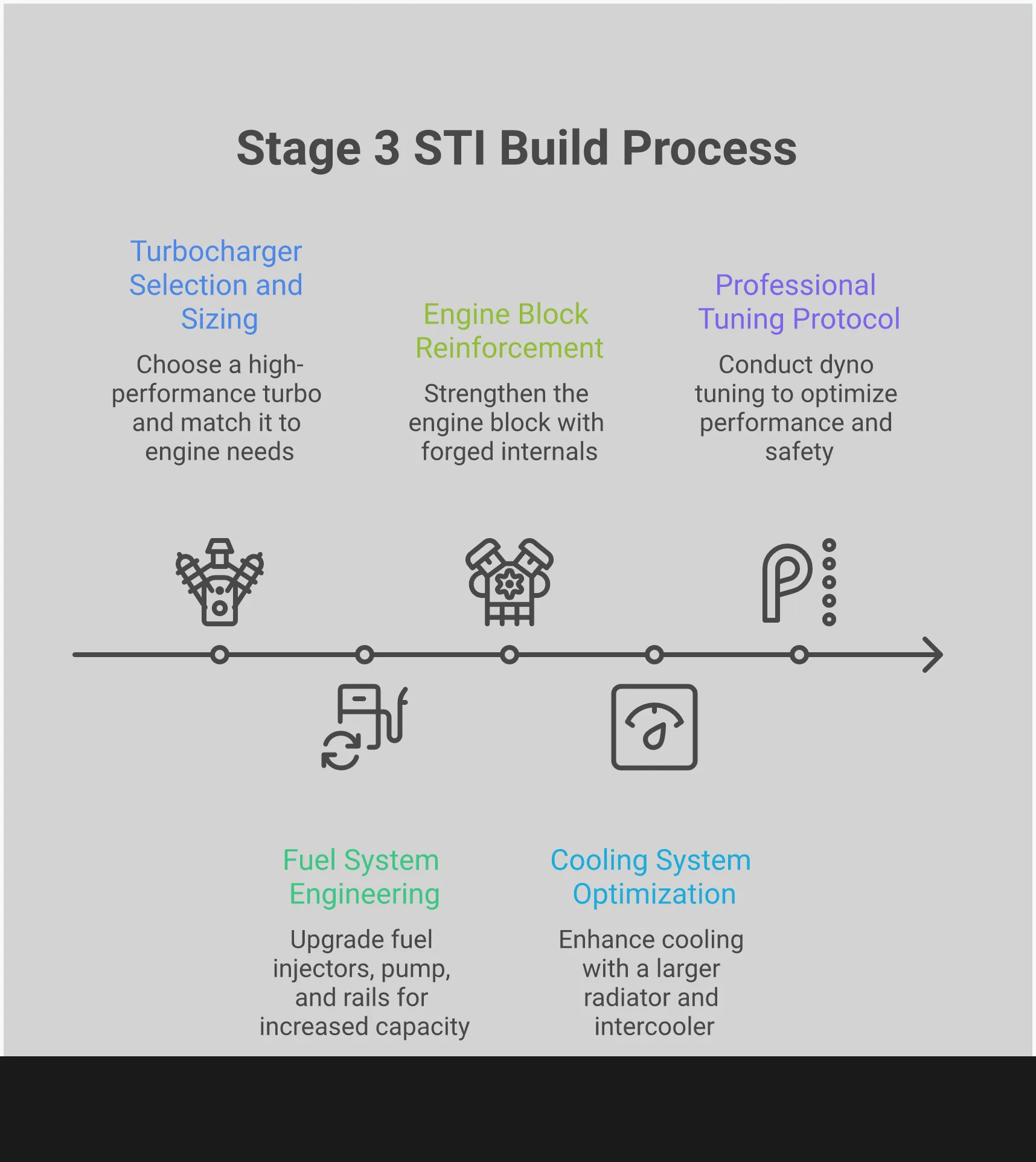
Choosing the Right Turbocharger
The heart of any Stage 3 power increase is a larger, more efficient turbocharger. The stock turbo is designed for factory power levels and simply can't move enough air to get you into the 400+ horsepower range. Upgrading to a high-performance turbo, like the popular Blouch Dominator 1.5XT-R, allows your engine to ingest significantly more air, which is the first step to making more power. This new turbo will provide the boost pressure needed to transform your STI's performance, but it also sets the demand for every other supporting modification on this list. It’s the component that defines your power goals.
Fueling Your Power: System Upgrades
With all that extra air from your new turbo, your engine needs a lot more fuel to maintain a safe air-to-fuel ratio. The stock fuel system isn't equipped to handle this demand, so a complete overhaul is necessary. This typically includes a higher-flow fuel pump, larger fuel injectors like the Cobb 1050x, and often upgraded fuel lines and rails. A comprehensive fuel system kit ensures consistent fuel delivery under heavy load, preventing a lean condition that can lead to catastrophic engine damage. Skimping on fuel is one of the fastest ways to ruin a new build.
Keeping it Cool: Intake and Intercooler Upgrades
To make the most of your new turbo, you need to optimize the airflow entering and exiting it. An enhanced air intake kit reduces restriction, allowing the turbo to pull in cool, dense air more easily. Just as important is an upgraded intercooler, usually a front-mount system. The larger turbo will generate much more heat as it compresses air. A high-quality front-mount intercooler drastically lowers the intake air temperature, which increases air density and reduces the risk of detonation. This ensures your engine makes consistent power, pull after pull.
Why Forged Internals Are a Must
This is what truly separates a "built" motor from a stock one. The factory pistons, connecting rods, and bearings in an EJ25 engine were not designed for the cylinder pressures of a Stage 3 setup. To handle the power reliably, you need forged internals. A professionally assembled short block, like an IAG 700 long block, often features a closed-deck design that reinforces the cylinder walls for extra strength. Forged pistons and rods can withstand far more heat and stress, making them essential for the longevity of your high-horsepower engine. These core performance parts are the foundation of a durable build.
Breaking Down the Cost of a Stage 3 STI Build
Planning a Stage 3 build for your STI is exciting, but it's also a major financial commitment. The total cost can vary significantly depending on your horsepower goals, the parts you choose, and how you approach the build. To give you a clear picture of the investment required, let's break down the expenses into three main areas: complete packages, individual components, and the often-overlooked cost of labor. Understanding these elements will help you create a realistic budget and build the high-performance STI you've been dreaming of.
What's Included in a Stage 3 Package?
If you want a straightforward path to more power, a complete Stage 3 package is an excellent option. These kits bundle all the necessary components to hit a specific power target, taking the guesswork out of parts matching. For example, some shops offer packages that achieve a reliable 400 wheel horsepower for around $12,700. This price often includes the parts, professional installation, and a custom tune. Choosing a package gives you a proven combination of components that are designed to work together seamlessly, making it a popular choice for owners who value reliability and convenience.
The Price of Building It Yourself
For those who prefer a more hands-on approach, building your engine with individually selected parts offers maximum flexibility. This path allows you to tailor every component to your exact specifications. The centerpiece of any build is the engine block. A high-performance short block capable of handling 550 to over 1,100 horsepower can range from $4,500 to $18,000. A complete long block assembly might start around $12,750. Remember, these figures are just for the engine itself. You still need to budget for a turbo, fuel system, intercooler, and other essential performance parts to complete your build.
Understanding Core Charges and Purchase Options
When you're shopping for major components like a built short block, you'll likely come across a "core charge." This is simply a deposit you pay on top of the part's price, which is refunded once you send your original part back to the manufacturer. This system encourages the return of old components so they can be remanufactured, which is a sustainable practice that helps keep costs down for everyone. Think of it as a temporary hold that you get back for recycling your old STI parts, not as a permanent fee.
A Stage 3 build is a significant financial undertaking, but you have options for managing the expense. Many performance shops offer financing plans that make the process more accessible by allowing you to spread the cost over time. This means you don't have to pay for the entire build at once. It can be a great way to get the high-quality performance parts you need now without completely draining your savings, turning your dream build into a more immediate reality instead of a distant goal.
Don't Forget Labor and Tuning Costs
The cost of parts is only half the story; professional labor is a critical part of your Stage 3 budget. Installing and tuning a built engine is a complex job that requires deep expertise with the Subaru platform. While labor rates vary, you can expect this to add several thousand dollars to your total cost. This is where all-in-one packages can offer great value, as the price often includes installation by experienced technicians. Whether you buy a package or individual parts, always factor in the cost of professional engine tuning services to ensure your new setup runs safely and performs at its peak.
Supporting Mods: What Else Your Stage 3 STI Needs
Building a Stage 3 STI is about more than just dropping in a powerful engine and a bigger turbo. To create a reliable and truly high-performance machine, you need to upgrade the systems that support the engine. Think of it like building a house: a strong foundation is required to support the structure. For your STI, that foundation consists of the cooling, oiling, fuel, and drivetrain systems. Neglecting these areas is a fast track to frustration and expensive repairs.
The stock components on your STI were designed for stock power levels. When you start making significantly more horsepower and torque, these factory parts are pushed beyond their limits. The cooling system can’t dissipate the extra heat, the fuel pump can’t supply enough fuel, and the clutch can’t handle the torque. A proper Stage 3 build addresses every one of these potential failure points. These supporting modifications aren’t just recommended, they are essential for protecting your investment and ensuring your car performs consistently, whether you’re on the street, at the track, or carving up a mountain road. By building a balanced car, you ensure every component works in harmony to deliver thrilling and dependable power.
Keeping Temperatures in Check
Increased power generates a massive amount of heat, and your engine's survival depends on keeping temperatures in check. The factory radiator can quickly become overwhelmed, so upgrading to a high-quality aluminum radiator is one of the first steps. Equally important is addressing the infamous cylinder four cooling issue common in EJ engines. A simple cooling mod can prevent detonation and ensure even temperatures across all cylinders. To protect your engine from oil contamination, a Crawford Performance Air Oil Separator (AOS) is a must. It prevents oil vapor from entering your intake, keeping your intercooler and valves clean and maintaining your fuel's octane rating. Finally, an upgraded oil pan, pickup, and baffle will prevent oil starvation during hard cornering, ensuring your engine always has the lubrication it needs.
Matching Your Fuel System to Your Power
A Stage 3 engine is thirsty, and the stock fuel system simply can't keep up. To make more power, your engine needs more air and a lot more fuel to match. Running out of fuel under high load can cause a lean condition, which leads to detonation and catastrophic engine failure. This is why a complete fuel system upgrade is non-negotiable. The process starts with a high-flow fuel pump to get more fuel out of the tank. From there, you’ll need larger fuel injectors, often 1000cc or more, to deliver that fuel into the cylinders. To manage it all, an upgraded fuel pressure regulator and sometimes new fuel rails are necessary to maintain consistent pressure. These STI upgrades ensure your engine has the fuel it needs to make big power safely.
Tuning and Exhaust: The Final Pieces
With all the new hardware installed, you need a way to control it and let the engine breathe. A high-flow, turbo-back exhaust system is essential for reducing backpressure, allowing the larger turbo to spool efficiently and evacuate exhaust gases quickly. However, the single most important component of your entire build is the engine management system and the subsequent tune. The COBB Accessport is the industry standard for a reason, giving a professional tuner full control over every engine parameter. A custom tune from an experienced professional is what ties all your performance parts together. Your tuner will create a specific map for your exact setup, optimizing fuel, ignition timing, and pressure to create reliable power while keeping the engine safe.
Can Your Drivetrain Handle the Power?
Once you’re making Stage 3 power, the next challenge is transferring it to the ground. The first weak link in the drivetrain will be your factory clutch. It was never designed to hold the massive increase in torque from a built engine and will start slipping almost immediately. You will need to install an upgraded performance clutch and flywheel combination rated for your new power goals. Fortunately, the STI’s 6-speed transmission is famously durable and can reliably handle significant power, often up to 800 wheel horsepower. However, its lifespan is heavily influenced by your driving habits. While the gearbox itself is strong, a high-performance clutch is a mandatory part of any serious build.
How Much Power Will a Stage 3 STI Make?
When you invest in a Stage 3 build, the big question is always about the power gains. While there isn't a single magic number, a properly executed Stage 3 setup transforms your STI into a formidable performance machine. The final output depends heavily on the specific components you choose, the quality of the installation, and most importantly, the precision of the engine tune. A professional tune ensures all your new parts work together harmoniously to deliver reliable power. Let's look at what you can realistically expect.
What HP and Torque Numbers to Expect
A well-sorted Stage 3 package is designed for a major leap in performance. The goal for many builds is to achieve around 400 wheel horsepower (whp). For context, a stock STI from 2004 to 2021 typically produces about 240-260 whp. Reaching the 400 whp mark means you're getting a massive increase in acceleration and overall capability. This level of power makes the car incredibly responsive and thrilling to drive, whether you're on the street or the track. A complete package of upgraded parts and a solid tune is what helps your car make these impressive numbers.
Pump Gas Power: What to Expect on 93
While 400 whp is a common target, real-world results can vary based on the dyno, tuner, and specific parts. It's helpful to look at actual figures from other owners. For example, after a Stage 3 upgrade and a custom tune on 93 octane fuel, one owner reported that their STI produced "340 horsepower and 351 foot-pounds of torque" at 18 PSI of boost. These numbers demonstrate the potent, usable power a Stage 3 build delivers for daily driving or weekend fun. This also highlights how critical a professional engine tune is to maximizing the potential of your hardware safely.
WHP vs. CHP: What's the Difference?
When discussing power figures, it's important to know the difference between wheel horsepower (whp) and crank horsepower (crank hp). Crank horsepower is the raw power measured at the engine, while wheel horsepower is the power that actually reaches the pavement after going through the transmission and drivetrain. Since whp accounts for drivetrain loss, it's the more accurate measure of a car's real-world performance. Most tuners and enthusiasts focus on whp. It's also good to know the limits of your other components; for instance, many agree that around 800 wheel horsepower is the reliable limit for a stock STI gearbox.
Choosing the Best Brands for Your Build
When you’re investing in a Stage 3 build, the quality of your components is everything. This isn’t the time to cut corners. Choosing parts from reputable brands known for their engineering and track-tested reliability ensures your engine can handle the power you’re aiming for. A successful build depends on a combination of a strong foundation, efficient airflow, and precise tuning. Below, we’ll cover some of the top brands and components you should consider for a powerful and durable Stage 3 STI.
Why Choose a Crawford Performance Stage Built Engine
At Crawford Performance, we live and breathe Subaru performance. Our built engines are specifically engineered to handle the demands of a high-horsepower Stage 3 setup. We offer comprehensive Subaru STI upgrades, including blueprint-assembled short blocks that provide a rock-solid foundation for builds pushing well beyond 400 whp. With decades of experience, we’ve perfected our engine programs to deliver reliable power, giving you the confidence to push your STI on the street or the track. Our packages are designed to be a complete solution, taking the guesswork out of building a strong motor.
Our Go-To Turbos and Intercoolers
A Stage 3 build is defined by its larger, more efficient turbocharger. This is the heart of your new power level, so selecting the right one is critical. You'll need a turbo capable of supporting your horsepower goals without creating excessive heat or lag. Paired with the turbo, a high-quality front-mount intercooler is essential for keeping intake air temperatures down, which is vital for consistent performance and engine health. We recommend and supply a range of performance parts that have been proven in demanding conditions. These components work together to ensure your engine breathes efficiently and makes reliable power, run after run.
Why You Need a Cobb Accessport
Hardware is only half the equation; you need the right tools to manage it all. Cobb Tuning is a leader in the Subaru community for a reason. Their Accessport is an indispensable tool for any Stage 3 build, giving you or your tuner the ability to flash maps and make precise adjustments to fuel, timing, and boost. This ensures your engine runs safely and efficiently with all its new components. Beyond the Accessport, Cobb offers a suite of high-quality parts that integrate seamlessly into your build. Proper engine tuning services are what tie everything together, transforming your collection of parts into a cohesive, high-performance machine.
Beyond the STI: A Look at Other Stage Built Engines
While we’ve spent a lot of time on the Subaru STI, the concept of staged performance upgrades isn’t unique to one platform. Across the automotive world, from American muscle to Japanese imports, enthusiasts and builders use a similar framework to map out their performance goals. The specific parts and power figures change, but the underlying principle remains the same: a systematic approach to modification where each stage builds upon the last. This shared language helps owners understand what level of performance they can expect from a certain combination of parts.
However, it's important to recognize that these "stages" are more of a general guide than a strict set of rules. A Stage 3 Honda build will look very different from a Stage 3 Mustang. The real focus should always be on creating a balanced and reliable system tailored to your specific vehicle and how you plan to use it. Whether you're building a daily driver with some extra punch or a dedicated track machine, the core concepts of improving airflow, strengthening internals, and precise tuning are universal pillars of performance engineering.
Popular Engine Platforms for All Makes
The principles behind building a robust engine extend far beyond the Subaru world. Companies like 4 Piston Racing have built a reputation for creating high-horsepower Honda engines, while shops like Prestige Motorsports specialize in turn-key crate engines for Chevy, Ford, and Mopar platforms. These builders, much like us at Crawford Performance, understand that creating reliable power starts with a solid foundation. They offer complete engines with forged internals and optimized components designed to handle significant power increases, proving that the pursuit of performance is a shared passion across all makes and models. The specific architecture may differ, but the engineering goals are the same.
Built for Purpose: Street, Track, and Drag Racing
A performance build should always start with a clear goal. The parts and tuning required for a reliable street car are vastly different from what’s needed for a competitive race car. For example, a daily driver might focus on a broad torque curve for responsive city driving, while a drag racing engine is built for maximum power in short, intense bursts. A road racing or track build, like many of the performance parts we develop, must be engineered for endurance, with a heavy focus on cooling and oiling systems to survive lap after lap under extreme stress. This purpose-built approach ensures that every component is selected to meet a specific demand, creating a cohesive package that performs exactly as intended.
Build or Buy? Deciding on Your Stage 3 Engine
Once you've committed to a Stage 3 build, you face a major decision: do you buy a complete, pre-assembled engine, or do you build one from the ground up? Both paths can lead to incredible power, but they offer very different experiences in terms of cost, time, and control. Your answer will depend on your specific goals, budget, and how hands-on you want to be with the process. Let's break down the key factors to help you choose the right route for your STI.
Crate Engine vs. Custom Build: Which is Right for You?
A crate engine, often called a built long block, is a complete, ready-to-install package. Think of it as the "drop-in" solution. The major advantage is reliability; it’s assembled and balanced in a controlled environment by experts who have tested the combination of parts extensively. This path saves you the headache of sourcing components and reduces the risk of assembly errors.
On the other hand, a custom build gives you ultimate control. You can hand-select every component, from closed-deck blocks to specialized head gaskets, to create an engine perfectly tailored to your power goals. This is the ideal route for those pushing for maximum horsepower or who have a very specific vision for their build. The trade-off is complexity and a greater reliance on your chosen performance shop's expertise.
How Much Time and Skill Does Each Path Take?
Your timeline is a huge factor in this decision. A crate engine is almost always the faster option. While build times vary, you can often have a complete engine ready to ship in a matter of weeks, minimizing your car's downtime. This predictability is a major plus for many drivers.
A custom build is a much more involved project. The process of researching, sourcing, and waiting for individual parts can take months before the first wrench is even turned. This complexity requires careful project management and a deep trust in your builder. Whichever path you choose, a professional installation and precise engine tuning services are non-negotiable to protect your investment and achieve the reliable power you're after.
Common Stage 3 Build Challenges (And How to Solve Them)
A Stage 3 build is an exciting goal, but it’s more than just bolting on a bigger turbo. Pushing your STI to this level introduces new challenges for the engine and drivetrain. To build a car that’s not only powerful but also reliable, you need to anticipate these weak points and address them proactively. It’s about creating a balanced system where every component can handle the increased stress.
How to Build a Reliable Stage 3 STI
More power generates more heat, and managing it is critical for engine longevity. The stock cooling system can quickly become overwhelmed, so an upgraded aluminum radiator is a smart first step to improve heat dissipation. Another common issue on the EJ engine is uneven cooling in cylinder four, which can be addressed with a specific cooling mod. You also need to manage oil. An Air/Oil Separator (AOS) is one of the most important performance parts you can install. It prevents oil from contaminating your intake system, which can lower your fuel's octane and lead to detonation. We also recommend an upgraded oil pan, pickup, and baffle to increase oil capacity and prevent oil starvation during hard cornering.
Solving Common Fuel System Issues
Your STI’s factory fuel system was not designed for Stage 3 power levels. In fact, the stock fuel injectors are often maxed out with just a tune and an intake. Simply adding a downpipe and turning up the power without addressing fuel delivery is a recipe for disaster. A lean air-fuel mixture can cause catastrophic engine damage. To safely support the extra airflow from a larger turbo, you must upgrade your fuel pump, fuel injectors, and potentially your fuel rails and lines. This is a critical part of any list of Subaru STI upgrades and ensures your engine gets the fuel it needs to make reliable power without risking detonation.
Strengthening Your Transmission for More Power
All that new engine power has to travel through your transmission to get to the wheels. Fortunately, the STI’s 6-speed manual gearbox is famously robust and can reliably handle up to 800 wheel horsepower in most applications. If your power goals are within that range, the stock transmission is usually sufficient. However, if you’re planning to push past 800 whp and approach the 1000 whp mark, you’ll need to invest in strengthening the gearbox. This often involves upgrading to stronger gear sets and a high-performance clutch that can handle the immense torque. These drivetrain components are essential for transferring power effectively.
How to Find the Right Shop for Your Stage 3 Build
A Stage 3 build is a serious commitment of time and money, and the shop you choose is just as critical as the parts you install. Think of them as your partner in performance; their expertise will be the difference between a reliable, high-powered machine and a constant source of frustration. The right team ensures your investment is protected and performs exactly as you envisioned. A bad choice, on the other hand, can lead to costly repairs, endless downtime, and a car that never lives up to its potential.
Finding a shop with proven expertise, especially with the Subaru platform, is the most important step you'll take. This means looking beyond a flashy website or a low price quote. You need to dig into their reputation, their process, and the support they offer long after the work is done. Your goal is to find a team that not only has the technical skill but also treats your car with the same care and precision you would. This is about building a relationship with a trusted expert who can guide you through the process and help you maintain your vehicle for years to come.
What to Look for in a Performance Shop
When you start your search, focus on shops that specialize in Subarus. A general mechanic might be great for oil changes, but a Stage 3 engine build requires deep, platform-specific knowledge. Look for a shop with a long track record of successful high-horsepower Subaru builds. The best recommendations often come from word of mouth within the car community, so check with local Subaru clubs or online forums. A shop’s reputation is everything. Once you have a few candidates, visit them. A clean, well-organized facility with modern equipment is a strong indicator of professionalism. Ask to see examples of their previous work; a reputable shop will be proud to show off their custom builds.
What to Ask Your Builder Before You Commit
A Stage 3 engine is a major investment, and you need to protect it. Before you hand over your keys, have a direct conversation about warranties. A shop that is confident in its work will offer a clear and comprehensive warranty. Ask them specifically what is covered, for how long, and what the process is if an issue arises. A vague answer is a red flag. For example, we stand behind our work with a 12-month/12,000-mile warranty on our built engines because we believe in our components and our assembly process. This kind of guarantee provides peace of mind and shows that the shop is committed to your long-term satisfaction, not just the initial sale.
Warranty and Support
A Stage 3 engine is a major investment, and you need to protect it. Before you hand over your keys, have a direct conversation about warranties. A shop that is confident in its work will offer a clear and comprehensive warranty. Ask them specifically what is covered, for how long, and what the process is if an issue arises. A vague answer is a red flag. For example, at Crawford Performance, we stand behind our work with a 12-month/12,000-mile warranty on our built engines because we believe in our components and our assembly process. This kind of guarantee provides peace of mind and shows that the shop is committed to your long-term satisfaction, not just the initial sale.
Using Customer-Supplied Parts
It’s common for enthusiasts to acquire parts over time before committing to a full build. This brings up an important question: will the shop install parts you provide? Policies vary widely. Some shops are flexible and will work with customer-supplied components, while others prefer to source all parts themselves. A shop might insist on using their own suppliers to guarantee authenticity and quality, avoiding the risk of installing a counterfeit or incorrect part that could compromise the entire build. There’s no right or wrong answer, but it’s a conversation you must have upfront. Be prepared to discuss where you sourced your performance parts and understand that the shop’s warranty may not cover components they didn't provide.
Why Custom Tuning Experience Matters
All your high-performance parts are just a pile of potential until they are brought to life with a proper tune. For a Stage 3 build, a generic, off-the-shelf map won’t cut it. You need a custom tune performed by an experienced professional who understands the intricacies of the Subaru platform. An expert tuner will optimize your air-fuel ratios, ignition timing, and boost levels to extract maximum power safely and reliably. Their experience is what protects your engine from catastrophic failure. When vetting a shop, ask about their tuning process and the experience of their tuner. Our expert engine tuning services are designed to ensure every component in your build works in perfect harmony.
The Importance of Dyno Testing and Validation
After all the parts are installed, the final and most critical step is the dyno tune. A dynamometer, or "dyno," is a specialized machine that allows a tuner to run your car under simulated driving conditions in a safe, controlled environment. This isn't just about getting a flashy horsepower number to post online; it's about ensuring the health and reliability of your new engine. The dyno provides real-time data, allowing your tuner to precisely adjust fuel delivery, ignition timing, and boost pressure. This process ensures all your new performance parts are working together in perfect harmony, creating a safe and powerful setup that won't self-destruct on its first full-throttle pull.
Engine Repair and Rebuilding Services
Sometimes, the path to a Stage 3 build starts with a problem, like the dreaded "spun bearing" or another catastrophic failure. In these cases, an engine rebuild is a necessity, not just an upgrade. However, many owners choose to proactively build their engine to handle heavy modifications before any issues arise. The goal is to create a foundation strong enough to support the power you want to make reliably. A professional shop can assess your engine's condition and help you decide the best path forward, whether it's repairing a specific issue or building a fully forged motor from the ground up. This ensures your engine can handle the stress of a larger turbo and aggressive tune for years to come.
How to Care for Your Stage 3 Engine
Once the last bolt is tightened and your Stage 3 engine is assembled, the journey isn’t over. In fact, some of the most critical steps are still ahead. To ensure your investment delivers reliable power for years to come, you need to focus on a precise tune, a diligent maintenance schedule, and a proper break-in period. These final steps are what separate a powerful, dependable build from one that causes constant headaches. Getting this part right is essential for protecting your engine and truly enjoying the performance you’ve worked so hard to achieve.
Fine-Tuning for Peak Performance
A Stage 3 build is a collection of high-performance parts that must be orchestrated to work in perfect harmony. This is where a custom tune comes in. Unlike an off-the-shelf map, a professional dyno tune tailors your engine’s parameters to your specific components, fuel type, and climate. An expert tuner will optimize air-fuel ratios, ignition timing, and boost levels to extract maximum power safely. This process ensures your engine isn't just powerful, but also reliable. Opting for professional engine tuning services from a certified protuner is the best way to make sure your car runs perfectly and safely with its new upgrades.
Your Long-Term Maintenance Checklist
A modified engine demands more attention than a stock one. To keep your Stage 3 STI healthy, a proactive maintenance plan is non-negotiable. Beyond regular oil changes, consider adding components that address common Subaru engine vulnerabilities. An Air Oil Separator (AOS) is crucial for preventing oil from contaminating your intake system, a common issue under high boost. Upgrading to a high-capacity oil pan and pickup tube provides better oiling under hard cornering, while an improved radiator helps manage the extra heat your powerful engine will generate. These supporting performance parts are your engine’s life insurance policy.
How to Properly Break In Your New Engine
Before you can enjoy all that new power, your rebuilt engine needs a proper break-in period. This process allows the new piston rings, bearings, and other components to seat correctly. Typically, this involves driving for several hundred miles while varying the engine RPM and avoiding high boost. After the initial break-in, an oil change is essential to remove any metal particles from the new components. Once broken in and tuned, your car can produce impressive and reliable power, like a safe tune making 340 horsepower at 18 PSI of boost. Continuously monitor your engine’s health with gauges to keep an eye on oil pressure, boost, and air-fuel ratios.
Related Articles
Frequently Asked Questions
Can I still use my Stage 3 STI as a daily driver? Absolutely. A properly built and tuned Stage 3 STI can be perfectly reliable for daily use. The key is a professional tune that creates a smooth powerband and safe engine parameters for regular driving conditions. While you'll have a massive amount of power on tap, the car will remain manageable in traffic. The main difference you'll notice is the need for a more diligent maintenance schedule to keep everything running in top condition.
What is the single most important part of a Stage 3 build? While the upgraded turbo is what defines the stage, the most critical element is actually the custom tune. All the high-end hardware in the world won't perform correctly, or safely, without an expert tuner synchronizing every component. The tune is what protects your engine from damage, optimizes the air-to-fuel ratio, and ensures all your new parts work together as a cohesive system to produce reliable power.
Do I absolutely need forged engine internals for a Stage 3 build? For the power levels associated with a true Stage 3 setup, yes, forged internals are essential for long-term reliability. The stock pistons and connecting rods in the EJ25 engine were not designed to handle the increased cylinder pressure and heat from a larger turbo. Pushing a stock block to 400 wheel horsepower is a significant risk. Investing in a professionally built block with forged components is the foundation for a durable engine that won't leave you stranded.
How long will my car be in the shop for a build like this? The timeline can vary quite a bit depending on whether you choose a pre-assembled crate engine or a full custom build. A crate engine installation is generally faster, potentially taking a few weeks. A custom build, where parts are sourced individually, can take several months from start to finish. It's best to have a detailed conversation with your chosen shop to get a realistic timeline based on their schedule and parts availability.
I already have some Stage 2 parts. Can I reuse them for a Stage 3 build? Some parts, like a quality cat-back exhaust, can often be carried over. However, many core components will need to be replaced. A Stage 3 build requires a much larger turbo, a more robust fuel system, and a different intercooler setup than what a typical Stage 2 car uses. It's important to think of Stage 3 as a complete, balanced package where every part is chosen to support the new power goal, rather than just an addition to your old setup.