

Subaru Car Rack Guide: Roof, Hitch, or Carrier
Choosing a Subaru car rack starts with the gear you need to carry, not the rack that looks best in a product photo. A roof system can keep bikes, boards, and camping equipment out of the cabin. A hitch carrier can handle bulky, dirty gear at a lower loading height. For a track-focused build, the right choice may be a compact setup that preserves clearance and payload. This Subaru car rack guide compares the main options for street, performance, track, and overland use.
Contact Crawford Performance for help planning a Subaru build around your vehicle and use case.
What is the best Subaru car rack for your build?
The best Subaru car rack is the one that carries the intended load without exceeding the vehicle's roof, hitch, axle, or total payload limits. Use a roof rack for lighter, weather-sensitive gear and frequent access to the rear hatch. Choose a hitch carrier for bulky items, lower loading height, and equipment that does not belong inside the cabin. A full platform rack makes sense when modular mounting and trail durability matter more than minimum weight.
| Rack type | Best use | Main advantage | Primary tradeoff |
|---|---|---|---|
| Crossbars and roof box | Luggage, skis, camping gear, and bikes | Preserves cabin and rear cargo space | Raises vehicle height and affects wind noise |
| Full roof platform | Overland equipment, awnings, recovery boards, and modular mounts | Flexible mounting across a large footprint | Added weight, height, and aerodynamic drag |
| Hitch bike or tray rack | Bikes and equipment needing easy loading | Low loading height and simple access | Can limit hatch access and reduce rear clearance |
| Hitch cargo basket or box | Coolers, recovery gear, muddy equipment, and bulky luggage | Moves dirty cargo outside the cabin | Uses tongue-weight capacity and extends vehicle length |
Roof racks: when are crossbars or a platform the right choice?
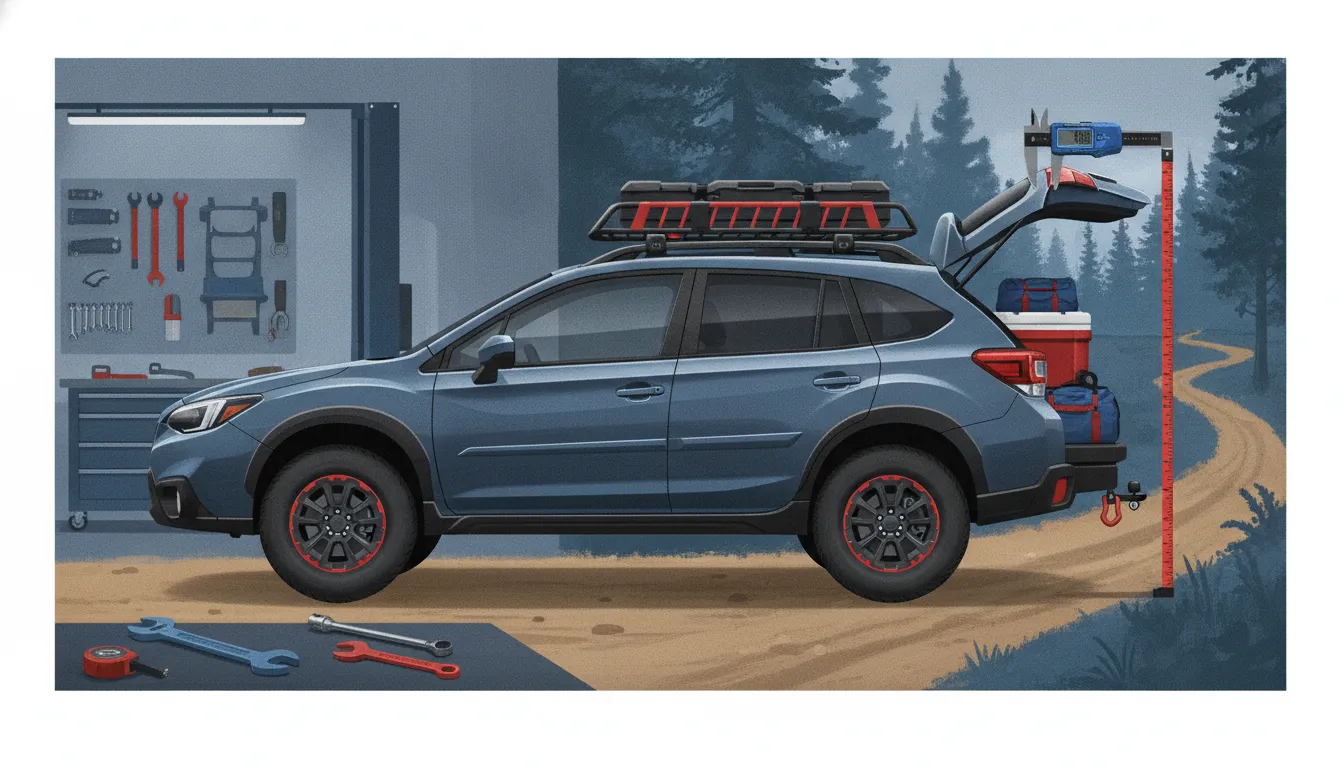
Roof racks are usually the cleanest answer when the cargo is relatively light, the rear hitch must remain available, or the cabin needs to stay open for passengers. Crossbars support a cargo box, bike mount, kayak carrier, or ski attachment. A platform rack adds more mounting positions for expedition equipment, but its larger surface and hardware usually add more weight and wind resistance.
Start with the Subaru's actual roof configuration. Some vehicles have raised rails, fixed mounting points, or a bare roof, and each requires a different foot, clamp, or fit kit. A rack that fits a 2018 Crosstrek is not automatically correct for a 2024 Crosstrek, Forester, Outback, WRX, or Impreza. Confirm the year, body style, roof type, bar spread, and the rack maker's approved fit list before ordering.
Plan around the complete load, not just the cargo box or platform. Add the carrier, crossbars, mounting hardware, and every item placed on top. The lowest rating in the vehicle and rack system controls the result. The owner's manual is the authority for vehicle limits, while the rack and accessory instructions control their own limits. Never treat a marketing capacity as permission to exceed the vehicle rating.
When is a hitch rack better than a roof rack?
A hitch rack is often the better Subaru car rack when the cargo is heavy, dirty, awkward to lift, or frequently removed. Bikes and large containers are easier to load at waist height than overhead. A hitch system also avoids adding as much wind noise as a roof box. The tradeoff is rear overhang, reduced departure angle, and the need to manage tongue weight carefully.
Match the carrier to the receiver size and vehicle application. The receiver, hitch hardware, carrier, and load must be compatible, and an adapter can change the effective leverage on the hitch. Check whether the carrier blocks the license plate, rear lights, backup camera, or hatch. A tilt or swing-away feature may improve access, but it does not remove the need to verify clearance when the carrier is loaded.
Hitch cargo is part of the vehicle's weight budget. The carrier's empty weight counts, and weight placed farther behind the receiver creates more leverage than the same weight close to the vehicle. Keep the heaviest items close to the vehicle, secure every container against movement, and recheck hardware after the first short drive. Use the Subaru's approved hitch and installation information for the exact vehicle rather than relying on a generic carrier rating.
Talk with Crawford Performance before adding rack weight to a performance or overland build.
How should track drivers choose a Subaru car rack?
Track drivers should treat a rack as part of the vehicle's handling and logistics package. The best setup carries helmets, tools, tires, or event gear without creating unnecessary drag, height, or rear overhang. A removable hitch tray or compact roof box can be more practical than a heavy permanent platform when the vehicle also needs predictable clearance on the way to an event.
- Prioritize the lowest practical carrier weight before loading gear.
- Keep heavy tools and fluids low, centered, and restrained.
- Confirm the rack does not interfere with a rear spoiler, hatch, exhaust, or tie-down points.
- Check ground clearance at ramps, steep driveways, and paddock entrances.
- Remove unused crossbars, boxes, and carriers before timed sessions when permitted.
- Recheck tire, suspension, and brake clearances after the vehicle is loaded.
A rack does not increase the Subaru's payload, braking capacity, or suspension margin. If a performance build already carries heavier wheels, fuel, skid plates, tools, or spare parts, calculate the total before adding a carrier. The result should support the event without turning transport equipment into a handling problem.
What fitment checks matter most on a Subaru car rack?
Fitment is more than matching a brand name to a Subaru model. Confirm the exact year range, body style, roof or receiver configuration, accessory interface, and clearance around doors, hatches, spoilers, exhaust outlets, and backup sensors. Then test the loaded position, because a box or basket can change hatch clearance, rear visibility, and departure angle even when the empty rack fits.
Roof fitment
- Identify raised rails, flush rails, fixed points, or a bare roof.
- Confirm the approved bar spread and the front-to-rear position.
- Measure hatch clearance with the hatch fully open.
- Check the loaded vehicle's total height before entering a garage or trail access gate.
- Confirm the cargo box, tent, bike, or board mount does not contact the roof or hatch.
For cargo boxes, Thule's fit guidance is a useful example of why bar spread and hatch clearance must be measured instead of guessed. Its R-min measurement describes the space needed between the front bar and the open hatch. Apply the same principle to any brand, then verify the exact instructions for the product you plan to install.
Hitch fitment
- Confirm the receiver size, pin location, and carrier shank compatibility.
- Check tongue-weight and payload limits using the vehicle's documentation.
- Measure departure angle and ground clearance with the carrier loaded.
- Verify lighting, plate visibility, hatch access, and sensor behavior.
- Use the correct torque values and hardware from the hitch and carrier instructions.
How do load limits, clearance, and installation work together?
Load limits, clearance, and installation are one decision, not three separate checkboxes. A carrier may fit the receiver but fail the clearance test when the Subaru enters a driveway. A roof box may stay below the roof rating but prevent the hatch from opening. A correctly rated platform can still be unsafe if its fasteners are loose or the load shifts during braking.
Use this installation sequence for a first pass:
- Read the vehicle owner's manual and the carrier instructions together.
- Dry-fit the carrier and check doors, hatch, spoiler, exhaust, lights, and sensors.
- Install every clamp, bolt, lock, and support required by the manufacturer.
- Torque fasteners to the specified values and mark them for visual inspection.
- Load the equipment with heavy items low and as close to the vehicle center as practical.
- Secure each item independently so a single strap or latch failure does not release the load.
- Drive a short route, stop, and recheck movement, straps, hardware, and clearance.
For hitch work, use the exact vehicle-specific instructions whenever possible. Subaru's official Forester tow hitch installation guide illustrates the level of vehicle-specific hardware and procedure detail that generic videos often omit. The exact guide will vary by model and year.
Which Subaru car rack works for overland and daily use?
Overland builds usually benefit from a modular plan instead of the largest rack available. Start with the cargo that must stay dry, secure, and accessible. Add only the mounts needed for that gear, then account for the weight of protection, lighting, recovery equipment, passengers, fuel, and water. This keeps the rack useful without consuming the payload needed for the trip itself.
For a Crosstrek, review Crawford's Crosstrek overland and off-road parts alongside the rack plan. Forester owners can compare the Forester overland parts collection. Both paths reinforce the same principle: suspension, protection, tires, lighting, and cargo equipment should work as one system.
Keep the center of gravity in mind. A tall roof load can change crosswind response and body motion, while a rear carrier can affect departure angle and reversing visibility. Pack frequently used items where they can be reached without unloading the whole vehicle. After dusty or salty trips, wash the hardware, inspect coating damage, and lubricate locks according to the rack maker's instructions.
Get a second set of eyes on your rack, payload, and Subaru build plan before installation.
How should you compare Subaru car rack options?
Compare the complete system cost and burden, not only the rack price. The real system includes the fit kit, crossbars or receiver hardware, locks, trays, boxes, straps, lighting provisions, and any installation tools. Then compare how often the equipment will stay on the vehicle and how much cargo it carries. Make sure you can still use the hatch, garage, trail approach, or track paddock as intended.
- Choose roof crossbars when you need flexible, lighter-duty cargo transport and want the hitch free.
- Choose a roof platform when modular overland mounting justifies added height and weight.
- Choose a hitch tray when bikes or bulky equipment need low, easy loading.
- Choose a hitch basket or box when dirty or irregular gear should stay outside the cabin.
- Choose a removable system when daily driving, fuel economy, or garage clearance matters.
If the rack will support a long-term adventure build, Crawford's Subaru overland build guide provides a useful reminder to build around capability first. The right carrier is one part of the package, alongside clearance, protection, suspension, tires, and the load you can safely manage.
Frequently asked questions about Subaru car racks
Do all Subarus come with a roof rack?
No. Subaru roof designs vary by model, year, trim, and rail configuration. Some vehicles have rails or fixed mounting points, while others require a specific clamp and fit kit. Confirm the exact vehicle configuration before buying crossbars or a cargo box.
Is a roof rack or hitch rack better for bikes?
A hitch tray is usually easier to load and unload, while a roof bike mount preserves rear access and hitch capacity. Compare bike weight, hatch clearance, rear visibility, ground clearance, and the number of bikes before choosing.
Can a Subaru car rack carry a rooftop tent?
Only when the complete roof system and vehicle support the tent's static and dynamic requirements. Include the tent, platform, mounting hardware, occupants, and gear in the calculation, and follow the vehicle and rack maker's instructions.
How do I stop a cargo carrier from affecting clearance?
Measure the loaded carrier at the lowest point, especially near the receiver and rear corners. Test driveways, ramps, and trail approaches slowly. A rise adapter may change clearance, but it also changes leverage, so confirm compatibility and limits before using one.
Should I install a rack myself?
Simple crossbars may be a reasonable owner installation when the instructions and tools are available. Hitch systems, platforms, and complex mounts deserve extra care because incorrect torque or fitment can release a load or damage the vehicle. Follow the vehicle-specific procedure and have the installation checked if anything is unclear.