


WRX Turbo Oil Control: Feed, Drain, and Restrictors
WRX Turbo Oil Control: Feed, Drain, and Restrictors
WRX Turbo Oil Control: Feed, Drain, and Restrictors
A turbocharger does not tolerate guesswork in its oil supply. The feed line must deliver clean oil at the pressure the cartridge requires. The drain must let oil leave the bearing housing freely by gravity. A restriction, clogged passage, or poor drain route can turn a lubrication problem into smoke, leakage, bearing wear, or a failed turbo.
Contact Crawford Performance to plan your Subaru turbo setup
Effective WRX turbo oil control means matching the feed line, banjo bolt, and restrictor to the exact turbo cartridge. It also means maintaining an unrestricted gravity drain and managing crankcase pressure. Turbocharger bearings need consistent oil pressure for lubrication and thermal regulation, but more oil is not automatically better.
This guide explains the oil path from the engine supply to the turbo bearings and back to the crankcase. It covers feed hardware, drain routing, journal and ball-bearing requirements, warning signs, inspection steps, and the role of an air oil separator in a reliable Subaru performance build.
How WRX Turbo Oil Control Works From Feed to Return
WRX turbo oil control works when clean, correctly regulated oil reaches the turbocharger through a cartridge-matched feed, then leaves through an open, continuously downhill drain. The feed supports lubrication and heat control. The return prevents oil from backing up in the bearing housing. Crankcase pressure must also stay controlled.
WRX turbo oil control is a complete system, not a single fitting. Pressurized engine oil enters the turbocharger through a dedicated feed. The bearing housing uses that oil for lubrication and heat management. Used oil then exits through a return line that should descend continuously to the oil pan or approved return point.
Pressurized feed to the bearing housing
Depending on the Subaru application and turbocharger, the feed path can include a line, banjo bolt, filter, or restrictor. These parts have different jobs. A filter helps protect a small passage from debris. A restrictor manages the amount of oil entering the cartridge. The turbo manufacturer determines which combination belongs on a specific unit.
Many journal-bearing turbochargers rely on a continuous oil film to support and center the rotating shaft. The oil film also carries heat away from the bearing area. A clean feed at the specified pressure is therefore more important than using the largest possible line or the most oil flow. Research on turbocharger lubrication likewise describes the need for controlled oil delivery for lubrication and thermal regulation. Review the turbocharger bearing research when checking the engineering principle.
Gravity return to the oil pan
The return side is not a second pressurized feed. It depends primarily on gravity. The drain should remain open, use a smooth route, and travel continuously downhill. Kinks, crushed hose, sharp bends, sealant intrusion, sludge, or a return point that sits too high can slow the flow and back oil up in the bearing housing.
Oil backing up in the housing can move toward the compressor or turbine side and resemble a failed seal. Elevated crankcase pressure can make the same drain function poorly even when the hose looks clear. That is why a turbo replacement without an oil-path inspection can repeat the original failure.
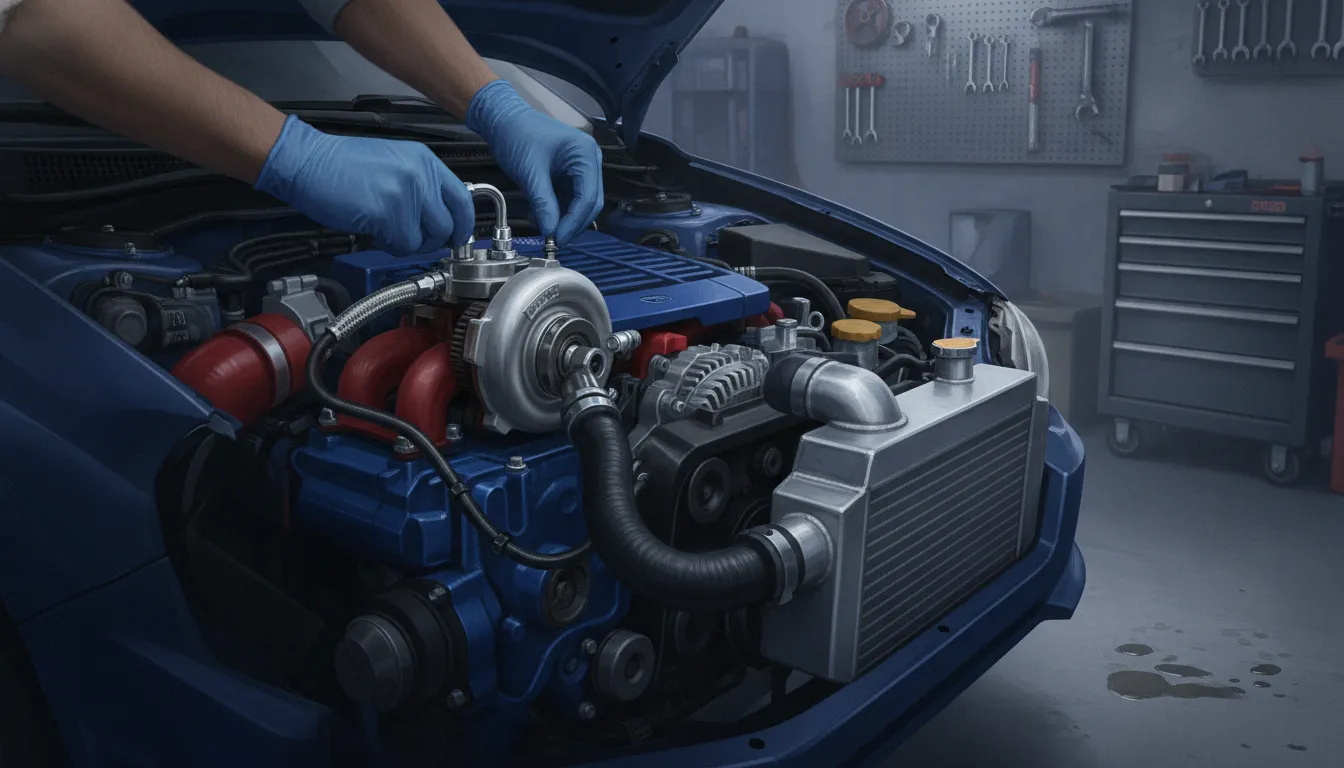
How Should You Choose WRX Turbo Feed Lines and Restrictors?
Choose WRX turbo feed lines, banjo bolts, filters, and restrictors from the exact turbocharger cartridge requirements. Confirm the part combination against the Subaru application, oil pressure, bearing design, and installation route. There is no universal WRX restrictor size. A correct feed must deliver enough clean oil without overwhelming the cartridge.
Choose the feed line and restrictor from the turbocharger manufacturer's requirements, then verify the parts against the actual cartridge and Subaru engine application. There is no universal WRX restrictor size that works for every turbo. Journal-bearing and ball-bearing cartridges can have different oil demands, and even two cartridges with the same bearing type may specify different pressure and flow.
Separate the jobs of filters and restrictors
A clogged banjo filter can starve a turbocharger. An incorrect restrictor can also reduce supply below the cartridge's needs. On the other hand, excessive flow or pressure can contribute to leakage when the turbo's oil-management system cannot control it. Do not install a restrictor simply because a different turbo used one, and do not remove a filter without confirming the complete feed arrangement.
When replacing a failed turbo, inspect the old feed line and fittings for debris. Contamination from the original failure can move into the replacement cartridge. Check crushed tubing, damaged sealing surfaces, heat damage, loose fittings, and the condition of each washer. Use the engine oil grade specified for the engine, climate, and build. Oil viscosity affects flow through small passages, especially during cold operation.
Feed and startup checks
- Identify the exact turbo cartridge and read its current installation guidance.
- Confirm whether the cartridge requires a filter, restrictor, both, or neither.
- Match the banjo bolt, washers, line, and port geometry to the application.
- Inspect the feed path for sludge, carbon, debris, crushed sections, and heat damage.
- Route the line away from hot components, moving parts, and sharp edges.
- Prime the turbo with clean oil before startup and inspect for leaks after the first heat cycle.
Correct feed selection is only half of reliable WRX turbo oil control. A properly sized restrictor cannot compensate for a blocked drain, and a clear drain cannot compensate for a contaminated feed.
Talk with Crawford Performance before changing turbo oiling hardware
Why Is the Turbo Oil Drain Line So Important?
A turbo oil drain line is important because the return is mainly gravity-fed. The line must remain open, smooth, and continuously downhill so used oil can leave the bearing housing. Kinks, blockages, a high return point, or elevated crankcase pressure can cause backup that resembles a failed turbo seal.
The drain line determines whether oil can leave the turbocharger after it has lubricated and cooled the bearing area. A turbo cannot force oil uphill through a narrow or damaged return. The route should descend toward the oil pan, avoid restrictions, and use fittings that support the specific installation.
Inspect the route before blaming the seals
When a WRX develops smoke, oil residue, or unexplained consumption, inspect the complete drain before condemning the turbo. Look for a hose pressed against a hot component, a tight bend near a fitting, a collapsed section, debris, and a return entry that is too high. Check the gasket and flange surfaces after installation. A small routing error can create enough backup to push oil toward the compressor or turbine side.
Drain routing also deserves a check after any turbo or engine change. A line that was clear on the workbench can become pinched once the engine is installed, the exhaust is heat-shielded, or nearby components settle into place. Confirm the line has support without being compressed, and inspect it again after the first heat cycle.
Crankcase pressure belongs in the same diagnosis. If pressure inside the engine opposes the oil leaving the turbo, the return can slow even when the hardware is open. Crawford's Subaru crankcase ventilation system guide explains why ventilation belongs in a complete turbo reliability plan.
Use symptoms as inspection triggers
Blue exhaust smoke, oil in charge plumbing, fresh residue around the housing, changing boost response, or a new siren-like sound deserves inspection. None of these signs proves a seal failure by itself. Check supply, return, crankcase pressure, intake leaks, exhaust restrictions, and the turbo manufacturer's service limits before replacing parts.
Do Journal and Ball-Bearing Turbos Need Different Oil Control?
Journal-bearing and ball-bearing turbochargers can need different oil control because their cartridges use oil differently. Bearing type alone does not determine the setup. Confirm the exact turbo model, then follow its requirements for feed pressure, flow, filtration, restrictor use, and gravity drain routing.
Yes. Bearing design affects how the cartridge uses oil, but it does not create a simple universal rule. Match the feed pressure, flow, filter, restrictor, and drain arrangement to the exact turbo manufacturer's instructions.
| Consideration | Journal-bearing cartridge | Ball-bearing cartridge |
|---|---|---|
| Shaft support | A continuous oil film supports and centers the shaft. | Rolling elements support the shaft, with requirements set by cartridge design. |
| Feed guidance | Clean, stable oil supply that maintains the bearing film. | Pressure and flow specified for that particular cartridge. |
| Restrictor decision | Use only the specified part and size. | Do not assume a journal-bearing setup transfers over. |
| Common mistake | Excessive flow, contamination, or poor drainage. | Generic restrictor or feed hardware without cartridge confirmation. |
Why cartridge-specific guidance matters
A restrictor is not a repair for a clogged feed passage or a blocked drain. Reducing flow to hide the wrong problem can turn a marginal supply into starvation. Excessive flow can create a different leakage pattern. Identify the turbo model, confirm the bearing arrangement, measure pressure when diagnosis requires it, and follow the current manufacturer specification.
For broader Subaru reliability planning, pair this oil-path review with Crawford's WRX reliability modifications guide. The goal is a matched system, not an isolated part selection.
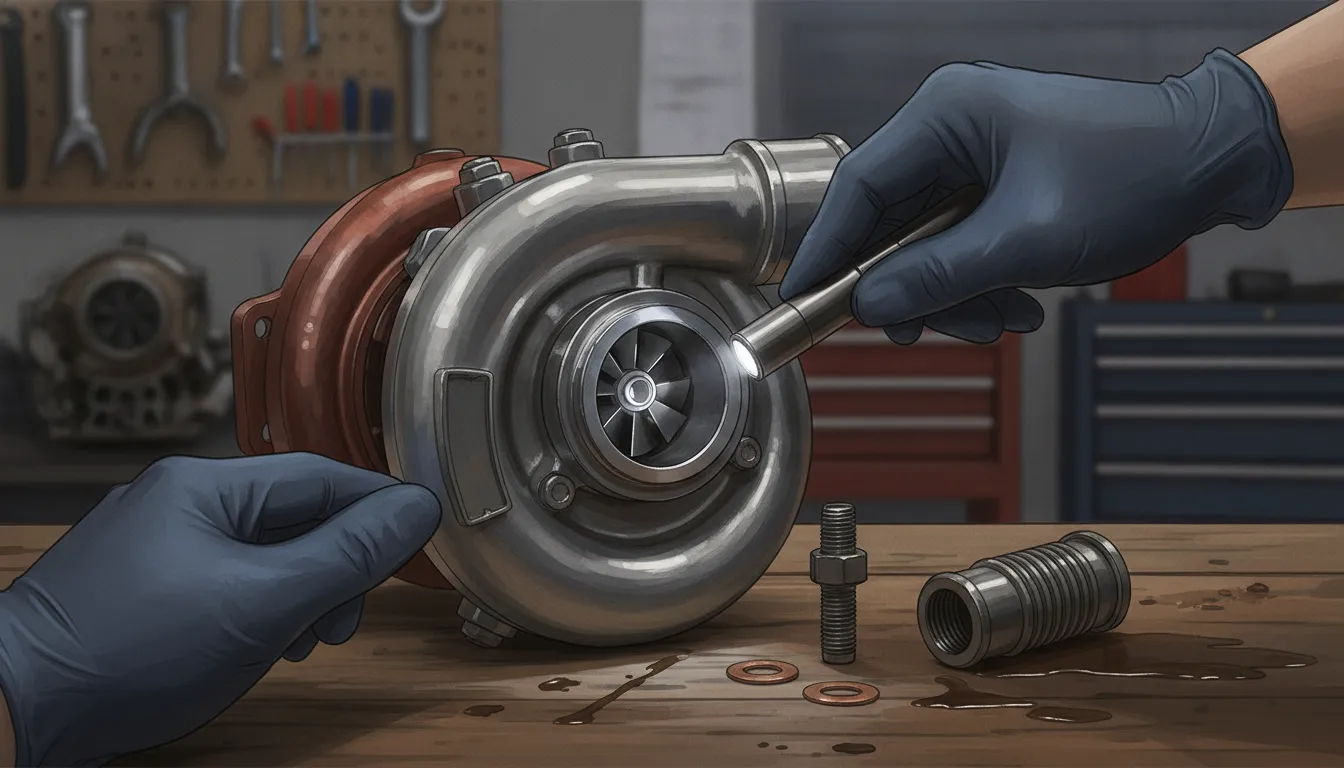
What Symptoms Point to Poor WRX Turbo Oil Control?
Common inspection triggers include blue smoke, increasing oil in charge plumbing, fresh oil around the turbo. Abnormal noise, shaft movement beyond service limits, loss of boost, and rising oil consumption. These symptoms can have several causes. Inspect the feed, drain, ventilation system, and turbo together before replacing parts.
Oil-control issues usually appear as a pattern rather than one conclusive sign. Use these symptoms to decide when to stop driving and inspect the system. A technician should evaluate the turbo, engine oiling system, ventilation, intake, and exhaust together.
Smoke and oil in the intake path
Blue exhaust smoke or increasing oil in the compressor outlet, charge pipe, or intercooler plumbing deserves attention. A light film can have multiple causes, including crankcase vapor. A growing quantity, smoke under load, or oil loss calls for a complete feed, drain, ventilation, and engine-condition check.
Noise, shaft movement, and performance changes
New scraping, siren-like noise, abnormal contact, loss of boost, slow spool, or rising oil consumption can indicate turbo wear or another fault. Shaft movement must be judged against the cartridge manufacturer's limits because some movement can be normal before oil pressure is present. Do not use sound alone to diagnose the seals.
Fresh leaks and residue
Clean the area and trace the first point where fresh oil appears. Check the feed connection, banjo bolt, drain flange, bearing housing, and nearby lines. If the system has a clogged filter or poor drain route, replacing the turbo without correcting that cause risks damaging the replacement.
A Practical WRX Turbo Oil Control Inspection Checklist
Use a WRX turbo oil control inspection to check the oil level, specification, feed line, banjo hardware, pressure, drain route, bearing housing, priming procedure, and post-startup leaks. Work on a cool engine and follow the turbo manufacturer's instructions. This sequence helps separate supply, return, ventilation, and turbo wear concerns.
Use this sequence for a turbo installation, smoke diagnosis, or service on a modified Subaru. Work on a cool engine, support the vehicle securely, and follow the turbocharger manufacturer's instructions.
- Check oil level and condition. Inspect for low level, contamination, sludge, or fuel smell.
- Verify the oil specification. Confirm the grade fits the engine, climate, and build.
- Inspect the feed. Check the line, banjo, filter, restrictor, fittings, and sealing surfaces.
- Measure pressure when needed. Compare results with engine and turbo manufacturer guidance.
- Verify the drain. Confirm a clear, smooth, continuously downhill return to the oil pan.
- Inspect the bearing housing. Look for scoring, overheating, carbon, and abnormal wear.
- Prime before startup. Pre-lubricate the turbo and confirm both connections are secure.
- Recheck after operation. Inspect for fresh leaks after the first heat cycle and investigate persistent symptoms.
How Does an AOS Fit Into a Reliable Turbo Build?
An air oil separator supports a reliable turbo build by managing oil vapor carried through the crankcase ventilation system. It does not replace correct turbo feed or drain hardware. Use an AOS as one part of a matched Subaru setup, alongside a cartridge-specific oil supply, open gravity return, and sound engine ventilation.
An air oil separator manages crankcase vapor, which is a different part of the system from the turbocharger feed and drain. During operation, crankcase gases can carry oil vapor toward the intake. An AOS can separate much of that vapor before it continues through the intake path. Crawford's WRX air oil separator guide provides related planning context.
An AOS does not correct an incorrect restrictor, clogged banjo filter, damaged feed line, or obstructed drain. Turbo bearings still need cartridge-specific oil pressure, and the return still needs an unrestricted gravity path. Treat ventilation as one part of a complete Subaru build plan. For larger engine projects, see Crawford's built Subaru long blocks and match the engine, turbo, oiling, and intended use.
Contact Crawford Performance for build-specific Subaru guidance
Frequently Asked Questions
What does a turbo oil restrictor do on a WRX?
A restrictor manages oil entering the turbocharger cartridge. Its size and location must match the turbo manufacturer's requirements. It is not a substitute for a clean feed, correct oil pressure, or an open gravity drain.
Can a blocked drain cause turbo smoke?
Yes. A blocked, kinked, or poorly routed drain can let oil back up in the bearing housing. Elevated crankcase pressure can worsen the same condition. Inspect the full oil path before concluding that a turbo seal has failed.
Do ball-bearing turbos use the same restrictor as journal-bearing turbos?
No universal answer applies. Bearing type affects oil requirements, but the exact cartridge specification controls the feed pressure, flow, filter, restrictor, and drain arrangement. Follow the turbo manufacturer's current instructions.
What are common signs of poor WRX turbo oil control?
Common inspection triggers include blue smoke, increasing oil in charge plumbing, fresh oil around the turbo. Unusual noise, shaft movement beyond service limits, loss of boost, and rising oil consumption. These symptoms can have several causes.
Does an AOS fix a turbo oil feed problem?
No. An AOS manages crankcase vapor. It does not repair a clogged feed, incorrect restrictor, damaged line, or blocked turbo drain. Those faults require their own inspection and correction.
Ready to plan your Subaru performance build? Contact Crawford Performance