

Vergleich der führenden FA20 Long Block Builder
Du liebst deinen WRX oder BRZ, aber du bist an deine Grenzen gestoßen. Du hast bereits Ansaugung, Auspuff und Motoroptimierung vorgenommen, weißt aber, dass da noch mehr Leistung drin ist. Das Problem: Der serienmäßige FA20-Motor hat seine Grenzen, insbesondere was Pleuel und Kolben angeht. Mit den serienmäßigen Innereien ist es riskant, über 350 PS an den Rädern hinauszukommen. Hier kommt der verstärkte FA20-Rumpfmotor ins Spiel. Er ist nicht einfach nur ein Ersatz, sondern eine komplette Überarbeitung des Motorkerns, ausgelegt für die Belastung durch hohe Leistung. Dieser Leitfaden führt dich durch alles, was du über dieses grundlegende Upgrade wissen musst.
Wichtigste Erkenntnisse
- Sicher über die Serienleistung hinaus : Ein FA20-Rumpfmotor bildet die ideale Basis, um die Leistungsgrenze des Serienmotors von ca. 350 PS zu überschreiten. Er ersetzt anfällige Serienteile durch geschmiedete Innenteile und schafft so einen robusten Kern, der auch größere Turbolader und aggressivere Tuning-Maßnahmen verkraftet.
- Bewerten Sie den Hersteller, nicht nur den Preis : Bei der Auswahl eines Motorblocks sollten Sie der Qualitätskontrolle, dem professionellen Montageprozess und der Garantie des Herstellers höchste Priorität einräumen. Diese Faktoren sind für die langfristige Zuverlässigkeit weitaus wichtiger als die angegebene PS-Zahl oder der Anschaffungspreis.
- Planen Sie die notwendigen Modifikationen und die Abstimmung : Ein getunter Motor ist nur ein Teil eines erfolgreichen Projekts. Sie müssen wichtige Komponenten wie ein optimiertes Kraftstoffsystem und eine professionelle Abstimmung einplanen, um sicherzustellen, dass Ihr neuer Motor sicher läuft und seine optimale Leistung erbringt.
Was ist ein FA20 Long Block?
Wenn Sie die Leistung Ihres Subaru deutlich steigern möchten, ist Ihnen wahrscheinlich der Begriff „FA20 Longblock“ schon begegnet. Ein FA20 Longblock ist ein Hochleistungsmotor, der das Herzstück eines solchen Umbaus bildet. Er umfasst die wichtigsten Komponenten: Motorblock, Zylinderköpfe und alle entscheidenden Innenteile wie Kolben, Pleuelstangen und Kurbelwelle. Diese Baugruppen sind speziell dafür ausgelegt, deutlich höhere Leistungen und Belastungen als ein Serienmotor zu verkraften.
Für viele Subaru-Fans ist der Einbau eines verstärkten Motorblocks der nächste logische Schritt, nachdem sie die Grenzen des serienmäßigen FA20 ausgereizt haben. Der Serienmotor eignet sich hervorragend für den Alltag, doch seine Komponenten weisen bekannte Schwachstellen auf, die bei erhöhtem Ladedruck oder sportlicher Fahrweise zu Ausfällen führen können. Ein leistungsstarker Motorblock ersetzt diese Schwachstellen durch robustere, geschmiedete Komponenten und bietet so eine zuverlässige Basis für ein Turbo-Upgrade, einen Kompressor oder ein anspruchsvolles Rennstrecken-Setup. Er ist die Lösung für ein Auto, das sowohl leistungsstark als auch langlebig ist.
Die Boxermotorkonstruktion
Der FA20 ist ein Boxermotor, auch bekannt als Vierzylinder-Flachmotor. Das bedeutet, dass seine vier Zylinder horizontal angeordnet sind, jeweils zwei auf jeder Seite, und sich wie die Schläge eines Boxers vor und zurück bewegen. Diese einzigartige Konstruktion ist ein Markenzeichen der Subaru-Ingenieurskunst und bietet einige entscheidende Vorteile. Durch die flache Anordnung der Zylinder ist der Motor deutlich flacher als ein herkömmlicher Reihen- oder V-Motor. Dies senkt den Gesamtschwerpunkt des Fahrzeugs, was sich direkt in einem besseren Handling, geringerer Seitenneigung in Kurven und einem stabileren Fahrgefühl niederschlägt. Die Boxerbauweise reduziert zudem Vibrationen, was zu einem ruhigeren Lauf und dem unverwechselbaren Subaru-Sound führt, den Fans so lieben.
Langblock vs. Kurzblock vs. Komplettmotor
Beim Kauf von Motorkomponenten stößt man auf Begriffe wie Shortblock, Longblock und Komplettmotor. Der Unterschied zu verstehen, ist entscheidend für die Planung des Projekts. Ein Shortblock ist die einfachste Baugruppe und besteht aus Motorblock, Kurbelwelle, Kolben und Pleuelstangen. Ein Subaru Longblock geht noch einen Schritt weiter und beinhaltet zusätzlich Zylinderköpfe und Ventiltriebkomponenten. Er umfasst jedoch keine externen Teile wie Ansaugkrümmer, Abgaskrümmer oder Kraftstoffsystem. Ein Komplettmotor, auch Kistenmotor genannt, ist die umfassendste Option. Er wird komplett montiert geliefert und kann direkt in Ihr Fahrzeug eingebaut werden. Für die meisten Leistungssteigerungen bietet der Longblock die perfekte Balance zwischen Komfort und Individualisierungsmöglichkeiten.
FA20 Long Block: Leistung und Spezifikationen
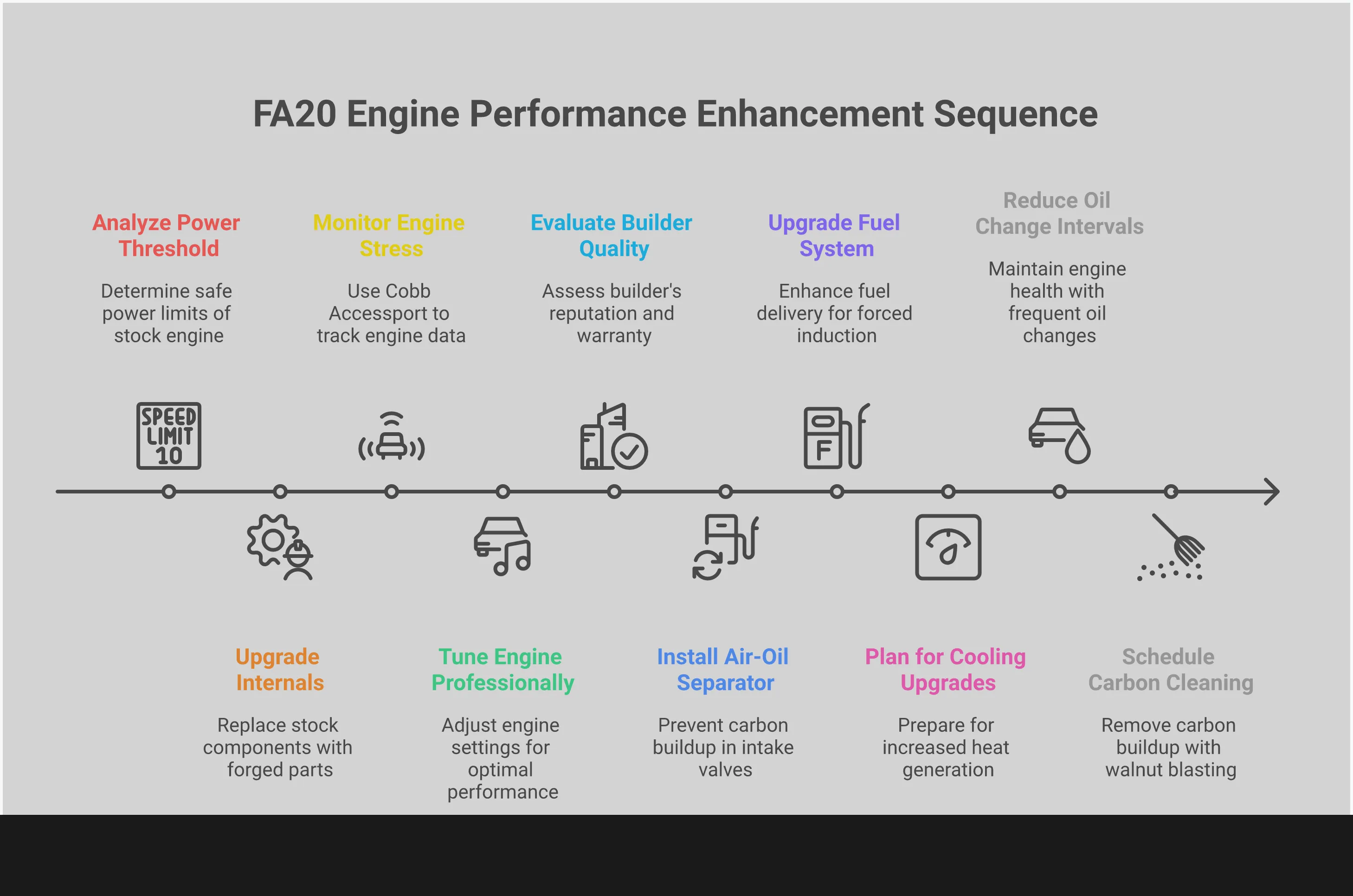
Der FA20-Motor ist ab Werk eine fantastische Basis und bietet eine hervorragende Balance zwischen Leistung und Alltagstauglichkeit. Wie jeder Serienmotor hat er jedoch seine Grenzen. Wer mehr Leistung anstrebt, wird schnell feststellen, dass die Serienkomponenten nur begrenzt belastbar sind. Diese Grenzen zu verstehen, ist der erste Schritt zum Aufbau eines zuverlässigen und leistungsstarken Subaru. Ein verstärkter Motorblock dient nicht nur der Leistungssteigerung, sondern schafft ein robustes Fundament, das allen Belastungen standhält. Betrachten wir die Leistungsfähigkeit des serienmäßigen FA20 und seine Verstärkungsbereiche.
Leistungsfähigkeit
Der FA20-Motor liefert ab Werk zuverlässig rund 300 bis 350 PS an den Rädern. Für viele Fahrer ist das mehr als genug für ein dynamisches Fahrerlebnis. Wer jedoch deutliche Leistungssteigerungen durch einen größeren Turbolader oder ein aggressiveres Tuning anstrebt, stößt an die Grenzen der serienmäßigen Innereien. Mit Serienkomponenten die 350-PS-Grenze zu überschreiten, ist riskant. Um sicher mehr Leistung zu erzielen, benötigt man einen Motor aus robusteren Materialien. Deshalb ist ein kompletter Motorblock mit optimierten Performance-Teilen für jedes ernsthafte Projekt unerlässlich.
Drehmomentgrenzen
Während die PS-Zahl im Fokus steht, ist das Drehmoment der eigentliche Test für die Belastbarkeit eines Motors. Die serienmäßigen Pleuelstangen des FA20 sind eine bekannte Schwachstelle und können maximal etwa 475 Nm Drehmoment aushalten. Eine aggressive Leistungssteigerung oder eine Zwangsbeatmung können das Drehmoment leicht über diesen Wert hinaus erhöhen und so einen Motorschaden riskieren. Deshalb ist eine einfache Erhöhung des Ladedrucks kein nachhaltiger Weg zu mehr Leistung. Um diese Grenze sicher zu überschreiten, benötigen Sie geschmiedete Pleuelstangen und Kolben. Unsere Motortuning-Services berücksichtigen diese mechanischen Grenzen stets, um sicherzustellen, dass Ihr Motor sowohl leistungsstark als auch zuverlässig ist.
Wichtige interne Komponenten
Ein leistungsoptimierter FA20-Rumpfmotor behebt die bekannten Schwachstellen des Serienmotors, indem er unter hoher Belastung anfällige Komponenten ersetzt. Das bedeutet, die serienmäßigen Gusskolben und schwächeren Pleuelstangen gegen deutlich robustere Schmiedeteile auszutauschen. Diese wichtigen Verbesserungen schaffen eine robuste Kurbelwelle, die deutlich mehr Leistung und Drehmoment als die Originalkonstruktion verkraftet. Durch die Verstärkung des Motorkerns bietet ein solcher Rumpfmotor die nötige Sicherheit für umfangreiche Subaru WRX-Upgrades und ermöglicht den Aufbau des leistungsstarken und zuverlässigen Fahrzeugs Ihrer Träume.
Der Crawford Performance FA20 Long Block
Wenn Sie die Grenzen des serienmäßigen FA20-Motors sprengen wollen, brauchen Sie eine Lösung, die auf Leistung, Zuverlässigkeit und Langlebigkeit ausgelegt ist. Bei Crawford Performance überholen wir Motoren nicht einfach nur; wir entwickeln sie von Grund auf neu, um eine Basis zu schaffen, die jeder Belastung gewachsen ist. Unser Ansatz basiert auf jahrzehntelanger Erfahrung im Rennstreckeneinsatz und stellt sicher, dass alle Komponenten perfekt aufeinander abgestimmt sind, um eine konstante und nutzbare Leistung zu liefern.
Unser FA20-Motorblock ist das Ergebnis systematischer Identifizierung und Beseitigung der Schwachstellen des originalen Werksmotors. Wir haben unzählige Stunden auf dem Prüfstand und der Rennstrecke verbracht, um ein Paket zu entwickeln, das die nötige Leistung für Turboaufladung und aggressives Tuning bietet. Dies ist nicht einfach nur ein Ersatz – es ist ein grundlegendes Upgrade für den anspruchsvollen Subaru-Enthusiasten, der mehr von seinem Fahrzeug erwartet.
Unsere Motorenpakete
Unsere Philosophie ist einfach: Qualität steht an erster Stelle, Robustheit an erster Stelle. Wir beheben die bekannten Schwachstellen des FA20, indem wir kritische interne Komponenten durch hochwertige, hochfeste Alternativen ersetzen. Die serienmäßigen Kolben und Pleuelstangen werden als Erstes ausgetauscht und durch robuste Schmiedeteile ersetzt, die deutlich höheren Zylinderdrücken und Temperaturen standhalten. Diese strategische Verstärkung ermöglicht es unseren Performance-Teilen, ihr volles Potenzial zu entfalten und einen Motor zu schaffen, der nicht nur leistungsstärker, sondern auch wesentlich langlebiger als das Serienmodell ist. Jeder Motor wird mit größter Sorgfalt in einer kontrollierten Umgebung montiert, um perfekte Toleranzen und zuverlässige Leistung vom ersten Tag an zu gewährleisten.
Leistungsdaten
Die FA20-Plattform birgt unglaubliches Potenzial, doch um dieses voll auszuschöpfen, müssen ihre systembedingten Grenzen überwunden werden. Unsere Motoren sind so konstruiert, dass sie die natürlichen Stärken des Motors – wie seinen niedrigen Schwerpunkt und seine Drehfreudigkeit – optimal nutzen und gleichzeitig seine Schwächen beheben. Das Ergebnis ist ein ausgewogenes und reaktionsschnelles Kraftpaket, das das Fahrerlebnis Ihres WRX oder BRZ revolutioniert. Durch die Schaffung einer soliden Basis ermöglichen unsere Motorblöcke aggressivere Motortuning-Leistungen und höhere Ladedrücke ohne Kompromisse bei der Zuverlässigkeit. So können Sie Ihr Fahrzeug stärker fordern, denn der Motor ist dafür bestens gerüstet.
Unsere 12-Monats-/12.000-Meilen-Garantie
Wir stehen mit einer umfassenden 12-monatigen/12.000-Meilen-Garantie auf alle unsere Motoren hinter unserer Handwerkskunst. Dies ist nicht nur ein Versprechen, sondern Ausdruck unseres Vertrauens in die Qualität unserer Komponenten und die Präzision unseres Montageprozesses. Die Investition in einen getunten Motor ist eine wichtige Entscheidung, und wir sind überzeugt, dass Sie sich darauf verlassen können sollten. Unsere Garantie schützt Ihre Investition und ermöglicht es Ihnen, die herausragende Leistung Ihres neuen, aufgerüsteten Subaru unbeschwert zu genießen. Sie ist unser Versprechen an Sie und ein Beweis für die Zuverlässigkeit, die wir in jeden einzelnen Motor einbauen, der unser Haus verlässt.
Vergleich der FA20 Long Block Builder
Wenn Sie sich nach einem getunten FA20 umsehen, werden Ihnen immer wieder einige Namen auffallen. Jeder Tuner bietet etwas Besonderes, von der PS-Zahl bis hin zu den Garantiebedingungen. Diese Unterschiede zu verstehen, ist entscheidend, um die richtige Basis für Ihr Projekt zu finden. Wir stehen zwar hinter unseren eigenen Motorenpaketen, sind aber überzeugt, dass ein gut informierter Fahrer ein zufriedener Fahrer ist. Werfen wir einen Blick auf einige der anderen führenden Tuner der Subaru-Community, damit Sie die verschiedenen Optionen vergleichen können.
IAG Performance
IAG Performance ist in der Subaru-Szene ein bekannter Name und bietet eine Reihe von Motorblöcken mit verschiedenen Leistungsstufen an. Der IAG 600 FA20 DIT Long Block ist besonders bei Besitzern eines WRX der Baujahre 2015–2021 beliebt. Diese Motoren werden komplett montiert mit voreingestellten Steuerkomponenten geliefert, was den Einbau vereinfacht. Im Inneren befinden sich verbesserte, geschmiedete Pleuel und Kolben, die für höhere Leistungen als die Serienkomponenten ausgelegt sind. IAG bietet außerdem eine Garantie von 12 Monaten bzw. 12.000 Meilen, die verlängert werden kann, wenn der Motor in einer zertifizierten Werkstatt eingebaut und abgestimmt wird. Damit sind die Motoren eine solide Option für alle, die einen bewährten und schrittweisen Upgrade-Plan suchen.
RalliSpec
RalliSpec legt bei seinen Motorenkonstruktionen größten Wert auf Detailgenauigkeit. Anstatt einfach nur Teile auszutauschen, konzentriert sich das Ingenieurteam darauf, die bekannten Schwächen des serienmäßigen FA20-Motors zu identifizieren und zu beheben. Das bedeutet, dass die Motorblöcke von Grund auf mit Blick auf erhöhte Zuverlässigkeit, insbesondere für sportliches Fahren, entwickelt werden. Wenn Ihr Hauptziel darin besteht, einen Motor zu bauen, der den Belastungen von Rennstreckentagen oder sportlicher Fahrweise problemlos standhält, ist RalliSpec aufgrund seines Fokus auf die Behebung der Schwachstellen der Plattform eine überzeugende Wahl. Sie bauen Motoren, die für Langlebigkeit unter extremen Belastungen ausgelegt sind.
GCH Longblock Racing
Wer auf maximale Leistung aus ist, sollte GCH Longblock Racing in Betracht ziehen. Der Stage 1 Long Block für den WRX (2015–2021) und andere FA20-Plattformen ist für bis zu 625 PS ausgelegt. Diese Leistungsfähigkeit wird durch verstärkte, geschmiedete Rennkolben und Pleuelstangen erreicht. GCH hebt außerdem seinen strengen internen Fertigungs- und Qualitätskontrollprozess hervor, der sicherstellt, dass jeder Motor die hohen Leistungsstandards erfüllt, bevor er ausgeliefert wird. Für Fahrer, die einen Umbau mit größerem Turbolader und entsprechenden Kraftstoffsystem-Upgrades planen, bietet GCH eine robuste Basis, die speziell für Hochleistungsanwendungen entwickelt wurde.
Subaru OEM
Sie können sich jederzeit direkt an Subaru wenden und einen originalen Subaru -Motorblock (OEM) erwerben. Diese Option bietet Ihnen einen brandneuen Motor, der exakt nach den Spezifikationen des werkseitig in Ihrem Fahrzeug verbauten Motors gefertigt wird. Dies ist der einfachste Weg, perfekte Kompatibilität zu gewährleisten und die ursprüngliche Leistung wiederherzustellen. Ein OEM-Block verfügt zwar nicht über die geschmiedeten Innenteile, die für deutliche Leistungssteigerungen erforderlich sind, bietet aber absolute Sicherheit für alle, die einfach nur einen verschlissenen oder beschädigten Motor ersetzen möchten. Diese Option ist in der Regel teurer als Alternativen aus dem Zubehörhandel, aber für ein Alltagsfahrzeug, bei dem Zuverlässigkeit oberste Priorität hat, ist sie eine verlässliche Wahl.
Welche Subarus haben den FA20-Motor?
Der FA20 ist ein moderner 2,0-Liter-Vierzylinder-Boxermotor, der sich zu einem Eckpfeiler der Subaru-Performance-Welt entwickelt hat. Sein Design bewahrt die klassischen Vorteile des Boxermotors – einen niedrigen Schwerpunkt für besseres Handling und Laufruhe – und integriert gleichzeitig moderne Technologien wie die Direkteinspritzung. Dieser Motor ist äußerst vielseitig und kommt sowohl als Saugmotor als auch als Turbomotor in verschiedenen beliebten Tuning-Modellen zum Einsatz. Seine robuste Konstruktion und sein Tuningpotenzial machen ihn zu einem Favoriten unter Fahrern, die mehr Leistung aus ihren Fahrzeugen herausholen möchten.
Ob Sie nun in einem leichten Coupé Kurven meistern oder den Allradantrieb einer Sportlimousine genießen – die Wahrscheinlichkeit ist groß, dass der FA20 das Herzstück Ihres Fahrzeugs bildet. Seine weite Verbreitung sorgt für eine riesige Subaru-Community und umfangreiches Zubehörangebot und macht ihn damit zur idealen Basis für den Aufbau eines leistungsstarken Fahrzeugs. Obwohl er durch und durch ein Subaru-Motor ist, reicht sein Einfluss auch bis in die erfolgreiche Zusammenarbeit mit Toyota zurück, wodurch dieser beeindruckende Boxermotor noch mehr Fahrern zugänglich wird. Zu wissen, welche Modelle mit dem FA20 ausgestattet sind, ist der erste Schritt auf dem Weg zu Ihrem individuellen Performance-Projekt.
Subaru BRZ
Der Subaru BRZ ist ein reinrassiges Sportcoupé, das ganz auf den Fahrer zugeschnitten ist, und sein Motor passt perfekt zu dieser Philosophie. Er verfügt über die Saugmotorversion des FA20, die 200 PS und 205 Nm Drehmoment leistet. Dieser Motor wurde für ein spontanes Ansprechverhalten und eine lineare Leistungsentfaltung entwickelt, die zum Ausdrehen bis zum Drehzahlbegrenzer bei 7.000 U/min einlädt. Im Fokus steht hier nicht die reine Leistung, sondern Balance und Agilität. Die leichte und kompakte Bauweise des FA20 trägt zum niedrigen Schwerpunkt und der nahezu perfekten Gewichtsverteilung des BRZ bei und macht ihn zu einem der dynamischsten und spaßigsten Fahrzeuge auf dem Markt.
Subaru WRX
Der Subaru WRX schlägt mit dem FA20 DIT (Direct Injection Turbo)-Motor auf Basis der FA20-Plattform einen völlig neuen Weg ein. Diese Variante ist auf maximale Leistung ausgelegt und liefert ab Werk beeindruckende 268 PS. Der entscheidende Unterschied liegt im Twin-Scroll-Turbolader in Kombination mit der Direkteinspritzung, die für ein spontanes Ansprechverhalten und ein breites, gleichmäßiges Drehmomentband sorgt. Dieser Motor verwandelt den WRX in eine vom Rallyesport inspirierte Sportlimousine mit atemberaubender Beschleunigung. Für Enthusiasten ist der FA20 DIT eine hervorragende Basis, um ein wahres Kraftpaket zu schaffen, das mit den richtigen Subaru WRX-Upgrades noch viel Potenzial bietet.
Toyota 86 & Scion FR-S
Dank einer wegweisenden Zusammenarbeit zwischen Subaru und Toyota kommt der FA20-Motor auch im Toyota 86 und seinem Vorgänger, dem Scion FR-S, zum Einsatz. Diese Coupés teilen sich Chassis und Antriebsstrang mit dem Subaru BRZ und sind somit mit demselben 2,0-Liter-Boxermotor mit Saugrohreinspritzung ausgestattet. Genau wie im BRZ leistet der FA20 im 86 und FR-S 200 PS und 205 Nm Drehmoment und bietet ein identisches Fahrerlebnis, das auf Ausgewogenheit, Präzision und direkte Rückmeldung an den Fahrer ausgelegt ist. Durch diese Partnerschaft wurde die herausragende Ingenieurskunst des FA20 einem noch breiteren Publikum von Sportwagenbegeisterten zugänglich gemacht.
Wie man einen FA20 Langblock auswählt
Die Wahl eines komplett überholten FA20-Motorblocks ist eine der wichtigsten Investitionen für Ihren Subaru. Er ist das Herzstück Ihres Projekts, und die richtige Wahl sorgt jahrelang für zuverlässige Leistung, während die falsche zu Frustration und kostspieligen Reparaturen führen kann. Um eine sichere Entscheidung zu treffen, sollten Sie nicht nur auf die PS-Zahl achten, sondern den Motorenbauer anhand einiger wichtiger Kriterien bewerten: die Qualität seiner Komponenten, die Expertise im Montageprozess und die Transparenz seiner Richtlinien. Einem Motorenbauer, der in diesen Punkten offen ist, können Sie die Leistung Ihres Projekts anvertrauen.
Qualitätskontrolle
Die Qualitätssicherung ist für einen Motorenbauer von höchster Bedeutung. Dies geht weit über die Verwendung hochwertiger Teile hinaus; es umfasst einen sorgfältigen Prozess der Prüfung, Vermessung und des Testens jeder einzelnen Komponente. Ein leistungsoptimierter FA20-Rumpfmotor behebt die bekannten Schwachstellen des Serienmotors, indem Komponenten wie Kolben und Pleuelstangen durch hochwertigere Alternativen ersetzt werden. Fragen Sie potenzielle Motorenbauer nach ihren Arbeitsabläufen, wie z. B. der Erstellung von Konstruktionszeichnungen und der Überprüfung der Toleranzen. Ein Motorenbauer, der mit einer soliden Motorgarantie für seine Arbeit einsteht, beweist Vertrauen in seine Qualitätskontrolle und gibt Ihnen Sicherheit.
Geschmiedete Innenteile
Der serienmäßige FA20 ist ein leistungsstarker Motor, doch bei Überschreitung seiner Grenzen treten bekannte Schwachstellen zutage, die für einen zuverlässigen Betrieb behoben werden müssen. Hier kommen geschmiedete Innenteile ins Spiel. Geschmiedete Kolben und Pleuelstangen werden unter enormem Druck gefertigt, wodurch sie dichter und fester als serienmäßige Gussteile sind. Diese Festigkeit ist unerlässlich, um den erhöhten Zylinderdruck bei höherem Ladedruck zu bewältigen. Achten Sie beim Vergleich von Motorblöcken darauf, dass diese hochwertige geschmiedete Innenteile von renommierten Herstellern enthalten. Diese Komponenten sind der Schlüssel zu mehr Leistung und ermöglichen Ihnen eine sichere Leistungssteigerung.
Professionelle Montage
Die besten Teile der Welt nützen nichts, wenn sie nicht fachgerecht montiert werden. Der Bau eines Hochleistungsmotors ist eine Kunst, die Präzision, Fachwissen und eine absolut saubere Arbeitsumgebung erfordert. Suchen Sie nach Motorenbauern mit nachweislicher Erfahrung und erfahrenen Technikern, die sich auf Subaru-Plattformen spezialisiert haben. Der Bau Ihres FA20-Motors ist ein wichtiger Schritt hin zu Ihrem Traum-WRX oder -BRZ mit hoher Leistung – und Sie sollten ihn in die Hände von Experten geben. Eine professionelle Montage gewährleistet, dass jede Schraube mit dem vorgeschriebenen Drehmoment angezogen und jedes Spiel perfekt eingestellt ist. Dies ist entscheidend für die Langlebigkeit und Leistung des Motors.
Kernbörsenrichtlinien
Die meisten Motoreninstandsetzer arbeiten mit einem Austauschverfahren. Das bedeutet, Sie zahlen eine Kaution (die sogenannte „Altteilgebühr“), die Ihnen zurückerstattet wird, sobald Sie Ihren alten, funktionstüchtigen Motor eingeschickt haben. Bevor Sie sich für einen Motorinstandsetzer entscheiden, sollten Sie sich unbedingt über die Rückgabebedingungen des Anbieters informieren. Unter welchen Bedingungen wird ein Altteil akzeptiert? Wie lange haben Sie Zeit, es zurückzusenden? Eine klare und faire Regelung kann Ihnen viel Geld sparen und unerwartete Kosten vermeiden. Dieses Verfahren ermöglicht es den Motoreninstandsetzern, sich Motorblöcke für zukünftige Subaru WRX-Upgrades zu sichern und trägt dazu bei, die Kosten für die gesamte Community niedrig zu halten.
Aufschlüsselung der Kosten eines FA20 Long Blocks
Der Einbau eines komplett überholten FA20-Motorblocks ist eine der bedeutendsten Verbesserungen, die Sie an Ihrem Subaru vornehmen können. Die Leistungssteigerung ist verlockend, doch es ist ebenso wichtig, die Gesamtkosten im Blick zu behalten. Der Preis des Motors selbst ist nur ein Teil des Ganzen. Für eine realistische Budgetplanung müssen Sie den Basismotor, die Einbaukosten und die notwendigen Modifikationen berücksichtigen, die für einen reibungslosen und zuverlässigen Betrieb erforderlich sind. Im Folgenden erfahren Sie, mit welchen Kosten Sie rechnen müssen.
Grundmotorpreis
Die Kosten für einen FA20-Rumpfmotor variieren stark je nach Hersteller, Qualität der internen Komponenten und seiner Belastbarkeit. Für einen Motor mit hoher Leistung bietet sich beispielsweise der IAG 600 FA20 DIT Long Block an, der für bis zu 600 PS ausgelegt ist und etwa 16.500 US-Dollar kostet. Für diejenigen mit bescheideneren Ansprüchen oder einem kleineren Budget gibt es Optionen wie das Stage-1-Paket von GCH Longblock Racing ab ca. 5.600 US-Dollar. Beachten Sie, dass die meisten Hersteller eine Altteilkaution verlangen, die Sie nach Einsendung Ihres alten Motors zurückerhalten.
Installationskosten
Nach dem Kauf Ihres Motorblocks kommt als nächstes der Einbau hinzu. Die Arbeitskosten variieren je nach Werkstatt, aber es gibt eine gute Nachricht: Da ein Motorblock komplett montiert geliefert wird, ist der Einbau recht unkompliziert. Ein erfahrener Mechaniker muss in der Regel nur die äußeren Komponenten Ihres alten Motors übernehmen, was oft an einem Tag erledigt ist. Dies ist auch der ideale Zeitpunkt, um die dazugehörigen Verschleißteile auszutauschen. Beispielsweise können neue Steuerkomponenten wie Steuerketten, Kettenspanner und Führungsschienen die Endrechnung um etwa 1.900 US-Dollar erhöhen, sind aber eine sinnvolle Investition in die langfristige Zuverlässigkeit.
Budgetierung für unterstützende Mods
Ein getunter Motor kann sein volles Potenzial nur mit den passenden Komponenten entfalten. Der wichtigste Schritt nach dem Einbau ist die professionelle Motorabstimmung. Eine korrekte Abstimmung gewährleistet das sichere und effiziente Zusammenspiel aller neuen Bauteile und schützt Ihre Investition vor Totalausfällen. Planen Sie außerdem eine angepasste Wartungsroutine ein. Bei modifizierten FA20-Motoren empfiehlt es sich, häufigere Ölwechsel durchzuführen – in der Regel alle 5.000 bis 6.500 Kilometer –, um die Motorleistung zu erhalten. Wenn Sie diese Maßnahmen zur Verbesserung der Zuverlässigkeit und die erforderlichen Wartungsarbeiten von Anfang an in Ihr Budget einplanen, vermeiden Sie teure Überraschungen.
Die besten Modifikationen für Ihren neuen FA20 Long Block
Der Einbau eines getunten FA20-Rumpfmotors ist eine bedeutende Investition in die Leistung Ihres Subaru, aber nur der erste Schritt. Um sein volles Potenzial auszuschöpfen, benötigen Sie weitere Modifikationen, die optimal auf Ihren neuen Motor abgestimmt sind. Betrachten Sie den Rumpfmotor als das stabile Fundament; nun ist es an der Zeit, die Hochleistungsstruktur darauf aufzubauen.
Die Wahl der richtigen Komponenten ist entscheidend für maximale Leistung, Zuverlässigkeit und den Schutz Ihrer Investition. Von der Zwangsbeatmung bis zur präzisen Abstimmung – jedes Teil trägt wesentlich zu einem ausgewogenen und leistungsstarken System bei. Lassen Sie uns die wichtigsten Upgrades durchgehen, die Sie nach dem Einbau Ihres neuen FA20 planen sollten.
Zwangsbeatmung: Turbolader und Kompressoren
Ein fachgerecht aufgebauter FA20-Motor kann problemlos über 600 PS verkraften – mehr als genug für aufregende Trackdays oder den Alltag. Um diese Leistung zu erreichen, benötigen Sie ein Aufladungssystem, beispielsweise einen Turbolader oder Kompressor. Ein größerer Turbolader allein reicht jedoch nicht aus. Mehr Leistung erzeugt mehr Belastung und Hitze, daher benötigen Sie die passenden Performance-Komponenten. Dazu gehören ein größerer Ladeluftkühler zur Kühlung der komprimierten Luft, ein verbesserter Kühler für eine bessere Motorkühlung und eine robuste Kupplung, die das höhere Drehmoment bewältigt.
Kraftstoffsystem-Upgrades
Mehr Luft durch einen Turbo- oder Kompressoraufladung erfordert mehr Kraftstoff, um ein sicheres Luft-Kraftstoff-Gemisch zu gewährleisten. Das serienmäßige Kraftstoffsystem eines WRX oder BRZ reicht für die Anforderungen eines leistungsstarken Motors einfach nicht aus. Sie benötigen mindestens eine Kraftstoffpumpe mit höherem Fördervolumen und größere Einspritzdüsen, um die erforderliche Kraftstoffmenge zu liefern. Wenn Sie E85-Kraftstoff für maximale Leistung verwenden möchten, bedenken Sie, dass dieser etwa 30 % mehr Kraftstoff benötigt als Benzin. Daher ist ein Upgrade Ihres Kraftstoffsystems für ein sicheres und leistungsstarkes Setup unerlässlich.
Die Bedeutung einer soliden Melodie
Eine professionelle Motorabstimmung ist der wichtigste Schritt nach dem Einbau von Leistungsteilen. Sie ist das Herzstück des Motors und sorgt dafür, dass alle neuen Komponenten sicher und effizient zusammenarbeiten. Ein erfahrener Tuner passt Kraftstoffkennfelder, Zündzeitpunkt und Ladedruck an, um die Leistung zu optimieren und gleichzeitig die Motorparameter im sicheren Bereich zu halten. Immer wenn Sie ein Teil einbauen, das die Atmung Ihres Motors verändert, wie z. B. Ansaugung, Abgasanlage oder Turbolader, ist eine professionelle Motorabstimmung unerlässlich. Diesen Schritt zu überspringen, ist der schnellste Weg, Ihren neuen Motor zu beschädigen.
Ansaug- und Abgasanlagen-Upgrades
Damit Ihr Motor mehr Leistung erbringt, muss er besser atmen können. Die Optimierung des Ansaug- und Abgassystems ist daher unerlässlich, um die Effizienz Ihrer Turboaufladung zu maximieren. Ein Ansaugsystem mit hohem Durchfluss ermöglicht es dem Turbolader, mehr kühle, dichtere Luft anzusaugen, während ein weniger restriktives Abgassystem den Abgasausstoß erleichtert, den Abgasgegendruck reduziert und das Ansprechverhalten des Turboladers verbessert. Diese Subaru WRX-Upgrades sind grundlegend, um das volle Leistungspotenzial Ihres getunten FA20-Motors auszuschöpfen und sollten zusammen mit den Modifikationen an Turbolader und Kraftstoffsystem geplant werden.
Wie Sie Ihren gebauten FA20-Langblock instand halten
Die Investition in einen getunten FA20-Motorblock ist ein klares Bekenntnis zu Höchstleistungen. Um diese Investition zu schützen und sicherzustellen, dass Ihr Motor über Jahre hinweg zuverlässige Leistung erbringt, benötigen Sie einen ebenso sorgfältigen Wartungsplan. Ein getunter Motor hat andere Bedürfnisse als ein Serienmotor, und die regelmäßige Wartung einiger wichtiger Punkte macht den entscheidenden Unterschied. Betrachten Sie es als die Basis für all den Fahrspaß, den Sie auf der Straße oder der Rennstrecke erleben werden.
Die richtige Pflege geht weit über das bloße Auffüllen von Flüssigkeiten hinaus; sie beinhaltet einen proaktiven Ansatz, um Ihren Motor sauber, geschmiert und innerhalb sicherer Parameter zu halten. Durch die Einhaltung eines regelmäßigen Wartungsplans und den Einbau einiger wichtiger Modifikationen können Sie häufige Probleme vermeiden und das volle Potenzial Ihres leistungsstarken Subaru ausschöpfen. Lassen Sie uns die wichtigsten Schritte zur Wartung Ihres getunten FA20 durchgehen.
Ölwechselplan
Für einen modifizierten FA20-Motor reicht das Standard-Ölwechselintervall nicht aus. Die erhöhte Belastung und Hitzeentwicklung durch höhere Leistungsstufen führen zu einem deutlich schnelleren Ölabbau. Um die inneren Motorteile sauber und optimal geschmiert zu halten, sollten Sie das vom Hersteller empfohlene Ölwechselintervall halbieren. Das bedeutet, Öl und Filter alle 3.000 bis 4.000 Meilen (ca. 4.800 bis 6.400 km) zu wechseln. Wenn Sie Ihr Fahrzeug häufig auf der Rennstrecke oder bei sportlicher Fahrweise stark beanspruchen, ist ein Ölwechselintervall von etwa 3.000 Meilen (ca. 4.800 km) empfehlenswert. Diese einfache und konsequente Vorgehensweise ist eine der effektivsten Methoden, die Lebensdauer Ihres getunten Motors zu verlängern.
Einbau eines Luft-Öl-Abscheiders (AOS)
Wenn es eine Modifikation gibt, die jeder FA20-Besitzer unbedingt haben sollte, dann ist es der Einbau eines Ölabscheiders. Der FA20 ist ein Direkteinspritzmotor und daher anfällig für Kohlenstoffablagerungen an den Einlassventilen. Ein Ölabscheider fängt ölhaltige Dämpfe aus der Kurbelgehäuseentlüftung ab, bevor sie in den Ansaugtrakt gelangen können. Dadurch wird verhindert, dass sich das Öl an den Ventilen festsetzt, was zu reduziertem Luftdurchsatz, Leistungseinbußen und sogar gefährlichem Motorklopfen führen kann. Der Einbau eines unserer Crawford Performance Ölabscheider ist ein entscheidender Schritt zur Erhaltung der Zuverlässigkeit und Leistung Ihres Motors.
Kohlenstoffreinigung
Selbst mit einem Ölabscheider (AOS) ist eine gewisse Kohlenstoffablagerung mit der Zeit unvermeidlich. Um die optimale Leistung Ihres Motors zu erhalten, sollten Sie alle 40.000 bis 60.000 Meilen eine professionelle Kohlenstoffreinigung durchführen lassen. Diese Dienstleistung, oft auch als „Walnussstrahlen“ bezeichnet, verwendet zerkleinerte Walnussschalen, um Kohlenstoffablagerungen schonend von den Einlassventilen und -kanälen zu entfernen, ohne die Metalloberflächen zu beschädigen. Durch die Entfernung dieser Ablagerungen wird der optimale Luftstrom wiederhergestellt, sodass Ihr Motor ruhig läuft und die erwartete Leistung erbringt. Dies ist ein wichtiger Bestandteil der langfristigen Wartung jedes Direkteinspritzmotors, insbesondere eines Hochleistungsmotors.
Überwachung des Motorzustands
Man kann ein Problem nicht beheben, von dem man nichts weiß. Der Einsatz eines Tools wie des Cobb Accessport oder spezieller Messgeräte ist unerlässlich, um die wichtigsten Motorfunktionen im Blick zu behalten. Achten Sie besonders auf Werte wie das Luft-Kraftstoff-Verhältnis (AFR), den Ladedruck und die Flüssigkeitstemperaturen. Die Echtzeitüberwachung dieser Daten ermöglicht es Ihnen, kleine Unregelmäßigkeiten zu erkennen, bevor sie zu größeren Schäden führen. Dieser proaktive Ansatz, kombiniert mit professionellen Motortuning-Services, versetzt Sie in die Lage, fundierte Entscheidungen zu treffen und die Lebensdauer Ihres getunten FA20-Motors deutlich zu verlängern.
Verwandte Artikel
Häufig gestellte Fragen
Warum sollte ich einen komplett überholten Motorblock einbauen lassen, anstatt nur meinen Serienmotor aufzurüsten? Stellen Sie sich einen überholten Motorblock wie ein starkes Fundament für Ihr Haus vor. Zwar können Sie Ihren Serienmotor mit zusätzlichen Teilen ausstatten, doch seine Kernkomponenten – wie Kolben und Pleuelstangen – sind nicht für hohe Leistungen ausgelegt. Ein überholter Motorblock ersetzt diese werkseitigen Schwachstellen von vornherein durch deutlich stärkere, geschmiedete Teile. Dadurch entsteht eine zuverlässige Basis, die die Belastung durch einen größeren Turbolader und ein aggressives Tuning problemlos verkraftet und so einen Motorschaden verhindert.
Ab welcher Leistung ist ein verstärkter FA20-Rumpfmotor notwendig? Eine allgemeingültige Regel gibt es nicht, aber die serienmäßigen FA20-Innereien gelten im Allgemeinen als gefährdet, sobald man 350 PS an den Rädern oder 475 Nm Drehmoment überschreitet. Die Pleuelstangen sind eine bekannte Schwachstelle und können bei Überschreitung dieser Grenze brechen. Wenn Ihre Leistungsziele höhere Werte erfordern, ist ein verstärkter Rumpfmotor nicht nur empfehlenswert, sondern unerlässlich, um Ihren Motor intakt zu halten.
Was deckt eine Motorgarantie typischerweise ab? Eine Garantie auf einen zusammengebauten Motor schützt Sie vor Mängeln an den Teilen oder im Montageprozess. Der Hersteller garantiert damit, dass er hochwertige Komponenten verwendet und diese fachgerecht montiert hat. Dieser Garantieschutz setzt jedoch voraus, dass Sie Ihren Teil dazu beitragen. Fehler wie unsachgemäßer Einbau, fehlende professionelle Abstimmung, Überhitzung des Motors oder zu niedriger Ölstand führen mit hoher Wahrscheinlichkeit zum Erlöschen der Garantie. Befolgen Sie daher stets die spezifischen Einfahr- und Wartungsanweisungen des Herstellers.
Ist der Einbau eines Rumpfmotors schwierig? Der Einbau eines Rumpfmotors ist zwar eine umfangreiche Arbeit, aber weniger komplex als eine komplette Motorüberholung, da die Kernkomponenten vormontiert geliefert werden. Dabei werden externe Teile wie Ansaugkrümmer, Turbolader und Anbauteile vom alten auf den neuen Motor übertragen. Dies erfordert Spezialwerkzeug und fundierte mechanische Kenntnisse. Wir empfehlen daher dringend, den Einbau von einer Fachwerkstatt mit Erfahrung im Subaru-Tuning durchführen zu lassen.
Was ist der wichtigste Schritt nach dem Einbau meines neuen Motorblocks? Das Allerwichtigste ist eine professionelle Motorabstimmung. Ihr neuer Motor und die dazugehörigen Teile bilden ein System, das sich grundlegend von der Werkskonfiguration unterscheidet. Ein erfahrener Tuner kalibriert das Steuergerät Ihres Fahrzeugs präzise auf die neue Hardware, optimiert die Leistung und gewährleistet gleichzeitig die Sicherheit aller Parameter. Auf eine professionelle Abstimmung zu verzichten, ist der schnellste Weg, Ihre neue Investition zu beschädigen.