


Subaru Fuel System Upgrades for Performance Builds
Adding boost, increasing displacement, or switching fuel changes more than the dyno target. The delivery system must keep fuel pressure and volume consistent as the engine demands more, while remaining compatible with the car's intended use and tuning strategy.
Contact Crawford Performance to plan your Subaru fuel system
A reliable Subaru Fuel System is planned as one matched package: pump, injectors, regulator, and lines sized for the complete power goal. That matters because inadequate delivery can create a lean condition and put engine reliability at risk. If flex fuel is part of the build, verify that the lines and injectors are compatible with E85 before selecting capacity.
The right upgrade is not necessarily the largest individual component. It is the combination that supports the engine, fuel type, wiring, pressure control, and operating conditions together. Start by defining what the system must support, then choose each component against that requirement.
Build around the complete combination, not one oversized component.
What a Subaru Fuel System Must Support
A fuel system is the delivery chain that moves fuel from the tank to the engine. The pump creates flow, the lines and filter carry and clean that fuel, the regulator manages pressure, and the injectors meter it into the engine. These parts do not work as independent upgrades. Each one must support the same power target, fuel type, boost level, and operating conditions.
Start with the complete combination rather than a single component. A pump that appears capable on paper may not maintain the required flow once pressure rises under boost. Injectors that are large enough for a power goal still depend on stable pressure and adequate supply from the pump, wiring, lines, and filter. If any part of that chain becomes the restriction, the engine may run lean. That condition can threaten reliability, especially during sustained track, rally, or high-load operation.
Plan around the real power goal
Define the intended use and the engine's realistic output before selecting parts. A street car that sees occasional spirited driving has different demands from a track car that spends long sessions at high load. A built engine, larger turbocharger, or future power increase can also change the fuel requirement. Leave a sensible margin for the actual combination and its tuning strategy, rather than sizing the system only for today's dyno number.
Fuel type matters as well. Gasoline and ethanol-based fuels can require different compatibility checks and calibration decisions. If flex-fuel or E85 is part of the plan, verify that the lines, seals, pump, and injectors are suitable for that fuel before installation. Compatibility is a system requirement, not an assumption based on one product description.
Account for boost and duty cycle
Boost increases the work the fuel system must do because the regulator and injectors must maintain the intended delivery relationship as intake pressure changes. Duty cycle describes how much of each available injector operating period is being used. An injector operating near its limit has less headroom for changing conditions, temperature, fuel demand, or tuning adjustments. The correct target depends on the complete engine, fuel, pressure, and calibration, so avoid applying a universal injector-size rule to every Subaru.
For a practical planning framework, see Crawford's guide to upgrading your Subaru fuel system alongside the engine and turbocharger decisions. Treat fuel delivery as foundational engine protection, then select the pump, injectors, regulator, and lines as one matched system.
How Do You Choose a Fuel Pump for a Subaru Fuel System?
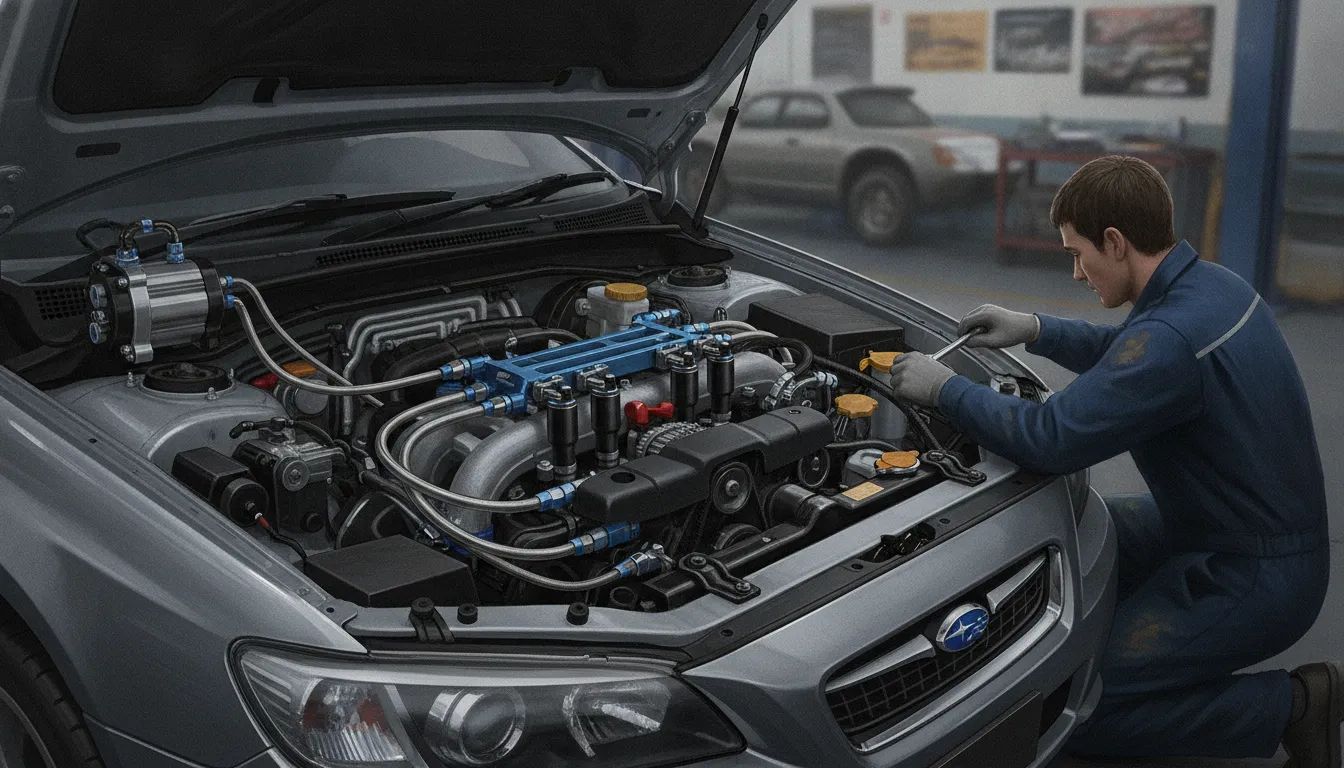
Choose a fuel pump around the complete combination, not a headline flow number. Your Subaru fuel system must deliver the required volume at the pressure your injectors and regulator need, while remaining reliable under the conditions where you drive. Start with the engine's target power, fuel type, boost level, and intended use. A daily-driven street car, a track car that spends long periods at high load, and a rally car exposed to heat, vibration, and fuel slosh may need different solutions. That remains true even when their peak power targets look similar.
| Requirement | What to verify | Why it matters |
|---|---|---|
| Fuel type | Gasoline, ethanol blend, or E85 compatibility | The pump and surrounding fuel-system materials must be compatible with the fuel. |
| Power target | Flow capacity at operating pressure, with usable headroom | Flow can decrease as pressure rises, so a free-flow rating alone is not enough. |
| Electrical supply | Wiring, fuse, relay, connectors, and voltage under load | A capable pump still underperforms if voltage drops or the circuit cannot support it. |
| Filtration and installation | Pre-pump strainer, post-pump filter, routing, cooling, and service access | Contamination, restriction, heat, or poor access can shorten pump life and limit delivery. |
| Operating conditions | Track duration, ambient heat, fuel level, slosh, and duty cycle | Real-world demand can expose weaknesses that a brief dyno pull does not. |
Do not size the pump in isolation. The pump, injectors, regulator, filters, and lines need to work as one system for the intended power goal. If delivery falls short, the engine can run lean under load, creating a reliability risk. Confirm the pump's published flow at your actual pressure and fuel type, then verify the wiring and charging system can maintain the needed voltage.
Sputtering, power loss, or hard starts can be diagnostic clues associated with fuel-pump trouble, but they do not prove the pump is failing. A clogged filter, leaking line, electrical fault, or calibration issue can create similar symptoms. Test fuel pressure and volume under the conditions that reproduce the problem before replacing parts. For a performance build, treat filtration, wiring, and installation quality as part of the pump choice, not as afterthoughts.
How Should You Size Injectors in a Subaru Fuel System?
Injector selection is not a standalone horsepower purchase. It is a system and calibration decision that begins with the engine's actual combination, intended fuel, boost strategy, and future power goal. The injector must supply the required fuel across the operating range while leaving usable headroom. If it is too small, the ECU can run out of pulse width at high load, increasing the risk of a lean condition. If it is excessively large for the combination, idle and low-load fueling can become more difficult to control.
Start with fuel type and the complete combination
Gasoline and ethanol fuels do not place identical demands on the fuel system. If E85 or another ethanol blend is part of the plan, choose injectors that are explicitly compatible with that fuel and confirm that the pump, lines, seals, rails, and fittings meet the same requirement. Flex-fuel planning also requires the ECU and sensor strategy to account for changing ethanol content, rather than treating every fill-up as the same fuel.
Then evaluate the whole delivery path. Injector capacity has little value if the pump cannot maintain flow at operating pressure, or if the regulator and lines create pressure loss before fuel reaches the rails. Crawford's guide to high-capacity Subaru fuel system upgrades provides a useful example of why supporting components must be considered alongside the engine's power target.
Leave headroom without losing control
A sensible design leaves operating headroom instead of selecting an injector that is expected to run at its limit. The appropriate margin depends on the engine, fuel, boost, injector data, and tuner strategy. Crawford's fuel-system guidance recommends planning roughly 20 to 30 percent of additional fuel-flow capacity so the injectors can operate within a safer duty cycle. Treat that range as a planning guideline, not a universal formula or a guaranteed power rating. Your tuner should verify the final choice against measured fuel pressure, injector characterization data, and the intended load range.
Calibration and matching matter
Changing injector size requires ECU recalibration. The tune must account for the injector's flow rate, dead time, and spray behavior so commanded fueling remains accurate from startup and idle through full load. Flow-matched injectors are also valuable on a performance build because consistent injector output helps each cylinder receive a more balanced fuel charge. After installation, log fuel pressure, commanded and measured fueling, injector duty cycle, and knock-related data under controlled conditions. That verification is more useful than choosing a size based on a single advertised horsepower number.
Regulators, Rails, and Return vs Returnless Systems
The regulator controls fuel pressure so the injectors see a predictable pressure differential as engine load changes. On a return-style system, fuel travels through the rails, reaches a regulator, and excess fuel returns to the tank. On a returnless system, the regulator or pressure-control hardware is located closer to the tank or integrated into the module. And the ECU manages delivery without a dedicated return line from the engine bay.
Neither layout is automatically better for every Subaru Fuel System upgrade. The correct choice depends on the vehicle's original architecture, fuel pump, injector requirements, fuel type, packaging, and tuning strategy. Model-year and platform differences matter, so verify the application-specific requirements with your tuner and the relevant service documentation before changing the system layout.
| Consideration | Return system | Returnless system |
|---|---|---|
| Pressure control | A regulator at the rail or engine side manages pressure and sends excess fuel back to the tank. | Pressure control is typically handled near the tank or within the fuel module, with ECU strategy varying by application. |
| Manifold reference | A manifold-referenced regulator can adjust fuel pressure with vacuum and boost, helping maintain injector differential pressure. | The factory control strategy may use sensors and ECU commands instead of an engine-bay regulator. Confirm compatibility before adding or relocating components. |
| Rail balance | Rail routing, feed location, and regulator placement must provide stable pressure across all injectors. | Rail design and the factory feed path still need to support consistent pressure and distribution under load. |
| Serviceability | Pressure measurement and component access can be straightforward when the system is built with accessible fittings and a gauge provision. | Diagnosis may depend more heavily on factory sensors, wiring, and scan data, especially when the regulator is integrated into the tank module. |
A manifold-referenced regulator is useful because boost pressure acts against injector outlet pressure. The fuel pump therefore needs enough capacity at the combined base pressure and intended manifold pressure, not merely at free-flow specifications. A properly selected regulator helps keep differential pressure consistent across changing load conditions, while a properly designed rail helps limit pressure variation between injectors.
Talk with Crawford Performance before changing your fuel-system architecture.
When selecting rails and a regulator, plan around the complete combination rather than installing the largest available part. Check fitting compatibility, pressure range, return routing, electrical control, gauge access, and tuner support. Any change to injector flow, fuel pressure, or fuel type requires calibration and verification under load. Stable pressure is a reliability requirement: a system that falls short can create a lean condition when the engine needs fuel most.
Lines, Filters, and E85 Compatibility
Fuel delivery does not end at the pump or injectors. The lines, filters, fittings, and routing between those components determine whether fuel reaches the engine consistently and safely. They also need to match the fuel you plan to use. A system designed around gasoline should not automatically be assumed compatible with E85 or another flex-fuel blend.
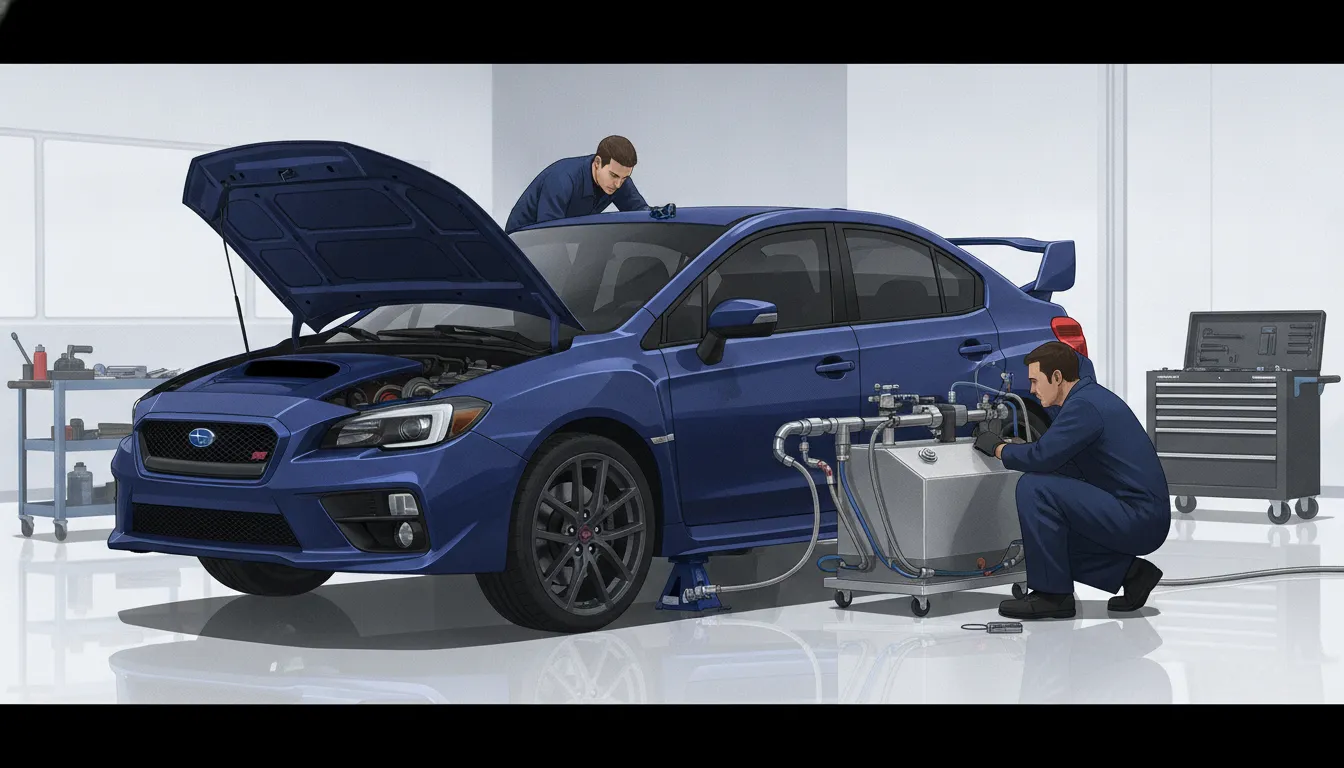
- Identify the fuel and the complete combination. Start with the fuel your Subaru will actually run, then account for the pump, injectors, regulator, rails, and lines as one system. Flex-fuel planning requires verifying that both the lines and injectors are compatible with E85. Do not select a single component in isolation and assume the rest of the system will support the change.
- Choose line materials and fittings for the application. Confirm that the hose, hard line, seals, and fittings are rated for the intended fuel. Pay attention to every transition, including connections at the tank, pump, filter, rails, and regulator. A fitting that physically threads into place is not necessarily the correct choice for the fuel or pressure demands of the build.
- Place the filter where it can be inspected and serviced. The filter should protect downstream components without being buried behind heat shields, wiring, or other parts that make inspection difficult. A clogged filter can restrict delivery and create symptoms that resemble a pump or tuning problem. Use the vehicle's intended environment and access requirements when deciding how the filter is mounted.
- Route lines away from heat, abrasion, and moving parts. Secure the lines so they cannot rub against brackets, suspension components, belts, or sharp edges. Keep them protected from excessive heat and inspect every clamp and connection for movement. On a track, rally, or off-road vehicle, vibration and debris can expose weaknesses that may not appear during a short street drive.
- Check for leaks before tuning or increasing load. Inspect the complete route from the tank to the engine bay, including fittings and areas hidden by covers. Leaking lines are a fuel-system safety issue, not a minor cosmetic defect. If the engine shows sputtering, loss of power, or hard starting, include the filter, lines, and pump in the inspection instead of assuming the calibration is at fault.
- Verify the finished system under the intended conditions. Confirm that the fuel, lines, injectors, and other components remain compatible after installation, then have the system checked as part of the tune. E85 compatibility is a design requirement that should be verified before the vehicle is operated on that fuel, not corrected after a drivability or reliability problem appears.
Careful routing and compatibility checks give the Subaru fuel system a dependable foundation. They also make future troubleshooting more direct because each component can be inspected, isolated, and serviced without dismantling the entire fuel path.
How Do You Match a Fuel System to a Subaru Build?
Match the fuel system to the whole vehicle, not just the engine's advertised power target. Turbo choice, fuel type, intended use, electrical capacity, engine management, and expected operating conditions all affect the final combination. A system that works for a mildly modified street car may not provide the same margin or serviceability required for a track, rally, or off-road build.
Start with the car's actual use
- Street: Prioritize quiet operation, predictable cold starts, reliable wiring, accessible filters, and compatibility with the fuel you can consistently buy. Avoid selecting track-focused parts simply because they have a larger published capacity.
- Track: Account for sustained high load, heat, repeated sessions, and fuel level changes during cornering. Confirm that the pump, pickup, tank arrangement, regulator, and lines can maintain stable delivery for the entire session.
- Rally: Favor secure routing, vibration resistance, protection from impact, and service access between stages. Component selection must fit the vehicle's competition requirements and operating environment.
- Off-road: Plan around dust, shock, temperature changes, and limited service conditions. Protect lines and connections, and do not assume a part intended for competition use is automatically appropriate for every street application.
- Higher-power builds: Size the pump, injectors, regulator, rails, filters, and lines as one system. The Subaru engine upgrade path can help place fuel-system work within the broader progression from stock to built components.
Coordinate the hardware with the tune
Fuel-system planning should happen before the final calibration, not after a fuel-pressure problem appears. Give the tuner a complete parts list, the intended fuel, the expected power range, and details about the vehicle's use. The tuner can then account for injector behavior, pump control, pressure reference, and the engine-management strategy rather than compensating for an unknown restriction.
Verification matters as much as selection. Log fuel pressure and mixture under the loads the car will actually see, and compare those readings with the system's expected behavior. Sputtering, loss of power, or hard starting can point to a fuel-delivery issue, but they are diagnostic clues rather than proof of one failed component. Inspect the full path, including the pump, filter, lines, connections, and electrical supply.
Higher-power builds should also be matched to the right product path. Review Crawford's performance parts collection and WRX upgrades with the intended pump, injector, and tuning plan.
For a high-output EJ application, the high-capacity Subaru fuel system upgrades discussed alongside specific build levels provide useful context. For broader system decisions, Crawford's Subaru fuel system tuning and components guidance reinforces the same principle: reliability comes from a compatible combination. Crawford Performance approaches custom Subaru engines and components with precision engineering for high-stress motorsport conditions, but every build still needs application-specific sizing, installation, and validation.
Contact Crawford Performance to plan the next fuel-system step for your Subaru.
Frequently Asked Questions
What are the common symptoms of a bad fuel pump in a Subaru?
Sputtering, loss of power under load, and hard starting can point to a fuel-pump problem. They are diagnostic clues, not proof of pump failure. Check fuel pressure, electrical supply, wiring, and related components before replacing the pump.
Do Subarus have two fuel pumps?
Fuel-pump configuration varies by Subaru model, year, fuel tank design, and performance setup. Some applications may use more than one pump or a staged arrangement, while others use a single pump. Confirm the specific vehicle's service information and inspect the existing system before planning an upgrade.
How should I inspect a Subaru fuel filter?
Follow the maintenance schedule and service information for the exact model. During diagnosis, inspect the filter for restriction and consider it alongside pump performance, fuel pressure, and line condition. A clogged filter can limit delivery, while leaking lines create a separate safety and reliability concern.
Can a Subaru fuel system run on E85?
Only when the complete fuel system and calibration are designed for it. Verify that the pump, injectors, seals, lines, and other wetted components are compatible with E85, then tune for the selected fuel. Flex-fuel planning should account for changing fuel composition and the demands of the complete engine combination.
What fuel-system problems should I check before upgrading?
Start with the fundamentals: pump operation, filter condition, fuel pressure, electrical connections, and any signs of leaking or damaged lines. Correct existing faults first, then size the pump, injectors, regulator, and lines together for the intended power goal and use.
Contact Crawford Performance About Your Fuel System
A fuel system works best when the pump, injectors, regulator, lines, and tune are planned as one combination. Contact Crawford Performance for help matching components to your Subaru build, fuel type, and intended use.
Contact Crawford Performance to discuss the right next step for your project.