

Is a Subframe Drop Lift Right for Your Subaru?
So, you want to lift your Subaru for bigger tires and more ground clearance. But you've seen the forum debates and heard the horror stories about bad CV angles and premature wear. This is where a subframe drop lift comes in. It's not just another part; it's the engineered solution that protects your car. By lowering your entire engine cradle, it keeps your drivetrain geometry correct and your axles happy. Before you buy any parts, it's crucial to understand how a subframe drop works and why it's the right way to lift your Subaru.
Key Takeaways
- Preserve Drivetrain Angles for Longevity: A subframe drop is the correct way to lift your Subaru because it lowers the engine and suspension cradle. This action maintains the factory-spec angles of your CV axles and steering components, preventing premature wear and ensuring your vehicle handles predictably.
- Create Functional Clearance for Larger Tires: The main benefit of a subframe drop lift is creating the room needed for larger, more aggressive tires. This upgrade provides the most significant gains in ground clearance and traction, while also improving your vehicle's approach and departure angles for clearing trail obstacles.
- Factor in Post-Installation Alignment and Maintenance: A professional wheel alignment immediately after installation is mandatory to correct your suspension geometry and prevent unsafe handling. Plan for this step, along with more frequent inspections of suspension parts, to keep your lifted Subaru reliable and safe.
What is a Subframe Drop Lift?
If you’re looking to lift your Subaru, you’ve probably heard the term “subframe drop.” So, what is it? Think of it as the essential foundation for a proper lift. A subframe drop involves installing spacers to lower the section of your vehicle’s frame that holds the engine, transmission, and key suspension components. The goal isn’t just to raise your car; it’s to do so while maintaining the factory geometry of your drivetrain and suspension.
Without a subframe drop, lifting your vehicle can pull your axles and steering components into severe angles they were never designed to handle. This can lead to accelerated wear, vibrations, and poor handling. By lowering the subframe, you effectively reset those angles back to their original, optimal positions. This simple but critical modification is the difference between a lift that works with your Subaru and one that works against it, making it a cornerstone of our overlanding solutions. It ensures your lifted ride remains reliable and performs as it should, whether you're on the highway or a backcountry trail.
How Does a Subframe Drop Work?
A subframe drop works by using a set of precision-engineered spacers and brackets. These components are installed between your vehicle’s main body and the subframe itself. This process physically lowers the mounting points for your control arms, steering rack, and other vital parts. By lowering these connection points by the same amount as your lift, you preserve the original angles of your CV axles and tie rods.
This is crucial for the health of your drivetrain. When you lift a vehicle without correcting the geometry, the CV axles are forced to operate at a steep, constant angle, which can cause the joints to bind and fail prematurely. A subframe drop kit prevents this by keeping the axles nearly level, just as the manufacturer intended. This maintains smooth power delivery and protects your car from unnecessary strain and costly repairs.
Subframe Drop vs. Traditional Lift: What's the Difference?
When exploring lift options, you’ll see "subframe drop kits" and "traditional suspension lift kits." A traditional lift typically involves replacing components like springs, struts, and control arms with longer ones to achieve height. While effective, this method can be more complex and expensive, as it requires swapping out numerous factory parts. It also directly alters the suspension’s operating angles, which can sometimes require even more components to correct.
A subframe drop kit, often called a drop bracket lift, achieves height by lowering the entire suspension cradle. This approach allows you to retain many of your stock suspension components, which helps maintain a ride quality similar to the factory setup. While a traditional lift might provide more absolute clearance under every single component, a subframe drop offers a balanced, reliable, and often more affordable way to fit larger tires and gain the ground clearance needed for most off-road adventures. It’s an excellent solution for many Subaru Crosstrek and Forester owners.
Understanding Subframe Lifts on Trucks
While the term "subframe lift" is common in the world of body-on-frame trucks, the principle is even more critical for unibody platforms like the Subaru Forester and Crosstrek. On a traditional truck, the body and frame are separate, but on your Subaru, they are one integrated structure. When you lift a unibody vehicle without correcting the geometry, you're putting significant stress on the drivetrain and suspension components. This is why a subframe drop is the correct engineering solution for our overlanding solutions. It lowers the entire engine and transmission cradle, which keeps your CV axles and steering rack at their factory-designed angles. This prevents premature wear and ensures your AWD system performs reliably, whether you're tackling a tough trail or just driving to work.
Will a Subframe Drop Lift Fit Your Subaru?
If you own a modern Subaru and want to lift it, you’ve probably wondered if a subframe drop is the right solution for your specific model. The short answer is yes. Subframe drop kits are one of the most effective ways to lift a range of Subaru vehicles because they are engineered to work with the car's existing design, not against it. This approach ensures you get the added height you want without sacrificing the performance and handling you love. Whether you're driving a rugged Forester or a sporty WRX, this type of lift is designed to provide a balanced and reliable upgrade.
Fitment Guide for Popular Subaru Models
Subframe drop kits are engineered to fit a wide variety of popular models from 2002 to the present, including the Forester, Crosstrek, Impreza, WRX, and STI. The design uses precision-machined spacers to lift the body of your Subaru, creating more ground clearance. At the same time, it lowers the engine and transmission cradle (the subframe) to keep your vehicle's geometry in check. This is the key to a successful lift. It means that whether you're looking to install a lift on your Subaru Crosstrek for off-road adventures or give your Forester a more aggressive stance, the kit is built to integrate seamlessly with your vehicle's factory setup.
Why Subframe Drops Work So Well with Subaru AWD
A subframe drop is especially beneficial for Subaru's Symmetrical All-Wheel-Drive system. When you lift a vehicle with traditional strut spacers alone, you change the angle of the axles. This puts constant stress on the CV joints, leading to accelerated wear and potential failure. A subframe drop corrects this by keeping the drivetrain components at their original, intended angles. This preserves the life of your CV axles and protects the entire drivetrain from unnecessary strain. By maintaining proper steering geometry, you ensure your car’s handling remains responsive and predictable, which is essential for both highway safety and exploring demanding overlanding solutions.
Before You Lift: Important Considerations
Deciding to lift your Subaru is a big step, and it’s exciting to think about the new trails you’ll be able to explore. But before you add that lift kit to your cart, it’s important to take a step back and think about the big picture. A lift changes more than just your car's appearance; it affects its handling, mechanics, and long-term reliability. The key to a successful build is having a clear plan and realistic expectations from the start. This means understanding what a lift can and cannot do for your specific vehicle, knowing the true source of ground clearance, and even considering powerful alternatives that might better suit your immediate goals.
Setting Realistic Expectations for Your Build
It’s easy to see lifted rigs online and want that same aggressive look, but it's crucial to understand what you're getting into. A lift is not just a cosmetic change; it's a functional modification that needs to be done correctly to avoid issues. For a Subaru, this means acknowledging that you're not working with a body-on-frame truck. A subframe drop is essential because lifting with only strut spacers puts your CV joints at extreme angles, leading to rapid wear and potential failure on the trail. Setting realistic expectations means budgeting for a complete, quality kit and the necessary follow-up, like a professional alignment, to protect your investment and keep your ride safe.
Unibody vs. Body-on-Frame
Your Subaru has a unibody chassis, meaning its frame and body are a single, integrated structure. This design is fantastic for on-road performance, providing a lower center of gravity and responsive handling. In contrast, traditional trucks and some large SUVs use a body-on-frame design, where the body is mounted onto a separate, heavy-duty ladder frame. While body-on-frame vehicles are often easier to lift to extreme heights, modifying a unibody requires more engineering precision. A well-designed subframe drop kit is engineered to work with your Subaru's unibody, preserving its structural integrity and factory-designed geometry so you can gain capability without sacrificing reliability.
Understanding Factory Ground Clearance
Here’s a common misconception: a two-inch lift kit gives you two extra inches of clearance everywhere. In reality, a lift kit raises the body of the car, but it doesn’t raise the lowest points of your drivetrain, like the front and rear differentials. The most significant benefit of a lift is that it creates the space needed to install larger, more capable tires. It’s the increased diameter of those new tires that actually lifts your axles and differentials higher off the ground, giving you the true ground clearance needed to crawl over rocks and ruts without issue. Think of the lift kit as the enabler and the tires as the provider of true clearance.
Subaru Forester Wilderness vs. Off-Road Trucks
The Subaru Forester Wilderness edition is a great benchmark, coming from the factory with an impressive 9.2 inches of ground clearance. It’s a testament to how capable a Subaru can be. However, it's helpful to keep that number in perspective. A stock Ford Bronco can have up to 11.6 inches of clearance, and a Jeep Wrangler Rubicon boasts up to 12.9 inches. This isn't to say one is better than the other, but to highlight that they are different classes of vehicles built for different primary purposes. A lifted Subaru Forester is an incredibly versatile machine that blends daily drivability with impressive off-road chops, but it’s important to know its structural limits compared to a dedicated off-road truck.
Alternatives to Improve Off-Road Performance
A lift kit is a fantastic upgrade, but it isn't always the first or only step you should take to make your Subaru more capable off-road. Depending on your budget and the type of terrain you plan to tackle, there are other high-impact modifications that can make a huge difference. In fact, some of the most effective upgrades have nothing to do with suspension height. Focusing on traction, vehicle protection, and your own abilities can transform your experience on the trail and build a solid foundation for any future modifications you decide to make.
Upgrading Tires and Protection
Before you invest in a lift, consider a set of quality all-terrain tires. This is arguably the single most effective upgrade for off-road performance. Good tires provide the traction you need to handle mud, loose dirt, and rocky surfaces—conditions where stock all-season tires will quickly leave you spinning. At the same time, think about protection. Your Subaru’s underbelly, especially the oil pan and rear differential, is vulnerable on the trail. Installing skid plates is a smart, relatively inexpensive way to add armor and confidence. These foundational performance parts can dramatically improve your capability without altering your vehicle's suspension.
Improving Your Off-Road Driving Skills
The most underrated modification is the "driver mod." Learning how to properly drive off-road can be more valuable than any part you can bolt onto your car. Understanding how to choose a good line, how to use momentum, and when to apply throttle or brakes can get you through obstacles that would stop a novice in a highly modified rig. You don't need to be an expert overnight. Start by finding some easy, well-maintained forest roads. Join a local Subaru or overlanding group to learn from others. Building your skills is free, and the confidence you gain will make every trip more enjoyable and safe.
What Are the Benefits of a Subframe Drop Lift?
A subframe drop lift kit offers more than just a taller stance; it provides a smart, engineered solution for improving your Subaru's capability. By thoughtfully redesigning how your vehicle is lifted, this method delivers significant performance gains without the usual trade-offs. From protecting your drivetrain to opening up new possibilities for your build, the benefits address the core needs of any serious off-road or overlanding enthusiast. Let's break down exactly what you gain when you install one.
Restores Correct Suspension Geometry
This is arguably the most important benefit of a subframe drop. When you install a traditional lift, you change the angles of your CV axles and steering components. This can cause accelerated wear and tear on your drivetrain and lead to poor handling on the road. A subframe drop kit corrects this by lowering the entire subframe assembly, which includes your engine, transmission, and control arm mounting points. This keeps your suspension and axle geometry within factory specifications, ensuring your Subaru drives smoothly and its components last longer. It’s the right way to achieve a lift without compromising your vehicle's engineering.
Gain Crucial Ground Clearance
The most obvious advantage of any lift is increased ground clearance, and a subframe drop delivers. By raising the body of your Subaru, you create more space between the chassis and the ground. Our kit, for example, lifts the front by two inches and the rear by one and a half inches, which also levels out the factory rake for a more aggressive look. This added height allows you to clear larger rocks, ruts, and other obstacles on the trail that would otherwise scrape or damage your vehicle's underbody. It’s a fundamental step in turning your daily driver into a capable adventure rig.
Finally Fit Those Larger Tires
If you want to run bigger, more aggressive tires, a lift is essential. A subframe drop provides the necessary clearance in your wheel wells to fit larger-diameter tires without rubbing. Larger tires are a game-changer for off-road performance, offering better traction in mud, sand, and snow while also providing an additional increase in ground clearance. For models like the Crosstrek, fitting beefier all-terrain tires is often the main goal of a lift, completely transforming its off-road prowess. This single modification is a gateway to a whole new level of performance parts and capabilities.
Improve Your Approach and Departure Angles
Beyond simple ground clearance, a subframe drop significantly improves your vehicle's approach and departure angles. These angles determine how steep of an obstacle you can drive up to or away from without scraping your front or rear bumpers. By lifting the body and bumpers higher off the ground, you can tackle more aggressive inclines and declines on the trail. This is a critical metric for serious off-roading and overlanding, giving you the confidence to get through technical terrain. It’s an essential part of building a truly capable Subaru Forester or Crosstrek.
How Does a Subframe Drop Affect Ride Quality?
A common question is whether a lift kit will ruin the way a Subaru drives. It's a valid concern. You want the off-road capability without sacrificing the on-road comfort and handling you love. The right subframe drop kit is designed to give you the best of both worlds. It doesn't just lift your vehicle; it intelligently repositions key components to maintain performance, stability, and reliability, whether you're on the pavement or the trail.
Keep Your CV Axles and Drivetrain Safe
When you lift your Subaru, the distance between the wheels and the chassis increases. This can pull the CV axles to an extreme angle, putting constant stress on the joints. Over time, this leads to accelerated wear, annoying vibrations, and eventual failure. A subframe drop kit prevents this by lowering the entire engine and transmission cradle. This simple adjustment keeps your CV axles operating at their intended, factory-spec angles. By protecting these critical components, you can confidently use your vehicle's all-wheel-drive system without worrying about premature damage to your drivetrain. It’s a foundational step for any reliable lift.
Keep Your On-Road Handling Sharp
Lifting a vehicle can sometimes result in vague or unresponsive steering, which is the last thing you want during your daily commute. A quality subframe drop kit is engineered to maintain your Subaru's original steering geometry. By lowering the subframe, the kit ensures that components like your tie rods and control arms remain at the correct angles. This means your car's steering will feel as crisp and predictable as it did before the lift. You get the benefit of added ground clearance without the unnerving feeling of a "wandering" vehicle on the highway, ensuring your Subaru remains a stable and enjoyable daily driver. Proper engine tuning services can further refine your vehicle's overall responsiveness after modification.
Improve Your Capability on the Trail
This is where a subframe drop truly shines for adventurers. The lift enabled by the drop kit dramatically improves your Subaru's off-road credentials. By increasing ground clearance, you also improve your vehicle's approach, departure, and breakover angles. In simple terms, this means you can tackle steeper inclines without scraping your front bumper, descend sharp drops without damaging your rear, and clear obstacles in the middle of the trail that would have stopped you before. This modification transforms your vehicle into a much more capable machine, opening up new possibilities for exploration. It’s a key component in many of our favorite overlanding solutions.
Which Lift Kit Offers the Smoothest Ride?
When it comes to lifting your Subaru, maintaining a smooth, comfortable ride is just as important as gaining clearance. For the smoothest ride, a subframe drop lift kit is the clear winner. Unlike simple strut spacers that can create harsh angles for your drivetrain, a subframe drop is an engineered system. By lowering the entire engine and suspension cradle, it preserves the factory-spec angles of your CV axles and steering components. This prevents the binding and vibrations that often cause a rough ride in poorly lifted vehicles. The result is a lift that feels stable and predictable on the road while giving you the capability you need on the trail. It’s the smart way to get height without sacrificing the comfort you expect from your Subaru.
Subframe Drop Myths: Busted
When you start researching lift kits for your Subaru, you'll quickly come across the term "subframe drop." It's a key component in many lift systems, but it's also surrounded by a lot of questions and misinformation. Let's clear the air and tackle some of the most common myths so you can make an informed decision for your build.
Does it defeat the purpose of a lift?
This is probably the biggest misconception out there. The short answer is no, a subframe drop absolutely does not defeat the purpose of a lift. In fact, for a Subaru with its independent suspension, it's a critical part of doing the lift correctly. When you lift your vehicle, you change the angles of the drivetrain components. Without a subframe drop, the angles on your CV joints can become too steep, leading to premature wear or even breakage on the trail. The subframe spacers simply lower the mounting points of your engine and suspension, keeping everything in proper alignment.
How much clearance do you really gain?
It's true that you won't gain a full two inches of clearance directly under the rear differential if you install a two-inch lift with a subframe drop. Since the subframe is lowered, the differential comes down with it. However, you still gain a significant amount of ground clearance everywhere else. Your approach, departure, and breakover angles all improve, which is what helps you clear obstacles without scraping your undercarriage. Plus, the main reason for a lift is often to fit larger tires, and that's where you'll see a massive improvement in overall ground clearance. These kits are essential for serious overlanding solutions.
Is installation really that simple?
Because these kits are sometimes called "spacer lifts," it's easy to assume the installation is a simple bolt-on affair. This is another myth. While a subframe drop kit uses spacers to lower the suspension attachment points, the process is more involved. In many cases, the installation requires permanently cutting the vehicle's subframe to fit the new components. This isn't a modification you can easily reverse in your garage. It's a serious job that requires precision and the right tools. While it's the best way to preserve your Subaru's factory geometry, you should be prepared for a complex installation. This is a key part of installing many performance parts correctly.
Are There Downsides to a Subframe Drop?
Every vehicle modification involves trade-offs, and a subframe drop is no exception. While the benefits for off-road capability and appearance are significant, it’s important to have a clear picture of the potential downsides before you commit. Being aware of these factors ensures you’re making the best choice for your Subaru and your driving needs. A quality kit is designed to minimize these issues, but understanding them will help you manage your expectations and properly care for your modified vehicle. From clearance specifics to long-term wear, let’s walk through what you should consider.
What to Know About Differential Clearance
One common question is about how much ground clearance you truly gain. While a subframe drop lifts your vehicle's body, it also lowers the subframe assembly, which includes your rear differential. This means you won't see the full lift height in clearance directly under the differential. However, this is less of a drawback than it sounds. The primary benefit comes from the increased space in the wheel wells for larger tires, which do lift the differential higher off the ground. The improved approach and departure angles also dramatically improve your ability to clear obstacles, which is essential for any overlanding solutions.
A Look at Long-Term Component Wear
Lifting any vehicle can change its suspension dynamics and place additional stress on certain components. Even with a subframe drop correcting the geometry, parts like CV axles and shocks may experience slightly accelerated wear compared to a stock setup. Using high-quality performance parts designed for lifted applications can help manage this. It's also important to distinguish between different types of lift kits. Some lower-quality kits require cutting the vehicle's frame, which can compromise its structural integrity. Our kits are designed as a bolt-on solution, preserving the frame and ensuring a safer, more reliable modification for your Subaru.
Will a Subframe Drop Affect Resale Value?
Any modification can influence your vehicle's resale value, and the outcome often depends on the buyer. The biggest hit to resale value comes from irreversible modifications. Lift kits that require cutting or welding the frame can make a vehicle difficult to sell and may even cause issues with insurance coverage. Because our subframe drop kits are bolt-on, the modification is completely reversible. This gives you the flexibility to return the vehicle to its stock configuration if needed. For the right buyer, a professionally installed, high-quality lift on a Subaru Forester or Crosstrek can actually be a major selling point, saving them the time and expense of doing it themselves.
Potential Impacts on Fuel Economy and On-Road Handling
Let's be upfront: lifting your Subaru will affect its fuel economy and on-road handling. It's a trade-off for gaining off-road capability. The higher stance increases aerodynamic drag, and adding larger, heavier all-terrain tires increases rolling resistance, both of which will likely cause a dip in your miles per gallon. However, the impact on handling is where a quality kit makes all the difference. A well-engineered subframe drop is specifically designed to maintain your Subaru's original steering geometry by keeping control arms and tie rods at their correct angles. This prevents the vague, wandering feeling common with poorly designed lifts. While your car will have a higher center of gravity and feel different in corners, a proper kit ensures the steering remains predictable and safe for daily driving, giving you confidence both on and off the pavement.
Installing Your Subframe Drop: What to Expect
Installing a subframe drop is a major step in transforming your Subaru, but it doesn't have to be intimidating. With the right approach, the process can be straightforward and rewarding. It really comes down to two key phases: the installation itself and the critical adjustments that follow. Understanding what's involved will help you plan the project, whether you're grabbing the wrenches yourself or handing the keys to a trusted mechanic. A successful installation ensures your vehicle not only gains the clearance you want but also maintains the safety and performance you expect from your Subaru. Let's break down what you need to know to get it done right.
Essential Safety Procedures for DIY Installation
If you’re comfortable with a wrench and have a good set of tools, installing a subframe drop kit yourself can be an incredibly satisfying project. However, this is a major modification, and your safety should always be the top priority. Before you even think about loosening a bolt, you need to have a solid plan for working safely. These aren't just suggestions; they are essential steps to protect yourself and your vehicle. Taking the time to set up your workspace correctly ensures the job gets done right and you can enjoy the results without any regrets.
Work on a Hard, Level Surface
This is the first rule of working on any vehicle. You must perform the installation on a hard, level surface like a concrete garage floor or a paved driveway. Never attempt a job like this on grass, dirt, or uneven asphalt. The jack stands that will support the entire weight of your Subaru need a solid, stable base to be effective. A soft or sloped surface can allow a stand to shift or sink, creating a dangerously unstable situation that could lead to serious injury or damage to your car. A successful installation ensures your vehicle not only gains the clearance you want but also maintains the safety and performance you expect from your Subaru.
Use Wheel Chocks and Jack Stands Correctly
A hydraulic floor jack is designed for lifting, not for supporting. Once your Subaru is at the desired height, you must secure it with a set of appropriately rated jack stands. Place them on strong points of the vehicle's frame, as recommended in your owner's manual or a reliable service guide. Before you lift one end of the car, be sure to place wheel chocks securely behind the tires at the opposite end to prevent any possibility of rolling. Never, under any circumstances, get under a vehicle that is only supported by a jack. This is a simple rule that saves lives and protects your investment.
Perform a Stability Test Before Working
Once your Subaru is in the air and resting securely on the jack stands, perform a final stability test. With the wheels chocked and the stands in place, give the vehicle a firm push from several angles. It should not rock, sway, or move at all. If you notice any instability, carefully lower the vehicle and start the process over again, ensuring your jack stands are properly positioned on a level surface. This quick check gives you the confidence that the car is secure before you begin working underneath it. Understanding what's involved will help you plan the project, whether you're grabbing the wrenches yourself or handing the keys to a trusted mechanic.
Understanding the Costs
Now that you know what’s involved in the installation, let's talk about the budget. The price of the subframe drop kit itself is just the starting point. To do the job right and get the most out of your new lift, there are several other costs you need to factor into your plan. Thinking about these expenses ahead of time will prevent surprises and ensure you have a complete, well-rounded build. From the kit itself to the final alignment, a realistic budget is key to a successful project that you'll be happy with for years to come.
Kit and Parts Pricing
A quality subframe drop kit is a piece of precision engineering, and its price reflects the research, development, and high-quality materials that go into it. A subframe drop kit, often called a drop bracket lift, achieves height by lowering the entire suspension cradle. This approach allows you to retain many of your stock suspension components, which helps maintain a ride quality similar to the factory setup. While it may seem like a simple set of spacers, our kits are designed to perfectly match your Subaru's specifications, ensuring a perfect fit and long-term durability for your overlanding solutions. Investing in a well-made kit is the first step toward a reliable build.
Accounting for Unexpected Expenses
The total cost of lifting your Subaru goes beyond the kit itself. While a subframe drop kit uses spacers to lower the suspension attachment points, the process is more involved. Some kits on the market require you to permanently cut the vehicle's subframe to fit the new components, which is a serious, irreversible step. Our kits are designed as a bolt-on solution, which is a critical distinction that preserves your vehicle's frame and resale value. Beyond the kit, you must budget for a professional wheel alignment immediately after installation—this is not optional. You should also account for the cost of larger tires to complete the build, and potentially professional installation labor if you decide not to DIY.
Should You DIY or Hire a Pro?
Your first decision is who will perform the installation. If you have a solid mechanical background, a well-stocked toolbox, and a safe place to work, a DIY install is a great way to get to know your vehicle better. However, this is a significant job. If you aren't completely confident working on suspension components, a professional installation is the best choice. A pro will have the right equipment, like a vehicle lift, and the experience to handle the job efficiently and safely. This ensures every part is installed correctly, giving you total peace of mind on your next adventure.
Common DIY Installation Hurdles
If you're considering the DIY route, it's important to be realistic about the challenges. This isn't a simple weekend project with a basic socket set. Some lift kits on the market may require you to permanently cut your vehicle's subframe to fit the new components—a step that requires precision and can't be undone. Even with a quality bolt-on kit, the process is complex. The most critical part? A professional wheel alignment is mandatory immediately after installation to correct the suspension geometry and ensure your Subaru handles safely. Skipping this step isn't an option. Factoring in these hurdles is part of building capable overlanding solutions and will help you decide if tackling the job yourself is the right move.
Why an Alignment After Installation is Crucial
This part is not optional. You absolutely must get a professional wheel alignment immediately after the lift kit is installed. Lifting your Subaru changes its suspension geometry, and driving without correcting it will cause poor handling, unpredictable steering, and accelerated tire wear. Don't risk your safety or the lifespan of your tires. Plan ahead and schedule an alignment for the same day the installation is finished. This final step is essential to lock in the benefits of your new lift and ensure your Subaru Forester drives as well as it looks.
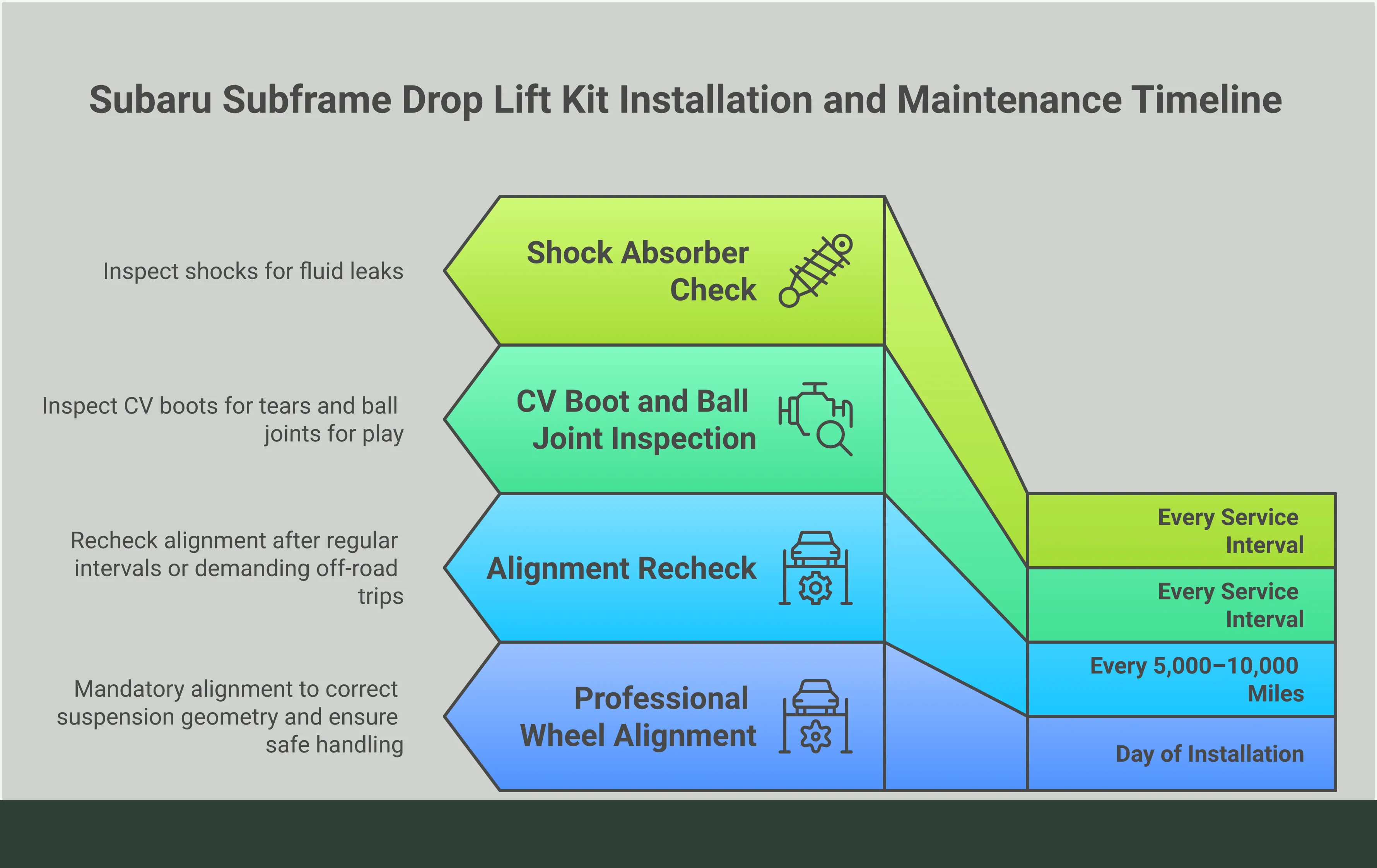
Keeping Your Subframe Drop in Top Shape
A subframe drop is one of the best ways to lift your Subaru while protecting its drivetrain, but like any significant modification, it requires a little extra attention to keep your vehicle performing at its best. Think of it as a small investment of time to protect your much larger investment in your car and its capabilities. Proper maintenance ensures your Subaru remains reliable, safe, and ready for whatever you throw at it, whether that's a daily commute or a weekend on the trails. By staying on top of a few key areas, you can prevent small issues from becoming major problems down the road.
This proactive approach is especially important if you frequently take your vehicle off-road, as the added stress from uneven terrain can accelerate wear on certain components. A consistent maintenance routine will give you peace of mind and keep your lifted Subaru running just as smoothly as the day you installed the kit. It’s not about fixing things that are broken; it’s about keeping them from breaking in the first place. Regular checks on your suspension and alignment will help you catch wear early, extend the life of your tires and drivetrain, and maintain the predictable handling you rely on. Let's go over the simple but crucial steps to keep your lifted Subaru in top shape for years to come.
Your Regular Inspection Checklist
After installing a lift, your CV joints, ball joints, and shocks are working at slightly different angles. While a subframe drop corrects the most extreme geometry changes, these parts can still experience different stress patterns than they did at stock height. That’s why regular inspections are so important. Make it a habit to visually check these components for any signs of wear, damage, or leaks. Look for torn CV boots, which can lead to joint failure if dirt gets inside. Check your ball joints for excessive play and listen for any clunking sounds while driving. A quick look at your shocks for any fluid leaks will tell you if they are still functioning correctly. Catching these issues early helps you maintain vehicle safety and allows you to replace any worn performance parts before they cause bigger problems.
When to Check Your Alignment
Getting a professional alignment is not optional; it's a critical step immediately after your subframe drop is installed. This initial alignment resets your suspension to the correct specifications for the new ride height, ensuring your Subaru handles safely and predictably. It’s also your first line of defense against premature and uneven tire wear. Beyond that first appointment, you’ll need to check your alignment more frequently than you would with a stock vehicle. A good rule of thumb is to have it checked every 5,000 to 10,000 miles or after any demanding off-road trip. This helps you correct any changes caused by rough terrain and is essential for anyone with serious overlanding solutions on their build.
Take it Further: Upgrades to Pair with Your Lift
A subframe drop is a fantastic foundational upgrade, but its true potential is realized when you pair it with other modifications. Think of it as the first step in creating a cohesive, capable build that matches your driving ambitions. By combining your subframe drop with the right suspension components, wheels, and tires, you create a system where every part works together. This approach ensures you get the performance you want without compromising the integrity of your Subaru.
Whether you're building a weekend trail explorer or a serious overlanding rig, planning your upgrades together will give you the best results. Let's look at the most common and effective pairings for your subframe drop lift kit.
Pairing with Other Suspension Upgrades
A subframe drop is almost never a standalone part; it’s the key that makes a proper lift kit work. When you lift your Subaru, you change its suspension geometry. A subframe drop kit lowers a section of the frame to keep your axles and steering components at their correct, factory-designed angles. This is crucial for preventing accelerated wear on your CV joints and maintaining predictable handling on and off the road.
That’s why you’ll often find subframe drops included in comprehensive overlanding solutions. These kits are engineered to provide a true lift while preserving your Subaru’s drivetrain and ride quality, giving you a reliable setup you can count on.
Identifying Other Necessary Upgrades
A subframe drop creates the necessary space for the single most impactful off-road upgrade: larger, more aggressive all-terrain tires. This is where you’ll see major gains in traction and true ground clearance. To support this new capability, you should also consider upgrading your factory shocks and struts to a set designed to handle the increased demands of trail driving. With more clearance, you'll be tackling tougher obstacles, so protection becomes critical. Skid plates for your engine and differential are essential armor for your underbody. These upgrades work together as a complete system, turning your Subaru into a reliable partner for any adventure. You can find many of these components bundled in comprehensive overlanding solutions designed to work together seamlessly.
Choosing the Right Wheels and Tires
One of the main reasons to install a lift kit is to create more room in the wheel wells. This extra space allows you to fit larger, more aggressive tires. Bigger tires provide a larger contact patch for better traction on loose surfaces like dirt and gravel, and their taller sidewalls can help absorb bumps on the trail. They also give you a bit more ground clearance beyond what the lift itself provides.
Keep in mind that upsizing your tires can affect on-road handling and fuel economy. However, for many drivers, the trade-off is well worth the massive improvement in off-road capability. Pairing a lift with the right tires is a core part of transforming your Subaru Crosstrek or Forester into a confident trail machine.
Build Inspiration for Overlanding and Off-Roading
Once you’ve sorted out your suspension and tires, you can focus on outfitting your Subaru for adventure. While a stock Forester or Crosstrek is surprisingly capable, a proper lift opens the door to more demanding trails and heavier loads. This is where you can add other performance parts to complete your build.
Consider adding skid plates for underbody protection, a roof rack for carrying gear like recovery boards and extra fuel, or auxiliary lighting for navigating trails after dark. A subframe drop provides the solid foundation you need to build a rig that can take you further, turning your daily driver into a purpose-built vehicle ready for any expedition.
Is a Subframe Drop Right for Your Subaru?
If you’re thinking about lifting your Subaru, the real question isn’t just if you should do it, but how. A subframe drop is a critical part of any well-designed lift kit. It works by lowering a section of your vehicle's frame to maintain the correct angles for vital parts like your axles and steering components. Simply adding spacers to your struts without this correction can lead to rapid wear on your drivetrain and negatively impact your car's handling.
So, who is this upgrade for? If you plan on taking your Subaru on challenging trails or want to build a serious overlanding setup, a subframe drop is a must. It preserves your drivetrain by keeping your CV joints from wearing out too quickly and ensures your steering remains responsive and predictable, even on rough terrain. While you might not get the full lift height directly under the rear differential, the overall improvement in clearing obstacles is significant, especially once you add larger tires.
It's also important to consider the full picture. Some lift kits require permanent modifications, which could potentially affect your vehicle's resale value. However, high-quality, bolt-on kits are designed to integrate seamlessly without compromising structural integrity. Ultimately, if you're lifting your Subaru to improve its capability on anything more than a gravel road, choosing a lift kit that includes a subframe drop is the best way to protect your vehicle and get the performance you're paying for. It ensures your Subaru remains reliable, capable, and fun to drive wherever you take it.
Related Articles
- 2017+ Subaru Impreza 2" Lift Kit & Subframe Drop Kit by Crawford
- 2017-2023 Subaru Impreza Crawford Performance Subframe Drop Kit
Frequently Asked Questions
Can I just lift my Subaru with strut spacers instead of a full subframe drop kit? While you technically can use only strut spacers for a small lift, it is not the recommended way to do it. Using spacers alone forces your CV axles and steering components into severe angles they were not designed for. This leads to vibrations, poor handling, and premature failure of your drivetrain parts. A subframe drop is the correct method because it preserves the factory geometry, protecting your vehicle from unnecessary wear and ensuring it performs reliably.
Will a subframe drop make my daily commute uncomfortable or ruin my car's handling? A quality subframe drop kit is engineered specifically to prevent poor handling. By keeping your steering and suspension components at their correct angles, it maintains the responsive, stable feel you expect from your Subaru on the road. You get the benefits of added height for off-road use without sacrificing the safe and predictable drivability you need for your daily commute.
I heard a subframe drop lowers the differential, so do I really gain any ground clearance? This is a common point of confusion. While the differential is lowered along with the subframe, you still gain significant clearance under the rest of your vehicle's body, which is crucial for improving your approach and departure angles. The primary reason for the lift is to fit larger tires, and those new tires are what will lift the entire vehicle, including the differential, higher off the ground for better overall clearance.
Is installing a subframe drop kit a reversible modification? It depends entirely on the kit you choose. Some lower-quality kits require you to permanently cut or weld your vehicle's frame, which is not a reversible process and can negatively affect resale value. A well-designed, bolt-on kit, however, can be completely removed. This gives you the flexibility to return the vehicle to its stock configuration if you ever need to.
What is the single most important step to take after installing the lift? Without a doubt, the most critical step is getting a professional wheel alignment immediately after the installation is complete. Lifting your vehicle changes its suspension geometry, and driving without a proper alignment will cause unsafe handling and destroy your tires in a very short time. You should plan to have this done the same day the lift is installed to ensure your vehicle is safe and drives correctly.