


Subaru Dyno Tune: What to Expect and How to Prepare
Subaru Dyno Tune: What to Expect and How to Prepare
A Subaru dyno tune gives you measured information about how your car responds under controlled load.
Contact Crawford Performance to plan your Subaru tuning session
The tuner can evaluate power, fueling, boost, temperatures, and drivability against the hardware and fuel actually in the car. That is more useful than relying on a road impression or a generic map.
What does a Subaru dyno tune measure?
A Subaru dyno tune measures horsepower, torque, fueling, boost, temperatures, and engine behavior under controlled load. AWD testing uses coordinated front and rear rollers. Baseline pulls document the starting point. Final pulls show the calibration under comparable conditions. These measurements connect the tune to the car's hardware, fuel, and intended use.
A dynamometer measures how the vehicle responds while its driven wheels turn rollers. The equipment applies resistance or controlled load. Its data system records the car across a selected range of speed and load, giving the tuner a repeatable reference for evaluating calibration changes.
Torque and horsepower curves
Torque is the engine's twisting force. Horsepower relates torque to engine speed and describes the rate at which the engine performs work. During a pull, the dyno records both across a range rather than producing only one useful number.
Peak wheel horsepower can help compare controlled tests, but it does not describe the entire driving experience. A smooth torque curve, predictable boost response, and stable temperatures may matter more than a small increase at the top of the graph. Ask to review the complete curve and the conditions behind it.
Fueling, boost, ignition, and temperature
The tuner watches the inputs that control combustion. Fueling affects the mixture delivered to the engine. Ignition timing determines when the spark occurs. Boost reflects turbocharger pressure, while intake and coolant temperatures show how the car responds as heat builds.
A wideband oxygen sensor provides air-fuel information under load. Data logs can reveal inconsistent boost, a fueling limitation, or ignition activity that casual driving may not expose. The goal is not to chase a graph at any cost. It is to create a calibration that matches the car's mechanical condition, fuel, installed parts, and intended use. Crawford's Subaru WRX and STI performance collection can help when you are planning supporting hardware.
Why does an AWD Subaru need the right dyno?
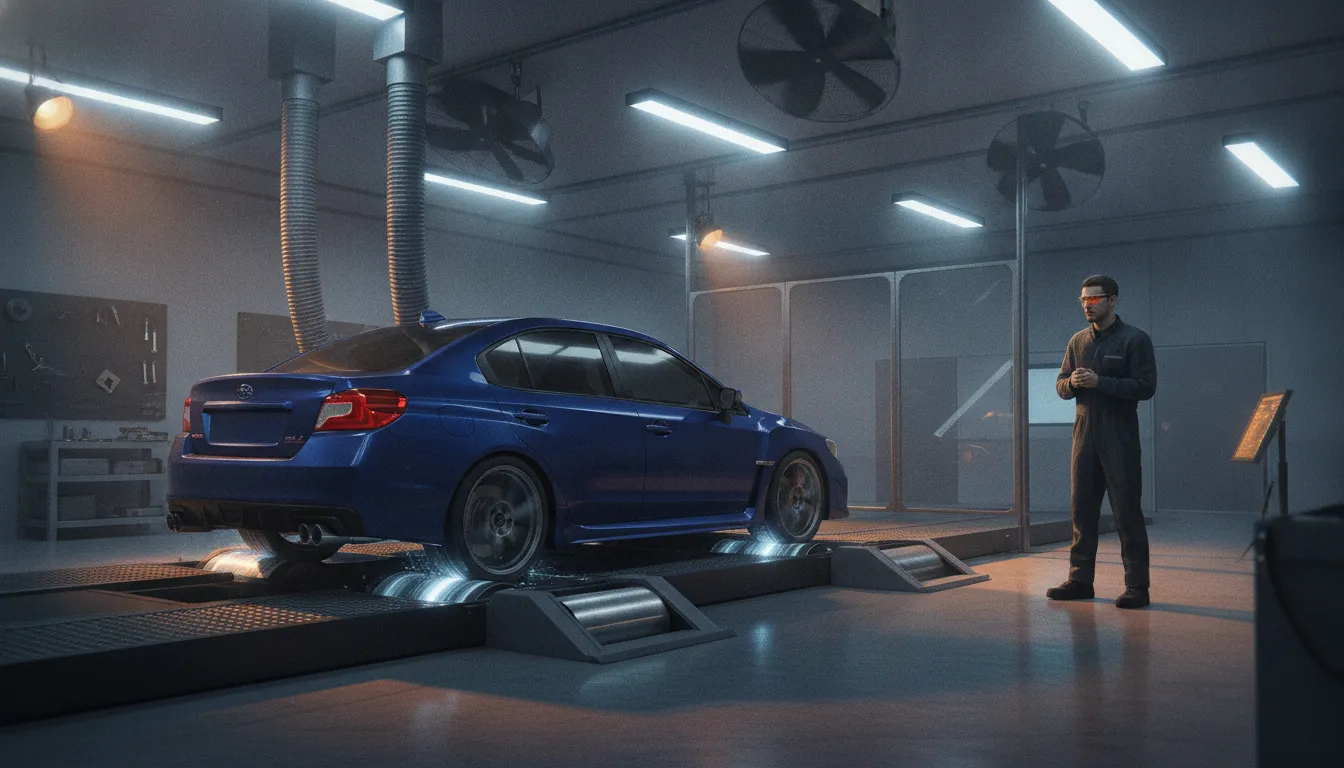
An AWD Subaru needs a dynamometer that coordinates the front and rear rollers at the correct speed. Proper synchronization helps avoid an artificial axle-speed difference during a pull. The operator should also confirm the vehicle-specific setup, secure the car correctly, manage cooling airflow, and monitor the drivetrain throughout testing.
Subaru AWD systems connect the front and rear wheels through the drivetrain. That makes dyno selection and operating mode important. An AWD-capable dynamometer uses front and rear rollers that rotate in coordination with the vehicle. The setup should follow the requirements of the specific Subaru and dyno manufacturer before high-load testing begins.
Roller synchronization matters
If the axles experience an artificial speed difference during a pull, the center differential and related components may be exposed to avoidable stress. Synchronized rollers let the car run in a way that better reflects its normal power transfer.
The operator should confirm the correct mode, secure the vehicle properly, and verify tire condition and pressure before testing. Ask what equipment the shop uses, how it handles AWD vehicles, and what safety checks happen before the first pull. A careful setup protects the car and makes the resulting comparisons more meaningful.
Heat management and operator control
High-load testing creates heat and exhaust flow. The dyno cell needs suitable ventilation, cooling airflow, and clear controls that let the operator stop a pull when readings move outside the expected range. Intake air temperature can change the result on a turbocharged Subaru, so the tuner should account for heat soak and the time between pulls.
A dyno is a controlled measurement environment, not a substitute for a road test or mechanical inspection. The safest session combines synchronized equipment, active monitoring, a clear test plan, and a willingness to pause when the data identifies a problem.
What happens during a Subaru dyno tuning session?
A Subaru dyno tuning session usually includes a build review, safety inspection, baseline pulls, measured calibration changes, live monitoring, and final verification. The exact sequence depends on the vehicle's engine management, fuel, hardware, condition, and intended use. The useful result is a documented comparison, not just a peak horsepower number.
A professional session is a sequence of checks, baseline pulls, measured revisions, and verification. The exact scope depends on the vehicle, engine management, fuel, installed parts, and condition of the car.
- Review the build. The tuner confirms the engine platform, turbocharger, intake, intercooler, exhaust, injectors, fuel system, boost control, engine internals, map history, and intended use.
- Inspect and secure the car. The operator checks for obvious leaks, loose connections, warning lights, tire concerns, and fluid issues. The Subaru is strapped down on the correct AWD dyno, cooling equipment is positioned, and ventilation is confirmed.
- Record baseline pulls. Initial pulls document current torque, horsepower, boost, fueling, temperatures, and other relevant parameters. The baseline provides a reference rather than promising a specific final gain.
- Adjust calibration areas. The tuner makes controlled revisions to fueling, boost control, ignition timing, or related tables. Another pull follows each meaningful change so the effect can be evaluated against previous data.
- Monitor every pull. The operator watches air-fuel ratio, boost behavior, intake temperature, ignition activity, and platform-appropriate safeguards. If a reading is outside the expected range, tuning pauses while the cause is investigated.
- Complete final pulls. Once the calibration is stable, final runs verify the result under comparable conditions. The tuner documents the map, fuel assumptions, data, and recommendations for future maintenance or hardware.
A dyno chart should always be read with its conditions. Fuel, correction method, temperature, tire setup, gear, and equipment can affect the result. A repeatable comparison within the same session is more useful than treating an isolated number as universal.
Use the session to answer practical questions, not only to collect a peak figure. Does boost build predictably? Does the car maintain stable fueling across the pull? Does the final calibration suit street driving, track work, or another intended use? Recording these observations alongside the graph makes the result easier to use later.
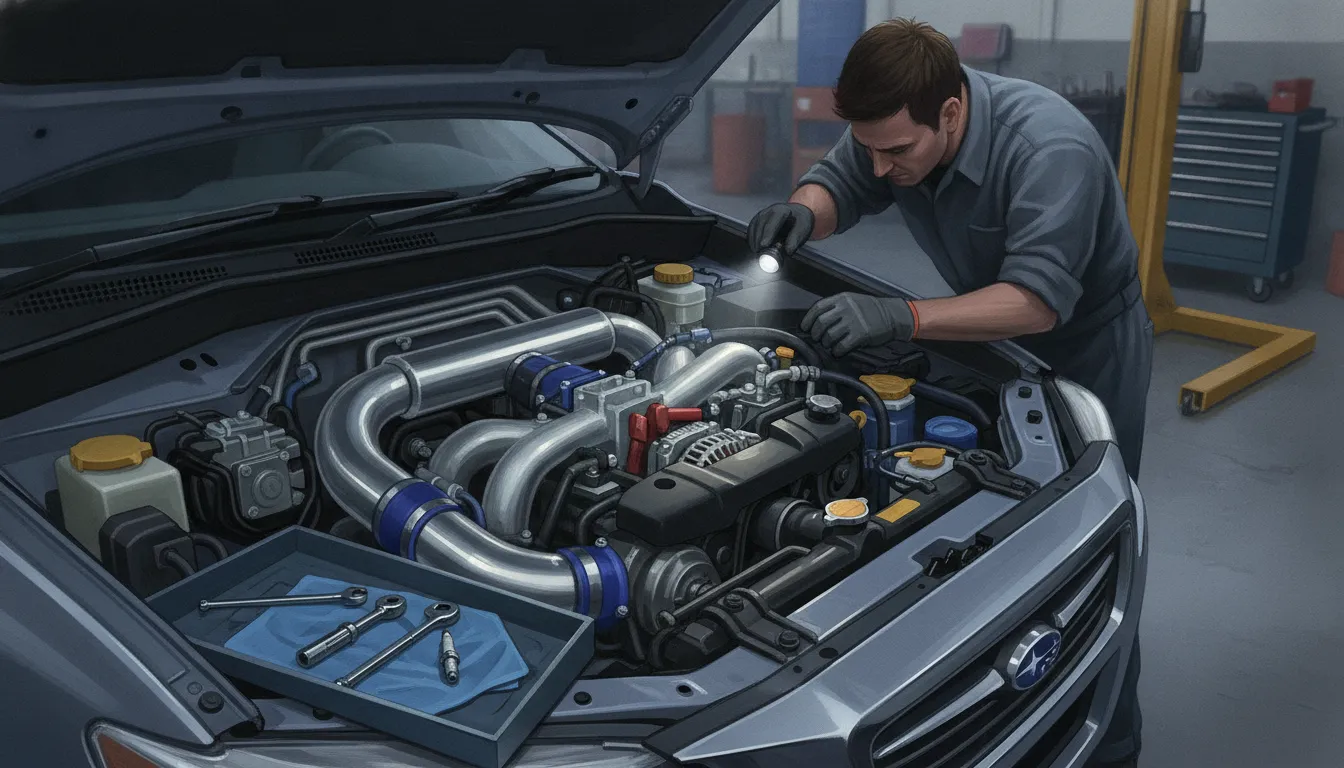
For context, Crawford's Subaru exhaust horsepower guide shows why measured results need to be interpreted with the tested setup. The same principle applies when comparing dyno pulls from different shops or different days.
Talk with Crawford Performance about your Subaru build and tuning goals
How should you prepare your Subaru for a dyno tune?
Prepare your Subaru for a dyno tune by checking fluids, tires, spark plugs, charge piping, vacuum lines, and possible boost leaks. Bring known fuel, a complete modification list, previous maps or logs, service records, and clear goals. Finish hardware changes before the appointment so the final calibration matches the configuration you will drive.
Arrive with a mechanically sound vehicle. A dyno session places more demand on the engine, drivetrain, cooling system, and tires than ordinary street driving. The appointment is not the right time to discover basic maintenance problems for the first time.
Complete the mechanical checks
Check for oil or coolant leaks, damaged hoses, loose clamps, warning lights, worn belts, and unsecured battery connections. Confirm that all four tires are in good condition and set consistently. Make sure fluids are at appropriate levels and that a service interval is not already overdue.
On a turbocharged Subaru, inspect charge pipes, couplers, vacuum lines, intercooler connections, and boost-control plumbing. A boost leak can create unstable pressure and make calibration work inefficient. Spark plugs deserve the same attention. Use the correct plugs for the engine and build, inspect their condition and gap, and replace worn or fouled plugs before the appointment. If you are reviewing oil-separation hardware, Crawford's Subaru air oil separator collection is a relevant starting point.
Bring accurate fuel and parts information
Use known fuel that matches the intended calibration. Tell the tuner the fuel grade and whether the vehicle will use a different fuel afterward. There should be enough fuel for loading, repeated testing, and the drive home. Inconsistent or unknown fuel makes the result harder to interpret.
Bring a complete list of modifications, including the turbocharger, intake, intercooler, exhaust, injectors, fuel pump, regulator, boost controller, and engine internals. Bring previous maps, data logs, service records, and notes about recent repairs, symptoms, or unusual behavior. If you plan to install hardware, finish those changes before tuning the final configuration.
Plan around temperature and use
Avoid arriving immediately after repeated hard driving. Give the tuner a clear account of how the car is used and what you want it to do. A daily-driven WRX may prioritize smooth response and broad torque, while a track or rally car may need a different balance of power, heat management, and durability. Clear goals help the operator choose appropriate tradeoffs.
Is dyno tuning better than an AccessPort or e-tuning?
Dyno tuning, e-tuning, and AccessPort map loading serve different purposes. A dyno provides live calibration under controlled load. E-tuning uses owner-collected logs and remote revisions. An AccessPort manages compatible maps. The best path depends on the car's health, modifications, fuel, access to equipment, and driving goals.
Live dyno tuning is an in-person calibration process under controlled load. E-tuning uses owner-collected data logs, remote analysis, and revised maps. An AccessPort is a device used to load or switch compatible maps. It is a tool in a tuning workflow, not automatically a substitute for individualized calibration.
| Option | Strength | Best fit |
|---|---|---|
| Live dyno tune | Real-time observation | Complex builds and precise verification |
| E-tuning | Remote revisions | Healthy cars with usable road logs |
| AccessPort map loading | Convenient map management | Loading compatible maps |
When live dyno testing has an advantage
A dyno lets the technician watch fueling, boost, ignition activity, temperature, torque, and horsepower together. The tuner can make a measured change, repeat the pull, and stop quickly if the data points to a problem. This can be especially valuable after changes to the turbocharger, intake, exhaust, fueling, or engine internals.
Live testing does not repair a boost leak, weak fuel delivery, or worn plugs. It can expose a limitation under load before you rely on the car. The best method depends on the vehicle's health, hardware, fuel, location, and goals.
How much does a Subaru dyno tune cost?
There is no responsible universal price for a Subaru dyno tune. The scope can include inspection, baseline pulls, calibration changes, data analysis, final verification, and documentation. Vehicle condition, hardware, fuel, engine management, and the owner's goals determine how much work the session requires.
A healthy, lightly modified street car may need a different amount of work than a turbocharged build with new fueling and engine-management requirements. The number of pulls is only one part of the appointment. If the inspection finds a leak or unstable component, repairs should come before high-load tuning.
Questions to ask before booking
- What equipment will test my AWD Subaru? Ask how the shop coordinates the front and rear rollers and what vehicle-specific setup is required.
- What does the session include? Confirm whether inspection, baseline testing, calibration, final pulls, data review, and documentation are included in the scope.
- What should I bring? Provide the modification list, fuel information, previous maps or logs, service records, and a clear description of the car's intended use.
- What happens if the car has a problem? Ask how the shop handles a boost leak, unstable fueling, warning light, or other issue discovered under load.
When comparing shops, ask how AWD testing is handled and what information you receive after the session. A lower quoted scope is not necessarily a better value if it omits the checks needed to make the calibration useful.
Ask Crawford Performance which tuning path fits your Subaru
Frequently Asked Questions
How should I prepare my Subaru for a dyno tune?
Check fluids, tire condition and pressure, spark plugs, charge piping, vacuum lines, and possible boost leaks. Bring known fuel, a parts list, previous maps or logs, service records, and clear information about the car's intended use.
Why does a Subaru need an AWD dyno?
An AWD Subaru should be tested on equipment that coordinates the front and rear rollers. Correct synchronization helps avoid an artificial axle-speed difference and gives the tuner a controlled way to apply load.
What are baseline and final pulls?
Baseline pulls document the vehicle before calibration changes. Final pulls verify the completed setup under comparable conditions. Comparing both helps distinguish a repeatable change from a one-time result.
Is dyno tuning better than an AccessPort or e-tuning?
They serve different purposes. An AccessPort manages compatible maps, e-tuning uses remote logs and revisions, and dyno tuning provides live calibration under controlled load. The right option depends on the build, equipment access, and goals.
How much does a Subaru dyno tune cost?
Pricing depends on technician time, equipment, vehicle complexity, fuel, inspection, calibration changes, and verification. Ask what the session includes rather than comparing a price without its scope.
Contact Crawford Performance About Your Subaru Build
A dyno session is most useful when the tune, hardware, fuel, and intended driving conditions are considered together. If you are planning a Subaru dyno tune or comparing tuning options, Crawford Performance can help you define the next step for your vehicle.
Contact Crawford Performance to discuss your Subaru performance goals